
Japan White Label Cosmetics Market
 |
Author:
Rahul B
|
Pages:
184
|
Author:
Rahul B
|
Pages:
184
Japan White Label Cosmetics Market Size, Share, By Product (Skincare, Haircare, Colour Cosmetics, Fragrance, and Others), By Distribution Channel (Direct-to-consumer (DTC) E-Commerce, Retail stores, Online marketplaces, and Others), Japan White Label Cosmetics Market Insights, Industry Trend, Forecasts to 2035.
CAGR
8.04%
REVENUE 2025
USD Million 36.7
FORECAST 2035
USD Million 85.9
REPORT COVERAGE
country
Japan White Label Cosmetics Market Insights Forecasts to 2035
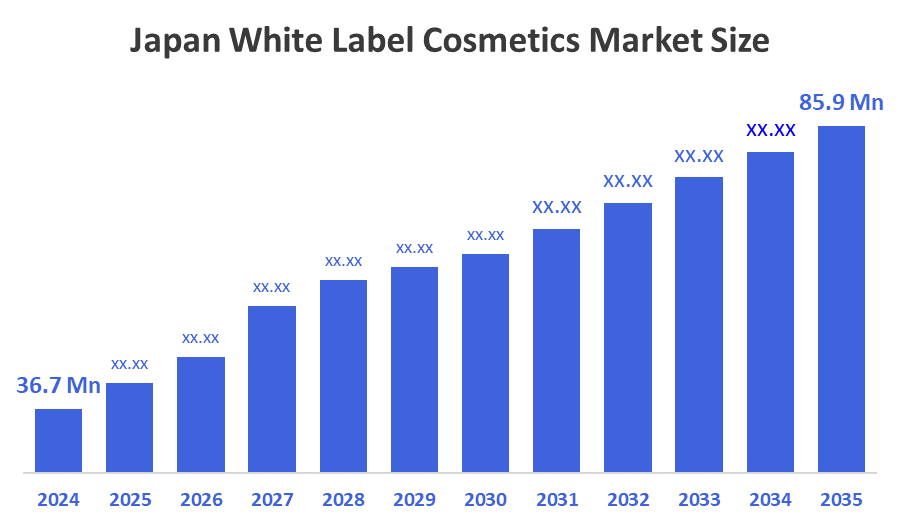
- Japan White Label Cosmetics Market Size 2024: USD 36.7 Mn
- Japan White Label Cosmetics Market Size 2035: USD 85.9 Mn
- Japan White Label Cosmetics Market CAGR 2024: 8.04%
- Japan White Label Cosmetics Market Segments: Product and Distribution Channel.
The Japanese white label cosmetics market is that portion of The cosmetic and personal care industry, which is produced by 3rd Party producers and marketed or sold under a retailer's or Brand owners' name. The types of products that are sold as white labels include skincare, haircare, makeup, and personal care, such as deodorant and body washes, and are made with standard forms or semi-standardised formulas, enabling brands to quickly enter into this market without a substantial investment of time or resources in creating an in-house R&D and manufacturing process.
Japan's white-label beauty products, government programs will also create a corresponding increase in the growth and development of the white-label beauty product market. Regulatory oversight that exists for the cosmetic industry through the Ministry of Health, Labour and Welfare (MHLW) has created a level of trust and safety related to many white-label products. Furthermore, through encouraging small and medium-sized enterprises in Japan to invest in R&D and create innovative products, and the use of biotechnology, and supporting sustainable manufacturing processes, government programs will also indirectly contribute to the growth of white-label beauty products.
Japanese white label cosmetics market with innovative product formulations, including biotechnology-based raw materials, using new fermentation techniques and utilizing nanotechnology to improve performance. Enhanced efficiency, customization, and environmental compliance in the production of white-label cosmetics will be achieved through automation, AI-based formulation optimization, and ongoing development of sustainable packaging systems.
Market Dynamics of the Japan White Label Cosmetics Market:
The Japan white label cosmetics market is driven by increasing trend toward price-competitive, speedy delivery of cosmetic products in the marketplace due to increased demand from many businesses, including new companies, D2C brands, salons, and influencers. The growth of consumer demand for natural, organic, clean-label, and dermatologically tested cosmetic products further supports the rise in popularity of white-label manufacturers.
The Japan white label cosmetics market is restrained by the intense competition, limited product differentiation among white-label products, and the need for strict adherence to the regulations imposed by Japan's Pharmaceutical and Cosmetic Laws. New companies entering the market must bear these costs associated with meeting high standards of product safety, quality, and transparency.
Japan's white-label cosmetics market is significantly expanding a comprehensive range of premium white-label skincare products, anti-ageing skincare, and functional and sustainable packaging options. The demand for men’s grooming products, sensitive-skin-friendly cosmetics, and vegan-friendly cosmetics continues to increase, alongside technological advances in cosmetics formulation; this will provide an excellent opportunity for continued growth and expansion over the long term.
Market Segmentation
The Japan White Label Cosmetics market share is classified into product and distribution channel.
By Product:
The Japan white label cosmetics market is divided by product into skincare, haircare, color cosmetics, fragrance, and others. Among these, the skincare segment accounted for the largest revenue share in 2024 and is expected to grow at a remarkable CAGR during the forecast period. This is due to an increase in the number of skin care routines being performed by individuals of all ages. White-label manufacturing gives brands the option of selling a wider selection of products with lower investment into the cost of producing these products in-house and allows them to enter the market.
By Distribution Channel:
The Japan white label cosmetics market is divided by distribution channel into direct-to-consumer (DTC) E-commerce, retail stores, online marketplaces, and others. Among these, the direct-to-consumer (DTC) e-commerce segment accounted for the largest market share in 2024 and is expected to grow at a significant CAGR during the forecast period. Access to online shopping has allowed brands to establish a more personal relationship with their customers as well as eliminating the need for middlemen or retailers to offer these products to consumers.
Competitive Analysis:
The report offers the appropriate analysis of the key organisations/companies involved within the Japan White Label Cosmetics market, along with a comparative evaluation primarily based on their product offering, business overviews, geographic presence, enterprise strategies, segment market share, and SWOT analysis. The report also provides an elaborative analysis focusing on the current news and developments of the companies, which includes product development, innovations, joint ventures, partnerships, mergers & acquisitions, strategic alliances, and others. This allows for the evaluation of the overall competition within the market.
Top Key Companies in Japan White Label Cosmetics Market:
- OEM Co., Ltd.
- Shiseido
- Kao Corporation
- Nihon Kolmar Co., Ltd.
- KOSÉ Corporation
- Pola Orbis Holdings
- Cosmetech Japan Ltd.
- Willumina Co., Ltd.
- Facelabo Co., Ltd.
Recent Developments in Japan White Label Cosmetics Market:
In December 2025, OEM Co., Ltd., as White Label Cosmetic Manufacturer, has announced its exhibition details for COSME Tech TOKYO (formerly COSME Week), which will take place in January 2026.
Key Target Audience
- Market Players
- Investors
- End-users
- Government Authorities
- Consulting and Research Firm
- Venture capitalists
- Value-Added Resellers (VARs)
Market Segment
This study forecasts revenue at the Japan, regional, and country levels from 2020 to 2035. Decisions Advisors has segmented the Japan White Label Cosmetics market based on the below-mentioned segments:
Japan White Label Cosmetics Market, By Product
- Skincare
- Haircare
- Color Cosmetics
- Fragrance
- Others
Japan White Label Cosmetics Market, By Distribution Channel
- Direct-to-consumer (DTC) E-Commerce
- Retail stores
- Online marketplaces
- Others
FAQ
Q: What is the market size and growth outlook of the Japan White Label Cosmetics Market?
A: The market was valued at USD 36.7 million in 2024 and is projected to reach USD 85.9 million by 2035, growing at a CAGR of 8.04% during the forecast period 2025–2035, driven by rising demand for cost-effective and fast-to-market beauty products.
Q: Which product segment dominates the Japan White Label Cosmetics Market?
A: The skincare segment held the largest market share in 2024. This dominance is attributed to increased skincare awareness across all age groups and the ability of white-label manufacturing to offer diverse skincare products without heavy in-house investment.
Q: Which distribution channel leads the market in Japan?
A: Direct-to-consumer (DTC) e-commerce accounted for the largest share in 2024. The growth is driven by rising online shopping adoption, stronger brand–consumer relationships, and reduced dependency on intermediaries.
Q: What are the key drivers of the Japan White Label Cosmetics Market?
A: Key drivers include growing demand from D2C brands, influencers, salons, and startups; preference for natural, clean-label, and dermatologically tested products; and the need for faster product launches at competitive prices.
Q: What challenges restrain market growth?
A: The market faces challenges such as intense competition, limited differentiation among white-label products, and strict compliance requirements under Japan’s pharmaceutical and cosmetic regulations, which increase entry and operating costs.
Q: Who are the target audiences for this market report?
A: The report targets market players, investors, end-users, government authorities, consulting and research firms, venture capitalists, and value-added resellers (VARs).
Check Licence
Choose the plan that fits you best: Single User, Multi-User, or Enterprise solutions tailored for your needs.
We Have You Covered
- 24/7 Analyst Support
- Clients Across the Globe
- Tailored Insights
- Technology Tracking
- Competitive Intelligence
- Custom Research
- Syndicated Market Studies
- Market Overview
- Market Segmentation
- Growth Drivers
- Market Opportunities
- Regulatory Insights
- Innovation & Sustainability
Report Details
| Scope | country |
| Pages | 184 |
| Delivery | PDF & Excel via Email |
| Language | English |
| Release | Dec 2025 |
| Access | Download from this page |