
Global Juicers Market
 |
Author:
Sayali T
|
Pages:
190
|
Author:
Sayali T
|
Pages:
190
Global Juicers Market Size, Share By Type (Centrifugal Juicers, Masticating Juicers, Triturating Juicers, Manual Juicers, and Others), By Application (Residential/Household, Commercial, Juice Bars & Cafés, Food Service Outlets, and Others), By Distribution Channel (Supermarkets & Hypermarkets, Specialty Stores, Online/E-Commerce, and Other Channels), and By Region (North America, Europe, Asia-Pacific, South America, Middle East & Africa), Analysis and Forecast 2026-2035
CAGR
8.7%
REVENUE 2025
USD Billion 3.5
FORECAST 2035
USD Billion 7.05
REPORT COVERAGE
Global
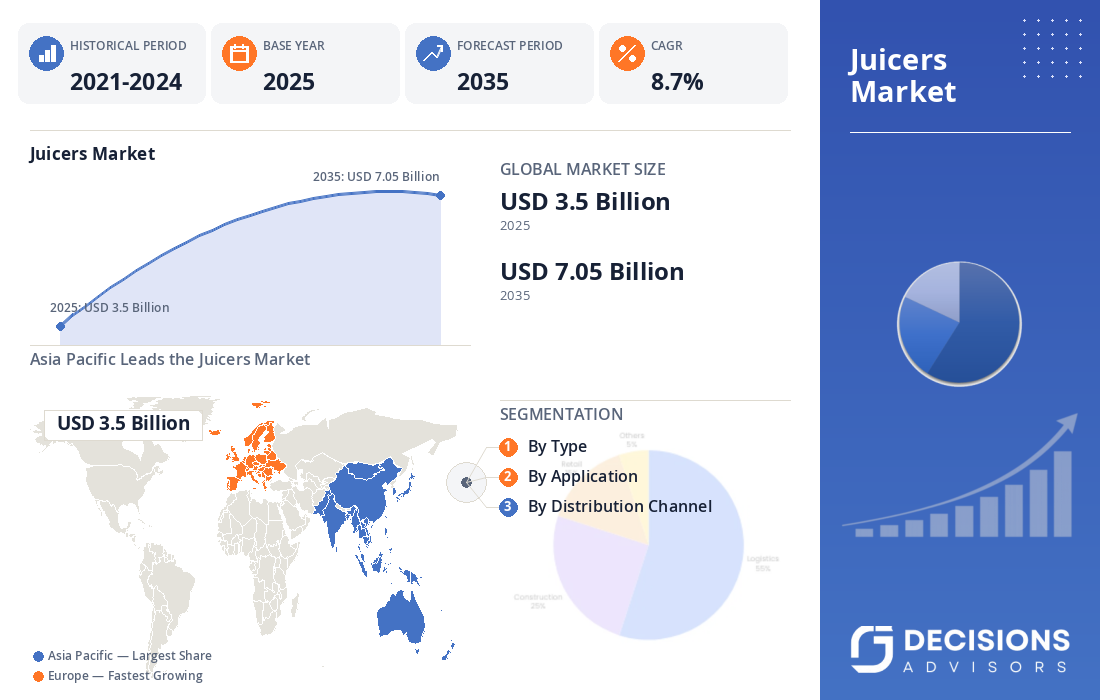
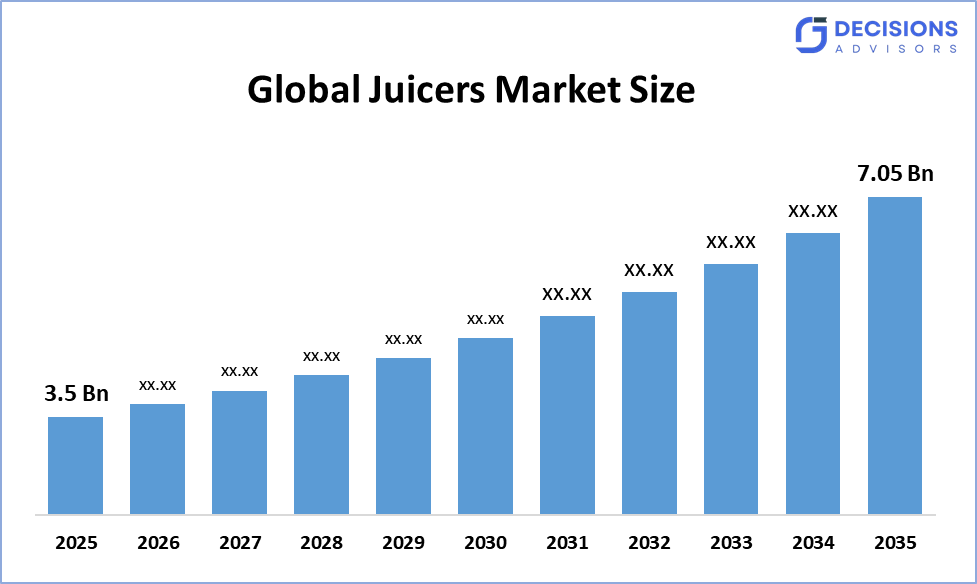
The Global Juicers Market Size is predicted to grow from USD 3.5 Billion in 2025 and is likely to reach around USD 7.05 Billion by 2035 with a CAGR of 8.70%. According to Decision Advisors, a detailed research report on the market reflects that the health and wellness trend dominates the Global Juicers Market, with cold-press and slow-juicing technology accounting for a growing share of consumer preference worldwide. Koninklijke Philips N.V. leads the market with approximately 8% global market share, with the top five players collectively holding around 36% share, making these companies the key contributors to global market development and growth dynamics.
Market Snapshot
- Global Juicers Market Size (2025): USD 3.5 Billion
- Projected Global Juicers Market Size (2035): USD 7.05 Billion
- Global Juicers Market Compound Annual Growth Rate (CAGR): 7.25 %
- Largest Regional Market: Asia Pacific
- 2nd Largest Region: North America
- Fastest Growing Region: Europe
- Base Year: 2025
- Historical Period: 2021-2024
- Market Forecast Period: 2026-2035
Market Overview/ Introduction
The Global Juicers Market refers to the industry that manufactures and distributes appliances designed to extract juice from fruits, vegetables, and other organic produce using centrifugal, masticating, and triturating mechanisms. The market is experiencing steady growth because of rising consumer focus on health and wellness, growing preference for fresh and nutrient-rich beverages, and increasing adoption of at-home juicing routines over packaged drinks. Government programs promoting energy-efficient appliances, domestic appliance manufacturing, and healthy dietary habits are creating favorable conditions for market expansion across regions. Key companies, including Koninklijke Philips N.V., Breville Group Ltd., Hurom America Inc., Panasonic Holdings Corp., and Omega Juicers, are developing compact, quiet, and high-yield juicing solutions that preserve nutrients while minimizing oxidation. The market provides customers with products that combine high juice yield, easy-clean designs, and low power consumption. The global market will experience future expansion through the development of smart and app-connected juicers, cold-press technology, and increasing penetration of juice bars, wellness cafés, and modern retail and e-commerce channels.
- The Ministry of Electronics and Information Technology's PLI Scheme for White Goods supports domestic manufacturing of home appliances in India, promoting the adoption of advanced juicing and kitchen appliance technologies through incentives and reduced import dependence.
- China's Ministry of Commerce trade-in program for green and smart home appliances is driving the adoption of energy-efficient juicers, supporting the development of connected, resource-efficient kitchen appliances across urban and rural markets.
Notable Insights: -
- Asia Pacific is anticipated to hold approximately 45% share of the Global Juicers Market over the predicted timeframe.
- North America is expected to grow at a rapid CAGR in the Global Juicers Market by holding approximately 23% of the share during the forecast period.
- By type, the Centrifugal Juicers segment dominated the market and holds approximately 48% share in 2025 and is projected to grow at a substantial CAGR during the forecast period.
- By application, the Residential/Household segment dominated the market and holds approximately 65% share in 2025 and is projected to grow at a substantial CAGR during the forecast period.
- The compound annual growth rate of the Global Juicers Market is 7.25 %
- The market is likely to achieve a valuation of USD 7.05 Billion by 2035.
Market Drivers
The Global Juicers Market experiences growth because more consumers are adopting health-conscious lifestyles and shifting toward fresh, nutrient-rich beverages over sugary packaged drinks. The expansion of juice bars, wellness cafés, and health-focused hospitality outlets drives increased adoption of commercial-grade juicing equipment. Growing popularity of cold-press and slow-juicing technology, which preserves enzymes and vitamins with minimal oxidation, is encouraging premiumization within the category. Rising disposable incomes and expanding modern retail and e-commerce infrastructure are improving product accessibility across developing regions. The growing demand for plant-based nutrition and functional beverages further supports market expansion, while manufacturers increasingly integrate smart, app-connected, and automated cleaning features to enhance convenience and user experience.
Restrain
The Global Juicers Market faces challenges such as the higher price points of premium cold-press and masticating juicers, which limit adoption among price-sensitive consumers. Cleaning complexity and maintenance requirements associated with multi-part juicer assemblies also discourage frequent use and act as a restraint on repeat purchases.
Competitive Analysis:
The report offers the appropriate analysis of the key organizations/companies involved within the Global Juicers Market along with a comparative evaluation primarily based on their product offerings, business overviews, geographic presence, enterprise strategies, segment market share, and SWOT analysis. The report also provides an elaborative analysis focusing on the current news and developments of the companies, which includes product development, innovations, joint ventures, partnerships, mergers & acquisitions, strategic alliances, and others. This allows for the evaluation of the overall competition within the market.
Top Companies in the Global Juicers Market
- Koninklijke Philips N.V.
- Breville Group Ltd.
- Hurom America Inc.
- Panasonic Holdings Corp.
- Omega Juicers
- Cuisinart Inc.
- Hamilton Beach Brands Holding Co.
- Kuvings SNS
- Electrolux AB
- DeLonghi S.p.A.
Government Initiatives
|
Country |
Key Government Initiatives |
|
US |
The U.S. Department of Energy and Environmental Protection Agency, through the ENERGY STAR appliance labeling program, encourage manufacturers to design energy-efficient kitchen appliances, supporting the development of low-power, high-performance juicer motors and components. |
|
India |
The Ministry of Electronics and Information Technology's Production-Linked Incentive (PLI) Scheme for White Goods promotes domestic manufacturing of home appliances, reducing import dependence and encouraging local production of juicers, mixers, and related kitchen appliances. |
|
China |
The Ministry of Commerce's 'Action Plan for Promoting the Replacement of Old Consumer Goods for New Consumer Goods' encourages trade-in subsidies for green and smart home appliances, driving adoption of energy-efficient and connected juicing equipment across the country. |
Market Segmentation
The Global Juicers Market share is classified into type, application and distribution channel
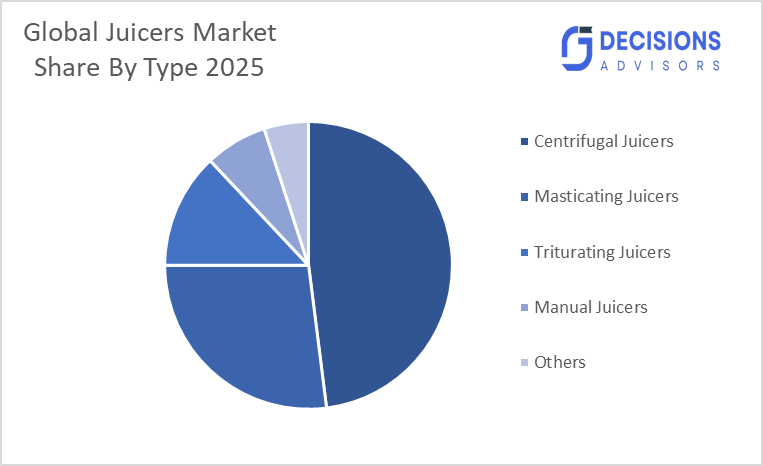
- The Centrifugal Juicers segment dominated the market and holds approximately 48% share in 2025 and is projected to grow at a substantial CAGR during the forecast period.
Based on the type, the Global Juicers Market is divided into Centrifugal Juicers, Masticating Juicers, Triturating Juicers, Manual Juicers, and Others. Among these, the Centrifugal Juicers segment dominates the market and holds approximately 48% share in 2025. This dominance is due to its affordability, fast processing speed, and wide availability across retail channels. These juicers are widely used in households seeking quick, convenient juice extraction, making them the most preferred choice among budget-conscious and time-constrained consumers globally.
- The Residential/Household segment accounted for the largest share of approximately 65% in 2025 and is anticipated to grow at a significant CAGR during the forecast period.
Based on the application, the market is divided into Residential/Household, Commercial, Juice Bars & Cafés, Food Service Outlets, and Others. Among these, Residential/Household accounted for the largest share and holds approximately 65% share in 2025. This dominance is due to rising health consciousness, growing at-home wellness trends, and increasing adoption of DIY juicing routines. Increasing availability of compact, easy-to-clean juicers further supports segment growth, making the residential segment the primary revenue contributor in the Global Juicers Market.
- The Supermarkets & Hypermarkets segment accounted for the largest share of approximately 44% in 2025 and is anticipated to grow at a significant CAGR during the forecast period.
Based on distribution channel, the market is divided into Supermarkets & Hypermarkets, Specialty Stores, Online/E-Commerce, and Other Channels. Among these, Supermarkets & Hypermarkets dominate the market and hold approximately 44% share in 2025. This dominance is due to widespread product availability, in-store demonstrations, and consumer preference for physical evaluation before purchase. Rapid growth of the Online/E-Commerce channel, supported by product reviews and competitive pricing, is expected to accelerate in the coming years.
Regional Segment Analysis of the Global Juicers Market
- North America (U.S., Canada, Mexico)?
- Europe (Germany, France, U.K., Italy, Spain, Rest of Europe)
- Asia-Pacific (China, Japan, India, Rest of APAC)
- South America (Brazil and the Rest of South America)?
- The Middle East and Africa (UAE, South Africa, Rest of MEA)
Asia Pacific is anticipated to hold approximately 45% share of the Global Juicers Market over the predicted timeframe.
Asia Pacific holds approximately 45% share of the Global Juicers Market due to rapid urbanization, rising disposable incomes, and growing adoption of modern kitchen appliances across China, Japan, India, and South Korea. The region benefits from its role as a major manufacturing hub for cost-efficient juicer components, which improves product accessibility and affordability for both household and commercial users. High adoption of health and wellness trends, expanding e-commerce penetration, and government initiatives promoting domestic appliance manufacturing further strengthen market growth. The presence of strong domestic brands alongside global manufacturers continues to support innovation and competitive pricing across the region.
North America is expected to grow at a rapid CAGR in the Global Juicers Market, holding approximately 23% of the share during the forecast period
North America is expected to grow at a rapid CAGR in the Global Juicers Market, holding approximately 23% share during the forecast period due to strong consumer focus on health and wellness, high demand for fresh juices and detox regimens, and a mature home appliance market. The region benefits from well-established retail infrastructure, including specialty kitchen stores and a highly developed e-commerce ecosystem. Rapid adoption of cold-press technology and premium masticating juicers is accelerating product upgrades among health-conscious consumers, with the United States accounting for the majority of regional revenue.
Europe is the fastest-growing region in the Global Juicers Market during the forecast period, holding a significant share.
Europe is the fastest-growing region in the Global Juicers Market during the forecast period, supported by the strong presence of health-conscious cafés and juice bars that encourage consumers to replicate similar wellness experiences at home. Increasing demand for sustainable food preparation equipment and stringent energy-efficiency regulations are encouraging manufacturers to introduce low-power, high-performance juicing technologies. Continuous investment in premium juicing products and rising awareness of the benefits of fresh juice consumption across countries such as Germany, France, and the U.K. are accelerating the adoption of juicer solutions across multiple end-use segments.
Future Market Trends in Global Juicers Market: -
- Expansion of Smart and App-Connected Juicers
Smart, app-connected juicers with preset programs and nutritional tracking are increasingly used by health-conscious consumers seeking personalized recipe recommendations and data-driven wellness insights. This trend is enhancing user engagement and driving premiumization across North American and European markets.
- Growing Adoption of Cold-Press and Slow-Juicing Technology
Cold-press and masticating juicers are gaining popularity due to their ability to preserve enzymes, vitamins, and nutrients with minimal oxidation and heat generation. Rising demand for nutrient-rich beverages among fitness enthusiasts is accelerating adoption of this technology globally.
- Rising Demand for Compact and Easy-Clean Designs
Manufacturers are increasingly focused on compact, vertical juicer designs with automated cleaning systems to address consumer pain points related to counter space limitations and maintenance complexity, particularly among urban households.
- Growth of Juice Bars, Wellness Cafés, and Commercial Juicing
Expansion of juice bars and wellness cafés across urban centers is driving demand for durable, high-throughput commercial juicers with self-clean features that reduce downtime in high-traffic hospitality and retail environments.
Recent Development
- In January 2025, Breville Group Ltd. announced the introduction of smart-connected juicers with app integration, preset programs, and nutritional tracking capabilities across North American and European markets.
- In December 2024, Koninklijke Philips N.V. launched an expanded range of compact, vertical slow juicers with enhanced juice yield and automated cleaning systems for health-conscious urban households.
Market Segment
This study forecasts revenue at global, regional, and country levels from 2020 to 2035. Decision Advisors has segmented the Global Juicers Market based on the below-mentioned segments:
Global Juicers Market, By Type
- Centrifugal Juicers
- Masticating Juicers
- Triturating Juicers
- Manual Juicers
- Others
Global Juicers Market, By Application
- Residential/Household
- Commercial
- Juice Bars & Cafés
- Food Service Outlets
- Others
Global Juicers Market, By Distribution Channel
- Supermarkets & Hypermarkets
- Specialty Stores
- Online/E-Commerce
- Other Channels
Global Juicers Market, By Regional Analysis
- North America
- US
- Canada
- Mexico
- Europe
- Germany
- UK
- France
- Italy
- Spain
- Russia
- Rest of Europe
- Asia Pacific
- China
- Japan
- India
- South Korea
- Australia
- Rest of Asia Pacific
- South America
- Brazil
- Argentina
- Rest of South America
- Middle East & Africa
- UAE
- Saudi Arabia
- Qatar
- South Africa
- Rest of the Middle East & Africa
Frequently Asked Questions (FAQ)
Q. How is cold-press technology improving juice quality in modern juicers?
A. Cold-press and masticating technology extracts juice at low speeds with minimal heat and oxidation, allowing manufacturers to design juicers that preserve enzymes, vitamins, and nutrients while offering higher juice yield and longer shelf life for extracted juice.
Q. Why are masticating juicers preferred over centrifugal juicers by health-conscious consumers?
A. They offer higher nutrient retention, quieter operation, and better performance with leafy greens and fibrous vegetables, making them more suitable for consumers seeking premium, nutrient-dense juice compared to faster but less efficient centrifugal models.
Q. What role do smart and app-connected juicers play in enhancing user experience?
A. They enable personalized recipe recommendations, preset programs, and nutritional tracking, helping consumers manage wellness goals more effectively while adding convenience through automated operation and connected mobile app integration.
Q. How is manufacturing innovation influencing juicer development?
A. Advances in motor efficiency, durable materials, and automated self-cleaning systems are enabling more compact, energy-efficient, and low-maintenance juicing solutions across residential, commercial, and hospitality applications.
Check Licence
Choose the plan that fits you best: Single User, Multi-User, or Enterprise solutions tailored for your needs.
We Have You Covered
- 24/7 Analyst Support
- Clients Across the Globe
- Tailored Insights
- Technology Tracking
- Competitive Intelligence
- Custom Research
- Syndicated Market Studies
- Market Overview
- Market Segmentation
- Growth Drivers
- Market Opportunities
- Regulatory Insights
- Innovation & Sustainability
Report Details
| Scope | Global |
| Pages | 190 |
| Delivery | PDF & Excel via Email |
| Language | English |
| Release | Aug 2026 |
| Access | Download from this page |