
Global K-12 Education Market
 |
Author:
Kunal M
|
Pages:
190
|
Author:
Kunal M
|
Pages:
190
Global K-12 Education Market Size, Share By Type (Public K-12 Education, Private K-12 Education, Online K-12 Education), By Application (Pre-primary School, Primary School, Middle School, High School), By Delivery Mode (Online, Offline), and By Region (North America, Europe, Asia-Pacific, Latin America, Middle East & Africa), Analysis and Forecast 2026-2035
CAGR
11.18%
REVENUE 2025
USD Billion 2.6
FORECAST 2035
USD Billion 7.5
REPORT COVERAGE
Global
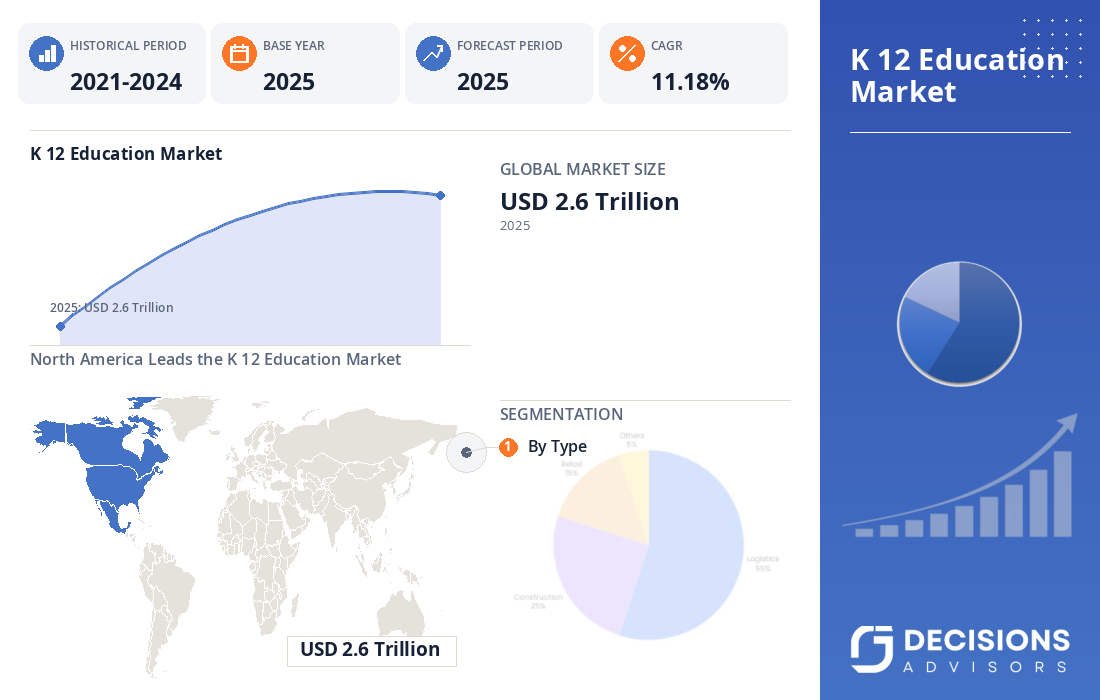
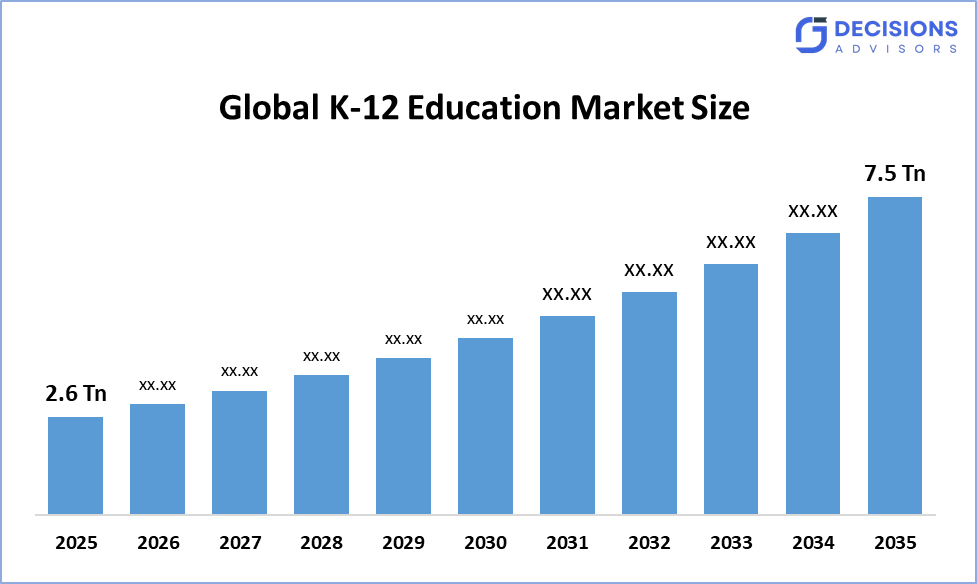
The Global K-12 Education Market Size is predicted to grow from USD 2.6 Trillion in 2025 and is likely to reach around USD 7.5 Trillion by 2035 with a CAGR of 11.18%. According to Decision Advisors, a digital content and e-books formed around 35.74% of expenditure on K-12 in 2025, whereas public schools were 61.74% of the total market. Pearson is one of the major competitors in the market along with McGraw Hill, Cengage Group, and Stride Inc. AI tutoring, adaptive learning, cloud-based learning management, and student analytics are rapidly changing the dynamics of the market. The rising trend towards personalized learning, government support for classroom digitalization, availability of broadband, and increasing demand for technology-driven education is fostering market growth across the globe.
Market Snapshot
- Global K-12 Education Market Size (2025): USD 2.6 Trillion
- Projected Global K-12 Education Market Size (2035): USD 7.5 Trillion
- Global K-12 Education Market Compound Annual Growth Rate (CAGR): 11.18%
- Largest Regional Market: North America
- 2nd Largest Region: Asia Pacific
- Fastest Growing Region: Asia Pacific
- Base Year: 2025
- Historical Period: 2021-2024
- Market Forecast Period: 2026-2035
Market Overview/ Introduction
The Global K-12 Education Market includes educational establishments, learning services, curricula, educational materials, and technology used to educate children from the kindergarten level up to secondary education. Various government policies and initiatives such as Sustainable Development Goal four, Gateways to Public Digital Learning from the United Nations Educational, Scientific and Cultural Organization, and Digital Education Strategy from UNICEF seek to ensure equality, digital technology infrastructure, teachers' development, and enhanced learning outcomes. Recent trends in the market involve global efforts to build up public digital learning platforms, increase connectivity, and promote inclusive technology-based learning. Governments and educational establishments invest more in digital classroom, online learning infrastructure, teacher training, and AI-based learning tools. The market is experiencing growth due to higher numbers of students, increased education spending, increased internet coverage, wider use of personalized learning, smart classrooms, STEM education, and hybrid learning approaches.
- India continues implementing NEP 2020 through the Ministry of Education, channeling funds into ICT labs, smart classrooms, and digital platforms like DIKSHA to expand equitable tech-based school education.
- Japan advances its nationwide digital rollout, providing high-speed school connectivity and individual student devices to boost digital literacy and administrative cloud automation across regional districts.
Notable Insights: -
- North America is anticipated to hold approximately 40.14% share of the Global K-12 Education Market over the predicted timeframe.
- Asia Pacific is expected to grow at a rapid CAGR in the Global K-12 Education Market, holding approximately 27.6% of the share during the forecast period.
- By type, the Public K-12 Education segment dominated the market and holds approximately 61.74% share in 2025 and is projected to grow at a substantial CAGR during the forecast period.
- By application, the High School segment dominated the market and holds approximately 39.59% share in 2025 and is projected to grow at a substantial CAGR during the forecast period.
- The compound annual growth rate of the Global K-12 Education Market is 11.18%.
- The market is likely to achieve a valuation of USD 7.5 trillion by 2035.
Market Drivers
The global K-12 education market witnesses’ growth due to increased student enrollments and high demand for quality education across the globe. Digital learning and e-learning technologies lead to an increase in the adoption of online courses, virtual classrooms, and educational software. Government investment in the construction of educational institutions and teachers' trainings helps to promote the development of the market. Increased use of artificial intelligence, personalized learning, and adaptive education technologies improves the engagement and results of students. Increasing use of smart classrooms, interactive boards, and learning management systems changes traditional approaches to education. Increased penetration of the internet and affordability of digital devices improves accessibility to educational material, especially in developing countries. Increased focus on STEM education, skills training, and competency-based learning promotes innovative educational practices.
Restrain
Inadequate funding for education, teacher shortages, unequal access to digital infrastructure, and differences in learning resources are some of the issues facing the global K–12 education market. Adoption of digital learning is hampered in underprivileged areas by limited internet connectivity and device availability.
Competitive Analysis:
The report offers the appropriate analysis of the key organizations/companies involved within the Global K-12 Education Market along with a comparative evaluation primarily based on their product offerings, business overviews, geographic presence, enterprise strategies, segment market share, and SWOT analysis. The report also provides an elaborative analysis focusing on the current news and developments of the companies, which includes product development, innovations, joint ventures, partnerships, mergers & acquisitions, strategic alliances, and others. This allows for the evaluation of the overall competition within the market.
Top Companies in the Global K-12 Education Market
- Pearson plc
- McGraw Hill
- Cengage Group
- Stride, Inc.
- TAL Education Group
- Google for Education
- Microsoft Education
- BYJU'S
- PowerSchool
- Scholastic Corporation
Government Initiatives
|
Country |
Key Government Initiatives |
|
India |
The National Education Policy (NEP), which emphasizes regional languages, vocational training, fundamental literacy, and digital platforms like DIKSHA, transforms K–12 education thru a 5+3+3+4 framework. |
|
United States |
Public K–12 education policy is governed by Every Student Succeeds Act (ESSA), which mandates that states establish high academic standards, carry out yearly reading and math assessments, and focus aid on underperforming schools. |
|
Bhutan |
Free education thru grade 12 is guarantyd by state-funded education, which is supported by high teacher pay and ongoing adherence to the Gross National Happiness curriculum. |
Market Segmentation
The Global K-12 Education Market share is classified into Type, Application and Delivery Mode
- The Public K-12 Education segment dominated the market and holds approximately 61.74% share in 2025 and is projected to grow at a substantial CAGR during the forecast period.
Based on the type, the Global K-12 Education Market has been classified into three segments, including Public K-12 Education, Private K-12 Education, and Online K-12 Education. Out of these segments, the Public K-12 Education segment leads the market, accounting for approximately 61.74% of market share in 2025. The reasons behind the leading market share of Public K-12 Education include huge government backing, high number of students enrolling for education, developed infrastructure for education, and rising public spending on digital education.
- The High School segment accounted for the largest share of approximately 39.59% in 2025 and is anticipated to grow at a significant CAGR during the forecast period.
Based on the application, the Global K-12 Education Market can be classified into Pre-primary School, Primary School, Middle School, and High School. Out of these segments, the highest market share is contributed by the High School segment, which captured a market share of about 39.59% in 2025. This can be attributed to rising enrolments, demand for secondary education, and digital learning as well as STEM initiatives. The growth in primary and middle school segments is being supported using technology-enabled teaching, whereas pre-primary education is witnessing increased focus through early childhood education programs.
- The Offline segment accounted for the largest share of approximately 72% in 2025 and is anticipated to grow at a significant CAGR during the forecast period.
Based on delivery mode, the Global K-12 Education Market can be segmented as Online and Offline. Out of these, the Offline segment is the leading segment that controls most of the market share of 72% in 2025 owing to its already existing school infrastructure, conventional teaching in the classroom, and physical interaction of teachers with students. The online segment is growing rapidly with the rise in the usage of the internet, virtual classrooms, and technological advancements in education.
Regional Segment Analysis of the Global K-12 Education Market
- Asia-Pacific (China, India, Japan, South Korea, Australia, and Rest of Asia-Pacific)?
- North America (United States, Canada, and Mexico)
- Europe (Germany, UK, France, Italy, Spain, and Rest of Europe)
- Latin America (Brazil, Mexico, Argentina, and the rest of Latin America)?
- The Middle East and Africa (Saudi Arabia, UAE, South Africa, and Rest of MEA)
North America is anticipated to hold approximately 40.14% share of the Global K-12 Education Market over the predicted timeframe.
North America is estimated to hold around 40.14% of the total market share of the Global K-12 Education Market because of its superior educational infrastructure, adoption of EdTech solutions, digital learning platforms, and significant investments in technology-enabled classrooms. North America has a high penetration rate of the internet and a well-developed education system in addition to the increasing use of artificial intelligence, personalized learning, and learning management systems. The United States is seen as the leading country in this region, while Canada is also responsible for developing the regional market.
Asia Pacific is expected to grow at a rapid CAGR in the Global K-12 Education Market, holding approximately 27.6% of the share during the forecast period
The Asia Pacific region contributes around 27.6% to the global market for K-12 education, aided by the presence of many students, increasing education infrastructure, rapid digitization, and investments in educational technologies. The major players contributing to the growth of the region include China and India, due to factors like high internet penetration, availability of cheap digital devices, learning portals, and government efforts to promote technology-led education. The region is witnessing the adoption of artificial intelligence, personalized learning, smart classroom concepts, and hybrid education models. Increasing education budgets, demand for good schools, and growth in private education further boost the development of the region.
Europe is the fastest-growing region in the Global K-12 Education Market during the period, holding approximately 20.1% share.
The Europe makes up about 20.1% of the Global K-12 Education Market because of its developed public education system, good funding from the government, digitization efforts, and rising adoption of EdTech products. Some of the leading countries include the United Kingdom, Germany, and France. The implementation of smart classrooms, AI-based learning technologies, digitized content, STEM curriculum, and personalization in education are boosting the demand in the market. European education programs like the European Education Area and Erasmus+ contribute to modernization and collaboration in schools. The rise in focus on digital literacy and education, as well as teaching with technology, are expected to bring continuous opportunities in K-12 education in Europe.
Future Market Trends in Global K-12 Education Market: -
-
- Expansion of Digital and Online Learning
Digital learning platforms, virtual classrooms, and online learning tools are becoming more important for K-12 education. They give flexibility in accessing learning material, make distance education possible, and facilitate interactive teaching. The rising rate of internet usage, cost-efficient devices, and personalized learning needs contribute to the development of digital education systems all around the world.
-
- AI-Enabled Personalized Learning
AI is being introduced in K-12 educational institutions to provide students with personalized education, automated assessments, and intelligent tutoring. An AI-based system can assess the performance of the student, pinpoint any weaknesses that exist and customize content based on the results. The increasing demand for adaptive education is resulting in the use of AI.
-
- Growth in Smart Classrooms
With an increased use of smart classrooms in the modern school environment, it becomes important to mention the presence of interactive displays, digital boards, learning management systems, and educational devices. This will result in better engagement, interactivity, and multimedia learning of students. There is an accelerated adoption of smart classrooms due to investments in educational infrastructure.
-
- Rising Adoption of STEM and Skill-Based Education
Educational institutions at the K-12 level are putting more emphasis on science, technology, engineering, mathematics, programming, robotics, and problem-solving abilities to ensure that they are better prepared for their future careers. The need for such skills is driving institutions to adopt new approaches and technologies for education.
Recent Development
- In January 2022, Microsoft Hong Kong introduced a comprehensive AI education program that helps K–12 teachers incorporate AI into their lesson plans and use new technologies in traditional classrooms.
- In December 2024, to enable individualized instruction and student performance analysis, researchers created DMP_AI, an AI-assisted K–12 teaching and learning system utilizing data mining, natural language processing, machine learning, and learning analytics.
- In August 2023, Samsung increased its global presence by installing interactive smart classroom displays in over 200,000 schools.
Market Segment
This study forecasts revenue at global, regional, and country levels from 2020 to 2035. Decision Advisors has segmented the Global K-12 Education Market based on the below-mentioned segments:
Global K-12 Education Market, By Type
- By Type (
- Public K-12 Education
- Private K-12 Education
- Online K-12 Education
Global K-12 Education Market, By Application
- Pre-primary School
- Primary School
- Middle School
- High School
Global K-12 Education Market, By Delivery Mode
- Online
- Offline
Global K-12 Education Market, By Regional Analysis
- Asia-Pacific
- China
- India
- Japan
- South Korea
- Australia
- Rest of Asia-Pacific
- North America
- United States
- Canada
- Mexico
- Europe
- Germany
- UK
- France
- Italy
- Spain
- Rest of Europe
- Latin America
- Brazil
- Mexico
- Argentina
- Rest of Latin America
- Middle East & Africa
- UAE
- Saudi Arabia
- South Africa
- Rest of MEA
Frequently Asked Questions (FAQ)
Q. What is the Global K-12 Education Market?
A. From pre-primary to secondary education, the market comprises educational services, institutions, curricula, learning materials, and technology.
Q. What factors are driving the Global K-12 Education Market?
A. Major growth factors include expanding student enrollment, the adoption of digital learning, government education programs, rising education spending, and the growing need for individualized and technologically enabled learning.
Q. How is artificial intelligence transforming K-12 education?
A. AI helps teachers find learning gaps and enhance student results by enabling individualized learning, intelligent tutoring, automated assessment, learning analytics, and adaptable educational content.
Q. Why is online K-12 education gaining popularity?
A. With the help of increasing internet connectivity and reasonably priced digital devices, online education offers flexible access to learning, digital materials, virtual classrooms, and individualized training.
Check Licence
Choose the plan that fits you best: Single User, Multi-User, or Enterprise solutions tailored for your needs.
We Have You Covered
- 24/7 Analyst Support
- Clients Across the Globe
- Tailored Insights
- Technology Tracking
- Competitive Intelligence
- Custom Research
- Syndicated Market Studies
- Market Overview
- Market Segmentation
- Growth Drivers
- Market Opportunities
- Regulatory Insights
- Innovation & Sustainability
Report Details
| Scope | Global |
| Pages | 190 |
| Delivery | PDF & Excel via Email |
| Language | English |
| Release | Aug 2026 |
| Access | Download from this page |