
Global Keloid Market
 |
Pages:
230
|
Pages:
230
Global Keloid Market Size, Share, and COVID-19 Impact Analysis, By Product (Elastic Wraps, and Ointment), By Treatment (Radiation Therapy, Cry Therapy, Surgical Treatment, Laser Treatment, Laser Treatment, and Interferon), and By Region (North America, Europe, Asia-Pacific, Latin America, Middle East, and Africa), Analysis and Forecast 2025-2035
REPORT COVERAGE
Global
Global Keloid Market Size Insights Forecasts to 2035
- The Global Keloid Market Size Was Estimated at USD 4.08 Billion in 2024
- The Market Size is Expected to Grow at a CAGR of around 3.92 % from 2025 to 2035
- The Worldwide Keloid Market Size is Expected to Reach USD 6.23 Billion by 2035
- North America is expected to grow the fastest during the forecast period.
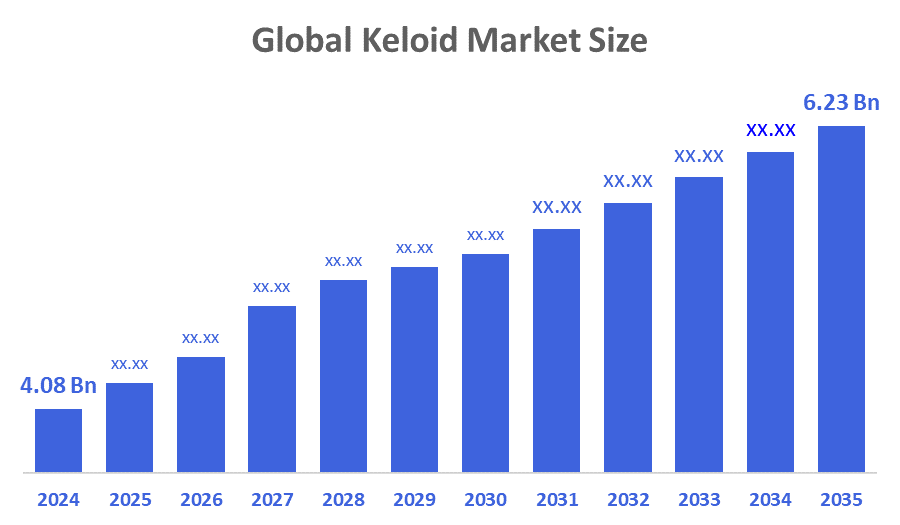
According to a research report published by Decisions Advisors and Consulting, The Global Keloid Market Size Was Worth Around USD 4.08 Billion In 2024 And Is Predicted To Grow To Around USD 6.23 Billion By 2035 With A Compound Annual Growth Rate (CAGR) Of 3.92 % From 2025 To 2035. This market is an important component of the dermatology and cosmetic surgery sectors due to its emphasis on individualised medicine and minimally invasive procedures. Improvements in biomaterials and regenerative medicine are also improving patient outcomes and creating new opportunities for regenerative medicine in the treatment of keloids. The market for keloid treatment is expanding rapidly, supported by a number of important factors and patterns.
Market Overview
A keloid medical condition develops from excessive collagen production, which occurs when the body repairs a wound or injury. The body produces excessive collagen, which results in the formation of a raised, thick scar that takes on an irregular shape and extends beyond the boundaries of the initial wound. The scars which develop can reach sizes that range from a few millimetres to several centimetres and display colours of pink, red, brown and flesh tones. Keloids produce both itching and tenderness, which may result in discomfort and pain. The physical symptoms of keloids cause emotional distress because their appearance leads to social stigma. A physical examination, together with a medical history assessment, serves as the primary method to diagnose this medical condition. A dermatologist or healthcare provider needs to assess the keloid together with its nearby skin area to identify specific signs, which include elevated, shiny scars that go beyond the initial wound area. The doctor will ask the patient about their past medical conditions, which include their previous injuries and surgical procedures and their family members' history of keloids. A physician may use a biopsy procedure to confirm the diagnosis while eliminating other skin conditions from consideration. Physicians use multiple imaging tests, including ultrasound, MRI, and CT scans, to measure the size of the keloid.
Report Coverage
This research report categorizes the keloid market based on various segments and regions, forecasts revenue growth, and analyzes trends in each submarket. The report analyses the key growth drivers, opportunities, and challenges influencing the keloid market. Recent market developments and competitive strategies, such as expansion, product launch, development, partnership, merger, and acquisition, have been included to draw the competitive landscape in the market. The report strategically identifies and profiles the key market players and analyzes their core competencies in each sub-segment of the keloid market.
Driving Factors
The keloid market experiences its main expansion because people show more skin injuries, which include surgical scars, burns, acne, deep cuts and other skin injuries. The market experiences additional growth because more people get cosmetic procedures, which include piercings and tattoos that create a risk for keloid development. The market shows positive development because people widely use corticosteroid injections to decrease keloid size, which makes keloids less visible. The market experiences growth because people increasingly demand cryotherapy, which uses liquid nitrogen to freeze keloids and destroy keloid tissue until it falls off. The market growth receives support from diagnostic techniques that use multiphoton microscopy and optical coherence tomography to produce high-resolution skin images, which help detect keloid size and location. The keloid market will experience growth in the upcoming years because radiofrequency ablation is becoming more popular, as it provides multiple advantages compared to traditional surgical methods, which include less scarring, better functionality and lower risk of complications.
Massey Ventures, the Gillies McIndoe Research Institute, and AFT Pharmaceuticals have partnered to develop a topical treatment for keloid and hypertrophic scarring. This collaboration builds on their earlier work in 2022 on a therapy for strawberry birthmarks. Keloids and hypertrophic scars are disfiguring, often painful, and lack truly effective treatments. The new project aims to create a novel, accessible option to reduce recurrence and improve patient outcomes.
A recent study highlighted by Medical Dialogues shows that postoperative radiotherapy significantly reduces keloid recurrence compared to surgery alone. Researchers found that patients who underwent surgical excision followed by radiotherapy had markedly lower recurrence rates, underscoring the importance of combination therapy. This approach addresses the high relapse risk associated with surgery-only treatment and offers a more effective long-term management strategy for keloid scars.
Restraining Factors
The market for keloid treatments is impacted in multiple ways by high treatment prices and reimbursement issues. Moreover, with restricted insurance coverage, patients often choose less expensive or do-it-yourself treatments over more effective therapies. This lowers market demand for expensive medicines while limiting innovation and investment in the industry.
Market Segmentation
The keloid market share is classified into product and treatment.
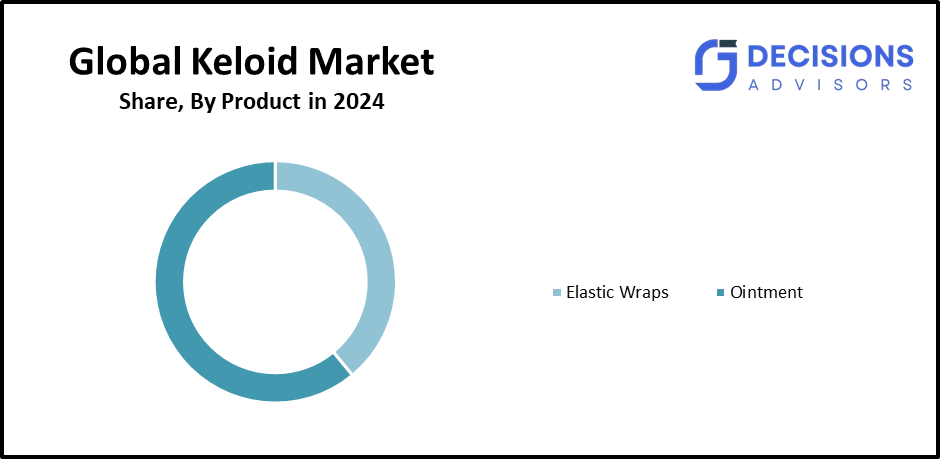
- The ointment segment accounted for the largest share in 2024 and is anticipated to grow at a significant CAGR during the forecast period.
Based on the product, the keloid market is divided into elastic wraps, and ointment. Among these, the ointment segment accounted for the largest share in 2024 and is anticipated to grow at a significant CAGR during the forecast period. Physicians frequently employ topical corticosteroid medications to help alleviate small episodes of inflammation and irritation. Product penetration is enhanced in both developed and developing economies by retail pharmacies and internet retail. This advantage led the segment in several regional areas and improved continuity in volume sales. alleviation of symptoms and flattening.
- The intralesional corticosteroid injection segment accounted for the highest market revenue in 2024 and is anticipated to grow at a significant CAGR during the forecast period.
Based on the treatment, the keloid market is divided into occlusive dressing, compression therapy, cryosurgery, excision, radiation therapy, laser therapy, interferon therapy, intralesional corticosteroid injection, and others. Among these, the intralesional corticosteroid injection segment accounted for the highest market revenue in 2024 and is anticipated to grow at a significant CAGR during the forecast period. This is due to its low cost and widespread reimbursement in hospital and outpatient dermatology offices; this approach is highly favoured by doctors. Additionally, the demand for these kinds of injections is probably going to be increased by the high adoption rates of intralesional corticosteroids due to their capacity to produce measurable scar flattening and symptomatic relief.
Regional Segment Analysis of the Keloid Market
- North America (U.S., Canada, Mexico)
- Europe (Germany, France, U.K., Italy, Spain, Rest of Europe)
- Asia-Pacific (China, Japan, India, Rest of APAC)
- South America (Brazil and the Rest of South America)
- The Middle East and Africa (UAE, South Africa, Rest of MEA)
Asia Pacific is anticipated to hold the largest share of the keloid market over the predicted timeframe.
Asia Pacific is anticipated to hold the largest share of the keloid market over the predicted timeframe. The market expansion occurs because people now understand skin health better, while their disposable incomes increase, and more people seek cosmetic enhancements. The introduction of new treatment options through regulatory support enables better access to advanced therapies for patients across the region. Japan, South Korea and Australia lead the global market for adopting new keloid treatment methods. The market continues to grow because the region's different skin types and demographic makeup create chances for customised treatment methods.
For instance, Mabwell has initiated its global Phase II clinical trial of anti-IL-11 monoclonal antibody 9MW3811, dosing the first patient at Shanghai Ninth People’s Hospital. This marks the world’s first IL-11?targeting therapy study for pathological scarring, aiming to assess safety, tolerability, and efficacy while advancing treatment options for fibrotic skin conditions.
North America is expected to grow at a rapid CAGR in the keloid market during the forecast period. The region's growth is driven by increasing awareness of keloid treatments and medical technology advancements, and the existence of supportive regulatory frameworks. The rising incidence of keloids, especially among people who have darker skin tones, creates a need for new treatment solutions, which drives the demand for effective medical treatments. North America has a strong competitive market, which includes major companies such as Keloid Solutions, Sientra and Revance Therapeutics. The U.S. healthcare system leads worldwide because it has implemented strong health service delivery systems and allocated substantial resources for scientific investigations and product development. The established companies and startup ventures create a vibrant environment for scientific progress, which guarantees that patients will receive continuous access to new treatment methods.
One of the main clinical issues in both the industrialised and developing nations is the creation of hypertrophic scars from burn injuries, traumatic injuries, and surgical treatments. In the US alone, the estimated yearly cost of treatment is $4 billion, and there is currently no commercially viable, widely effective, and affordable medication.
Competitive Analysis:
The report offers the appropriate analysis of the key organizations/companies involved within the keloid market, along with a comparative evaluation primarily based on their product offering, business overviews, geographic presence, enterprise strategies, segment market share, and SWOT analysis. The report also provides an elaborative analysis focusing on the current news and developments of the companies, which includes product development, innovations, joint ventures, partnerships, mergers & acquisitions, strategic alliances, and others. This allows for the evaluation of the overall competition within the market.
List of Key Companies
- Avita
- Bristol-Myers Squibbnull
- Novartis
- Pacific World
- Perrigo
- Revitol
- RXi
- Sonoma
- Valeant
- Xylem Inc
- Others
Key Target Audience
- Market Players
- Investors
- End-users
- Government Authorities
- Consulting and Research Firm
- Venture capitalists
- Value-Added Resellers (VARs)
Recent Development
- In July 2025, Syntara Limited announced that the first patient had been dosed in the SATELLITE Phase 1c clinical trial for keloid scars. The study is evaluating SNT?6302, a topical lysyl oxidase inhibitor (formerly PXS?6302), developed to address the unmet need for effective keloid treatments. Led by Professor Fiona Wood in collaboration with the Fiona Wood Foundation and the University of Western Australia, the trial will assess safety, tolerability, and preliminary efficacy in patients with active keloid scars.
- In October 2024, Researchers at the University of Cape Town’s Hair and Skin Research (HSR) Laboratory developed a promising new combination therapy for keloid disease, a difficult-to-treat scarring condition. Keloids are non-cancerous dermal tumours that grow beyond the original wound, often causing pain, itching, and functional impairment. The new approach integrates multiple therapeutic agents to improve outcomes and reduce recurrence, offering hope for patients in populations where keloids are more prevalent, such as those of African, Asian, and Hispanic descent.
Market Segment
This study forecasts revenue at global, regional, and country levels from 2020 to 2035. Decisions Advisors has segmented the keloid market based on the below-mentioned segments:
Global Keloid Market, By Product
- Elastic Wraps
- Ointment
Global Keloid Market, By Treatment
- Radiation Therapy
- Cry Therapy
- Surgical Treatment
- Laser Treatment
- Interferon
Global Keloid Market, By Regional Analysis
- North America
- US
- Canada
- Mexico
- Europe
- Germany
- UK
- France
- Italy
- Spain
- Russia
- Rest of Europe
- Asia Pacific
- China
- Japan
- India
- South Korea
- Australia
- Rest of Asia Pacific
- South America
- Brazil
- Argentina
- Rest of South America
- Middle East & Africa
- UAE
- Saudi Arabia
- Qatar
- South Africa
- Rest of the Middle East & Africa
Frequently Asked Questions (FAQ)
- What role does regenerative medicine play in the future of keloid treatment?
Regenerative medicine is expected to significantly influence the keloid market by introducing biologics, growth factor modulators, and advanced biomaterials that target abnormal collagen production. These therapies may reduce recurrence rates and improve aesthetic outcomes compared to traditional excision or steroid-based approaches.
- Why is recurrence a major challenge in the keloid treatment market?
Keloids have a high recurrence rate, especially when treated with surgery alone. This creates a need for combination therapies such as surgical excision followed by radiotherapy or corticosteroid injections. Recurrence challenges drive demand for innovative treatment modalities and long-term management solutions.
- How does increasing cosmetic awareness impact market growth?
Rising awareness regarding aesthetic appearance, especially among younger populations, has increased demand for scar management solutions. Social media influence and cosmetic dermatology expansion contribute to higher adoption of minimally invasive and topical treatment options.
- What technological advancements are improving keloid diagnosis?
Emerging imaging technologies such as high-resolution ultrasound and optical coherence tomography allow dermatologists to assess scar depth, vascularity, and tissue structure more accurately. Early and precise diagnosis supports personalised treatment planning.
- How do demographic factors influence the keloid market?
Keloids are more prevalent among individuals with darker skin tones. Regions with higher populations of African, Asian, and Hispanic descent show stronger demand for treatment solutions, influencing regional market expansion strategies.
- What impact does outpatient dermatology care have on market revenue?
The shift toward outpatient dermatology clinics and ambulatory surgical centres has improved accessibility to intralesional corticosteroid injections and laser therapies, contributing significantly to overall treatment revenue growth.
- How are pharmaceutical companies diversifying their keloid treatment portfolios?
Companies are investing in biologics, monoclonal antibodies, enzyme inhibitors (such as lysyl oxidase inhibitors), and combination topical therapies to address unmet clinical needs and reduce relapse rates.
Check Licence
Choose the plan that fits you best: Single User, Multi-User, or Enterprise solutions tailored for your needs.
We Have You Covered
- 24/7 Analyst Support
- Clients Across the Globe
- Tailored Insights
- Technology Tracking
- Competitive Intelligence
- Custom Research
- Syndicated Market Studies
- Market Overview
- Market Segmentation
- Growth Drivers
- Market Opportunities
- Regulatory Insights
- Innovation & Sustainability
Report Details
| Scope | Global |
| Pages | 230 |
| Delivery | PDF & Excel via Email |
| Language | English |
| Release | Mar 2026 |
| Access | Download from this page |