
Global Knitting Machine Market
 |
Author:
Pranali P
|
Pages:
240
|
Author:
Pranali P
|
Pages:
240
Global Knitting Machine Market Size, Share By Type (Warp knitting machines, Raschel warp, Tricot warp, Others (crochet, etc.), Weft knitting machines, Circular, Straight bar, Others (loop wheel, etc.)), By Knit Type (Single knit, Double knit), By End Use (Automotive textiles, Sports textiles, Apparel textiles, home textiles, Others (footwear industry, etc.)), and By Region (North America, Europe, Asia-Pacific, Latin America, Middle East & Africa), Analysis and Forecast 2026-2035.
CAGR
6.27%
REVENUE 2025
USD Billion 5.67
FORECAST 2035
USD Billion 10.42
REPORT COVERAGE
Global
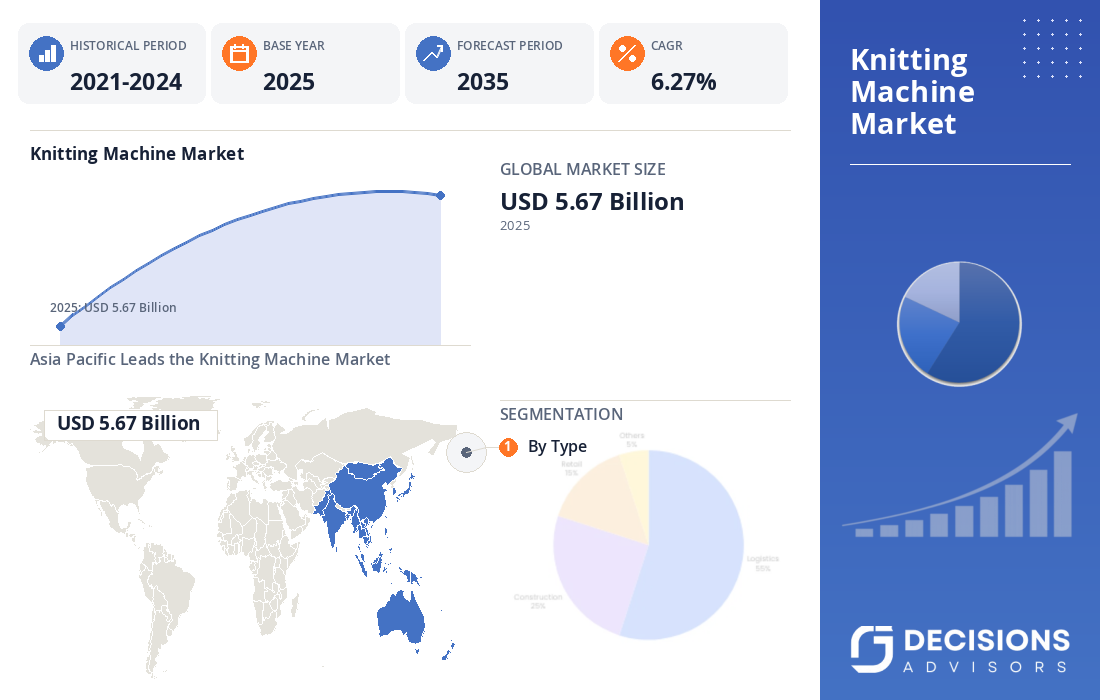
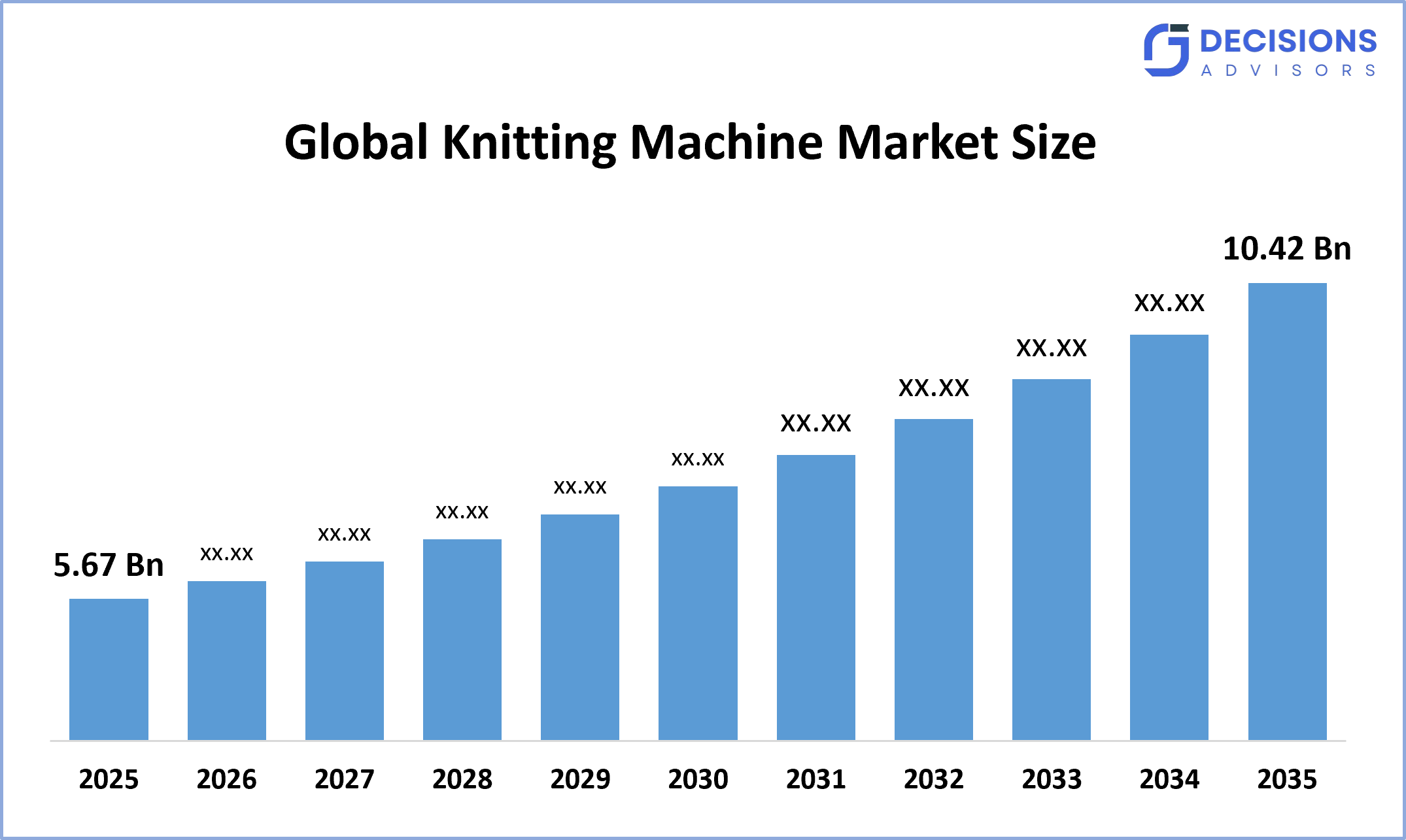
The Global Knitting Machine Market Size is predicted to grow from USD 5.67 Billion in 2025 and is likely to reach around USD 10.42 Billion by 2035 with a CAGR of 6.27%. According to Decision Advisors, it can be observed that automation and intelligent knitting are important trends, contributing around 40% of the total market demand across the globe. Karl Mayer is one of the leading firms in the industry, having approximately 6% market share globally, which makes it an important part of technological advancements and market growth.
Market Snapshot
- Global Knitting Machine Market Size (2025): USD 5.67 Billion
- Projected Global Knitting Machine Market Size (2035): USD 10.42 Billion
- Global Knitting Machine Market Compound Annual Growth Rate (CAGR): 6.27%
- Largest Regional Market: Asia Pacific
- 2nd Largest Region: Europe
- Fastest Growing Region: Latin America
- Base Year: 2025
- Historical Period: 2021-2024
- Market Forecast Period: 2026-2035
Market Overview/ Introduction
The Global Knitting Machine Market refers to the machinery used for manufacturing knitted products via automated or computerized knitting machines which include circular, flat, warp and weft knitting systems. The government policies promoting the modernization of textiles like Indian PM MITRA Parks, PLI Scheme for Textiles, National Technical Textiles Mission, among others, have prompted investments in modern machinery. Latest trends include the increasing use of computerized knitting machines, digital design software, seamless knitting systems, and energy-efficient machinery. The companies are also focusing on automation and intelligent production capabilities. The growth in the market is being attributed to the increase in the production of apparels, the use of technical textiles, custom clothing, faster turnaround times, and focus on sustainable manufacturing. Automated and computerized knitting machines increase productivity, cut down material wastage, allow the making of complex designs, lower labor dependence, and improve operational efficiency.
- India promotes large-scale manufacturing via PM MITRA parks and state-level capital investment schemes (details on the Press Information Bureau). Tamil Nadu rolled out a 20% investment subsidy for advanced knitting equipment upgrades.
- Vietnam secures major sustainable textile investments through provincial approvals for recycling and circular production complexes, strengthening local raw material loops for advanced eco-friendly knitting machinery operations.
Notable Insights: -
- Asia Pacific is anticipated to hold approximately 41% share of the Global Knitting Machine Market over the predicted timeframe.
- Latin America is expected to grow at a rapid CAGR in the Global Knitting Machine Market by holding approximately 6.04% of the share during the forecast period.
- By type, the Weft Knitting Machines, segment dominated the market and holds approximately 58% share in 2025 and is projected to grow at a substantial CAGR during the forecast period.
- By knit type, the Single Knit segment dominated the market and holds approximately 55% share in 2025 and is projected to grow at a substantial CAGR during the forecast period.
- The compound annual growth rate of the Global Knitting Machine Market is 6.27%.
- The market is likely to achieve a valuation of USD 10.42 Billion by 2035.
Market Drivers
The Knitting Machines Market Growth can be attributed to increasing global demand for knitted apparels, sportswear, hosiery, and fashion clothes. The expansion of textile and garments industry, especially in developing nations, will push manufacturers to adopt efficient and effective knitting machines to enhance their output and productivity. Rising acceptance of automation and computerization of knitting machines is facilitating better productivity, better fabric quality, reduced labor intensity, and more design flexibility. The increasing preference for seamless clothing and custom-made clothing is also contributing to the increased usage of complex knitting machines. Technical textiles application in industries such as automotive, health care, industrial, and protective textiles also present new growth opportunities for knitting machines. The increasing adoption of Industry 4.0 is motivating manufacturers to adopt digital technology in their knitting machines. Rising environmental demands have pushed manufacturers to adopt energy-efficient machines.
Restrain
Smaller firms' adoption of the global knitting machine market is hampered by issues such high machinery prices, the need for specialized staff, maintenance costs, and complicated technological integration. Investment requirements are increased by high machinery expenses, especially for small and medium-sized textile producers.
Competitive Analysis:
The report offers the appropriate analysis of the key organizations/companies involved within the Global Knitting Machine Market along with a comparative evaluation primarily based on their product offerings, business overviews, geographic presence, enterprise strategies, segment market share, and SWOT analysis. The report also provides an elaborative analysis focusing on the current news and developments of the companies, which includes product development, innovations, joint ventures, partnerships, mergers & acquisitions, strategic alliances, and others. This allows for the evaluation of the overall competition within the market.
Top Companies in the Global Knitting Machine Market
- Karl Mayer
- Shima Seiki Mfg. Ltd
- Mayer & Cie. GmbH & Co. KG
- Santoni
- Terrot GmbH
- H. Stoll AG & Co. KG
- Pai Lung Machinery Mill Co., Inc.
- Ningbo Cixing Co., Ltd.
- Orizio S.r.l.
- Monarch Knitting Machinery Corp
Government Initiatives
|
Country |
Key Government Initiatives |
|
India |
The Ministry of Textiles runs production-linked incentives and capital support to boost high-value fabric production, attract advanced computerized knitting tech, and expand local output. |
|
China |
Beijing drives automated factory upgrades under intelligent manufacturing guidelines, offering local subsidies for IoT and AI-enabled industrial knitting machinery integration to maintain global export dominance. |
|
Turkey |
State agencies support industrial cluster modernization and large-scale investments, encouraging textile plants to adopt high-speed, automated, and energy-efficient European and domestic knitting machinery. |
Market Segmentation
The Global Knitting Machine Market share is classified into Type, Knit Type and End Use
- The Weft Knitting Machines segment dominated the market and holds approximately 58% share in 2025 and is projected to grow at a substantial CAGR during the forecast period.
Based on the type, the Global Knitting Machine Market comprises segments such as Warp Knitting Machines, Raschel Warp, Tricot Warp, Other (Crochet, etc.), Weft Knitting Machines, Circular, Straight Bar, and Other (Loop Wheel, etc.). Out of these segments, the segment of Weft Knitting Machines occupies the largest market share of around 58% in 2025. This is since Weft knitting machines are highly productive, versatile, and are used for the manufacture of apparel, hosiery, sports apparels, and home textiles. The circular knitting machines are more preferred owing to their high efficiency.
- The Single Knit segment accounted for the largest share of approximately 55% in 2025 and is anticipated to grow at a significant CAGR during the forecast period.
Based on the knit type, the Global Knitting Machine Market has been segmented into Single Knit and Double Knit. Amongst these segments, Single Knit was the largest, accounting for about 55% of market share in 2025. The segment is the most dominant due to its extensive application in apparels, sportswear, hosiery and production of lightweight fabrics. The advantages offered by single knit machines include high efficiency of production, cost-effectiveness and flexibility in producing different structures of fabrics. Demand for comfortable and light weight knitted clothing drives the growth of this segment, which leads the revenue generation in the Global Knitting Machine Market.
- The Apparel Textiles segment accounted for the largest share of approximately 48% in 2025 and is anticipated to grow at a significant CAGR during the forecast period.
Based on end use, the Global Knitting Machine Market Segmentation includes Automotive Textiles, Sports Textiles, Apparel Textiles, Home Textiles, and Others (Footwear Textile industry). Out of all these segments, the Apparel Textiles Segment leads the market with a 48% share in 2025. The reason behind this is the rising demand from various parts of the world for knitted apparels like Sweaters, Hosiery products, Undergarments, and Fashion clothing. Increasing production of Apparel, rising demand for Comfortable and Fast Fashion, and increasing use of Automated knitting machines have further contributed to the growth of this segment.
Regional Segment Analysis of the Global Knitting Machine Market
- Asia-Pacific (China, India, Japan, Bangladesh, Vietnam, South Korea, and Rest of Asia-Pacific)?
- North America (United States, Canada, and Mexico)
- Europe (Germany, Italy, France, UK, and Rest of Europe)
- Latin America (Brazil, Argentina, Colombia, Chile, and Rest of Latin America)?
- The Middle East and Africa (Turkey, UAE, Saudi Arabia, South Africa, Egypt, and Rest of MEA)
Asia-Pacific is anticipated to hold approximately 41% share of the Global Knitting Machine Market over the predicted timeframe.
The Asia-Pacific region holds about 41% share in the Global Knitting Machine Market due to its huge presence of textile and apparels manufacturing industry in nations like China, India, Bangladesh, Vietnam, and Japan. The region has advantages due to the presence of supply chain of textiles, production of apparels in bulk, and automation and computerization of the knitting machines. China, India, and Vietnam are some of the major regions with Asia being the recipient of the largest number of knitting machine supplies across the globe. Growth in Asia is driven by export of apparels, modernization of the textile industry, use of energy-efficient machines, and need for technical and sportive textiles.
Latin America is expected to grow at a rapid CAGR in the Global Knitting Machine Market, holding approximately 6.04% of the share during the forecast period
The Latin America holds around 6.04% share of the Global Knitting Machine Market, facilitated by growing textile and clothing manufacturing operations in countries like Brazil, Mexico, Peru, and Chile. Brazil is a significant market as it constitutes about 55% of regional knitting machine consumption, along with Brazil, Mexico, and Peru being the top import markets for these machines. Latin America is also facilitated by modernization in textile manufacturing units, computerization of knitting machines, nearshoring, and growing requirements of clothing, home textiles, and technical textiles. Together, Brazil, Mexico, and Chile form a substantial part of Latin America's textile machinery market requirement.
Europe is the fastest-growing region in the Global Knitting Machine Market during the period, holding approximately 16.08% share.
The Europe constitutes 16.08% of the Global Knitting Machine Market owing to the presence of a technologically adept textile manufacturing framework, engineering expertise, and the need for efficient knitting machines in the region. Countries like Germany, Italy, France, and the UK are major contributors to the regional market share. There is a growing trend towards automation and computerization of knitting machinery, growing demand for technical and premium textiles, and rising awareness about efficient and sustainable machinery in Europe. The presence of top-notch knitting machine manufacturers and technologically adept textile manufacturing industries helps improve the competitiveness of the region. The manufacturers are making substantial investments in digital controls, automated quality control, energy-efficient technology, and advanced production management systems.
Future Market Trends in Global Knitting Machine Market: -
-
- Expansion of Automated and Computerized Knitting Machines
Automatic computerized knitting machines have become widely used because of the improvement in production efficiency and design capabilities. Thanks to sophisticated control systems, producers can knit complicated designs almost without any manual interference. The increasing cost of labor and the necessity for increased speed of production result in the wide usage of smart knitting machinery.
-
- Integration of Industry 4.0 and Smart Manufacturing
IoT, Artificial Intelligence, Digital Monitoring, and Data Analytics are some of the features being adopted by the manufacturing companies of knitting machines. Through these technologies, it becomes possible to have live monitoring of the machines, automated maintenance, quality control, and efficient manufacturing process. The use of industry 4.0 in the textile industry is helping in lowering downtime and increasing productivity.
-
- Rising Demand for Sustainable and Energy-Efficient Machinery
The increasing number of environmental regulations and sustainability needs has motivated textile producers to use energy-efficient knitting machines. The new technology minimizes electricity usage, material waste, and inefficiencies during the production process while promoting environmental manufacturing. The rising need for sustainable fabrics has led to the acquisition of efficient machinery to maximize efficiency, minimize costs, and decrease environmental impacts.
-
- Growing Adoption of Seamless and Technical Textile Production
The demand for seamless garments, sportswear, medical textiles, automotive textiles, and other technical textiles is rising. Knitting machines give much more versatility in terms of producing special structures, design customization, and high-performance fabrics. Growing use of these materials in medicine, automobiles, sports, and industries is motivating companies to develop advanced knitting machines that can handle such special textiles.
Recent Development
- In May 2024, At ITM 2024, Terrot displayed their I3P 196 circular knitting machine, showcasing its high productivity, adaptable configuration, and capacity to create various fabric structures for a range of textile applications.
- In April 2024, Stoll, a division of the Karl Mayer Group, unveiled their revised CMS flatbed knitting line targeted for technical and fashion applications across multiple industries.
Market Segment
This study forecasts revenue at global, regional, and country levels from 2020 to 2035. Decision Advisors has segmented the Global Knitting Machine Market based on the below-mentioned segments:
Global Knitting Machine Market, By Type
- Warp knitting machines
- Raschel warp
- Tricot warp
- Others (crochet, etc.)
- Weft knitting machines
- Circular
- Straight bar
- Others (loop wheel, etc.)
Global Knitting Machine Market, By Knit Type
- Single knit
- Double knit
Global Knitting Machine Market, By End Use
- Automotive textiles
- Sports textiles
- Apparel textiles
- home textiles
- Others (footwear industry, etc.)
Global Knitting Machine Market, By Regional Analysis
- Asia-Pacific
- China
- India
- Japan
- Bangladesh
- Vietnam
- South Korea
- Rest of Asia-Pacific
- North America
- United States
- Canada
- Mexico
- Europe
- Germany
- Italy
- France
- UK
- Rest of Europe
- Latin America
- Brazil
- Argentina
- Colombia
- Chile
- Rest of Latin America
- Middle East & Africa
- Turkey
- UAE
- Saudi Arabia
- South Africa
- Egypt
- Rest of MEA
Frequently Asked Questions (FAQ)
Q. What factors are driving the growth of the Global Knitting Machine Market?
A. The market is expanding due to rising demand for knitted clothing, sportswear, technological textiles, and seamless clothing as well as rising textile automation and modernization.
Q. Why are computerized knitting machines becoming increasingly popular?
A. Higher production efficiency, accurate pattern control, less reliance on labor, and more freedom for creating intricate and personalized textile designs are all provided by computerized knitting machines.
Q. What role does automation play in the knitting machine industry?
A. Automation decreases manufacturing time, material waste, and the need for manual labor while increasing productivity, fabric consistency, operational efficiency, and quality control.
Q. How is Industry 4.0 influencing knitting machine development?
A. Knitting production systems are becoming smarter, more efficient, and linked thanks to Industry 4.0 technologies including IoT connectivity, real-time monitoring, predictive maintenance, and data analytics.
Check Licence
Choose the plan that fits you best: Single User, Multi-User, or Enterprise solutions tailored for your needs.
We Have You Covered
- 24/7 Analyst Support
- Clients Across the Globe
- Tailored Insights
- Technology Tracking
- Competitive Intelligence
- Custom Research
- Syndicated Market Studies
- Market Overview
- Market Segmentation
- Growth Drivers
- Market Opportunities
- Regulatory Insights
- Innovation & Sustainability
Report Details
| Scope | Global |
| Pages | 240 |
| Delivery | PDF & Excel via Email |
| Language | English |
| Release | Aug 2026 |
| Access | Download from this page |