
Global Lab Automation in Protein Engineering Market
 |
Author:
David J
|
Pages:
235
|
Author:
David J
|
Pages:
235
Global Lab Automation in Protein Engineering Market Size, Share By Application (Drug Discovery, Protein Synthesis, Genomic Analysis, Cellular Engineering), By Product Type (Automated Liquid Handling Systems, Robotic Workstations, Microplate Readers, Mass Spectrometers), By End User (Academic Institutions, Pharmaceutical Companies, Biotechnology Firms, Contract Research Organizations), and By Region (North America, Europe, Asia-Pacific, Latin America, Middle East & Africa), Analysis and Forecast 2026-2035.
CAGR
7.52%
REVENUE 2025
USD Billion 4.05
FORECAST 2035
USD Billion 8.36
REPORT COVERAGE
Global
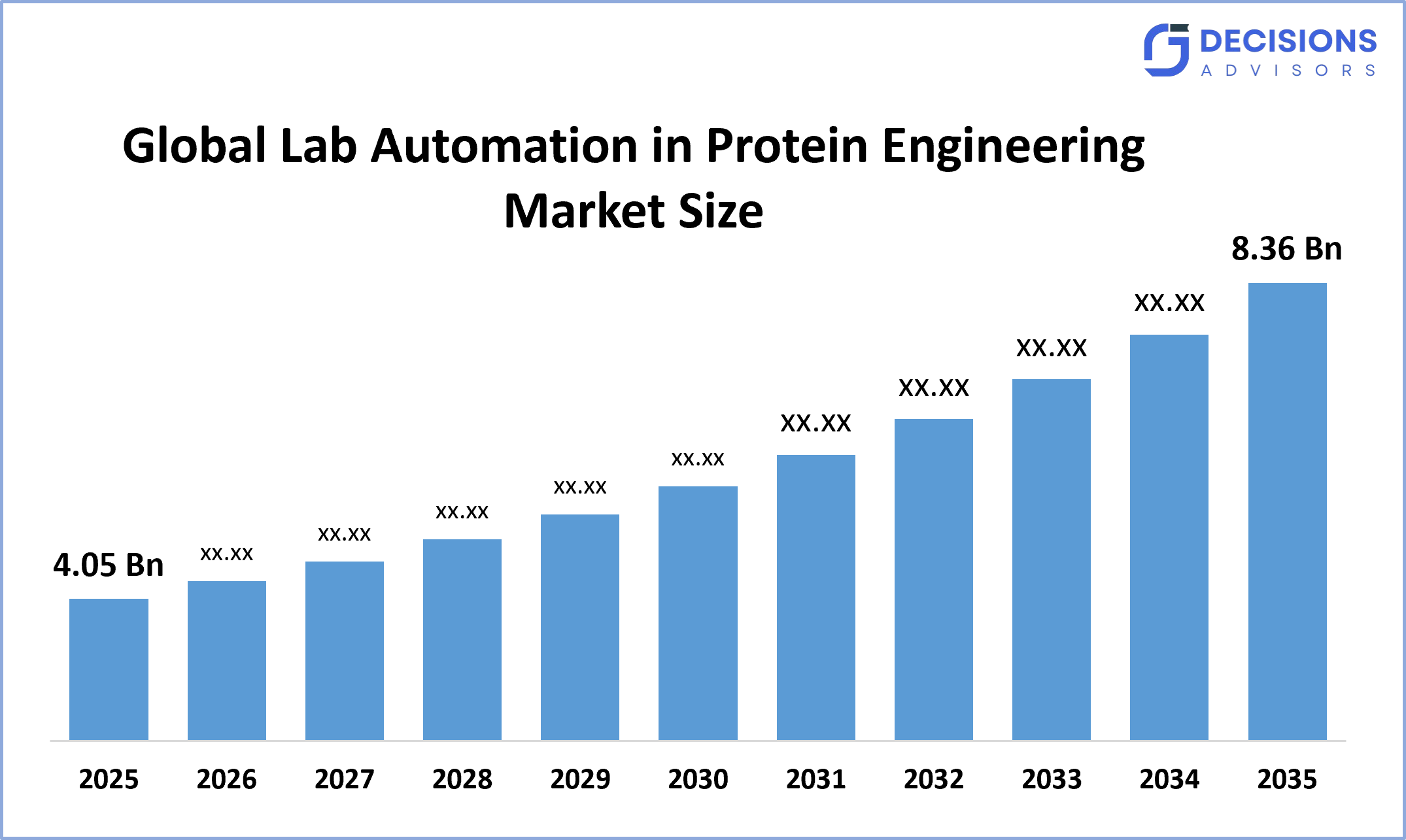
The Global Lab Automation in Protein Engineering Market Size is predicted to grow from USD 4.05 Billion in 2025 and is likely to reach around USD 8.36 Billion by 2035 with a CAGR of 7.52%. According to Decision Advisors, a detailed market research study indicates that trends like the incorporation of AI and machine learning, high-throughput screening, and complete workflow automation have significantly impacted market development. Some of the key players include Thermo Fisher Scientific, whereas North America is the dominant region, and Asia Pacific is the fastest-growing regional segment with around 12.4% CAGR for the period from 2025 to 2030. There is an increased use of automated liquid handlers, robotic workstations, microplate readers, and software applications within the market.
Market Snapshot
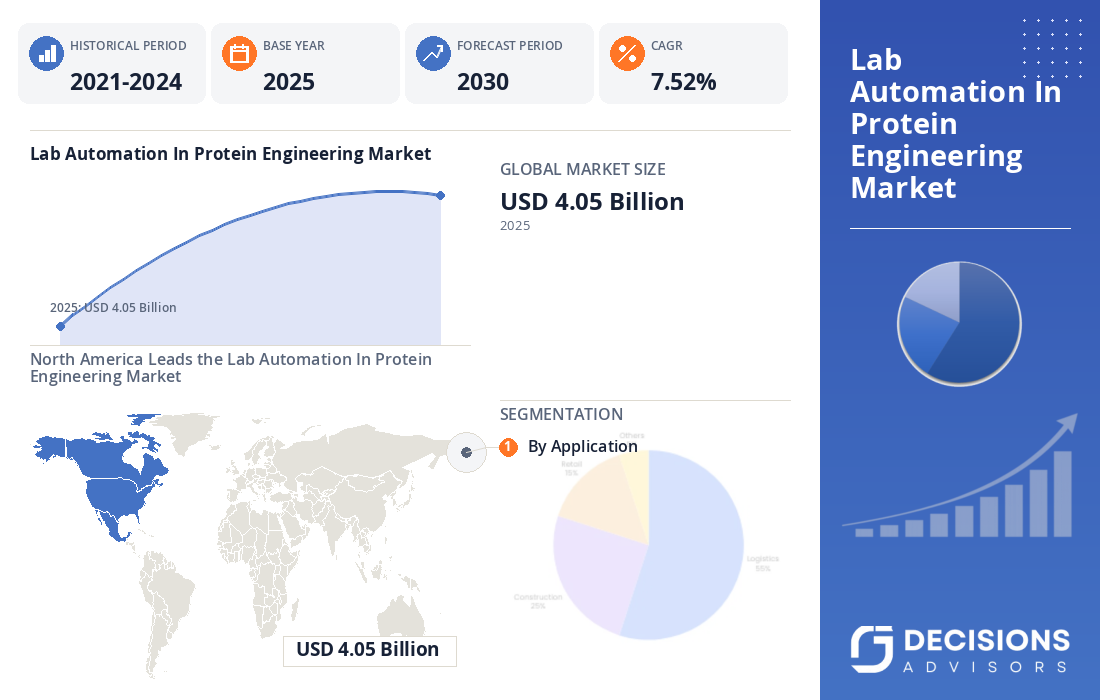
- Global Lab Automation in Protein Engineering Market Size (2025): USD 4.05 Billion
- Projected Global Lab Automation in Protein Engineering Market Size (2035): USD 8.36 Billion
- Global Lab Automation in Protein Engineering Market Compound Annual Growth Rate (CAGR): 7.52%
- Largest Regional Market: North America
- 2nd Largest Region: Europe
- Fastest Growing Region: Asia Pacific
- Base Year: 2025
- Historical Period: 2021-2024
- Market Forecast Period: 2026-2035
Market Overview/ Introduction
The Global Lab Automation in Protein Engineering Market consists of automated tools and technologies used to facilitate protein engineering, including design, synthesis, production, and characterization of proteins. Government initiatives are enabling automation in terms of biomedical research and biotechnology projects. In the US, NIH grants enable the upgrading of biomedical facilities with advanced automated equipment, while in India, the BioE3 policy encourages biofoundry, biomanufacturing facilities, and Bio-AI. Recent development in the field includes NSF’s initiative in August 2025 for AI-programmable cloud laboratories to boost automation of scientific discovery. Growth drivers of the market are increased demand for high-throughput protein engineering, reproducibility of experiments, AI-based design, screening, and faster discovery of biopharmaceuticals.
- The U.S. National Science Foundation awarded $20 million to build an AI-driven, automated protein engineering cloud lab to scale up open-access synthetic biology data.
- India advanced its Bio-Economy policy through the Department of Biotechnology, prioritizing automated biomanufacturing for smart proteins, enzymes, and precision therapeutics.
Notable Insights: -
- North America is anticipated to hold approximately 42.8% share of the Global Lab Automation in Protein Engineering Market over the predicted timeframe.
- Asia Pacific is expected to grow at a rapid CAGR in the Global Lab Automation in Protein Engineering Market by holding approximately 25% of the share during the forecast period.
- By application, the Drug Discovery, segment dominated the market and holds approximately 42% share in 2025 and is projected to grow at a substantial CAGR during the forecast period.
- By product type, the Automated Liquid Handling Systems segment dominated the market and holds approximately 44% share in 2025 and is projected to grow at a substantial CAGR during the forecast period.
- The compound annual growth rate of the Global Lab Automation in Protein Engineering Market is 7.52%.
- The market is likely to achieve a valuation of USD 8.36 Billion by 2035.
Market Drivers
The Global Market for Lab Automation in Protein Engineering is influenced by the increasing need for fast and accurate research on proteins in various pharma and biotech companies. With an increased use of automated liquid handling, high-throughput screening, and robotic laboratory systems, protein engineering processes get accelerated and manual errors are minimized. Increased research and development activities on drugs and biological products help in growth in the global market due to the extensive use of engineered proteins in therapies and industries. With the help of advancements in artificial intelligence and machine learning, scientists can design and optimize proteins efficiently, thus automating the entire process. Complexity of experiments on protein engineering increases the need for automation platforms which can handle larger data sets and repetitive tasks. Further, an increasing research activity in personalized medicine, enzyme engineering, and synthetic biology is creating significant demand for automated protein engineering globally.
Restrain
Smaller research labs and biotechnology businesses are less likely to adopt the Global Lab Automation in Protein Engineering Market due to expensive initial investment and complicated integration requirements. Laboratory expenses are raised by expensive hardware, software, upkeep, and integration needs.
Competitive Analysis:
The report offers the appropriate analysis of the key organizations/companies involved within the Global Lab Automation in Protein Engineering Market along with a comparative evaluation primarily based on their product offerings, business overviews, geographic presence, enterprise strategies, segment market share, and SWOT analysis. The report also provides an elaborative analysis focusing on the current news and developments of the companies, which includes product development, innovations, joint ventures, partnerships, mergers & acquisitions, strategic alliances, and others. This allows for the evaluation of the overall competition within the market.
Top Companies in the Global Lab Automation in Protein Engineering Market
- Thermo Fisher Scientific
- Danaher Corporation
- Agilent Technologies
- Tecan Group
- Revvity (PerkinElmer)
- Hudson Robotics
- F. Hoffmann-La Roche
- Becton, Dickinson and Company
- Siemens Healthineers
- Bio-Rad Laboratories
Government Initiatives
|
Country |
Key Government Initiatives |
|
Japan |
Strategic national programs designate synthetic biology and automated biofoundry networks as critical technologies, funding public-private laboratories to streamline functional protein production. |
|
India |
The government launched the BioE3 Policy to establish national biofoundries, biomanufacturing hubs, and bio-AI hubs, integrating automation and data science to advance bioprocess and protein engineering applications. |
|
United Kingdom |
Through the UK Research and Intelligence (UKRI) Synthetic Biology for Growth program, the state funded multidisciplinary research centers focusing on automated DNA synthesis and advanced bioengineering workflows. |
Market Segmentation
The Global Lab Automation in Protein Engineering Market share is classified into Application, Product Type and End User
- The Drug Discovery segment dominated the market and holds approximately 42% share in 2025 and is projected to grow at a substantial CAGR during the forecast period.
Based on the application, the Global Lab Automation in Protein Engineering Market can be segmented into Drug Discovery, Protein Synthesis, Genomics, and Cell Engineering. In these segments, the Drug Discovery segment leads the market and is expected to have a market share of around 42% in 2025. This leadership is mainly due to the rising demand for high-throughput screening, automation of protein characterization, and drug discovery process. Lab automation helps in making laboratory processes more efficient, precise, and error-free. The adoption of automated processes by pharmaceutical and biotech companies for complex protein engineering makes it a leading segment.
- The Automated Liquid Handling Systems segment accounted for the largest share of approximately 44% in 2025 and is anticipated to grow at a significant CAGR during the forecast period.
Based on the product type, the Global Lab Automation in Protein Engineering Market includes Automated Liquid Handling Systems, Robotic Workstations, Microplate Readers, and Mass Spectrometers. Out of all these categories, Automated Liquid Handling Systems contributed the highest market share, having around 44% share by 2025. This is due to increasing requirement of precision, speed, and reproducibility in laboratory workflows. Increasing use of automated liquid handling techniques such as pipetting, sample preparation, and protein synthesis processes have also contributed in the segment growth.
- The Pharmaceutical Companies segment accounted for the largest share of approximately 46% in 2025 and is anticipated to grow at a significant CAGR during the forecast period.
Based on end user, the Global Lab Automation in Protein Engineering Market is segmented into Academic Institutes, Pharmaceutical Companies, Biotech Companies, and Contract Research Organizations. Out of all these segments, the Pharmaceutical Companies segment dominates the market and holds around 46% share in 2025. The reason behind this dominance is increased investment in drug discovery, protein engineering, high throughput screening, and lab automation processes. The rising adoption of advanced lab automation technology by this segment leads to efficient research and accurate results. The rising number of R&D activities in the pharmaceutical sector drives segment growth.
Regional Segment Analysis of the Global Lab Automation in Protein Engineering Market
- Asia-Pacific (China, Japan, India, South Korea, Australia, and Rest of Asia-Pacific)?
- North America (United States, Canada, and Mexico)
- Europe (Germany, U.K., France, Italy, Spain, and Rest of Europe)
- Latin America (Brazil, Mexico, Argentina, and Rest of Latin America)?
- The Middle East and Africa (Israel, Saudi Arabia, UAE, South Africa, and Rest of MEA)
North America is anticipated to hold approximately 42.8% share of the Global Lab Automation in Protein Engineering Market over the predicted timeframe.
The North America is home to nearly 42.8% share of the Global Lab Automation in Protein Engineering Market owing to the presence of a highly developed biotechnology environment, flourishing pharmaceutical and biotech industries, and widespread acceptance of lab automation technology. North America is well-endowed with ample funding for research and development, presence of key players of the life sciences industry, and adoption of lab automation systems to facilitate protein engineering and drug discovery processes. The US is the dominant player in the North American region.
Asia Pacific is expected to grow at a rapid CAGR in the Global Lab Automation in Protein Engineering Market, holding approximately 25% of the share during the forecast period
The Asia Pacific region constitutes about 25% of the Global Lab Automation in Protein Engineering Market due to higher investments being made in biotechnology and biopharmaceutical research, improved lab facilities, and increased usage of automated liquid handling, high throughput screening, and laboratory integration technologies. Countries like China, Japan, India, and South Korea are improving their expertise in protein engineering and life sciences.
Europe is the fastest-growing region in the Global Lab Automation in Protein Engineering Market during the period, holding approximately 30% share.
The Europe is the region that makes up about 30% of the global lab automation in protein engineering market, ranking among the largest regional markets. Factors contributing to its growth include presence of a well-established pharmaceuticals and biotech sector, highly developed laboratories, substantial research and development spending, and rising use of automation solutions for protein engineering and drug discovery. Germany, the UK, Switzerland, and France play an important role in this regional market.
Future Market Trends in Global Lab Automation in Protein Engineering Market: -
-
- Increasing Adoption of AI-Driven Laboratory Automation
Laboratory automation powered by artificial intelligence is revolutionizing protein engineering through intelligent experimentation, data analytics, and predictive modeling. The use of machine learning and automated systems increases the accuracy of protein design and speeds up the screening process. Increased need for rapid, efficient, and repeatable research is driving its adoption worldwide.
-
- Expansion of High-Throughput Protein Engineering Workflows
High-throughput automation is becoming popular for dealing with large amounts of protein variations effectively. Liquid handlers, robotic systems, and plate readers allow screening, characterizing, and optimizing proteins in a very short time. Growing need for fast drug development, biological drugs creation, and synthetic biology studies encourages laboratories to use automated methods all over the world.
-
- Growing Integration of Cloud-Based Laboratory Systems
Laboratory automation systems based on the cloud concept have started becoming popular due to their capability to manage data centrally, allow remote monitoring and real-time collaboration, and integrate easily into various laboratory facilities. It has become a common practice for pharmaceutical and biotechnology firms to employ such platforms to enhance their workflow efficiency.
-
- Increasing Demand for Automated Protein Synthesis and Analysis
Increasingly, automation is facilitating the protein synthesis, purification, analysis, and characterization processes. Modern mass spectrometers, robots, and automated liquid handling systems help scientists handle their complicated procedures effectively. The growing number of studies on protein engineering and biopharmaceuticals is forecasted to increase the demand for automation systems worldwide.
Recent Development
- In January 2024, to improve the speed and precision of high-throughput protein analysis procedures, Agilent Technologies introduced an automated parallel capillary electrophoresis system.
- In December 2023, to develop modular hardware and software orchestration systems that integrate the Waters Andrew+ Pipetting Robot for intricate sample preparation automation, Biosero secured a significant multi-million-dollar deal.
- In January 2023, Becton, Dickinson and Company (BD) introduced its third-generation modular robotic track system worldwide, allowing for customizable, extensible whole lab automation setups that drastically reduce the amount of time needed for manual processing.
Market Segment
This study forecasts revenue at global, regional, and country levels from 2020 to 2035. Decision Advisors has segmented the Global Lab Automation in Protein Engineering Market based on the below-mentioned segments:
Global Lab Automation in Protein Engineering Market, By Application
- Drug Discovery
- Protein Synthesis
- Genomic Analysis
- Cellular Engineering
Global Lab Automation in Protein Engineering Market, By Product Type
- Automated Liquid Handling Systems
- Robotic Workstations
- Microplate Readers
- Mass Spectrometers
Global Lab Automation in Protein Engineering Market, By End User
- Academic Institutions
- Pharmaceutical Companies
- Biotechnology Firms
- Contract Research Organizations
Global Lab Automation in Protein Engineering Market, By Regional Analysis
- Asia-Pacific
- China
- Japan
- India
- South Korea
- Australia
- Rest of Asia-Pacific
- North America
- United States
- Canada
- Mexico
- Europe
- Germany
- U.K.
- France
- Italy
- Spain
- Rest of Europe
- Latin America
- Brazil
- Mexico
- Argentina
- Rest of Latin America
- Middle East & Africa
- Israel
- Saudi Arabia
- UAE
- South Africa
- Rest of MEA
Frequently Asked Questions (FAQ)
Q. How is lab automation improving protein engineering workflows?
A. By boosting experimental speed, precision, reproducibility, and throughput and decreasing human error and manual intervention across intricate laboratory procedures, lab automation enhances protein engineering.
Q. Why are automated liquid handling systems important in protein engineering?
A. Automated liquid handling systems are crucial for effective protein engineering workflows because they allow for accurate and reliable sample preparation, reagent dispensing, protein synthesis, and high-throughput screening.
Q. What role does AI play in lab automation for protein engineering?
A. Researchers can speed up protein discovery and development processes by using AI to optimize experimental design, evaluate massive information, predict protein features, and automate decision-making.
Q. How are pharmaceutical companies driving demand for laboratory automation?
A. Pharmaceutical businesses are increasingly using automated systems to improve research efficiency, scalability, and reproducibility while speeding up drug discovery, protein characterization, high-throughput screening, and biologics development.
Check Licence
Choose the plan that fits you best: Single User, Multi-User, or Enterprise solutions tailored for your needs.
We Have You Covered
- 24/7 Analyst Support
- Clients Across the Globe
- Tailored Insights
- Technology Tracking
- Competitive Intelligence
- Custom Research
- Syndicated Market Studies
- Market Overview
- Market Segmentation
- Growth Drivers
- Market Opportunities
- Regulatory Insights
- Innovation & Sustainability
Report Details
| Scope | Global |
| Pages | 235 |
| Delivery | PDF & Excel via Email |
| Language | English |
| Release | Aug 2026 |
| Access | Download from this page |