
Global Laboratory Plastic Consumables Market
 |
Author:
David J
|
Pages:
240
|
Author:
David J
|
Pages:
240
Global Laboratory Plastic Consumables Market Size, Share By Product Type (Pipette Tips, Tubes & Vials, Microplates, Petri Dishes & Flasks, and Others), By Application (Life Sciences Research, Clinical Diagnostics, Pharmaceutical & Biopharmaceutical, Academic & Research Institutions, and Others), By End User (Research Laboratories, Diagnostic Laboratories, Pharmaceutical & Biotechnology Companies, Hospitals & Healthcare Facilities, and Others), and By Region (North America, Europe, Asia-Pacific, Latin America, Middle East & Africa), Analysis and Forecast 2026-2035.
CAGR
3.7%
REVENUE 2025
USD Billion 10.6
FORECAST 2035
USD Billion 15.1
REPORT COVERAGE
Global
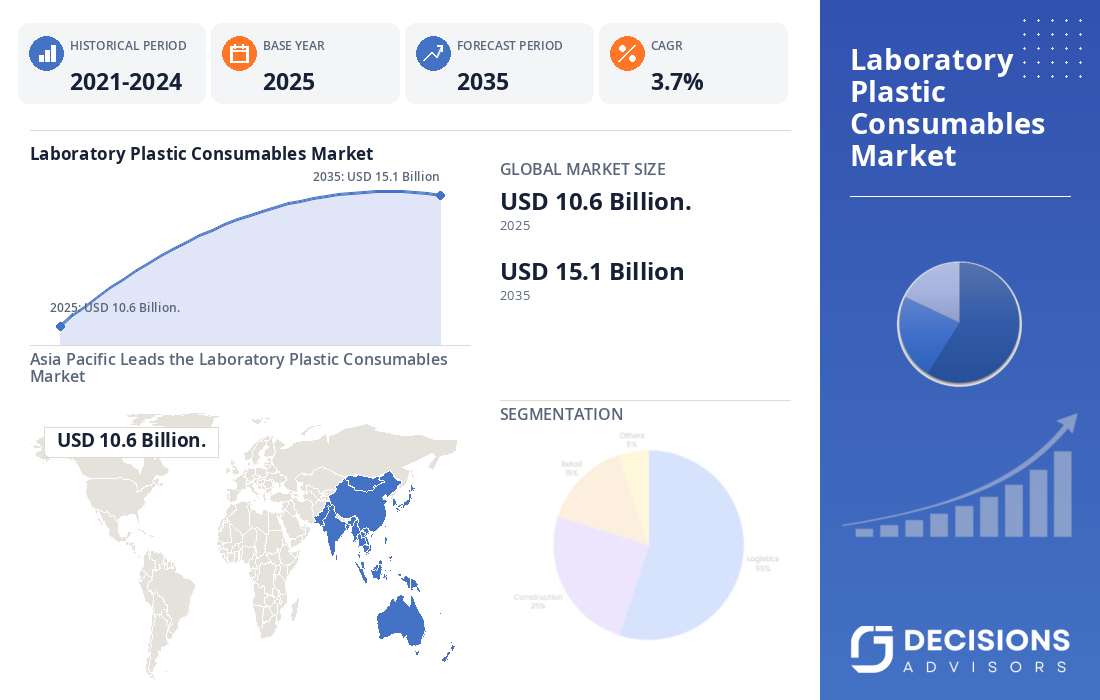
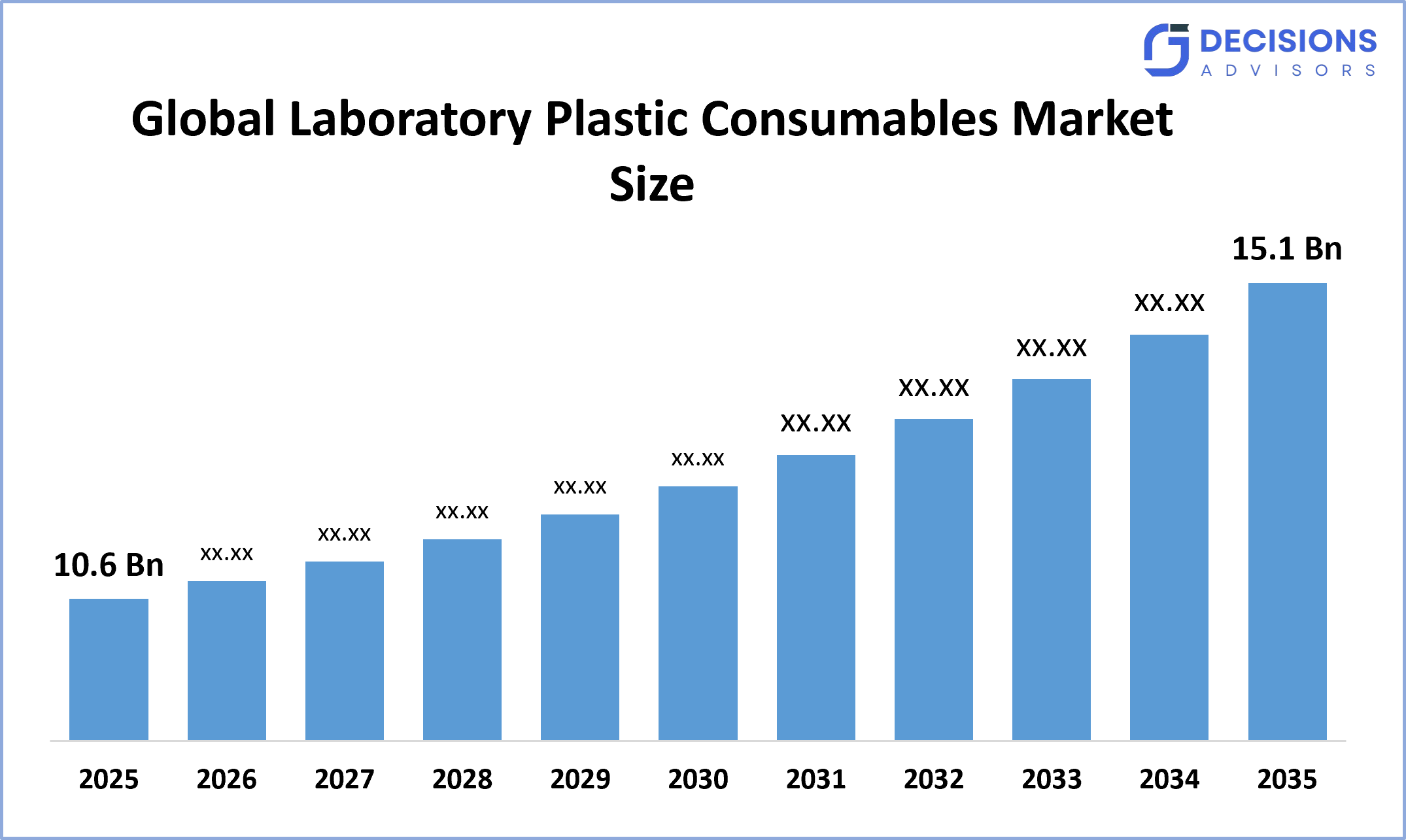
The global laboratory plastic consumables market size is predicted to grow from USD 10.6 Billion in 2025 and is likely to reach around USD 15.1 Billion by 2035 with a CAGR of 3.7%. The 2025 baseline is consistent with published industry estimates placing the laboratory plastic consumables market at approximately USD 10.6 billion. According to Decision Advisors, the market is primarily driven by rising laboratory testing volumes, expansion of molecular diagnostics, pharmaceutical R&D, biopharmaceutical manufacturing, and increased use of single-use laboratory products. Asia Pacific is estimated to lead with approximately 34% of global revenue in 2025. Thermo Fisher Scientific is considered one of the leading suppliers because of its extensive Nalgene, Nunc, and laboratory plasticware portfolio; the company reported USD 44.56 billion in total revenue in 2025, including USD 10.37 billion from Life Sciences Solutions.
Market Snapshot
- Global Laboratory Plastic Consumables Market Size (2025): USD 10.6 Billion.
- Projected Global Laboratory Plastic Consumables Market Size (2035): USD 15.1 Billion
- Global Laboratory Plastic Consumables Market CAGR: 3.7%.
- Largest Regional Market: Asia Pacific
- 2nd Largest Region: North America
- Fastest Growing Region: Europe
- Base Year: 2025
- Historical Period: 2021-2024
- Market Forecast Period: 2026-2035
Market Overview/ Introduction
The global laboratory plastic consumables market comprises disposable and reusable plastic products used for sample collection, preparation, storage, liquid handling, cell culture, molecular testing, diagnostics, and laboratory analysis. Major products include pipette tips, centrifuge tubes, microcentrifuge tubes, PCR plates, microplates, Petri dishes, culture flasks, specimen containers, cryogenic vials, and laboratory bottles. Thermo Fisher Scientific, Corning, Eppendorf, Sartorius, Merck, Greiner Bio-One, BD, and Sarstedt maintain broad product portfolios across research, clinical, pharmaceutical, and biotechnology workflows. Thermo Fisher, for example, offers Nalgene and Nunc plasticware spanning pipettes, tips, tubes, bottles, microplates, cell-culture plastics, cryotubes, and sample-storage products.
- United States, The U.S. research ecosystem continues to generate demand for laboratory consumables through large-scale biomedical R&D. NIH reported USD 35.3 billion in competing and noncompeting extramural biomedical research awards in FY2025, supporting a broad base of laboratories and research programs.
- Japan, Japan's AMED continues to support medical R&D from basic research through practical application under its FY2025-FY2029 plan, supporting demand for laboratory infrastructure and consumables used in drug discovery, diagnostics, regenerative medicine, and medical-device research.
- Europe, Horizon Europe continues to fund health research, biotechnology, diagnostics, personalized medicine, and digital health. The EU also launched a life-sciences strategy in 2025 aimed at making Europe a leading global life-sciences location by 2030.
Notable Insights: -
- Asia Pacific is anticipated to hold approximately 34% share of the Global Laboratory Plastic Consumables Market over the predicted timeframe.
- North America is expected to account for approximately 31.5% of the global market during the forecast period, supported by high laboratory spending and established life-science infrastructure.
- By Product Type, the Pipette Tips segment dominated the market and holds approximately 31% share in 2025 and is projected to grow at a substantial CAGR during the forecast period.
- By Application, the Life Sciences Research segment dominated the market and holds approximately 34% share in 2025 and is projected to grow at a substantial CAGR during the forecast period.
- By End User, Research Laboratories accounted for approximately 38% share in 2025 and are expected to remain the largest consuming group through 2035.
- The compound annual growth rate of the Global Laboratory Plastic Consumables Market is 3.7%.
- The market is likely to achieve a valuation of approximately USD 15.1 Billion by 2035.
Market Drivers
The global laboratory plastic consumables market is primarily driven by the expansion of pharmaceutical, biotechnology, clinical diagnostics, academic research, and molecular biology activities. Rising use of PCR, next-generation sequencing, cell culture, immunoassays, genomics, proteomics, and high-throughput screening increases recurring demand for sterile tubes, pipette tips, microplates, culture vessels, and sample-storage products. Automation is another important growth factor because robotic liquid-handling platforms require standardized, machine-compatible consumables with consistent dimensions and low variability.
Restrain
The market faces several constraints, particularly the environmental impact of single-use plastics, increasing waste-management requirements, raw-material price volatility, and the need for strict product-quality controls. Laboratory consumables used with biological samples or hazardous materials are often difficult to recycle because of contamination and disposal requirements. Manufacturers must also maintain extremely low levels of extractables, leachables, endotoxins, nucleases, and other contaminants, increasing production and quality-control costs.
Competitive Analysis:
The report offers the appropriate analysis of the key organizations/companies involved within the global laboratory plastic consumables market, along with a comparative evaluation primarily based on their product offerings, business overviews, geographic presence, enterprise strategies, segment market share, and SWOT analysis. The report also provides an elaborative analysis focusing on the current news and developments of the companies, which includes product development, innovations, joint ventures, partnerships, mergers & acquisitions, strategic alliances, and others. This allows for the evaluation of the overall competition within the market.
Top Companies in the Global Laboratory Plastic Consumables Market
- Thermo Fisher Scientific
- Corning Incorporated
- Eppendorf SE
- Sartorius AG
- Merck KGaA
- Becton Dickinson and Company
- Greiner Bio-One International
- Sarstedt AG & Co. KG
- Avantor
- SPL Life Sciences.
Government Initiatives
|
Country |
Key Government Initiatives |
|
United States |
The National Institutes of Health continues to provide substantial biomedical research funding. NIH reported USD 35.3 billion in extramural research awards during FY2025, supporting research laboratories and associated demand for laboratory consumables |
|
Japan |
AMED's FY2025-FY2029 strategy supports medical R&D across drug discovery, regenerative medicine, medical devices, healthcare, clinical data, and basic medical research, strengthening the laboratory research ecosystem |
|
China |
National priorities around biotechnology, advanced manufacturing, diagnostics, pharmaceutical innovation, and research infrastructure are supporting the expansion of laboratory and life-science capabilities |
Market Segmentation
The Global Laboratory Plastic Consumables Market share is classified into product type, application, and end user.
- The Pipette Tips segment dominated the market and holds approximately 31% share in 2025 and is projected to grow at a substantial CAGR during the forecast period.
Based on Product Type, the Global Laboratory Plastic Consumables Market is divided into Pipette Tips, Tubes & Vials, Microplates, Petri Dishes & Flasks, and Others. Among these, Pipette Tips dominate the market and hold approximately 31% share in 2025. Their dominance is supported by extremely high usage frequency in molecular biology, diagnostics, pharmaceutical research, genomics, and clinical laboratories. Automation and high-throughput screening further increase demand because robotic systems require standardized and reliable disposable tips. Growing concerns about contamination and cross-sample carryover also encourage laboratories to use sterile and filter pipette tips.
- The Life Sciences Research segment accounted for the largest share of approximately 34% in 2025 and is anticipated to grow at a significant CAGR during the forecast period.
Based on application, the market is divided into life sciences research, clinical diagnostics, pharmaceutical & biopharmaceutical, academic & research institutions, and others. Among these, Life Sciences Research accounted for the largest share and holds approximately 34% share in 2025. Research activities involving genomics, proteomics, molecular biology, cell biology, microbiology, and drug discovery consume large volumes of plastic tubes, plates, tips, flasks, and storage vessels. Increasing investment in biotechnology and personalized medicine is generating additional demand for high-quality consumables. The increasing adoption of automated research workflows is also supporting recurring purchases of standardized plastic products.
- The Research Laboratories segment accounted for the largest share of approximately 38% in 2025 and is anticipated to grow at a significant CAGR during the forecast period.
Based on end user, the market is divided into research laboratories, diagnostic laboratories, pharmaceutical & biotechnology companies, hospitals & healthcare facilities, and others. Among these, Research Laboratories dominate the market and hold approximately 38% share in 2025. Academic, government, pharmaceutical, and private research laboratories conduct large volumes of repetitive experiments requiring disposable tubes, pipette tips, microplates, and sample-storage products. Growing research activity in genomics, drug discovery, cell culture, and advanced biological sciences is supporting sustained consumables demand.
Regional Segment Analysis of the Global Laboratory Plastic Consumables Market
- North America (U.S., Canada, Mexico)?
- Europe (Germany, U.K., France, Italy, Spain, Netherlands, Rest of Europe).
- Asia-Pacific (China, Japan, India, Australia, South Korea, Rest of Asia-Pacific).
- South America (Brazil, Argentina, Rest of South America).
- Middle East & Africa (UAE, Saudi Arabia, South Africa, Rest of MEA).
Asia Pacific is anticipated to hold approximately 34% share of the Global Laboratory Plastic Consumables Market over the predicted timeframe.
Asia Pacific is projected to remain the largest regional market because of its expanding pharmaceutical manufacturing base, increasing clinical testing, growing biotechnology industry, and substantial academic and government research activity. China, Japan, South Korea, and India are major contributors to regional demand, while Southeast Asia is becoming increasingly important for pharmaceutical production and laboratory testing. The region benefits from lower-cost manufacturing capabilities and growing domestic demand for diagnostic and research products.
North America is expected to grow at a rapid CAGR in the Global Laboratory Plastic Consumables Market, holding approximately 31.5% of the share during the forecast period.
North America has a highly developed laboratory ecosystem supported by pharmaceutical companies, biotechnology firms, universities, research institutions, hospitals, and clinical diagnostic networks. The U.S. remains the largest contributor because of high biomedical research spending and extensive adoption of molecular diagnostics and advanced laboratory technologies. NIH's FY2025 extramural awards of USD 35.3 billion demonstrate the scale of the underlying biomedical research ecosystem. Major suppliers including Thermo Fisher Scientific, Corning, BD, Danaher companies, and other life-science manufacturers provide extensive laboratory plasticware portfolios.
Europe is the fastest-growing region in the Global Laboratory Plastic Consumables Market during the period, holding approximately 23% share.
Europe is expected to register the fastest growth because laboratories and manufacturers are increasingly combining scientific performance with sustainability objectives. The EU's life-sciences strategy seeks to strengthen Europe's position as a global life-sciences leader by 2030, while Horizon Europe supports health research, biotechnology, diagnostics, personalized medicine, and related technologies. Sustainability regulations are also encouraging manufacturers to reconsider materials, packaging, recyclability, and the use of fossil-based plastics. The EU Packaging and Packaging Waste Regulation entered into force in February 2025 and generally applies from August 2026, reinforcing the direction toward recyclable and resource-efficient plastic products.
Future Market Trends in Global Laboratory Plastic Consumables Market: -
-
- Shift Toward Bio-Based Laboratory Plastics
Manufacturers are increasingly developing laboratory consumables using renewable or bio-based feedstocks. Eppendorf's BioBased tubes use bio-based polypropylene through a mass-balance approach, demonstrating the industry's move toward reducing dependence on fossil-based feedstocks while retaining conventional product performance.
-
- Growth of Automated-Compatible Consumables
Laboratory automation will increase demand for standardized consumables designed for robotic pipetting systems, automated sample preparation, high-throughput screening, and integrated diagnostic platforms. Precise dimensions, low variability, barcode compatibility, stackability, and consistent material properties will become increasingly important purchasing criteria.
-
- Expansion of High-Performance Plastic Materials
Demand will increase for polypropylene, polyethylene, polystyrene, PET, and specialized polymer formulations that provide improved chemical resistance, thermal stability, optical clarity, low binding characteristics, and reduced extractables and leachables.
-
- Sustainable and Circular Laboratory Workflows
Laboratories are increasingly evaluating reusable plasticware, recycling programs, reduced packaging, bio-based polymers, and lower-carbon manufacturing. Thermo Fisher promotes reusable Nalgene plasticware and sustainability-focused product programs, while Sartorius has introduced renewable-feedstock initiatives for selected plastic components.
Recent Development
- In February 2026, Green Elephant Biotech partnered with Labscoop in a distribution agreement to expand access to its plant-based 96-well laboratory plates among U.S. laboratories, supporting the transition toward lower-impact laboratory consumables.
- In August 2025, Corning and Revital Healthcare signed a letter of intention to establish a joint life-sciences manufacturing footprint in Africa, with the collaboration intended to increase regional production and availability of essential laboratory consumables.
- In June 2025, Eppendorf introduced its second-generation Safe-Lock Tubes BioBased, made with 100% bio-based polypropylene through a mass-balance approach, expanding its portfolio of lower-carbon laboratory consumables.
Market Segment
This study forecasts revenue at global, regional, and country levels from 2021 to 2035. Decision Advisors has segmented the global laboratory plastic consumables market based on the below-mentioned segment:
Global Laboratory Plastic Consumables Market, By Product Type.
- Pipette Tips
- Tubes & Vials
- Microplates
- Petri Dishes & Flasks
- Others.
Global Laboratory Plastic Consumables Market, By Application.
- Life Sciences Research
- Clinical Diagnostics
- Pharmaceutical & Biopharmaceutical
- Academic & Research Institutions
- Others.
Global Laboratory Plastic Consumables Market, By End User.
- Research Laboratories
- Diagnostic Laboratories
- Pharmaceutical & Biotechnology Companies
- Hospitals & Healthcare Facilities
- Others.
Global Laboratory Plastic Consumables Market, By Regional Analysis.
- North America
- US
- Canada
- Mexico
- Europe
- Germany
- UK
- France
- Italy
- Spain
- Russia
- Rest of Europe
- Asia Pacific
- China
- Japan
- India
- South Korea
- Australia
- Rest of Asia Pacific
- South America
- Brazil
- Argentina
- Rest of South America
- Middle East & Africa
- UAE
- Saudi Arabia
- Qatar
- South Africa
- Rest of the Middle East & Africa
Frequently Asked Questions (FAQ)
Q. What are the major products included in the Global Laboratory Plastic Consumables Market?
A. Major products include pipette tips, centrifuge and microcentrifuge tubes, PCR plates, microplates, Petri dishes, cell-culture flasks, cryogenic vials, specimen containers, bottles, and other plastic laboratory products. These products support sample handling, testing, storage, cell culture, molecular biology, and diagnostic workflows.
Q. Why are laboratory plastic consumables preferred over glass products in many applications?
A. Plastic consumables are lightweight, shatter-resistant, easier to handle, and available in standardized formats suitable for automation. Polypropylene and other laboratory-grade plastics can also provide strong chemical compatibility and controlled extractables and leachables, making them suitable for demanding analytical and biological applications.
Q. How is sustainability changing the laboratory plastic consumables market?
A. Sustainability is encouraging manufacturers to develop reusable, recyclable, bio-based, and lower-carbon consumables. Eppendorf's bio-based polypropylene tubes and Green Elephant Biotech's PLA-based 96-well plates demonstrate the movement toward renewable-material alternatives, while European regulatory developments are increasing pressure to improve resource efficiency and recyclability.
Check Licence
Choose the plan that fits you best: Single User, Multi-User, or Enterprise solutions tailored for your needs.
We Have You Covered
- 24/7 Analyst Support
- Clients Across the Globe
- Tailored Insights
- Technology Tracking
- Competitive Intelligence
- Custom Research
- Syndicated Market Studies
- Market Overview
- Market Segmentation
- Growth Drivers
- Market Opportunities
- Regulatory Insights
- Innovation & Sustainability
Report Details
| Scope | Global |
| Pages | 240 |
| Delivery | PDF & Excel via Email |
| Language | English |
| Release | Aug 2026 |
| Access | Download from this page |