
Global Lactose Free Milk Market
 |
Author:
Sayali T
|
Pages:
200
|
Author:
Sayali T
|
Pages:
200
Global Lactose Free Milk Market Size, Share By Product Type (Liquid and Powder), By Fat Content (Whole Milk, and More), By Packaging Type (PET Bottles, Glass Bottles, Carton, and Others), and By Region (North America, Europe, Asia-Pacific, Latin America, Middle East & Africa), Analysis and Forecast 2026-2035
CAGR
10.2%
REVENUE 2025
USD Billion 13.17
FORECAST 2035
USD Billion 34.77
REPORT COVERAGE
Global
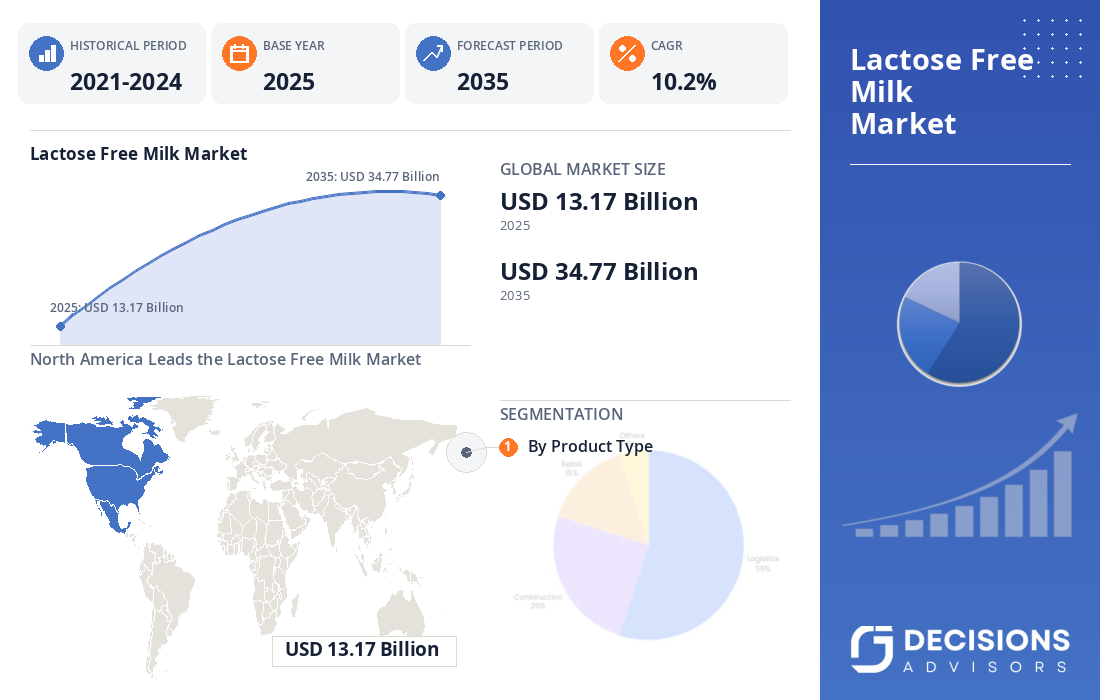
The Global Lactose Free Milk Market Size is predicted to grow from USD 13.17 Billion in 2025 and is likely to reach around USD 34.77 Billion by 2035 with a CAGR of 10.2%. According to Decision Advisors, the analysis of the research report of the market reveals that the trend of adoption of lactose-free and low-lactose products is dominant in the Global Lactose Free Milk Market, contributing about 58% to the overall share of the total market globally. The market is dominated by Nestlé, which earns about USD 100 billion annually and has a share of 10-15% of the global market. This makes it a major player in the growth and development of the global market.
Market Snapshot
- Global Lactose Free Milk Market Size (2025): USD 13.17 Billion
- Projected Global Lactose Free Milk Market Size (2035): USD 34.77 Billion
- Global Lactose Free Milk Market Compound Annual Growth Rate (CAGR): 10.2%
- Largest Regional Market: North America
- 2nd Largest Region: Europe
- Fastest Growing Region: Asia Pacific
- Base Year: 2025
- Historical Period: 2021-2024
- Market Forecast Period: 2026-2035
Market Overview/ Introduction
The Global Lactose Free Milk Market involves those milk products which have been processed to either hydrolyze or eliminate lactose from milk, thus making it suitable for lactose intolerant people. Programs that involve government initiatives for dairy modernization, nutrition, food-quality, processing and cold-chain development are promoting production capability, quality of milk, and availability for consumers across the globe. Some of the recent trends involve launch of fortified, functional, flavored, organic, and premium lactose-free milk products and expansion in retail and e-commerce distribution networks. Some of the factors contributing towards market growth include prevalence of lactose intolerance, rising consumer interest in digestive health and nutrition, increased disposable income, urbanization, premiumization, and availability of specialized dairy products. In addition, some of the factors include the development of better lactase processing technology and improved formulations to improve taste, nutritional value and shelf life of products. Some of the regions anticipated to witness fastest growth in the coming years include Asia Pacific due to higher health consciousness, increased milk consumption and modern retail/e-commerce availability.
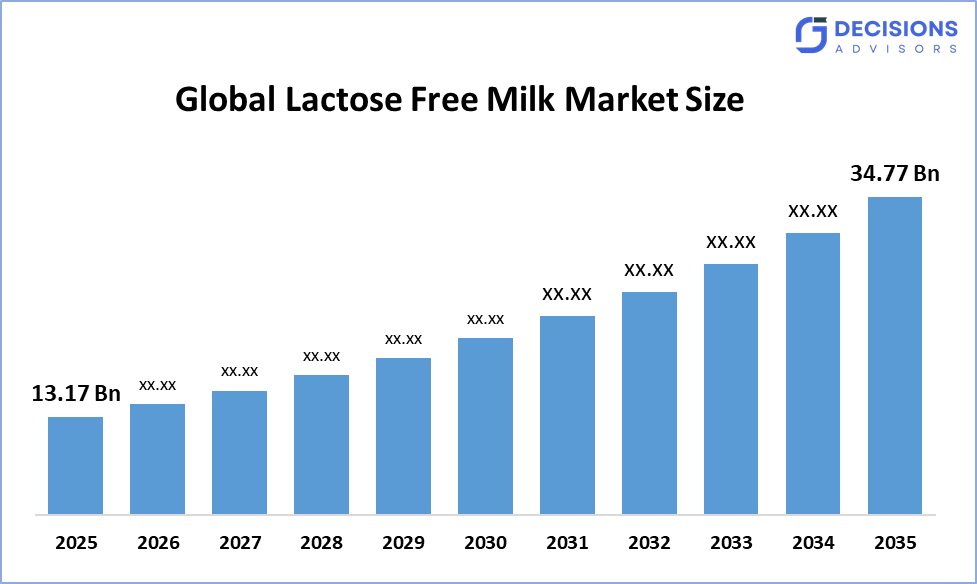
- Regulations require lactose-free products to be clearly and transparently identified to increase customer confidence and safety, which will boost market expansion.
- The Department of Animal Husbandry and Dairying utilizes the Animal Husbandry Infrastructure Development Fund to finance advanced cold chains and value-added processing plants for specialized dairy.
Notable Insights: -
- North America is anticipated to hold approximately 33.20% share of the Global Lactose Free Milk Market over the predicted timeframe.
- Asia Pacific is expected to grow at a rapid CAGR in the Global Lactose Free Milk Market by holding approximately 22.7% of the share during the forecast period.
- By product type, the Liquid segment dominated the market and holds approximately 91.28% share in 2025 and is projected to grow at a substantial CAGR during the forecast period.
- By fat content, the Whole Milk segment dominated the market and holds approximately 48.29% share in 2025 and is projected to grow at a substantial CAGR during the forecast period.
- The compound annual growth rate of the Global Lactose Free Milk Market is 10.2%.
- The market is likely to achieve a valuation of USD 34.77 Billion by 2035.
Market Drivers
The market for Global Lactose Free Milk is growing due to increased consumer awareness about lactose intolerance, leading to increased consumption of easily digestible dairy products. Consumers who are becoming health-conscious and are increasingly concerned about the wellness of their digestion systems are driving the demand for lactose-free milk. Growth in the presence of grocery stores, hypermarkets, convenience stores, and online channels enhances the accessibility of lactose free milk in both mature and developing markets. High levels of disposable income and premiumization are resulting in consumers purchasing specialized dairy products. Increased cases of lactose intolerance, especially in the Asia Pacific region, are creating an extensive consumer base for lactose-free milk. In addition, manufacturers are increasingly launching flavoured, organic, fortified and functional lactose-free milk.
Restrain
Higher production costs, premium pricing, restricted availability, and consumer concerns over product formulation and taste are some of the problems facing the global lactose-free milk market. Retail prices are higher than those of traditional milk because of higher production and processing costs.
Competitive Analysis:
The report offers the appropriate analysis of the key organizations/companies involved within the Global Lactose Free Milk Market along with a comparative evaluation primarily based on their product offerings, business overviews, geographic presence, enterprise strategies, segment market share, and SWOT analysis. The report also provides an elaborative analysis focusing on the current news and developments of the companies, which includes product development, innovations, joint ventures, partnerships, mergers & acquisitions, strategic alliances, and others. This allows for the evaluation of the overall competition within the market.
Top Companies in the Global Lactose Free Milk Market
- Nestlé S.A.
- Danone S.A.
- Arla Foods amba
- Lactalis Group
- The Coca-Cola Company (Fairlife)
- Valio Ltd.
- Fonterra Co-operative Group
- Saputo Inc.
- Dairy Farmers of America
- Gujarat Cooperative Milk Marketing Federation (Amul)
Government Initiatives
|
Country |
Key Government Initiatives |
|
India |
Through the National Dairy Development Board, the state indirectly supports value-added processing and cold-chain infrastructure upgrades, helping cooperatives transition toward specialized, high-protein, and easy-to-digest functional dairy extensions. |
|
China |
State authorities promote diverse dietary protein alternatives and nutritional awareness campaigns to manage urban health trends, encouraging domestic processing firms to scale up output in functional and plant-blended milk substitutes. |
|
France |
Through agricultural modernization programs, public entities support dairy sector investments in specialized separation technologies, helping major national conglomerates premiumize their export portfolios toward value-added dairy. |
Market Segmentation
The Global Lactose Free Milk Market share is classified into Product Type, Fat Content and Packaging Type
- The Liquid segment dominated the market and holds approximately 91.28% share in 2025 and is projected to grow at a substantial CAGR during the forecast period.
Based on the product type, the Global Lactose Free Milk Market has been segmented as Liquid and Powder. Out of these, Liquid segment is leading in the market with 91.28% market share in 2025. This leadership is because of the high consumer inclination towards ready-to-consume milk, easy availability through supermarkets, convenience stores, and online channels, and familiarity in terms of flavor and taste. Liquid lactose-free milk has been widely used at home as well as restaurants, thereby making it the preferred form across the globe. On the other hand, Powder segment is gaining momentum because of its longer shelf life and convenience.
- The Whole Milk segment accounted for the largest share of approximately 48.29% in 2025 and is anticipated to grow at a significant CAGR during the forecast period.
Based on the fat content, the Global Lactose-Free Milk Market can be segmented as Whole Milk, Reduced-Fat Milk, and Skimmed Milk. In the above-mentioned segments, the Whole Milk segment occupied the largest market share, constituting around 48.29% in 2025. Such dominance can be due to the increasing liking of consumers towards full-fat dairy products because of its rich taste, creamy texture, and nutritional value. Whole lactose-free milk is extensively used for consumption at home, in beverages, cooking, and foodservice usage.
- The Carton segment accounted for the largest share of approximately 44% in 2025 and is anticipated to grow at a significant CAGR during the forecast period.
Based on packaging type, the Global Lactose-Free Milk Market is classified based on Packaging Type such as PET Bottles, Glass Bottles, Carton, and Others. Out of these, the Carton category leads the market and accounts for around 44% market share in 2025. The leadership of this category is due to the lightweight nature of the cartons, easy handling, effective storage, and protection from light and contamination. The Carton pack also helps in shelf-life extension and packaging sustainability efforts, which is making it highly favored by consumers.
Regional Segment Analysis of the Global Lactose Free Milk Market
- Asia-Pacific (China, Japan, India, South Korea, Australia, and Rest of Asia-Pacific)?
- North America (United States, Canada, and Mexico)
- Europe (Germany, U.K., France, Italy, Spain, Netherlands, and Rest of Europe)
- Latin America (Brazil, Mexico, Argentina, and Rest of Latin America)?
- The Middle East and Africa (Saudi Arabia, UAE, South Africa, Turkey, Egypt, and Rest of MEA)
North America is anticipated to hold approximately 33.20% share of the Global Knitt Lactose Free Milk Market over the predicted timeframe.
The North America Region is expected to account for around 33.20% share of the Global Lactose Free Milk Market during the forecast period. The dominance of the region is driven by higher consumer awareness about lactose intolerance, presence of dairy processing capability, extensive retail coverage, and availability of lactose-free products. Among the countries of this region, the United States is leading followed by Canada and Mexico. Growing demand for digestive health products and premium dairy products along with lactose-free milk products adds to the strength of the market in this region.
Asia Pacific is expected to grow at a rapid CAGR in the Global Lactose Free Milk Market, holding approximately 22.7% of the share during the forecast period
The Asia Pacific holds about 22.7% share of the Global Lactose Free Milk Market owing to high levels of lactose intolerance and growing awareness of digestive health issues. Rising levels of disposable income, increasing urbanization, and changing food preferences among consumers are motivating them towards using lactose free dairy products. Some countries in the Asia Pacific region, like China, Japan, India, and South Korea, have seen rising demand for lactose free milk because of increasing health consciousness among consumers. The expansion of supermarkets, convenience stores, e-commerce sites, and cold chain networks is helping improve the availability of the products.
Europe is the fastest-growing region in the Global Lactose Free Milk Market during the period, holding approximately 30% share.
The Europe segment contributes about 30% to the Global Lactose Free Milk Market, backed by the high level of awareness among consumers regarding lactose intolerance, healthy dairy consumption, and developed infrastructure in the food processing sector. The major regional countries include Germany, the UK, France, and Italy. The growing level of health consciousness and need for digestion-friendly products is prompting consumers to opt for lactose free milk. Europe also enjoys a robust retail network in terms of supermarkets, hypermarkets, convenience stores, and online channels. New product innovations in the form of fortified, organic, flavored, and premium lactose free products have been introduced to cater to the changing preferences of consumers.
Future Market Trends in Global Lactose Free Milk Market: -
-
- Rising Demand for Fortified and Functional Lactose Free Milk
Manufacturers are now designing lactose-free milk that is enriched with elements like calcium, vitamins, proteins, probiotics, and many others. The demand for such products is due to increased awareness among consumers about their digestion, immunity, and well-being through proper nutrition. Growing health consciousness along with premiumization is pushing consumers towards these lactose-free dairy products.
-
- Expansion of Plant-Based and Hybrid Alternatives
The increasing trend of plant-based beverages is compelling the dairy industry to come up with some unique lactose-free and hybrid milk options. The need to incorporate both nutrition from dairy and ingredients from plants in one drink is increasing among consumers. Vegan tendencies, environmental consciousness, and diversified dietary trends are promoting product innovation.
-
- Growth of E-Commerce and Direct-to-Consumer Distribution
Electronic grocery websites are gaining popularity in the distribution of lactose free milk. Online shopping allows consumers easy access to dairy products with special requirements and wider range of products. Growing internet and mobile phone usage, as well as new purchasing habits, are driving companies towards adopting stronger online distribution strategies worldwide.
-
- Increasing Demand for Premium and Organic Products
Consumer preferences are moving toward high-end, organic, clean-label, and minimally processed lactose-free milk products. Increasing awareness about ingredients, nutrition, sustainability, and food safety is aiding the trend of premiumization. Producers are doing this by getting certifications of organic production, offering natural products, using recyclable packages, and developing differentiated products.
Recent Development
- In April 2024, Prairie Farms introduced "Gold Standard" line extensions that included family-size packaging options and lactose-free milk with a longer shelf life.
- In April 2026, to attract high-end digestive-health consumers, market researchers saw an increase in dual-benefit product launches that combine A2 protein genetics with lactose-free processing.
- In March 2025, Manufacturers improved the efficiency of lactose breakdown while preserving the natural taste, sweetness, and nutritional value of milk by optimizing β-galactosidase processing settings.
Market Segment
This study forecasts revenue at global, regional, and country levels from 2020 to 2035. Decision Advisors has segmented the Global Lactose Free Milk Market based on the below-mentioned segments:
Global Lactose Free Milk Market, By Product Type
- Liquid
- Powder
Global Lactose Free Milk Market, By Fat Content
- Whole Milk
- More
Global Lactose Free Milk Market, By Packaging Type
- PET Bottles
- Glass Bottles
- Carton
- Others
Global Lactose Free Milk Market, By Regional Analysis
- Asia-Pacific
- China
- Japan
- India
- South Korea
- Australia
- Rest of Asia-Pacific
- North America
- United States
- Canada
- Mexico
- Europe
- Germany
- U.K.
- France
- Italy
- Spain
- Netherlands
- Rest of Europe
- Latin America
- Brazil
- Mexico
- Argentina
- Rest of Latin America
- Middle East & Africa
- Saudi Arabia
- UAE
- South Africa
- Turkey
- Egypt
- Rest of MEA
Frequently Asked Questions (FAQ)
Q. What is driving the growth of the Global Lactose Free Milk Market?
A. The market is expanding due to factors such as growing awareness of lactose intolerance, growing worries about digestive health, growing health consciousness, premiumization, and increased availability through supermarkets and e-commerce platforms.
Q. Why are consumers choosing lactose free milk over conventional milk?
A. Lactose-free milk is becoming a more popular dairy alternative since it offers the nutritional advantages of dairy while being simpler to digest for those who are lactose intolerant.
Q. What role does product innovation play in the lactose free milk market?
A. To satisfy changing consumer tastes and improve product distinctiveness, manufacturers are launching lactose-free milk products that are fortified, organic, flavored, protein-enriched, and functional.
Q. Which region is expected to experience the fastest growth in the Global Lactose Free Milk Market?
A. Due to the high prevalence of lactose intolerance, growing health consciousness, rising disposable incomes, urbanization, and the expansion of modern retail and e-commerce channels, Asia Pacific is predicted to develop at the quickest rate.
Check Licence
Choose the plan that fits you best: Single User, Multi-User, or Enterprise solutions tailored for your needs.
We Have You Covered
- 24/7 Analyst Support
- Clients Across the Globe
- Tailored Insights
- Technology Tracking
- Competitive Intelligence
- Custom Research
- Syndicated Market Studies
- Market Overview
- Market Segmentation
- Growth Drivers
- Market Opportunities
- Regulatory Insights
- Innovation & Sustainability
Report Details
| Scope | Global |
| Pages | 200 |
| Delivery | PDF & Excel via Email |
| Language | English |
| Release | Aug 2026 |
| Access | Download from this page |