
Global Large Satellite Market
 |
Author:
Sanket C
|
Pages:
200
|
Author:
Sanket C
|
Pages:
200
Global Large Satellite Market Size, Share By Satellite Weight (Small Satellites (500 kg or less), Medium Satellites (500 kg - 2,500 kg), Large Satellites (2,500 kg or more)), By Satellite Power (Low Power Satellites (less than 1 kW), Medium Power Satellites (1 kW - 10 kW), High Power Satellites (10 kW or more)), By Satellite Application (Communications Satellites, Earth Observation Satellites, Navigation Satellites, Weather Satellites, Scientific Research Satellites), and By Region (North America, Europe, Asia-Pacific, Latin America, Middle East & Africa), Analysis and Forecast 2026-2035
CAGR
10.03%
REVENUE 2025
USD Billion 41.02
FORECAST 2035
USD Billion 106.68
REPORT COVERAGE
Global
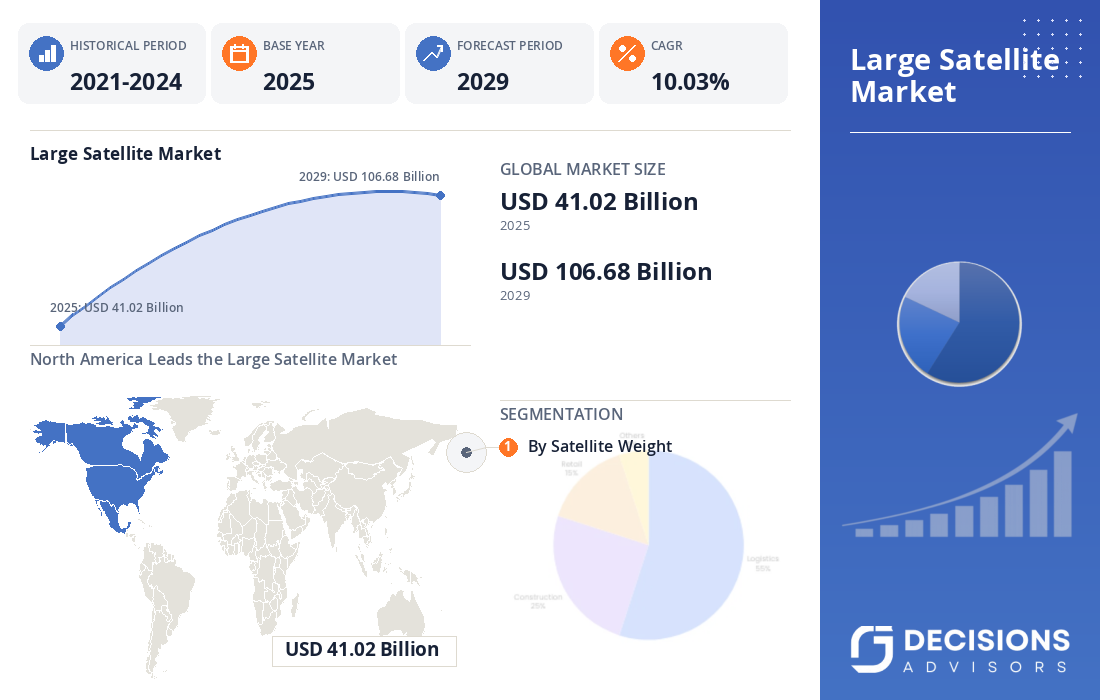
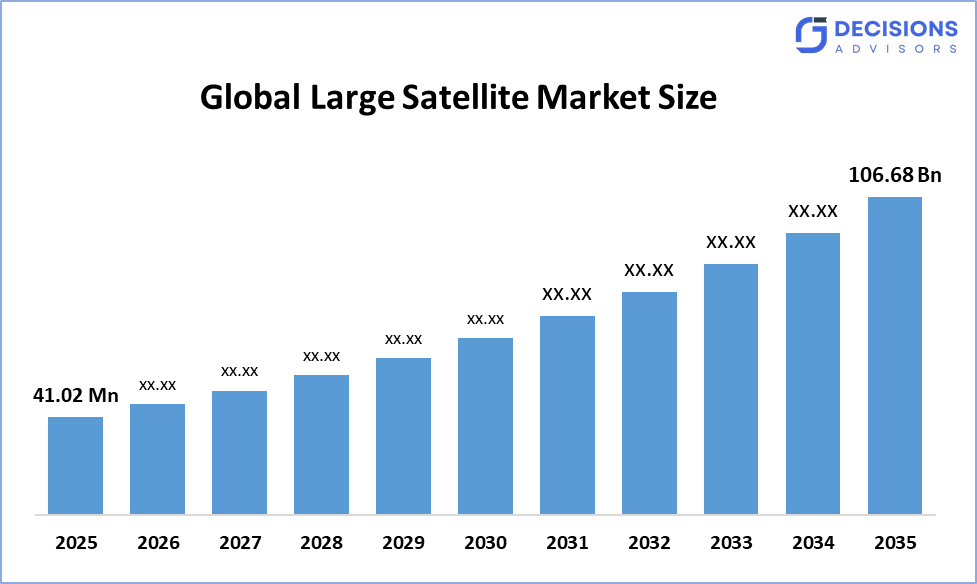
The Global Large Satellite Market Size is predicted to grow from USD 41.02 Billion in 2025 and is likely to reach around USD 106.68 Billion by 2035 with a CAGR of 10.03%. According to Decision Advisors, the evolution towards advanced satellite architecture, high-throughput payloads, and advanced propulsion technology is impacting the market development. Low Earth Orbit (LEO) satellites form an important trend, constituting nearly 50.5% of the market in 2024 and estimated to achieve 57.1% market share by 2029. The market structure is relatively concentrated, as the top five competitors hold nearly 82.66% of the market.
Market Snapshot
- Global Large Satellite Market Size (2025): USD 41.02 Billion
- Projected Global Large Satellite Market Size (2035): USD 106.68 Billion
- Global Large Satellite Market Compound Annual Growth Rate (CAGR): 10.03%
- Largest Regional Market: North America
- 2nd Largest Region: Europe
- Fastest Growing Region: Asia Pacific
- Base Year: 2025
- Historical Period: 2021-2024
- Market Forecast Period: 2026-2035
Market Overview/ Introduction
The Global Large Satellite Market is one that consists of highly efficient spacecraft used in the areas of communication, earth observation, navigation, research, and military purposes, with the help of state-of-the-art payloads, propulsion systems, and operational capabilities. Satellite development and commercial space activities are encouraged by government programs and space initiatives, including investments in the areas of satellite broadband, communication, security, earth observation, and navigation. These factors have contributed to the development of private sector investment policies that have increased industry growth. Some of the current developments include the launch of highly efficient communication satellites, upgrades in the earth observation systems, development of high throughput satellite systems, and collaboration between governments and commercial space companies.
- The Press Information Bureau reports that India launched a public-private framework via IN-SPACe to build indigenous Earth observation constellations, combining state oversight with private capital commitments.
- According to the SkyQuestt industry outlook, NASA, NOAA, and the Department of Defense continue heavy funding for advanced architectures and resilient low-Earth orbit satellite payloads.
Notable Insights: -
- North America is anticipated to hold approximately 50.91% share of the Global Large Satellite Market over the predicted timeframe.
- Asia Pacific is expected to grow at a rapid CAGR in the Global Large Satellite Market by holding approximately 18% of the share during the forecast period.
- By satellite weight, the Large Satellites (2,500 kg or more), segment dominated the market and holds approximately 42% share in 2025 and is projected to grow at a substantial CAGR during the forecast period.
- By satellite power, the High-Power Satellites (10 kW or more) segment dominated the market and holds approximately 44% share in 2025 and is projected to grow at a substantial CAGR during the forecast period.
- The compound annual growth rate of the Global Large Satellite Market is 10.03%.
- The market is likely to achieve a valuation of USD 106.68 Billion by 2035.
Market Drivers
The Global Large Satellite Market sees growth in the increasing demand for satellite communication services with higher capacity, broadband, and secure data transmissions. Investments in Earth observation and remote sensing technologies are resulting in the use of large satellites for environmental monitoring, weather forecasting, agriculture, and disaster management. National defense and security needs have led governments to develop more sophisticated large satellites. Satellite navigation and positioning systems are adding to market demand. Commercial space operations and investments from the private sector are also fast-tracking the development and launch of satellites. Advances in high-throughput payloads, electric propulsion systems, solar power generation, and satellite platforms are enhancing satellite operations. In addition, increasing demand for reliable global connectivity and space infrastructure continues to fuel market expansion.
Restrain
Long production cycles, complicated satellite development, high manufacturing and launch costs, and strict regulations are some of the obstacles facing the global large satellite market. Financial constraints for satellite producers and operators are increased by high development and launch expenses.
Competitive Analysis:
The report offers the appropriate analysis of the key organizations/companies involved within the Global Large Satellite Market along with a comparative evaluation primarily based on their product offerings, business overviews, geographic presence, enterprise strategies, segment market share, and SWOT analysis. The report also provides an elaborative analysis focusing on the current news and developments of the companies, which includes product development, innovations, joint ventures, partnerships, mergers & acquisitions, strategic alliances, and others. This allows for the evaluation of the overall competition within the market.
Top Companies in the Global Large Satellite Market
- Airbus SE
- Lockheed Martin Corporation
- Northrop Grumman
- The Boeing Company
- Thales Alenia Space
- Maxar Technologies
- China Aerospace Science and Technology Corporation (CASC)
- SpaceX
- Mitsubishi Electric
- OHB SE
Government Initiatives
|
Country |
Key Government Initiatives |
|
Russia |
Roscosmos maintains heavy state funding for sovereign high-capacity communication and military reconnaissance platforms, keeping its legacy orbital infrastructure operational amid geopolitical isolation. |
|
China |
Driven by state plans like the Guowang mega-constellation initiative, China scales heavy-lift and large satellite manufacturing via the CNSA to secure national broadband and independent space governance. |
|
United States |
The U.S. government drives large satellite demand via NASA, the Space Force, and NOAA, investing massively in next-generation military surveillance, GPS modernization, and commercial data acquisition programs. |
Market Segmentation
The Global Large Satellite Market share is classified into Satellite Weight, Satellite Power and Satellite Application
- The large satellite (2,500 kg or more) segment dominated the market and holds approximately 42% share in 2025 and is projected to grow at a substantial CAGR during the forecast period.
Based on satellite weight, the Global Large Satellite Market consists of small satellites, which are below 500 kg; medium satellites, between 500 kg and 2,500 kg; and large satellites, above 2,500 kg. Of these segments, the largest in the market is the large satellite segment, which makes up around 42% of the market in 2025. The main reason behind the success of this segment is the high capacity of payloads it carries, effective communication features, power supply system, and their application in defense, earth observation, navigation, and commercial communication purposes.
- The High-Power Satellites (10 kW or more) segment accounted for the largest share of approximately 44% in 2025 and is anticipated to grow at a significant CAGR during the forecast period.
Based on the satellite power, the Global Large Satellite Market is segmented into Low Power Satellites (up to 1 kW), Medium Power Satellites (1 kW – 10 kW), and High-Power Satellites (over 10 kW). Out of all the segments, the High-Power Satellites segment held the leading market share of around 44% in 2025. This is attributed to rising demand for communication, observation, defense, navigation, and broadband applications. The increased power generation ability makes high power satellites ideal for such applications.
- The Communications Satellites segment accounted for the largest share of approximately 46% in 2025 and is anticipated to grow at a significant CAGR during the forecast period.
Based on satellite application, the Global Large Satellite Market can be segmented into Communications Satellites, Earth Observation Satellites, Navigation Satellites, Weather Satellites, and Scientific Research Satellites. Out of these segments, the Communications Satellites Segment accounts for almost 46% of the total market share in 2025. This is mainly because of increasing demands for broadband connectivity, satellite television, secure communications, and data transmission. The increasing connectivity needs and development of communication infrastructure across the globe will contribute to the growth of this segment, which will become the largest revenue generator in the Global Large Satellite Market.
Regional Segment Analysis of the Global Large Satellite Market
- Asia-Pacific (China, Japan, India, South Korea, and Rest of Asia-Pacific)?
- North America (United States and Canada)
- Europe (France, Germany, United Kingdom, Italy, and Rest of Europe)
- Latin America (Brazil, Mexico, Argentina, and Rest of Latin America)?
- The Middle East and Africa (UAE, Saudi Arabia, Israel, South Africa, and Rest of MEA)
North American is anticipated to hold approximately 50.91% share of the Global Kni Large Satellite Market over the predicted timeframe.
The North American region holds approximately 50.91% share of Global Large Satellite Market due to high government expenditure towards space programs, advanced satellite production technologies, and established launch sites. The existence of major satellite and aerospace firms, coupled with rising demand for satellites used for communication, navigation, military, and earth observation purposes, also adds up to regional market performance. Further investments in satellite technologies, space research, national security, and commercial satellite services are expected to help North America retain its dominance in global large satellite market.
Asia Pacific is expected to grow at a rapid CAGR in the Global Large Satellite Market, holding approximately 18% of the share during the forecast period
The Asia Pacific Region constitutes about 18% of the Global Large Satellite Market through rising investments in manufacturing, launching, communication, Earth observation, navigation, and military applications of satellites. The countries that are the largest consumers in the region and drive innovation include China, India, Japan, and South Korea. Space initiatives of governments, rising involvement of the private sector, and investment in sophisticated satellite technologies have improved regional capabilities. Increasing requirements for high-capacity communication, Earth observation, navigation, and national security satellites also support the growth of the market. Moreover, increasing space exploration, modernization of satellite infrastructure, and development of indigenous launch systems make Asia-Pacific region more competitive in the global large satellite market.
Europe is the fastest-growing region in the Global Large Satellite Market during the period, holding approximately 20% share.
The Europe is one of the key players in the Global Large Satellite Market, commanding about 20% share in the market due to robust government-funded space initiatives, sophisticated satellite manufacturing facilities, and increasing investments in communication, earth observation, navigation, and defense applications. Countries like France, Germany, Italy, and the United Kingdom are among the key contributors in terms of regional demand. Increasing investments in satellite infrastructure, space exploration, secure communication services, and payloads are providing a boost to the position of Europe in the global market.
Future Market Trends in Global Large Satellite Market: -
-
- Expansion of High-Throughput Large Satellites
Higher throughput capacity is now being met by large satellites that are being deployed to offer better broadband connectivity and telecommunications and television broadcasts. Higher capacity, coverage and efficiency are offered through advanced payloads. The increase in global demands for better connectivity, especially in rural areas, is prompting the use of the next generation of large satellites.
-
- Integration of Software-Defined and Digital Payloads
Big satellites are now increasingly using software defined payload, digital processors and beam forming technologies. This allows dynamic modification of coverage, bandwidth and capacity depending on the needs of the customers. Increased need for flexible communication solutions, spectrum efficiency and adaptable satellite systems is driving the development of digitally capable large satellites globally.
-
- Rising Demand for Earth Observation Satellites
Larger satellites with sophisticated optical, hyperspectral, and synthetic aperture radar sensors have found significant applications in Earth observation. Their applications range from climate observation to agriculture, weather forecasting, disaster management, defense, and resource mapping. The increased government expenditure on environmental surveillance and security, along with high demand for geospatial data, is fueling growth in the industry.
-
- Increasing Government and Defense Investments
Governments are pouring funds into large satellite programs as part of their efforts to ensure that they can maintain strong capabilities in communication, surveillance, intelligence, navigation, and defense through satellites. As the geopolitical situation becomes tenser and the ambitions of nations grow in terms of space, large satellite manufacturers and operators are seeing many opportunities.
Recent Development
- In August 2024, Planet launched Tanager-1, a cutting-edge hyperspectral satellite designed to study greenhouse gas emissions in collaboration with NASA's Jet Propulsion Laboratory.
- In January 2026, under public-private frameworks, India achieved unprecedented growth, increasing the total number of domestic and international commercial satellite launches to around 400 payloads.
- In June 2024, to boost market efficiency, manufacturers are increasingly using standardized, modular satellite bus designs to speed up production, allow for flexible mission adaptation, and shorten development times for large spacecraft.
Market Segment
This study forecasts revenue at global, regional, and country levels from 2020 to 2035. Decision Advisors has segmented the Global Large Satellite Market based on the below-mentioned segments:
Global Large Satellite Market, By Satellite Weight
- Small Satellites (500 kg or less)
- Medium Satellites (500 kg - 2,500 kg)
- Large Satellites (2,500 kg or more)
Global Large Satellite Market, By Satellite Power
- Low Power Satellites (less than 1 kW)
- Medium Power Satellites (1 kW - 10 kW)
- High Power Satellites (10 kW or more)),
Global Large Satellite Market, By Satellite Application
- Communications Satellites
- Earth Observation Satellites
- Navigation Satellites
- Weather Satellites
- Scientific Research Satellites
Global Large Satellite Market, By Regional Analysis
- Asia-Pacific
- China
- Japan
- India
- South Korea
- Rest of Asia-Pacific
- North America
- United States
- Canada
- Europe
- France
- Germany
- United Kingdom
- Italy
- Rest of Europe
- Latin America
- Brazil
- Mexico
- Argentina
- Rest of Latin America
- Middle East & Africa
- UAE
- Saudi Arabia
- Israel
- South Africa
- Rest of MEA
Frequently Asked Questions (FAQ)
Q. What is driving the growth of the Global Large Satellite Market?
A. The growing need for satellite communications, Earth observation, navigation, defense applications, space exploration, and high-capacity broadband access is what propels market expansion.
Q. Why are large satellites important for communication services?
A. Large satellites are appropriate for broadband, television broadcasting, secure communications, and other high-capacity applications because they can support strong payloads, larger antennas, and increased communication capacity.
Q. What role do large satellites play in defense and national security?
A. Large satellites are crucial parts of contemporary defense infrastructure because they enable secure communications, intelligence, surveillance, reconnaissance, navigation, missile-warning systems, and strategic monitoring.
Q. How are technological advancements influencing the large satellite market?
A. Satellite capabilities, operational flexibility, dependability, and mission efficiency are all being enhanced by developments in modular satellite platforms, high-throughput payloads, electric propulsion, sophisticated sensors, and onboard processing.
Check Licence
Choose the plan that fits you best: Single User, Multi-User, or Enterprise solutions tailored for your needs.
We Have You Covered
- 24/7 Analyst Support
- Clients Across the Globe
- Tailored Insights
- Technology Tracking
- Competitive Intelligence
- Custom Research
- Syndicated Market Studies
- Market Overview
- Market Segmentation
- Growth Drivers
- Market Opportunities
- Regulatory Insights
- Innovation & Sustainability
Report Details
| Scope | Global |
| Pages | 200 |
| Delivery | PDF & Excel via Email |
| Language | English |
| Release | Aug 2026 |
| Access | Download from this page |