
Global Laser Marking Market
 |
Author:
Atul K
|
Pages:
230
|
Author:
Atul K
|
Pages:
230
Global Laser Marking Market Size, Share By Laser Type (Fiber Laser, CO? Laser, UV Laser, Green Laser, and Others), By Application (Automotive, Electronics & Semiconductors, Aerospace & Defense, Medical Devices, Packaging, and Industrial), By Technology (Annealing, Engraving, Ablation, Etching, and Foaming), and By Region (North America, Europe, Asia-Pacific, Latin America, Middle East & Africa), Analysis and Forecast 2026-2035.
CAGR
9.9%
REVENUE 2025
USD Billion 4.68
FORECAST 2035
USD Billion 12.08
REPORT COVERAGE
Global
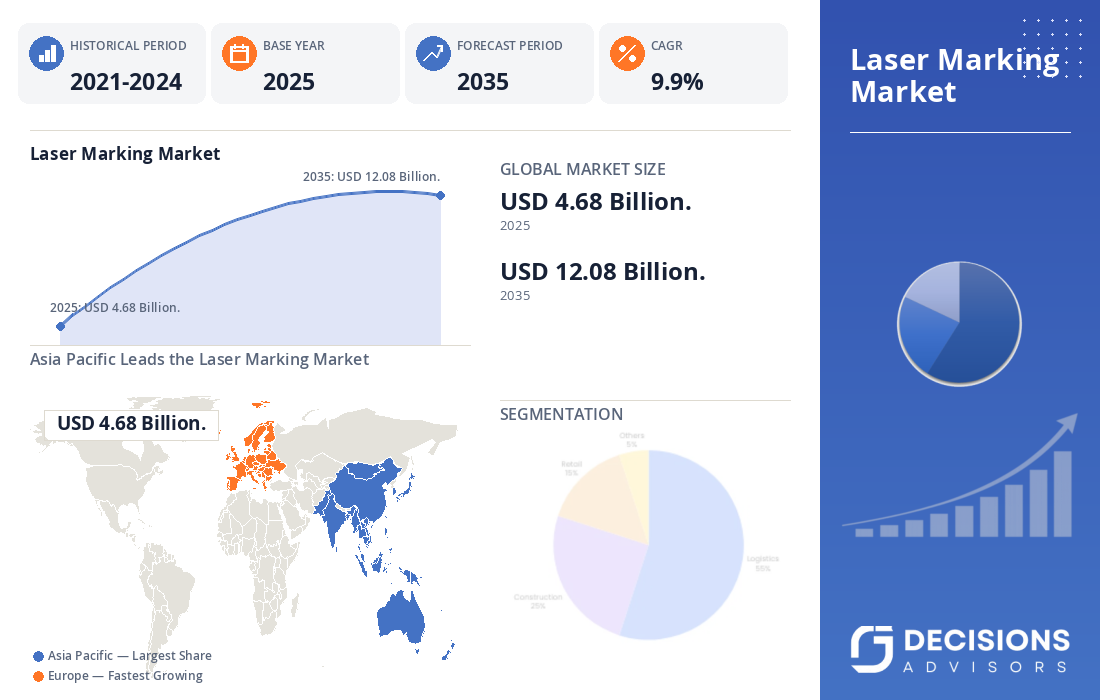
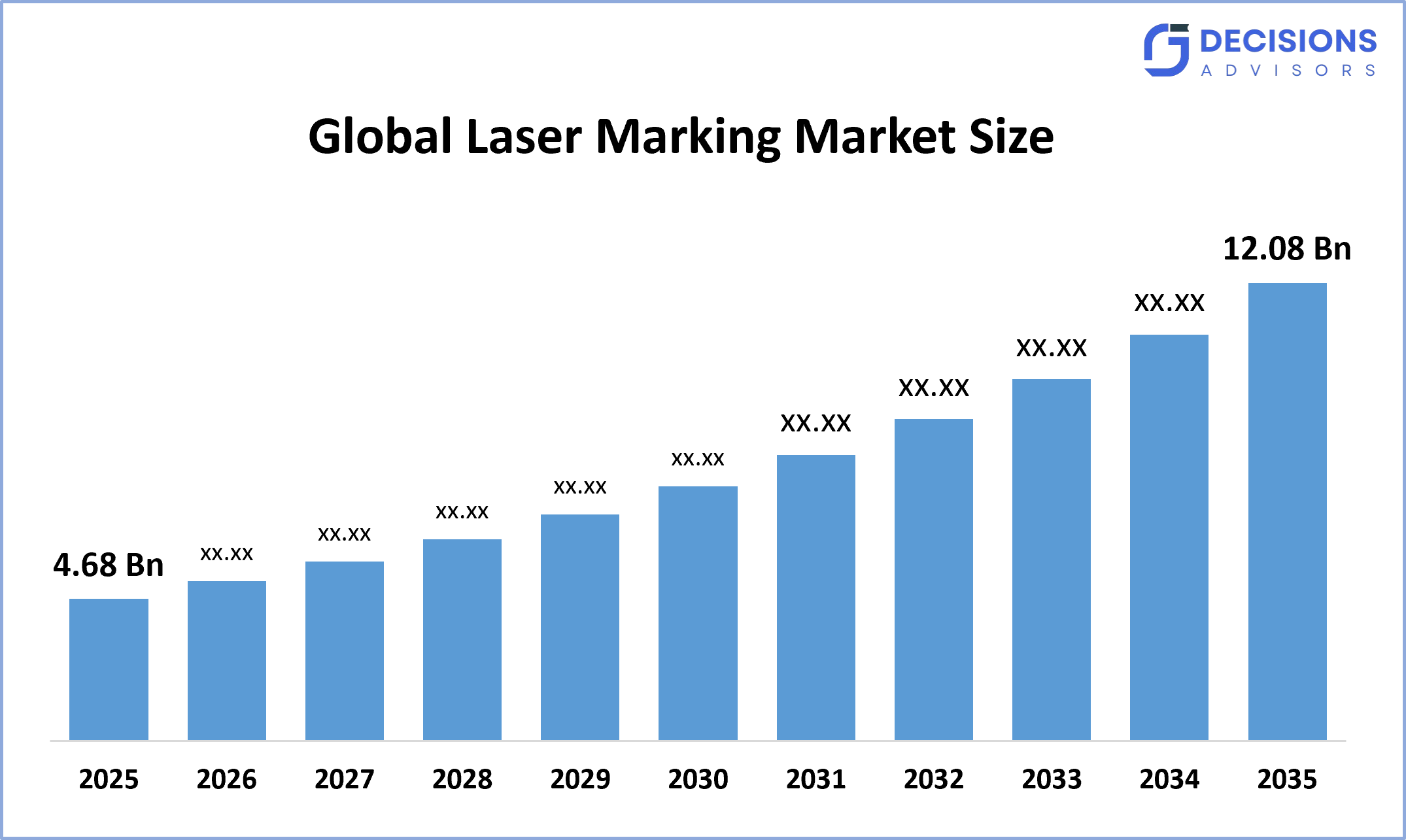
The Global Laser Marking Market Size is predicted to grow from USD 4.68 Billion in 2025 and is likely to reach around USD 12.08 Billion by 2035 with a CAGR of 9.90%. According to Decision Advisors, the increasing requirement for permanent product identification, serialization, traceability, anti-counterfeiting, and automated production is supporting market expansion. Fiber laser systems dominate because of their high efficiency, long operating life, low maintenance requirements, and suitability for high-speed industrial applications. Asia Pacific represents the largest regional market because of its strong electronics, semiconductor, automotive, and industrial manufacturing base. Published industry research independently identifies fiber laser systems as the leading laser-marking technology and reports strong growth driven by automation and mass manufacturing.
Market Snapshot
- Global Laser Marking Market Size (2025): USD 4.68 Billion.
- Projected Global Laser Marking Market Size (2035): USD 12.08 Billion.
- Global Laser Marking Market CAGR: 9.90%.
- Largest Regional Market: Asia Pacific
- 2nd Largest Region: North America
- Fastest Growing Region: Europe
- Base Year: 2025
- Historical Period: 2021-2024
- Market Forecast Period: 2026-2035
Market Overview/ Introduction
The global laser marking market comprises laser-based systems used to permanently mark, engrave, etch, anneal, or ablate products and components. These systems create serial numbers, barcodes, QR codes, DataMatrix codes, logos, regulatory information, and other identification marks without direct mechanical contact. Laser marking is increasingly used in automotive, electronics and semiconductors, aerospace and defense, medical devices, packaging, machinery, and general industrial manufacturing because it provides durable, precise, and machine-readable identification. The transition toward Industry 4.0 is strengthening demand for connected laser-marking equipment. Modern systems can integrate with machine vision, robotics, PLCs, manufacturing execution systems, automatic focusing, barcode readers, and mark-verification software. Fiber lasers are particularly important for high-volume metal marking, while UV and other specialized wavelengths are expanding applications involving sensitive electronics, plastics, and medical components.
- United States, Expansion of semiconductor and advanced manufacturing capacity is supporting demand for precision identification, inspection, serialization, and automated manufacturing technologies.
- Japan, Industrial automation, robotics, precision engineering, and labor-saving manufacturing initiatives support the deployment of automated laser marking systems.
- China, Smart-factory development and large-scale electronics and automotive manufacturing are increasing demand for automated marking, inspection, and traceability technologies.
Notable Insights: -
- Asia Pacific is anticipated to hold approximately 39% share of the Global Laser Marking Market over the predicted timeframe.
- North America is expected to hold approximately 27% share during the forecast period, supported by advanced manufacturing, aerospace, medical-device, and semiconductor industries.
- By Laser Type, the Fiber Laser segment dominated the market and holds approximately 46% share in 2025 and is projected to grow at a substantial CAGR during the forecast period.
- By Application, the Electronics & Semiconductors segment dominated the market and holds approximately 28% share in 2025 and is projected to grow at a substantial CAGR during the forecast period.
- The compound annual growth rate of the Global Laser Marking Market is 9.90%.
- The market is likely to achieve a valuation of USD 12.08 Billion by 2035.
Market Drivers
The growing requirement for permanent identification and traceability is one of the primary drivers of the global laser marking market. Automotive manufacturers increasingly use laser marking for component identification, serial numbers, barcodes, DataMatrix codes, and traceability. Electronics and semiconductor manufacturers require high-resolution marking on increasingly small components and packages, while medical-device manufacturers use permanent markings that can remain readable following cleaning and sterilization. Industrial automation is another major growth factor. Laser markers can be incorporated into automated manufacturing lines and connected with production databases, PLCs, robots, and vision systems. This enables automatic product identification, job selection, positioning, and mark verification while reducing manual errors. The semiconductor industry is creating additional opportunities. In May 2026, IDI Dynamics launched a high-speed laser marker for semiconductor assembly and test, reporting 2.5-times higher chip throughput and a 22% smaller footprint.
Restrain
High initial investment can limit laser-marking adoption among small and medium-sized manufacturers. A complete industrial system can require the laser source, scanning head, optics, enclosure, extraction equipment, machine vision, automation hardware, and specialized software. Material compatibility is another challenge. Metals, plastics, ceramics, glass, coatings, and composites respond differently to laser wavelengths and power levels. Incorrect parameters may cause discoloration, melting, cracking, or inadequate contrast.
Competitive Analysis:
The report offers the appropriate analysis of the key organizations/companies involved within the global laser marking market, along with a comparative evaluation primarily based on their product offerings, business overviews, geographic presence, enterprise strategies, segment market share, and SWOT analysis. The report also provides an elaborative analysis focusing on the current news and developments of the companies, which includes product development, innovations, joint ventures, partnerships, mergers & acquisitions, strategic alliances, and others. This allows for the evaluation of the overall competition within the market.
Top Companies in the Global Laser Marking Market
- TRUMPF
- KEYENCE Corporation
- Coherent Corp.
- Videojet Technologies
- Datalogic S.p.A.
- Gravotech
- Telesis Technologies
- FOBA Laser Marking + Engraving
- Panasonic Industry
- Han's Laser Technology Industry Group.
Government Initiatives
|
Country |
Key Government Initiatives |
|
United States |
Semiconductor and advanced-manufacturing programs are expanding domestic production and encouraging modernization of manufacturing facilities, indirectly supporting precision marking and traceability equipment |
|
Japan |
Government support for labor-saving investment, robotics, automation, and manufacturing digitalization encourages manufacturers to modernize production lines |
|
China |
Smart-factory and intelligent-manufacturing programs are accelerating factory automation and digital production, creating favorable conditions for automated laser marking and inspection systems |
Market Segmentation
The Global Laser Marking Market share is classified into laser type, application, and technology.
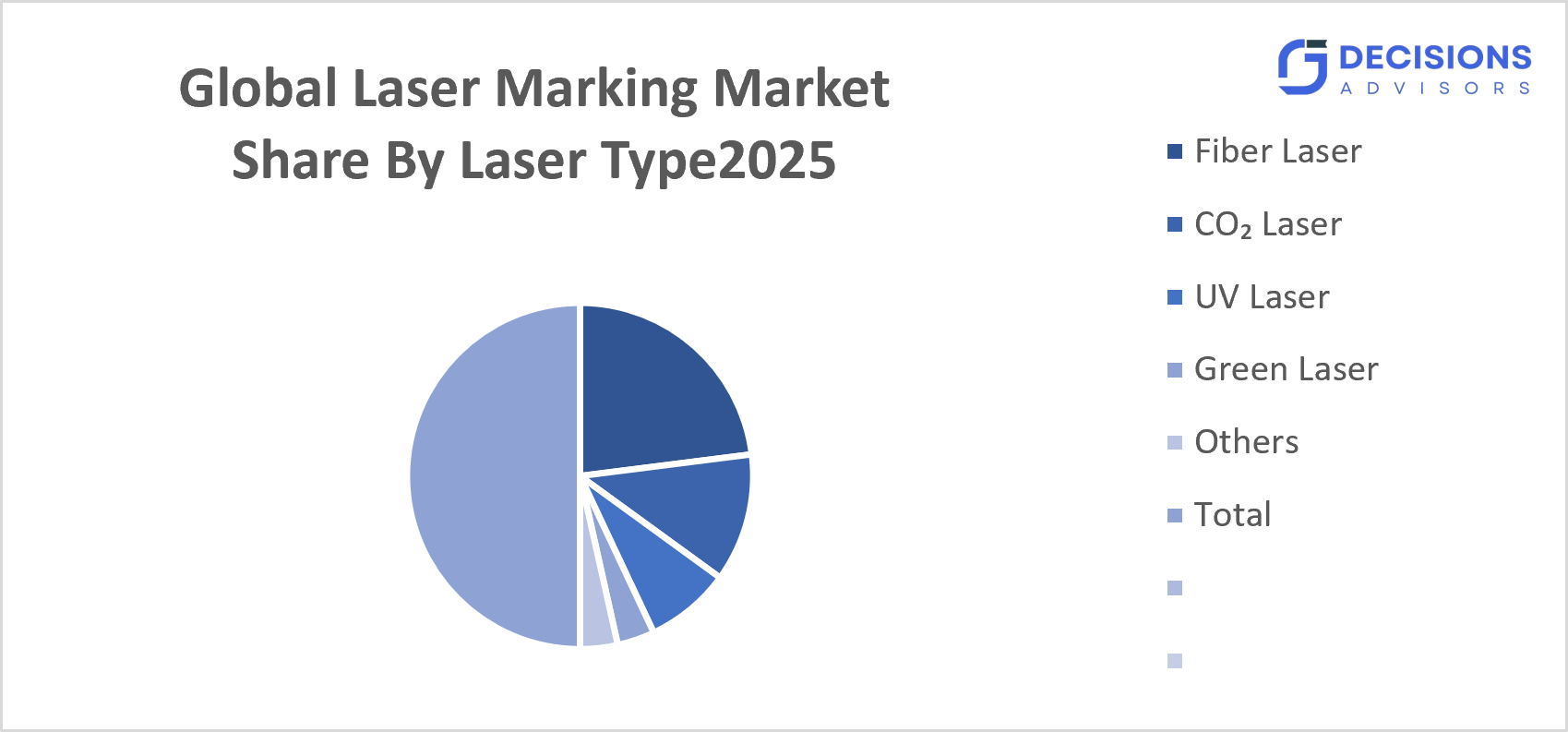
- The Fiber Laser segment dominated the market and holds approximately 46% share in 2025 and is projected to grow at a substantial CAGR during the forecast period.
Based on laser type, the global laser marking market is divided into Fiber Laser, CO? Laser, UV Laser, Green Laser, and Others. Fiber lasers dominate because they offer high efficiency, long service life, compact designs, and low maintenance requirements. They provide strong performance on metals and engineered materials used in automotive, electronics, aerospace, and industrial applications. Their compatibility with automated production lines makes them particularly attractive for high-volume manufacturing. Published market research also identifies fiber lasers as the dominant technology in laser marking.
- The Electronics & Semiconductors segment accounted for the largest share of approximately 28% in 2025 and is anticipated to grow at a significant CAGR during the forecast period.
Based on application, the market is divided into Automotive, Electronics & Semiconductors, Aerospace & Defense, Medical Devices, Packaging, and Industrial. Electronics and semiconductor production requires precise, repeatable, and machine-readable markings on small components and packages. Miniaturization and growing semiconductor production are increasing the requirement for high-resolution marking. The 2026 launch of IDI Dynamics' high-speed semiconductor laser marker illustrates the industry's focus on throughput and compact manufacturing equipment.
- The Annealing segment accounted for the largest share of approximately 31% in 2025 and is anticipated to grow at a significant CAGR during the forecast period.
Based on technology, the market is divided into Annealing, Engraving, Ablation, Etching, and Foaming. Annealing produces permanent, high-contrast marks on suitable metal surfaces while minimizing material removal. The process is useful for stainless steel medical devices, automotive components, tools, industrial equipment, and precision parts. Growing traceability requirements are supporting its adoption across high-value manufacturing.
Regional Segment Analysis of the Global Laser Marking Market
- North America (U.S., Canada, Mexico)?
- Europe (Germany, U.K., France, Italy, Spain, Netherlands, Rest of Europe).
- Asia-Pacific (China, Japan, India, Australia, South Korea, Rest of Asia-Pacific).
- South America (Brazil, Argentina, Rest of South America).
- Middle East & Africa (UAE, Saudi Arabia, South Africa, Rest of MEA).
Asia Pacific is anticipated to hold approximately 39% share of the global laser marking market over the predicted timeframe.
Asia Pacific remains the largest market because of its large electronics, semiconductor, automotive, machinery, and consumer-electronics manufacturing ecosystem. China represents the largest contributor, while Japan and South Korea support demand through advanced semiconductor, automotive, and precision-engineering industries. India is becoming increasingly important as electronics and automotive manufacturing capacity expands. Current industry research estimates Asia Pacific as the largest regional market for laser marking, with China and India showing particularly strong country-level growth potential.
North America is expected to grow at a rapid CAGR in the global laser marking market, holding approximately 27% of the share during the forecast period.
The region benefits from strong aerospace, defense, automotive, medical-device, electronics, and semiconductor industries. The United States has significant demand for high-value automated manufacturing systems requiring permanent identification and traceability. Growth in domestic semiconductor production and advanced manufacturing is expected to create additional opportunities for high-precision marking and inspection systems.
Europe is expected to be one of the fastest-growing regions in the Global Laser Marking Market, holding approximately 24% share.
European demand is supported by automotive manufacturing, aerospace, medical devices, industrial machinery, precision engineering, and packaging. Germany remains a major market because of its strong industrial automation and machine-tool ecosystem. Increasing emphasis on product identification, digital traceability, quality control, and automated manufacturing is expected to support further laser-marking adoption throughout Germany, France, Italy, the UK, and other European markets.
Future Market Trends in Global Laser Marking Market: -
-
- AI-Enabled Machine Vision and Mark Verification
Laser marking systems are increasingly being combined with machine vision to identify components, automatically position marking areas, verify codes, and detect defective marks. AI-based inspection is expected to further improve quality control and reduce manual inspection requirements.
-
- Growth of 3D and Multi-Axis Laser Marking
Three-axis and multi-axis systems are gaining importance for curved, irregular, and three-dimensional components. Datalogic's AREX400 AF, launched in March 2026, uses software-controlled adjustable focus and supports height variations without manual refocusing.
-
- Increasing Adoption of UV and Specialized Laser Sources
UV and other specialized laser sources are expected to gain adoption in applications involving sensitive plastics, electronics, medical devices, and precision components. These technologies provide manufacturers with greater control over thermal impact and marking quality.
-
- Connected Laser Marking and Smart Manufacturing
Future systems will increasingly connect with PLCs, MES platforms, robots, production databases, barcode readers, and quality-control systems. Pryor's Integrator Laser, introduced in 2026, specifically focuses on communication between the laser, PLC, network, and manufacturing execution environment.
Recent Development
- In March 2026, Datalogic launched the AREX400 AF fiber laser marking system with software-controlled adjustable focus, allowing automatic marking across components with different heights.
- In April 2026, Pryor Technology launched the Pryor Portable Laser, a battery-powered Class 1 portable laser marking machine designed to operate without external mains power or compressed air.
- In May 2026, IDI Dynamics launched its next-generation high-speed laser marker for semiconductor assembly and testing, offering 2.5-times higher marking speed and a 22% smaller footprint.
Market Segment
This study forecasts revenue at global, regional, and country levels from 2021 to 2035. Decision Advisors has segmented the Global Laser Marking Market based on the below-mentioned segment:
Global Laser Marking Market, By Laser Type.
- Fiber Laser
- CO? Laser
- UV Laser
- Green Laser
- Others.
Global Laser Marking Market, By Application.
- Automotive
- Electronics & Semiconductors
- Aerospace & Defense
- Medical Devices
- Packaging
- Industrial.
Global Laser Marking Market, By Technology.
- Annealing
- Engraving
- Ablation
- Etching
- Foaming.
Global Laser Marking Market, By Regional Analysis.
- North America
- US
- Canada
- Mexico
- Europe
- Germany
- UK
- France
- Italy
- Spain
- Russia
- Rest of Europe
- Asia Pacific
- China
- Japan
- India
- South Korea
- Australia
- Rest of Asia Pacific
- South America
- Brazil
- Argentina
- Rest of South America
- Middle East & Africa
- UAE
- Saudi Arabia
- Qatar
- South Africa
- Rest of the Middle East & Africa
Frequently Asked Questions (FAQ)
Q. What is driving the Global Laser Marking Market?
A. Increasing requirements for permanent product identification, serialization, traceability, anti-counterfeiting, and automated manufacturing are major growth drivers. Automotive, electronics, semiconductor, medical-device, aerospace, and packaging industries are expanding their use of laser marking.
Q. Why are fiber lasers widely used for industrial marking?
A. Fiber lasers offer high efficiency, long operating life, low maintenance requirements, and strong marking performance on metals. Their compact configuration also makes them suitable for automated production lines.
Q. How is automation changing laser marking?
A. aser markers are increasingly connected with machine vision, robotics, PLCs, MES platforms, and production databases. Automatic focusing, positioning, and verification improve productivity and reduce manual intervention.
Q. Which region dominates the Global Laser Marking Market?
A. Asia Pacific is expected to remain the largest regional market because of its extensive electronics, semiconductor, automotive, and industrial manufacturing base. China, Japan, South Korea, and India are important contributors.
Check Licence
Choose the plan that fits you best: Single User, Multi-User, or Enterprise solutions tailored for your needs.
We Have You Covered
- 24/7 Analyst Support
- Clients Across the Globe
- Tailored Insights
- Technology Tracking
- Competitive Intelligence
- Custom Research
- Syndicated Market Studies
- Market Overview
- Market Segmentation
- Growth Drivers
- Market Opportunities
- Regulatory Insights
- Innovation & Sustainability
Report Details
| Scope | Global |
| Pages | 230 |
| Delivery | PDF & Excel via Email |
| Language | English |
| Release | Aug 2026 |
| Access | Download from this page |