
Global Latent Tuberculosis Infection Detection Market
 |
Author:
Disha B
|
Pages:
230
|
Author:
Disha B
|
Pages:
230
Global Latent Tuberculosis Infection Detection Market Size, Share, and COVID-19 Impact Analysis, By Test Type (Tuberculin Skin Test, and Interferon Gamma Release Assays), By Brand (QFT-Plus (QuantiFERON-TB Gold Plus), and Others), By Application (Household Contacts with Pulmonary TB, PLHIV, and Others), and By Region (North America, Europe, Asia-Pacific, Latin America, Middle East, and Africa), Analysis and Forecast 2025-2035
CAGR
5.68%
REVENUE 2024
USD Billion 1.84
FORECAST 2035
USD Billion 3.38
REPORT COVERAGE
Global
Global Latent Tuberculosis Infection Detection Market Size Insights Forecasts to 2035
- The Global Latent Tuberculosis Infection Detection Market Size Was Estimated at USD 1.84 Billion in 2024
- The Market Size is Expected to Grow at a CAGR of around 5.68 % from 2025 to 2035
- The Worldwide Latent Tuberculosis Infection Detection Market Size is Expected to Reach USD 3.38 Billion by 2035
- Europe is expected to grow the fastest during the forecast period.
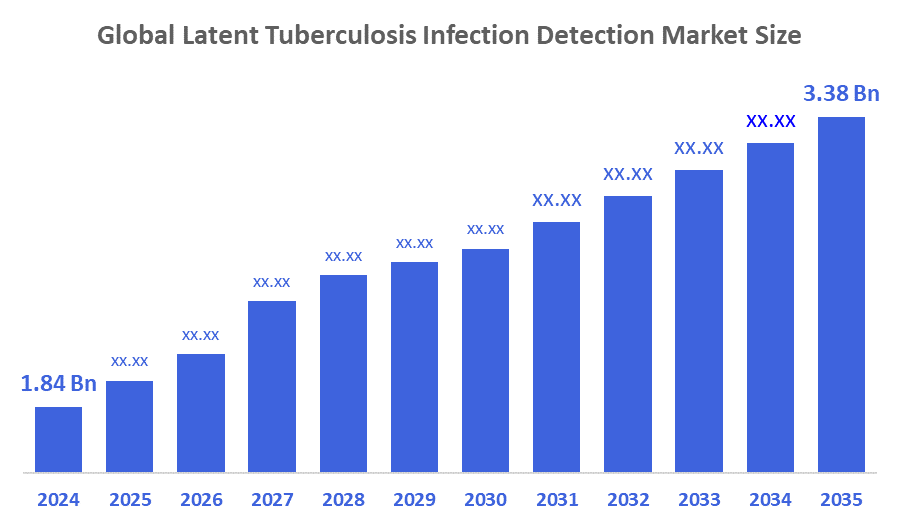
According to a research report published by Decisions Advisors and Consulting, The Global Latent Tuberculosis Infection Detection Market Size Was Worth Around USD 1.84 Billion In 2024 And Is Predicted To Grow To Around USD 3.38 Billion By 2035 With A Compound Annual Growth Rate (CAGR) Of 5.68 % From 2025 To 2035. The market growth can be attributed to the increased risk of developing an active form of tuberculosis and the awareness among the public to test for tuberculosis infection at an early stage. In addition, the synergy between public health institutions and diagnostic companies also plays a crucial role, as the diagnostic products can reach all regions. This growing awareness fosters a proactive approach to managing tuberculosis, emphasising the importance of latent TB testing.
Market Overview
The latent tuberculosis infection (LTBI) detection market refers to the global industry focused on diagnostic tools, technologies, and services used to identify latent TB infectionsn cases where individuals carry Mycobacterium tuberculosis without active disease symptoms but remain at risk of progression. It encompasses test methods, platforms, end-users, and regional demand trends. The market for latent TB testing is influenced by the consistent development of technologies in this area, which helps in increasing the accuracy and efficiency of such methodologies. An association also creates opportunities for working with healthcare service providers, diagnostic organisations, and health agencies, thereby promoting the multi-disciplinary approach to combating TB. Furthermore, the growing awareness about TB, as well as latent TB, among healthcare workers as well as the general public serves as an avenue to promote the disease, thereby increasing its demand. This includes methodologies such as interferon-gamma release assays, which have advanced in such a way that fewer false positives occur, thus reducing the level of re-testing that is necessary. In addition, automation helps in enhancing the efficiency of the value chain.
In August 2021, the Global Fund approved a grant of USD 37 million to FIND (Foundation for Innovative New Diagnostics) to strengthen TB prevention and control efforts in India, with a strong focus on expanding access to diagnostics and latent TB infection detection. This funding is part of India’s broader strategy to accelerate TB elimination by 2025.
Report Coverage
This research report categorises the latent tuberculosis infection detection market based on various segments and regions, forecasts revenue growth, and analyses trends in each submarket. The report analyses the key growth drivers, opportunities, and challenges influencing the latent tuberculosis infection detection market. Recent market developments and competitive strategies, such as expansion, product launch, development, partnership, merger, and acquisition, have been included to draw the competitive landscape in the market. The report strategically identifies and profiles the key market players and analyses their core competencies in each sub-segment of the latent tuberculosis infection detection market.
Driving Factors
The various driving forces for the market include the growing awareness about the screening tests for tuberculosis, government initiatives to detect the disease in the early stages, and the growing use of screening tests among high-risk patients. Further, the developments in the screening tests, such as the tuberculin skin tests and the growing awareness about preventive healthcare, are driving the tuberculin screening market forward. Moreover, they are high requires adequate measures and strategies of screening and diagnosing TB, which boost the industry expansion. There is a rise in the rate of LTBI tests in high TB load regions as a preventive method of controlling the prevalence and transmission rates of TB. Besides, the governments and non-governmental bodies in these regions are advocating for thorough screening of TB suspects, hence contributing significantly to the expansion of this market. The rising rates of migration are also contributing to the expansion of the LTBI testing market as various governments implement various measures to screen migrants and control TB transmission across borders.
Restraining Factors
However, the market for the LTBI testing process also poses some threats and challenges. One of the basic challenges in the market is the lack of access to state-of-the-art facilities for the testing process. Despite the development of specialised technologies in the form of IGRA, there are still some environments where TST, which is less reliable, is being used. The other challenges associated with the test are the possibility of false-negative results and differences in test results in different environments.
Market Segmentation
The latent tuberculosis infection detection market share is classified into test type, brand, and application.
- The tuberculin skin test segment accounted for the highest share in 2024 and is projected to grow at a notable CAGR over the forecast period.
Based on the test type, the latent tuberculosis infection detection market is divided into the tuberculin skin test and interferon gamma release assays. Among these, the tuberculin skin test segment accounted for the highest share in 2024 and is projected to grow at a notable CAGR over the forecast period. This dominance of the segment can be attributed to the popularity attached to this test. The test is an effective test for the screening of LTBI and is done by injecting tuberculin purified protein derivative into the inner layer of the skin. High market penetration rate of test, high rate of awareness of tuberculosis infection within the country, and cost-effectiveness of test are factors that may spur growth within the market segment in the future.
- The QFT-Plus (QuantiFERON-TB Gold Plus) segment accounted for the highest market share in 2024 and is projected to grow at a substantial CAGR over the forecast period.
Based on the brand, the latent tuberculosis infection detection market is segmented into QFT-Plus (QuantiFERON-TB Gold Plus) and others. Among these, the QFT-Plus (QuantiFERON-TB Gold Plus) segment accounted for the highest market share in 2024 and is projected to grow at a substantial CAGR over the forecast period. The sector that will see the most rapid growth will be the QFT-Plus, or QuantiFERON-TB Gold Plus. It is the current generation of Interferon-gamma, or IGRAs, developed and approved by the FDA, succeeding the older QuantiFERON-TB Gold In-Tube, referred to as the QFT-GIT. QFT-Plus has several inherent advantages, such as higher sensitivity (>95%) and the highest level of specificity for any test for infection.
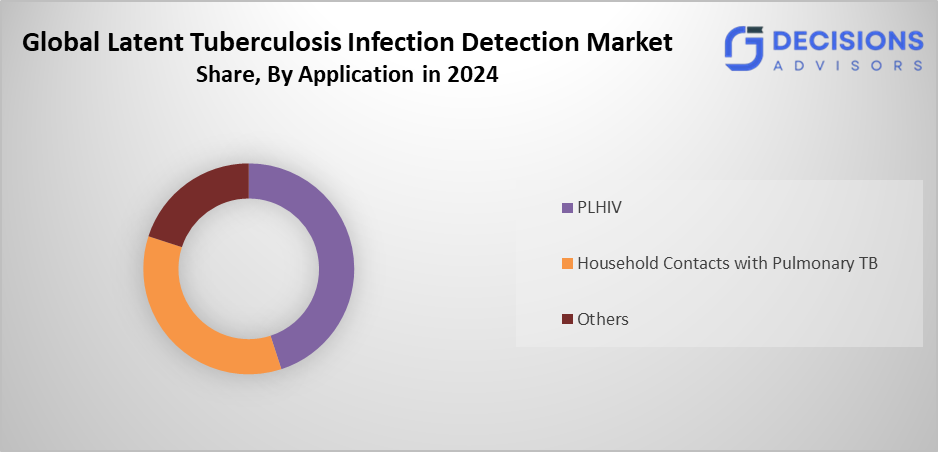
- The PLHIV segment accounted for the highest market revenue in 2024 and is anticipated to grow at a significant CAGR during the forecast period.
Based on the application, the latent tuberculosis infection detection market is differentiated into household contacts with pulmonary tb, PLHIV, and others. Among these, the PLHIV segment accounted for the highest market revenue in 2024 and is anticipated to grow at a significant CAGR during the forecast period. This is due to the huge risk of co-infection of TB among immunocompromised people. As such, the regular LTBI examinations and treatment have emerged as a worldwide priority in the management of HIV infections. Governments and other bodies, such as UNAIDS and the Global Fund, have made it an issue of priority to ensure early detection of TB infections among PLHIV.
Regional Segment Analysis of the Latent Tuberculosis Infection Detection Market
- North America (U.S., Canada, Mexico)
- Europe (Germany, France, U.K., Italy, Spain, Rest of Europe)
- Asia-Pacific (China, Japan, India, Rest of APAC)
- South America (Brazil and the Rest of South America)
- The Middle East and Africa (UAE, South Africa, Rest of MEA)
Asia Pacific is anticipated to hold the largest share of the latent tuberculosis infection detection market over the predicted timeframe.
Asia Pacific is anticipated to hold the largest share of the latent tuberculosis infection detection market over the predicted timeframe. The Asia Pacific region has the largest market share of the global LTBI testing market, and the reasons for this can be attributed to the high prevalence of tuberculosis and the high population density of the region. Geographically, the regional markets of India, China, and Indonesia are key contributors to TB control activities, and these countries implement large-scale screening programs to effectively control the spread of the disease. These are also the reasons behind the robust presence of regional players, thus boosting the market.
India’s TB elimination drive received a major boost with the launch of new Made-in-India diagnostic tests that significantly cut both cost and turnaround time, making latent and active TB detection more accessible across the country. These innovations are expected to strengthen screening programs and accelerate India’s target of eliminating TB by 2025.
Europe is expected to grow at a rapid CAGR in the latent tuberculosis infection detection market during the forecast period. Europe is the next contributor to the market, with countries like the UK, Germany, and France taking the lead in TB prevention and control. The market for LTBI testing in Europe is driven by strong government support and cooperation with various international entities to fight the TB disease. The efforts made to tackle the disease among populations like migrants are contributing to the growing need for LTBI testing. The market for LTBI testing is expected to grow steadily in the European market due to technological advancement and healthcare expenditure.
The UK’s Medicines and Healthcare products Regulatory Agency (MHRA) has approved SIILTIBCY®, a next-generation tuberculosis (TB) skin test developed by Serum Institute of India’s UK subsidiary, Serum Life Sciences Ltd. This test offers higher specificity than the traditional tuberculin skin test and can be used in both adults and children, regardless of BCG vaccination status.
Competitive Analysis:
The report offers the appropriate analysis of the key organisations/companies involved within the latent tuberculosis infection detection market, along with a comparative evaluation primarily based on their product offering, business overviews, geographic presence, enterprise strategies, segment market share, and SWOT analysis. The report also provides an elaborative analysis focusing on the current news and developments of the companies, which includes product development, innovations, joint ventures, partnerships, mergers & acquisitions, strategic alliances, and others. This allows for the evaluation of the overall competition within the market.
List of Key Companies
- Abbott Laboratories
- Aid Autoimmun Diagnostika GmbH
- Arkray, Inc.
- Beijing Wantai Biopharmaceutical Co., Ltd.
- Biomérieux
- Boditech Med Inc.
- Endo, Inc.
- Lionex Gmbh
- Oxford Immunotec (Perkinelmer)
- Qiagen
- Revvity
- Sanofi
- Sd Biosensor, Inc.
- Serum Institute Of India Pvt. Ltd.
- Others
Key Target Audience
- Market Players
- Investors
- End-users
- Government Authorities
- Consulting and Research Firm
- Venture capitalists
- Value-Added Resellers (VARs)
Recent Development
- In July 2025, Kerala rolled out the Cy-TB test, a new-generation intradermal skin test specifically designed to detect latent tuberculosis infection (LTBI). This initiative, under India’s National TB Elimination Programme (NTEP), aims to strengthen early detection and preventive treatment, helping Kerala move closer to the national goal of TB elimination by 2025.
- In October 2023, Serum Institute of India (SII) and Mylab Discovery Solutions jointly launched a new point-of-care skin test kit for detecting latent tuberculosis infections (LTBI), priced 50–70% lower than comparable global tests. This innovation is expected to make LTBI screening more affordable and accessible across India, supporting the country’s TB elimination target by 2025.
Market Segment
This study forecasts revenue at global, regional, and country levels from 2020 to 2035. Decisions Advisors has segmented the latent tuberculosis infection detection market based on the below-mentioned segments:
Global Latent Tuberculosis Infection Detection Market, By Test Type
- Tuberculin Skin Test
- Interferon Gamma Release Assays
Global Latent Tuberculosis Infection Detection Market, By Brand
- QFT-Plus (QuantiFERON-TB Gold Plus)
- Others
Global Latent Tuberculosis Infection Detection Market, By Application
- Household Contacts with Pulmonary TB
- PLHIV
- Others
Global Latent Tuberculosis Infection Detection Market, By Regional Analysis
- North America
- US
- Canada
- Mexico
- Europe
- Germany
- UK
- France
- Italy
- Spain
- Russia
- Rest of Europe
- Asia Pacific
- China
- Japan
- India
- South Korea
- Australia
- Rest of Asia Pacific
- South America
- Brazil
- Argentina
- Rest of South America
- Middle East & Africa
- UAE
- Saudi Arabia
- Qatar
- South Africa
- Rest of the Middle East & Africa
Frequently Asked Questions (FAQ)
- What is the current size and growth forecast for the global latent TB infection detection market?
The market was valued at USD 1.84 billion in 2024 and is expected to reach USD 3.38 billion by 2035, growing at a CAGR of 5.68% from 2025 to 2035.
- What are the main test types in the latent TB detection market?
The two primary types are Tuberculin Skin Test (TST), which held the largest share in 2024, and Interferon Gamma Release Assays (IGRA).
- Which brand leads the market, and why?
QFT-Plus (QuantiFERON-TB Gold Plus) held the highest share in 2024 due to its high sensitivity (>95%), specificity, and FDA approval as an advanced IGRA.
- What applications drive the most demand?
PLHIV (People Living with HIV) generated the highest revenue in 2024, followed by household contacts with pulmonary TB and others, due to high co-infection risks.
- Which region dominates the market?
Asia-Pacific holds the largest share, driven by high TB prevalence in countries like India, China, and Indonesia, with large-scale screening programs.
- What are the key growth drivers?
Rising TB awareness, government initiatives for early screening, high-risk patient testing, migration controls, and advancements in cost-effective diagnostics.
- Who are the major companies in this market?
Key players include Qiagen, Oxford Immunotec (PerkinElmer), Serum Institute of India, Abbott Laboratories, bioMérieux, and Sanofi, with recent innovations like India's Cy-TB and SIILTIBCY® tests.
Check Licence
Choose the plan that fits you best: Single User, Multi-User, or Enterprise solutions tailored for your needs.
We Have You Covered
- 24/7 Analyst Support
- Clients Across the Globe
- Tailored Insights
- Technology Tracking
- Competitive Intelligence
- Custom Research
- Syndicated Market Studies
- Market Overview
- Market Segmentation
- Growth Drivers
- Market Opportunities
- Regulatory Insights
- Innovation & Sustainability
Report Details
| Scope | Global |
| Pages | 230 |
| Delivery | PDF & Excel via Email |
| Language | English |
| Release | Feb 2026 |
| Access | Download from this page |