
Global LDS Antenna Market
 |
Author:
Shruti G
|
Pages:
190
|
Author:
Shruti G
|
Pages:
190
Global LDS Antenna Market Size, Share By Antenna Type (Main Antennas, Bluetooth/Wi-Fi Antennas, GPS/GNSS Antennas, NFC Antennas, and Others), By Application (Smartphones & Tablets, Wearables, Automotive, Healthcare, Networking & IoT, and Others), By Technology (Monopole, Inverted-F, Dipole, 3D-Shaped, and Others), and By Region (North America, Europe, Asia-Pacific, Latin America, Middle East & Africa), Analysis and Forecast 2026-2035.
CAGR
9.3%
REVENUE 2025
USD Billion 2.4
FORECAST 2035
USD Billion 5.84
REPORT COVERAGE
Global
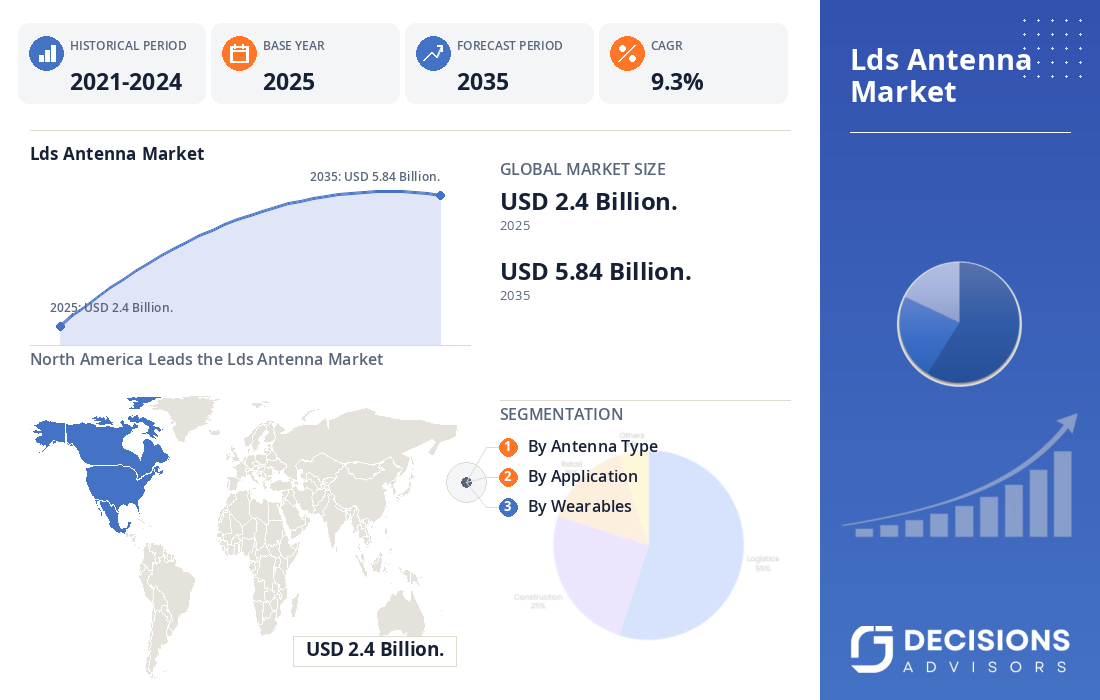
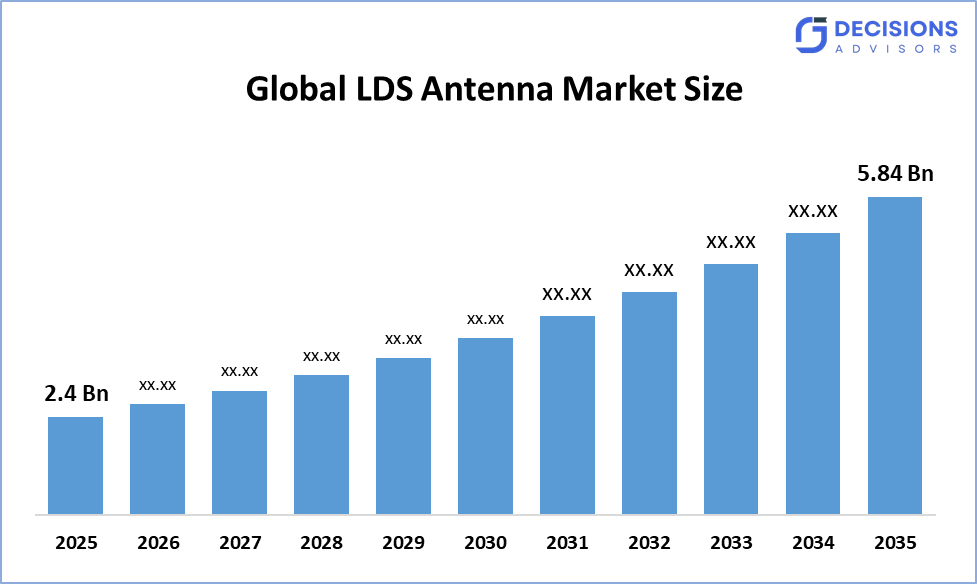
The Global LDS Antenna Market Size is predicted to grow from USD 2.4 Billion in 2025 and is likely to reach around USD 5.84 Billion by 2035 with a CAGR of 9.3%. According to Decision Advisors, the market reflects strong demand for compact, integrated, and three-dimensional antenna structures, particularly across smartphones, connected vehicles, IoT equipment, and wearable electronics. TE Connectivity remains one of the prominent participants in the LDS antenna ecosystem through its antenna, molded interconnect device, and connectivity capabilities. LDS technology enables antenna traces to be formed directly on three-dimensional plastic surfaces, reducing space requirements and supporting complex antenna geometries.
Market Snapshot
- Global LDS Antenna Market Size (2025): USD 2.4 Billion.
- Projected Global LDS Antenna Market Size (2035): USD 5.84 Billion.
- Global LDS Antenna Market Compound Annual Growth Rate (CAGR): 9.3%.
- Largest Regional Market: North America
- 2nd Largest Region: Asia Pacific
- Fastest Growing Region: Asia Pacific
- Base Year: 2025
- Historical Period: 2021-2024
- Market Forecast Period: 2026-2035
Market Overview/ Introduction
The Global LDS Antenna Market refers to antennas manufactured using Laser Direct Structuring (LDS) technology, in which laser processing creates conductive patterns on specially formulated three-dimensional plastic components. The technology allows antenna structures to become part of a device housing or molded component rather than remaining as separate flat parts. This provides greater freedom for three-dimensional antenna design while reducing component count and saving valuable internal space. TE Connectivity describes LDS as a technology capable of integrating electrical and mechanical functionality into a single component and supporting 3D routing compared with conventional 2D PCB structures. Market growth is being supported by increasing device miniaturization, 5G and emerging 6G connectivity requirements, connected vehicles, wearables, healthcare devices, and IoT deployments. Modern electronics increasingly require multiple wireless protocols, including cellular, Bluetooth, Wi-Fi, GNSS and NFC, within limited physical space.
- United States, Investment in advanced wireless infrastructure, connected vehicles, IoT and domestic semiconductor manufacturing supports demand for compact RF and antenna technologies.
- Japan, Advanced automotive electronics, robotics, consumer electronics and precision manufacturing provide a strong environment for 3D antenna integration.
- China and South Korea, Large-scale smartphone, wearable and electronics manufacturing ecosystems support high-volume adoption of miniaturized antenna technologies.
Notable Insights: -
- North America is anticipated to hold approximately 31% share of the Global LDS Antenna Market over the predicted timeframe.
- Asia-Pacific is expected to grow at the fastest CAGR, reaching approximately 34% share during the forecast period.
- By Antenna Type, the Main Antennas segment dominated the market and holds approximately 35% share in 2025 and is projected to grow at a substantial CAGR during the forecast period.
- By Application, the Consumer Electronics segment dominated the market and holds approximately 39% share in 2025 and is projected to grow at a substantial CAGR during the forecast period.
- The compound annual growth rate of the Global LDS Antenna Market is 9.3%.
- The market is likely to achieve a valuation of approximately USD 5.84 Billion by 2035.
Market Drivers
The Global LDS Antenna Market is driven primarily by the continuing miniaturization of wireless electronic products and the requirement for multiple communication standards within smaller device footprints. Smartphones, tablets, smartwatches, hearables, connected medical devices and IoT equipment increasingly require cellular, Wi-Fi, Bluetooth, GNSS and NFC connectivity. Automotive manufacturers are also incorporating more wireless functions into vehicles, including telematics, connectivity, navigation, V2X and infotainment systems. LDS technology provides designers with three-dimensional routing freedom and can integrate multiple antenna functions into molded plastic components. TE Connectivity has demonstrated LDS designs integrating cellular, GNSS and Bluetooth antennas within compact IoT equipment. The expansion of connected vehicles, 5G infrastructure, smart-home equipment, industrial IoT and wearable healthcare devices is expected to further support demand. Increasing requirements for lighter products, fewer components, improved RF performance and efficient use of internal space are encouraging manufacturers to consider LDS instead of conventional FPC, PCB or discrete antenna structures.
Restrain
The Global LDS Antenna Market faces limitations associated with the relatively high investment required for specialized laser equipment, tooling, materials and metallization processes. LDS manufacturing also requires compatible plastic substrates and tightly controlled processing conditions. Environmental and material constraints can increase manufacturing complexity, while RF performance may still depend on factors such as the ground plane, surrounding components and device geometry. In addition, conventional FPC and PCB antenna technologies remain competitive where low tooling investment, design flexibility or shorter production lead times are more important.
Competitive Analysis:
The report offers the appropriate analysis of the key organizations/companies involved within the Global LDS Antenna Market, along with a comparative evaluation primarily based on their product offerings, business overviews, geographic presence, enterprise strategies, segment market share, and SWOT analysis. The report also provides an elaborative analysis focusing on the current news and developments of the companies, which includes product development, innovations, joint ventures, partnerships, mergers & acquisitions, strategic alliances, and others. This allows for the evaluation of the overall competition within the market.
Top Companies in the Global LDS Antenna Market
- TE Connectivity Ltd.
- Molex LLC
- Amphenol Corporation
- Taoglas Limited
- Pulse Electronics Corporation
- Tongda Group Holdings Limited
- Laird Connectivity
- Würth Elektronik
- Shenzhen Sunway Communication Co., Ltd.
- Murata Manufacturing Co., Ltd.
Government Initiatives
|
Country |
Key Government Initiatives |
|
United States |
Semiconductor and advanced-manufacturing policies, together with investment in 5G, connected vehicles, IoT and advanced electronics, support domestic development of RF and wireless component technologies |
|
Japan |
Government-backed digital transformation, smart mobility, robotics and advanced manufacturing programs support deployment of compact wireless technologies across automotive, industrial and consumer electronics |
|
China |
Smart manufacturing, 5G infrastructure, IoT deployment and domestic electronics manufacturing policies support high-volume production and adoption of miniaturized wireless components |
Market Segmentation
The Global LDS Antenna Market share is classified into antenna type, application and technology.
- The Main Antennas segment dominated the market and holds approximately 35% share in 2025 and is projected to grow at a substantial CAGR during the forecast period.
Based on Antenna Type, the Global LDS Antenna Market is divided into Main Antennas, Bluetooth/Wi-Fi Antennas, GPS/GNSS Antennas, NFC Antennas, and Others. Among these, Main Antennas dominate the market and hold approximately 35% share in 2025. Main antennas support core cellular and wireless connectivity requirements in smartphones, connected devices and automotive equipment. Increasing demand for compact multi-band communication solutions supports their adoption. Their integration into three-dimensional housings also allows manufacturers to use otherwise unavailable internal space.
- The Consumer Electronics segment accounted for the largest share of approximately 39% in 2025 and is anticipated to grow at a significant CAGR during the forecast period.
Based on Application, the market is divided into Smartphones & Tablets, Wearables, Automotive, Healthcare, Networking & IoT, and Others. Among these, Consumer Electronics applications accounted for the largest share and hold approximately 39% share in 2025. Smartphones, tablets, smartwatches, hearables and other compact wireless products require highly integrated antennas because internal space is increasingly limited. LDS technology enables antenna patterns to follow complex 3D product geometries. Growing adoption of multi-standard wireless connectivity further strengthens this application.
- The 3D-Shaped Antenna segment accounted for the largest share of approximately 41% in 2025 and is anticipated to grow at a significant CAGR during the forecast period.
Based on Technology, the market is divided into Monopole Antennas, Inverted-F Antennas, Dipole Antennas, 3D-Shaped Antennas, and Others. Among these, 3D-Shaped Antennas dominate the market and hold approximately 41% share in 2025. LDS is particularly suited to three-dimensional antenna structures because conductive traces can follow the surface of molded plastic components. This provides greater design freedom compared with traditional planar antenna approaches. The technology is therefore attractive for highly miniaturized wearables, automotive modules, medical equipment and IoT devices.
Regional Segment Analysis of the Global LDS Antenna Market
- North America (U.S., Canada, Mexico)?
- Europe (Germany, U.K., France, Italy, Spain, Netherlands, Rest of Europe).
- Asia-Pacific (China, Japan, India, Australia, South Korea, Rest of Asia-Pacific).
- South America (Brazil, Argentina, Rest of South America).
- Middle East & Africa (UAE, Saudi Arabia, South Africa, Rest of MEA).
North America is anticipated to hold approximately 31% share of the Global LDS Antenna Market over the predicted timeframe.
North America is anticipated to hold approximately 31% share of the Global LDS Antenna Market over the predicted timeframe. The region benefits from advanced wireless communications infrastructure, strong automotive technology development, large IoT deployments and established RF component suppliers. The United States remains a major center for connected-device innovation, healthcare technology and automotive connectivity. Demand for compact antennas is also supported by wearables, networking equipment and increasingly connected transportation systems.
Asia-Pacific is expected to grow at the fastest CAGR, holding approximately 34% share during the forecast period.
Asia-Pacific is expected to grow at the fastest CAGR, holding approximately 34% share during the forecast period. China, Japan, South Korea and India provide extensive electronics manufacturing ecosystems, while smartphone, wearable, automotive and IoT production creates significant demand for compact antennas. The region's rapid 5G adoption and strong consumer-electronics manufacturing base further support LDS adoption. Current market research identifies Asia-Pacific as the fastest-growing LDS antenna region.
Europe is expected to maintain approximately 22% share of the Global LDS Antenna Market during the forecast period.
Europe is expected to maintain approximately 22% share of the Global LDS Antenna Market during the forecast period. Automotive electronics represent an important demand center, particularly as vehicles incorporate more connected functions, telematics, navigation and wireless communication systems. Germany, France and the U.K. are important markets because of their automotive, industrial and electronics capabilities.
Future Market Trends in Global LDS Antenna Market: -
-
- Integration of Multi-Band Antennas
LDS antenna designs are increasingly being used to integrate multiple wireless standards into compact components. Cellular, Wi-Fi, Bluetooth, GNSS and NFC functions can be accommodated within constrained product geometries, reducing component count and improving space utilization.
-
- Expansion of Automotive LDS Antennas
Connected vehicles and electric vehicles are expected to increase demand for compact antennas supporting telematics, navigation, connectivity and other wireless functions. LDS technology is particularly useful where vehicle modules have restricted installation space and complex three-dimensional housing requirements.
-
- Growth of Wearable and Medical Devices
Wearables, hearables and medical monitoring devices require small, lightweight antennas without sacrificing wireless performance. LDS provides designers with the ability to place conductive structures directly onto device housings, making it suitable for increasingly compact products.
-
- Development of 5G/6G and High-Frequency Antennas
The transition toward higher-frequency wireless systems is increasing the importance of precise antenna geometries, efficient space utilization and advanced materials. LDS manufacturing can create fine conductive patterns and complex 3D structures suitable for next-generation RF applications.
Recent Development
- In July 2022, TE Connectivity completed its acquisition of Linx Technologies, strengthening its portfolio of RF components and antenna solutions for IoT applications. The transaction expanded TE's capabilities across wireless connectivity, including antenna and RF connector technologies.
- In May 2023, TE Connectivity launched the new Linx ANT-5GW-FPC cellular FPC antenna series, supporting 5G New Radio, LTE, and cellular IoT applications and providing compact antenna options for wireless IoT devices.
- In August 2024, Taoglas marked its 20th anniversary and highlighted its expanded antenna and IoT component portfolio, reflecting its continued development of advanced connectivity solutions for global IoT applications.
Market Segment
This study forecasts revenue at global, regional, and country levels from 2021 to 2035. Decision Advisors has segmented the Global LDS Antenna Market based on the below-mentioned segment:
Global LDS Antenna Market, By Antenna Type.
- Main Antennas
- Bluetooth/Wi-Fi Antennas
- GPS/GNSS Antennas
- NFC Antennas
- Others.
Global LDS Antenna Market, By Application.
- Smartphones & Tablets
- Wearables
- Automotive
- Healthcare
- Networking & IoT
- Others.
Global LDS Antenna Market, By Technology.
- Monopole Antennas
- Inverted-F Antennas
- Dipole Antennas
- 3D-Shaped Antennas
- Others.
Global LDS Antenna Market, By Regional Analysis.
- North America
- US
- Canada
- Mexico
- Europe
- Germany
- UK
- France
- Italy
- Spain
- Russia
- Rest of Europe
- Asia Pacific
- China
- Japan
- India
- South Korea
- Australia
- Rest of Asia Pacific
- South America
- Brazil
- Argentina
- Rest of South America
- Middle East & Africa
- UAE
- Saudi Arabia
- Qatar
- South Africa
- Rest of the Middle East & Africa
Frequently Asked Questions (FAQ)
Q. What is an LDS antenna and how is it different from conventional antennas?
A. An LDS antenna is manufactured by using laser direct structuring to create conductive antenna traces directly on a three-dimensional plastic component. This allows greater 3D design freedom and can reduce space and component requirements compared with conventional planar antenna structures.
Q. Which industries are driving demand for LDS antennas?
A. Consumer electronics, automotive, healthcare, networking and IoT are the major application areas. Smartphones, wearables, connected vehicles and compact IoT products particularly benefit from the space-saving and integration capabilities of LDS technology.
Q. Why is Asia-Pacific expected to be the fastest-growing LDS antenna region?
A. Asia-Pacific combines large-scale smartphone and electronics manufacturing with rapidly expanding 5G, IoT and automotive connectivity. China, Japan, South Korea and India therefore provide a strong production and consumption base for compact wireless components.
Q. What is the major challenge facing the LDS antenna market?
A. High equipment and processing requirements, specialized materials, metallization complexity and competition from FPC and PCB antennas remain important challenges. The suitability of LDS also depends on product geometry, substrate materials and RF design requirements.
Check Licence
Choose the plan that fits you best: Single User, Multi-User, or Enterprise solutions tailored for your needs.
We Have You Covered
- 24/7 Analyst Support
- Clients Across the Globe
- Tailored Insights
- Technology Tracking
- Competitive Intelligence
- Custom Research
- Syndicated Market Studies
- Market Overview
- Market Segmentation
- Growth Drivers
- Market Opportunities
- Regulatory Insights
- Innovation & Sustainability
Report Details
| Scope | Global |
| Pages | 190 |
| Delivery | PDF & Excel via Email |
| Language | English |
| Release | Aug 2026 |
| Access | Download from this page |