
Global Leadless Pacemakers Market
 |
Author:
David J
|
Pages:
225
|
Author:
David J
|
Pages:
225
Global Leadless Pacemakers Market Size, Share, and COVID-19 Impact Analysis, By Chambers (Single Chamber and Dual Chamber), By Brands (Micra VR And VR2, Micra AV And AV2, Abbott Aveir DR, and Abbott Aveir VR) and By Region (North America, Europe, Asia-Pacific, Latin America, Middle East, and Africa), Analysis and Forecast 2025 - 2035
CAGR
7.27%
REVENUE 2024
USD Billion 916.42
FORECAST 2035
USD Billion 1982.87
REPORT COVERAGE
Global
Global Leadless Pacemakers Market Size Insights Forecasts to 2035
- The Global Leadless Pacemakers Market Size Was valued at USD 916.42 Million in 2024
- The Global Leadless Pacemakers Market Size is Expected to Grow at a CAGR of around 7.27% from 2025 to 2035
- The Worldwide Leadless Pacemakers Market Size is Expected to Reach USD 1982.87 Million by 2035
- Asia-Pacific is expected to grow the fastest during the forecast period.
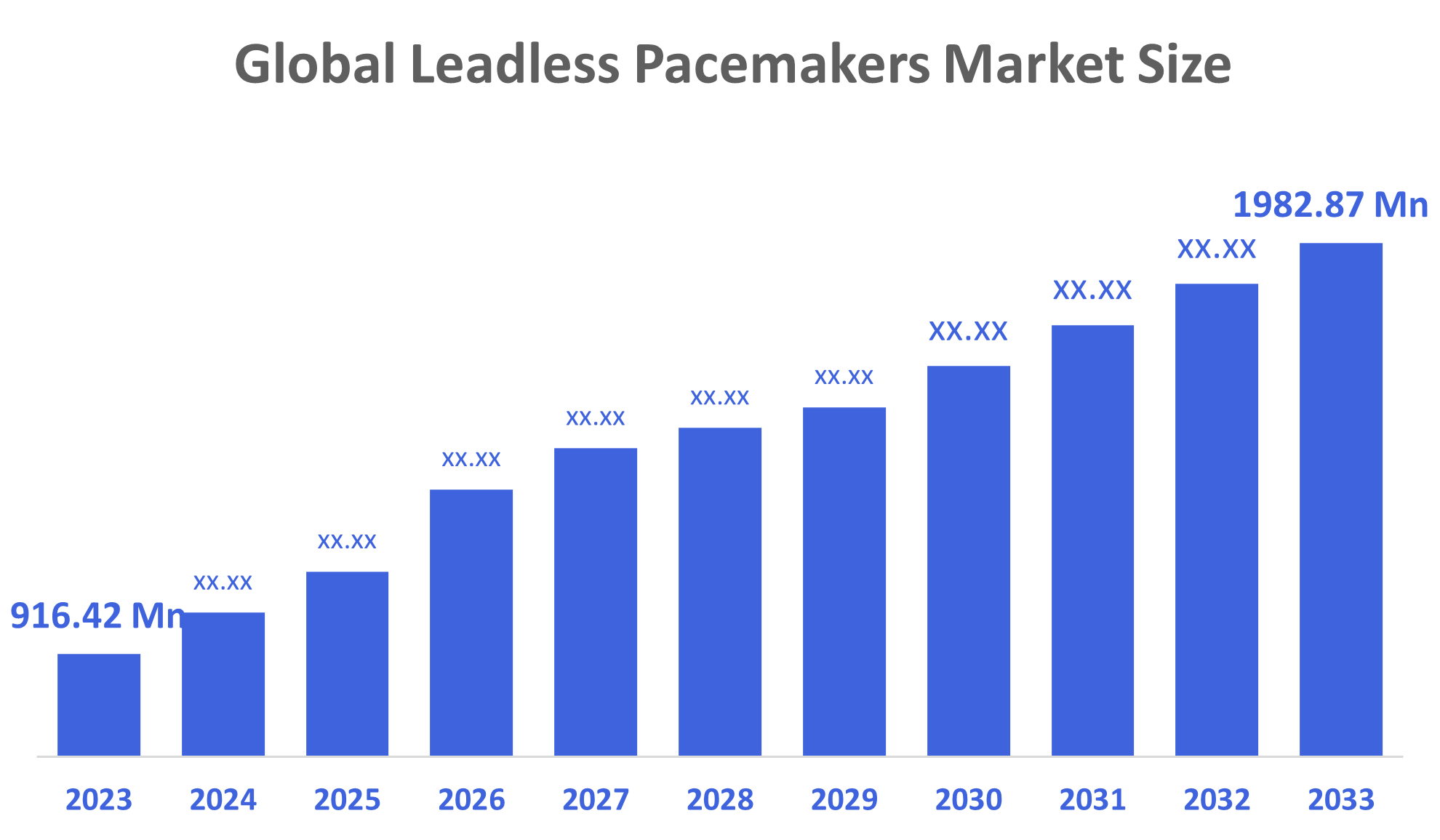
According to a research report published by Decisions Advisors and Consulting, The Global Leadless Pacemakers Market Size was worth around USD 916.42 Million in 2024 and is Predicted to Grow to around USD 1982.87 Million by 2035 with a Compound Annual Growth Rate (CAGR) of 7.27% from 2025 to 2035. The leadless pacemakers market experiences growth because of two main factors which include the rising incidence of heart diseases and the increasing number of elderly people. The adoption of leadless pacemakers receives support from government funding and private insurance policies.
Market Overview
The Global Leadless Pacemakers Market Size refers to the worldwide industry focused on the development, manufacturing, and distribution of miniaturized, self-contained pacemakers which medical professionals implant directly into the heart without using traditional leads or surgical pockets. Additionally, the leadless pacemakers market holds significant potential for growth because it can develop new products while extending its reach into new markets. Manufacturers are developing advanced medical devices which will serve a wider patient base that includes individuals with complex heart diseases. The market will benefit from ongoing research and development efforts which aim to improve battery life and create smaller devices. The extended operational time of leadless pacemakers will result in fewer necessary surgeries which will make these devices more appealing to users. The regions of Asia-Pacific and Latin America and the Middle East serve as emerging markets which have not yet been developed for business growth. Cardiovascular disease rates in these areas are increasing because people now follow unhealthy lifestyles while more cities are developed and their population ages. The current market for leadless pacemakers in these locations shows low adoption rates which creates a profitable opportunity for business growth. Companies which develop cost-saving device solutions or establish government partnerships to enhance device availability will succeed in capturing most of the market which currently remains unexploited.
Report Coverage
This research report categorizes the leadless pacemakers market based on various segments and regions, forecasts revenue growth, and analyzes trends in each submarket. The report analyses the key growth drivers, opportunities, and challenges influencing the leadless pacemakers market. Recent market developments and competitive strategies such as expansion, type launch, development, partnership, merger, and acquisition, have been included to draw the competitive landscape in the market. The report strategically identifies and profiles the key market players and analyses their core competencies in each sub-segment of the leadless pacemakers market.
Driving Factors
The global rise in cardiovascular diseases (CVDs) leads to increased demand for leadless pacemakers which drives market expansion. The growing requirement for leadless pacemakers results from the higher chance of developing atrial fibrillation and heart failure together with other heart problems. Leadless pacemakers provide patients with complex heart conditions a treatment option that requires less invasive procedures. The growing elderly population together with their high heart disease risk creates an increasing need for leadless pacemakers. The market for leadless pacemakers grows because healthcare professionals and patients now understand how these devices reduce complications while improving patient results.
Restraining Factors
The expensive nature of leadless pacemakers prevents their widespread acceptance in the market. The higher price of leadless pacemakers compared to conventional pacemakers creates a barrier to their market acceptance. The market growth of leadless pacemakers gets affected because their installation needs particular expert skills to complete their complex process. The market development suffers because leadless pacemaker procedures require patients to pay for costs which reimbursement policies do not cover.
Market Segmentation
The leadless pacemakers market share is classified into chambers and brands.
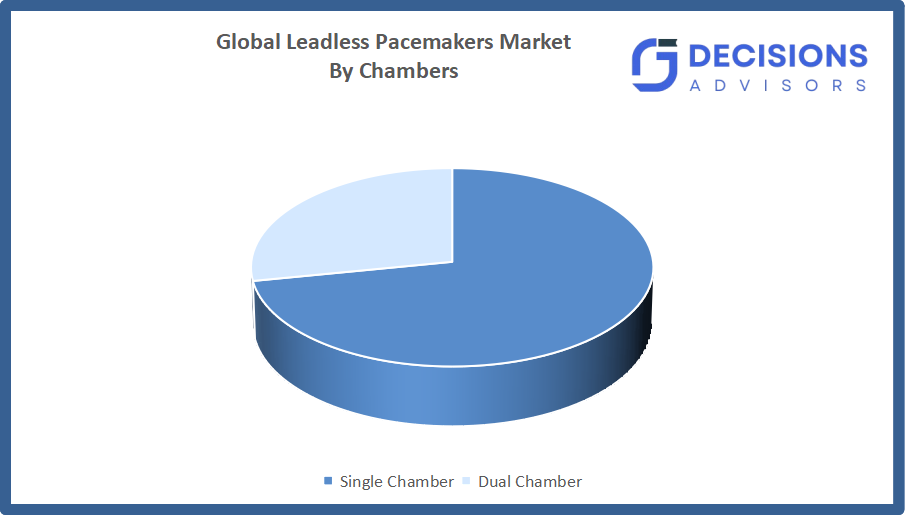
- The single chamber segment accounted for the largest share in 2024 and is anticipated to grow at a significant CAGR during the forecast period.
Based on the chambers, the Global Leadless Pacemakers Market Size is divided into single chamber and dual chamber. Among these, the single chamber segment accounted for the largest share in 2024 and is anticipated to grow at a significant CAGR during the forecast period. The need for less invasive heart treatment equipment together with technological progress has created this situation. The pacemakers function as pacing devices to deliver atrial or ventricular stimulation which makes them easier to use than standard dual-chamber systems. The main benefit of single-chamber pacemakers exists because their compact design helps to decrease lead placement complications while their lower expenses make them more affordable than dual-chamber systems. A 74-year-old woman received treatment for her pacemaker infection through a single-chamber leadless pacemaker which doctors performed using a minimally invasive procedure that required no incisions. The patient completed her discharge process after one day because the safety device could be taken out or upgraded according to her requirements.
- The micra VR and VR2 segment accounted for the highest market revenue in 2024 and is anticipated to grow at a significant CAGR during the forecast period.
Based on the brands, the Global Leadless Pacemakers Market Size is divided into micra VR and VR2, micra AV and AV2, abbott aveir DR, and abbott aveir VR. Among these, the micra VR and VR2 segment accounted for the highest market revenue in 2024 and is anticipated to grow at a significant CAGR during the forecast period. The Micra VR and Micra VR2 are single-chamber leadless pacemakers developed by Medtronic to manage bradycardia. The devices use a less invasive method of heart implantation which requires no leads and results in fewer complications than standard pacemaker systems. The devices rank among the smallest pacemakers available because they weigh 1.75 grams and occupy a volume of 0.8 cubic centimeters while being safe for 1.5T and 3T MRI scans. The Micra VR2 device provides extended operational time because 89% of patients will use their devices for over 10 years while its enhanced delivery system enables safer device implantation procedures. The European Heart Journal published an article in April 2024 which documented the Micra VR leadless pacemaker's five-year real-world performance from a worldwide post-approval registry. The device showed no need for Micra removals because of infection which demonstrates its long-term safety and reliability together with its low rate of complications.
Regional Segment Analysis of the Leadless Pacemakers Market
- North America (U.S., Canada, Mexico)
- Europe (Germany, France, U.K., Italy, Spain, Rest of Europe)
- Asia-Pacific (China, Japan, India, Rest of APAC)
- South America (Brazil and the Rest of South America)
- The Middle East and Africa (UAE, South Africa, Rest of MEA)
North America is anticipated to hold the largest share of the leadless pacemakers market over the predicted timeframe.
North America is anticipated to hold the largest share of the leadless pacemakers market over the predicted timeframe. The region experiences growth because of rising cardiovascular disease cases and new medical technologies and its current reimbursement methods. The FDA and other regulatory bodies support the medical device industry by streamlining the approval process for new products which leads to enhanced market conditions. The market expansion is driven by increasing patient demand for procedures that require less invasive techniques. The United States leads the North American market, with key players such as Medtronic, Boston Scientific, and Abbott dominating the landscape. These companies are investing heavily in R&D to develop new products and enhance existing products. The marketplace operates through competitive dynamics which organizations use to establish market presence through partnerships and cooperative agreements. Canada contributes to healthcare development by building better medical facilities and improving patient access to cutting-edge heart treatment technologies.
Asia-Pacific is expected to grow at a rapid CAGR in the leadless pacemakers market during the forecast period. The rapid urbanization process together with growing middle-class populations in Asia Pacific countries has created an increasing requirement for advanced cardiac care services that feature leadless pacemakers. Patients now understand better how modern pacing solutions provide advantages through their minimally invasive procedures, which result in shorter hospital stays and faster recovery times. The National Heart Institute (IJN) in Malaysia successfully performed the first dual-chamber leadless pacemaker implantation on 18 patients with Abbott AVEIR DR in June 2025, which represents the first such procedure in Southeast Asia. The miniaturised devices enable direct implantation into the right atrium and ventricle because they provide essential synchronized pacing without using traditional leads, which helps to minimize execution hazards.
Competitive Analysis:
The report offers the appropriate analysis of the key organizations/companies involved within the leadless pacemakers market, along with a comparative evaluation primarily based on their type of offering, business overviews, geographic presence, enterprise strategies, segment market share, and SWOT analysis. The report also provides an elaborative analysis focusing on the current news and developments of the companies, which includes type development, innovations, joint ventures, partnerships, mergers & acquisitions, strategic alliances, and others. This allows for the evaluation of the overall competition within the market.
List of Key Companies
- Abbott
- Medtronic
- EBR Systems, Inc.
- Boston Scientific Corporation
- MicroPort Scientific Corporation
- Others
Key Target Audience
- Market Players
- Investors
- End-users
- Government Authorities
- Consulting and Research Firm
- Venture capitalists
- Value-Added Resellers (VARs)
Recent Development
- In April 2025, EBR Systems, Inc. received FDA approval for its WiSESystem, which was the first leadless left ventricular endocardial pacing device for CRT, offering a physiological alternative for patients who had been unable to receive conventional lead-based therapy.
Market Segment
This study forecasts revenue at global, regional, and country levels from 2020 to 2035. Decisions Advisors has segmented the Global Leadless Pacemakers Market Size based on the below-mentioned segments:
Global Leadless Pacemakers Market, By Chambers
- Single Chamber
- Dual Chamber
Global Leadless Pacemakers Market, By Brands
- Micra VR And VR2
- Micra AV And AV2
- Abbott Aveir DR
- Abbott Aveir VR
Global Leadless Pacemakers Market, By Regional Analysis
- North America
- US
- Canada
- Mexico
- Europe
- Germany
- UK
- France
- Italy
- Spain
- Russia
- Rest of Europe
- Asia Pacific
- China
- Japan
- India
- South Korea
- Australia
- Rest of Asia Pacific
- South America
- Brazil
- Argentina
- Rest of South America
- Middle East & Africa
- UAE
- Saudi Arabia
- Qatar
- South Africa
- Rest of the Middle East & Africa
Frequently Asked Questions (FAQ)
- What is the CAGR of the leadless pacemakers market over the forecast period?
A: The global leadless pacemakers market is projected to expand at a CAGR of 7.27% during the forecast period.
- What is the market size of the leadless pacemakers market?
A: The global leadless pacemakers market size is estimated to grow from USD 916.42 million in 2024 to USD 1982.87 million by 2035, at a CAGR of 7.27% during the forecast period 2025-2035.
- Which region holds the largest share of the leadless pacemakers market?
A: North America is anticipated to hold the largest share of the leadless pacemakers market over the predicted timeframe.
- Who are the top 10 companies operating in the global leadless pacemakers market?
A: Abbott, Medtronic, EBR Systems, Inc., Boston Scientific Corporation, MicroPort Scientific Corporation, and Others.
- What are the market trends in the leadless pacemakers market?
A: The leadless pacemakers market shows key market trends through four main factors which include growing use of minimally invasive heart devices and advancements in battery life and fixation design and increasing number of product approvals and growing demand for pacing systems that reduce infection risk.
Check Licence
Choose the plan that fits you best: Single User, Multi-User, or Enterprise solutions tailored for your needs.
We Have You Covered
- 24/7 Analyst Support
- Clients Across the Globe
- Tailored Insights
- Technology Tracking
- Competitive Intelligence
- Custom Research
- Syndicated Market Studies
- Market Overview
- Market Segmentation
- Growth Drivers
- Market Opportunities
- Regulatory Insights
- Innovation & Sustainability
Report Details
| Scope | Global |
| Pages | 225 |
| Delivery | PDF & Excel via Email |
| Language | English |
| Release | Feb 2026 |
| Access | Download from this page |