
Global Legacy Modernization Market
 |
Author:
Piya P
|
Pages:
200
|
Author:
Piya P
|
Pages:
200
Global Legacy Modernization Market Size, Share By Service Type (Assessment, Migration, Integration, Maintenance), By Deployment Model (On-Premises, Cloud-Based, and Hybrid), By Organization Size (Small Enterprises, Medium Enterprises, and Large Enterprises), and By Region (North America, Europe, Asia-Pacific, Latin America, Middle East & Africa), Analysis and Forecast 2026-2035
CAGR
18.1%
REVENUE 2025
USD Billion 25.1
FORECAST 2035
USD Billion 132.5
REPORT COVERAGE
Global
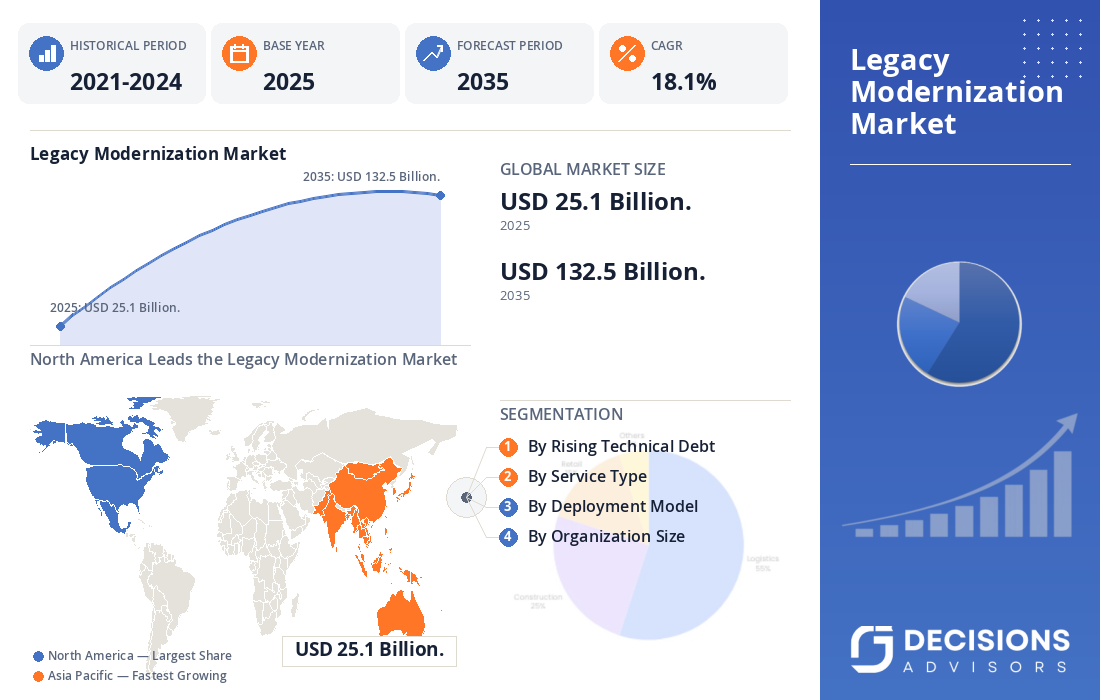
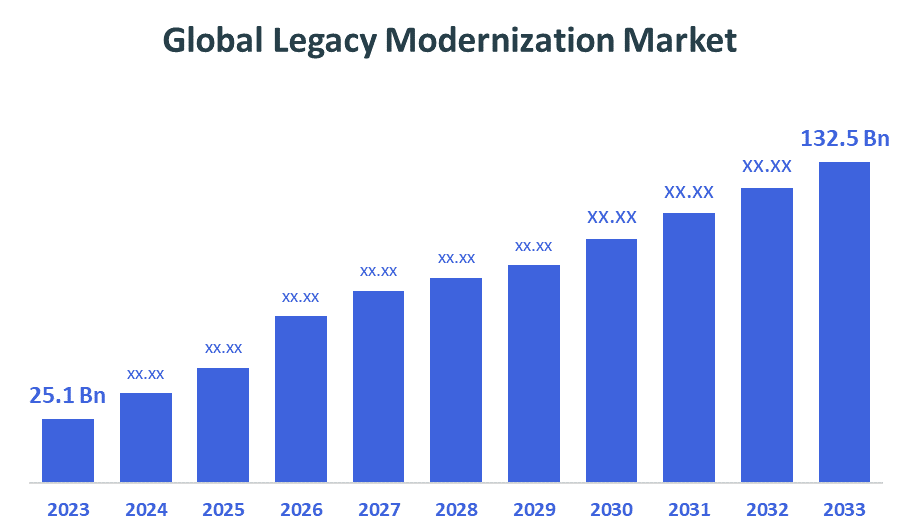
The Global Legacy Modernization Market Size is predicted to grow from USD 25.1 Billion in 2025 and is likely to reach around USD 132.5 Billion by 2035, with a CAGR of 18.1%. Decision Advisors estimates that increasing enterprise migration toward cloud-native infrastructure, rising technical debt, cybersecurity requirements and growing adoption of AI-assisted application transformation are strengthening demand for legacy modernization. North America remains the leading regional market, while Asia-Pacific is expected to record strong growth as enterprises accelerate cloud migration and digital transformation.
Market Snapshot
- Global Legacy Modernization Market Size (2025): USD 25.1 Billion.
- Projected Global Legacy Modernization Market Size (2035): USD 132.5 Billion.
- Global Legacy Modernization Market Compound Annual Growth Rate (CAGR): 18.1%.
- Largest Regional Market: North America
- 2nd Largest Region: Europe
- Fastest Growing Region: Asia-Pacific
- Base Year: 2025
- Historical Period: 2021-2024
- Market Forecast Period: 2026-2035
Market Overview/ Introduction
The global legacy modernization market comprises services, software and technologies used to modernize aging enterprise applications, infrastructure and mission-critical systems. Modernization activities include application assessment, migration, replatforming, refactoring, integration and maintenance, enabling organizations to move older technology environments toward cloud, hybrid-cloud, microservices, API-based and AI-ready architectures. The market is particularly relevant to organizations operating large application estates in banking, healthcare, government, telecommunications, retail and other industries where legacy systems continue to support essential business processes. Growth is being driven by rising technical debt, increasing maintenance costs, cybersecurity requirements, cloud adoption and the need to prepare enterprise systems for artificial intelligence. Organizations are increasingly moving beyond simple lift-and-shift strategies toward application redesign and business-process transformation. IBM describes application modernization as a combination of migration, modernization and incremental enhancement of brownfield applications across hybrid-cloud environments, while AWS and Accenture are increasingly applying AI and automated analysis to mainframe modernization.
- United States, Federal agencies and large enterprises continue investing in cloud migration, cybersecurity and replacement of aging IT infrastructure. AI-enabled modernization is increasingly being used to analyze and transform complex legacy application estates.
- United Kingdom, Public-sector modernization is creating additional demand. In August 2026, HM Revenue & Customs entered a £78 million, three-year agreement with Atos to accelerate IT modernization through low-code services under the Digital and Legacy Application Services framework.
- Asia-Pacific, Rapid digitalization, cloud adoption and expansion of enterprise technology infrastructure are accelerating modernization programs across India, China, Japan, South Korea and Southeast Asia.
Notable Insights: -
- North America is anticipated to hold approximately 39% share of the Global Legacy Modernization Market over the predicted timeframe.
- Asia-Pacific is expected to grow at a rapid pace and hold approximately 30% share during the forecast period.
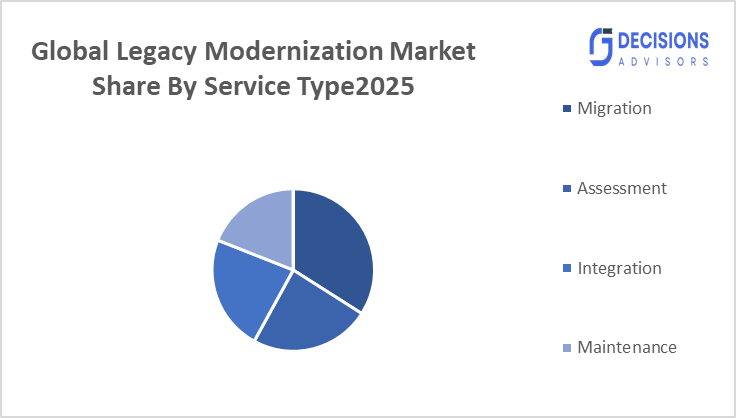
- By Service Type, the Migration segment dominated the market and holds approximately 34% share in 2025.
- By Deployment Model, the Cloud-Based segment dominated the market and holds approximately 43% share in 2025.
- By Organization Size, the Large Enterprises segment dominated the market and holds approximately 61% share in 2025.
- The compound annual growth rate of the Global Legacy Modernization Market is 18.1%.
- The market is likely to achieve a valuation of USD 132.5 Billion by 2035.
Market Drivers
The major market driver is the growing need to reduce technical debt and modernize applications that are expensive to maintain and difficult to integrate with newer technologies. Enterprises are increasingly adopting cloud platforms, microservices, APIs, containers and AI-enabled development environments to improve scalability and development speed. Cybersecurity requirements are another important factor because unsupported legacy environments can create vulnerabilities and make security controls more difficult to implement. In addition, organizations are preparing their technology infrastructure for generative and agentic AI, increasing the need for modern data architectures and interoperable applications. Capgemini has identified outdated legacy systems, fragmented data and complex technology environments as barriers to broader enterprise AI adoption, supporting the connection between AI investment and modernization spending.
Restrain
High modernization costs remain a major constraint, particularly for organizations with large mainframe estates and highly customized applications. Legacy systems frequently contain undocumented business logic and complex dependencies, making migration and refactoring difficult. Organizations must also manage operational continuity, data security, regulatory requirements and integration risks while transforming mission-critical systems. Shortages of specialists familiar with older programming languages and platforms can further increase project costs and implementation periods.
Competitive Analysis:
The report offers the appropriate analysis of the key organizations/companies involved within the global legacy modernization market, along with a comparative evaluation primarily based on their product offerings, business overviews, geographic presence, enterprise strategies, segment market share, and SWOT analysis. The report also provides an elaborative analysis focusing on the current news and developments of the companies, which includes product development, innovations, joint ventures, partnerships, mergers & acquisitions, strategic alliances, and others. This allows for the evaluation of the overall competition within the market.
Top Companies in the Global Legacy Modernization Market
- Accenture
- IBM
- Oracle
- Tata Consultancy Services
- Infosys
- Cognizant
- HCLTech
- Wipro
- Capgemini
- DXC Technology.
Government Initiatives
|
Country |
Key Government Initiatives |
|
United States |
Federal modernization programs emphasize cloud migration, cybersecurity, digital services and replacement of aging government IT systems |
|
Japan |
Digital transformation programs encourage modernization of government and enterprise technology infrastructure, cloud adoption and automation |
|
China |
Smart manufacturing, enterprise digitalization and cloud-computing programs are supporting modernization of industrial and enterprise IT infrastructure |
Market Segmentation
The global legacy modernization market share is classified into service type, deployment model and organization size.
- The Migration segment dominated the market and holds approximately 34% share in 2025 and is projected to grow at a substantial CAGR during the forecast period.
Based on service type, the global legacy modernization market is divided into assessment, migration, integration and maintenance. Among these, Migration dominates because organizations frequently begin modernization by moving workloads away from aging infrastructure. Cloud migration allows enterprises to improve scalability without immediately replacing all existing applications. It also provides a foundation for subsequent refactoring, containerization and integration with modern applications. The continued movement toward hybrid and cloud-native environments is therefore expected to sustain migration demand.
- The Cloud-Based segment accounted for the largest share of approximately 43% in 2025 and is anticipated to grow at a significant CAGR during the forecast period.
Based on deployment model, the market is divided into on-premises, cloud-based and hybrid. among these, cloud-based accounted for the largest share. Cloud environments provide scalable infrastructure and access to managed databases, analytics, AI and application-development services. Enterprises can modernize workloads progressively while reducing dependence on aging physical infrastructure. The increasing requirement for AI-ready IT environments is further strengthening cloud-based modernization.
- The Large Enterprises segment accounted for the largest share of approximately 61% in 2025 and is anticipated to grow at a significant CAGR during the forecast period.
Based on Organization Size, the market is divided into Small Enterprises, Medium Enterprises and Large Enterprises. Large enterprises dominate because they typically operate extensive application portfolios and mission-critical legacy systems. Banking, insurance, telecommunications, healthcare and government organizations often have decades of accumulated technical debt. Their larger IT budgets and complex modernization requirements make them significant contributors to global modernization spending.
Regional Segment Analysis of the Global Legacy Modernization Market
- North America (U.S., Canada, Mexico)?
- Europe (Germany, U.K., France, Italy, Spain, Netherlands, Rest of Europe).
- Asia-Pacific (China, Japan, India, Australia, South Korea, Rest of Asia-Pacific).
- South America (Brazil, Argentina, Rest of South America).
- Middle East & Africa (UAE, Saudi Arabia, South Africa, Rest of MEA).
North America is anticipated to hold approximately 39% share of the Global Legacy Modernization Market over the predicted timeframe.
North America remains the largest regional market because of its substantial installed base of enterprise legacy applications and high spending on cloud transformation, cybersecurity and enterprise software. The United States has a particularly strong concentration of financial institutions, healthcare organizations, government agencies and multinational enterprises operating mission-critical legacy environments. The region also benefits from the presence of leading modernization providers and hyperscale cloud companies. The reference market study identifies North America as the largest regional market and reports a 2024 value of approximately USD 6.0 Billion.
Europe is anticipated to hold approximately 23% share of the Global Legacy Modernization Market during the forecast period.
European enterprises are investing in modernization to improve resilience, cybersecurity, operational efficiency and compliance. Financial services, manufacturing, telecommunications and public-sector organizations are important contributors. The United Kingdom, Germany and France are expected to remain major markets because of their large enterprise technology bases and continued digital-transformation programs.
Asia-Pacific is expected to hold approximately 30% share and remain the fastest-growing regional market.
Asia-Pacific is experiencing rapid enterprise digitalization, cloud adoption and expansion of technology infrastructure. India is an important contributor because of its large IT-services industry and global modernization delivery capabilities. Japan and South Korea have mature technology markets, while China has substantial enterprise and industrial modernization requirements. Increasing AI adoption is further encouraging enterprises to upgrade application architectures, data environments and legacy infrastructure.
Future Market Trends in Global Legacy Modernization Market: -
-
- AI-Assisted Application Modernization
AI is becoming a core technology in modernization workflows. Modern tools can analyze legacy code, identify dependencies, extract business rules, generate documentation and assist with code transformation. Accenture and AWS are currently using agentic AI approaches to analyze mainframe applications and support cloud-native redesign.
-
- Cloud-Native Modernization
Cloud-native architecture will continue to influence modernization strategies. Enterprises are increasingly adopting containers, microservices, APIs and managed cloud services to replace tightly coupled architectures. This enables organizations to modernize applications incrementally rather than executing disruptive full-system replacements.
-
- Mainframe Reengineering
Mainframe modernization is moving beyond simple rehosting. Enterprises increasingly want to extract business logic from mainframe applications and rebuild selected capabilities using modern cloud-native architectures. AWS and Accenture's July 2026 approach demonstrates this shift toward AI-supported mainframe reengineering.
-
- AI-Ready Enterprise Infrastructure
The rapid adoption of generative and agentic AI is creating a new modernization requirement: legacy systems must provide reliable, accessible and integrated data to AI applications. This is encouraging organizations to modernize databases, APIs, applications and integration layers. Capgemini has noted that legacy systems and fragmented data can restrict enterprise AI adoption.
Recent Development
- In July 2026, Accenture and AWS introduced an expanded approach for reimagining mainframe applications using AWS Transform and Accenture's AI agents. The solution combines automated mainframe discovery, business-rule extraction and AI-supported forward engineering for cloud-native applications.
- In May 2026, HCLTech and Pegasystems expanded their collaboration to accelerate AI-powered enterprise-system modernization. The companies combined HCLTech AI Force with Pega Blueprint to support discovery and transformation of legacy applications into cloud-native and AI-powered applications.
- In October 2025, Accenture and AWS expanded their collaboration to accelerate AI-powered reinvention and cloud modernization for public-service organizations. The collaboration combines Accenture's industry and transformation capabilities with AWS cloud and AI services.
Market Segment
This study forecasts revenue at global, regional, and country levels from 2021 to 2035. Decision Advisors has segmented the global legacy modernization market based on the below-mentioned segment:
Global Legacy Modernization Market, By Service Type.
- Assessment
- Migration
- Integration
- Maintenance
- Others.
Global Legacy Modernization Market, By Deployment Model.
- On-Premises
- Cloud-Based
- Hybrid
- Others.
Global Legacy Modernization Market, By Organization Size.
- Small Enterprises
- Medium Enterprises
- Large Enterprises
- Others.
Global Legacy Modernization Market, By Regional Analysis.
- North America
- US
- Canada
- Mexico
- Europe
- Germany
- UK
- France
- Italy
- Spain
- Russia
- Rest of Europe
- Asia Pacific
- China
- Japan
- India
- South Korea
- Australia
- Rest of Asia Pacific
- South America
- Brazil
- Argentina
- Rest of South America
- Middle East & Africa
- UAE
- Saudi Arabia
- Qatar
- South Africa
- Rest of the Middle East & Africa
Frequently Asked Questions (FAQ)
Q. What is legacy modernization?
A. Legacy modernization is the process of updating, migrating, replatforming, integrating or replacing older enterprise applications and infrastructure. It helps organizations improve scalability, security, flexibility and operational efficiency.
Q. Why are enterprises investing in legacy modernization?
A. Enterprises are investing because aging systems can create technical debt, high maintenance costs, cybersecurity risks and integration limitations. Cloud, AI and modern application architectures are increasing the need for flexible and interoperable IT environments.
Q. Which deployment model is expected to dominate the market?
A. Cloud-Based modernization is expected to remain the leading deployment model because cloud platforms provide scalable infrastructure and access to modern development, analytics and AI services. Hybrid environments will remain important for organizations that need to retain selected mission-critical legacy workloads.
Q. How is AI changing legacy modernization?
A. AI is being applied to application discovery, dependency analysis, code conversion, documentation, testing and modernization planning. Accenture and AWS are already applying agentic AI to mainframe modernization workflows, demonstrating the industry's transition toward automated transformation.
Check Licence
Choose the plan that fits you best: Single User, Multi-User, or Enterprise solutions tailored for your needs.
We Have You Covered
- 24/7 Analyst Support
- Clients Across the Globe
- Tailored Insights
- Technology Tracking
- Competitive Intelligence
- Custom Research
- Syndicated Market Studies
- Market Overview
- Market Segmentation
- Growth Drivers
- Market Opportunities
- Regulatory Insights
- Innovation & Sustainability
Report Details
| Scope | Global |
| Pages | 200 |
| Delivery | PDF & Excel via Email |
| Language | English |
| Release | Aug 2026 |
| Access | Download from this page |