
Global Life and Non-Life Insurance Market
 |
Author:
Nikita K
|
Pages:
210
|
Author:
Nikita K
|
Pages:
210
Global Life and Non-Life Insurance Market Size, Share By Insurance Type (Life Insurance, Non-Life Insurance), By Distribution Channel (Agents, Brokers, Bancassurance, Direct Sales, Online), By Customer Type (Individual, Group, Corporate, Government), and By Region (North America, Europe, Asia-Pacific, Latin America, Middle East & Africa), Analysis and Forecast 2026-2035
CAGR
5.51%
REVENUE 2025
USD Billion 7.25
FORECAST 2035
USD Billion 12.4
REPORT COVERAGE
Global
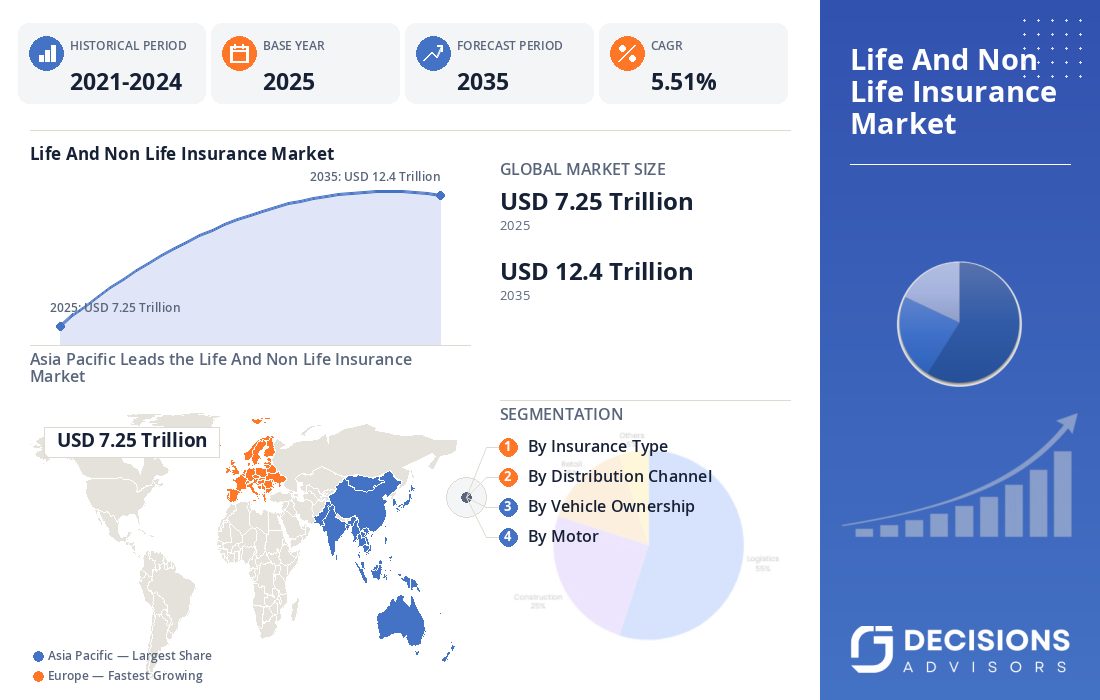
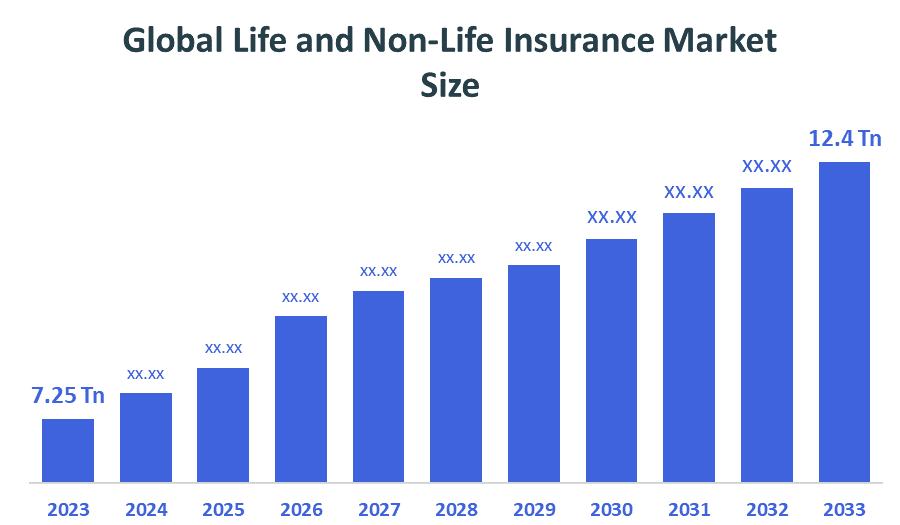
The Global Life and Non-Life Insurance Market Size is predicted to grow from USD 7.25 Trillion in 2025 and is likely to reach around USD 12.4 Trillion by 2035 with a CAGR of 5.51%. The market is supported by rising demand for financial protection, healthcare and retirement coverage, increasing exposure to property and climate risks, expanding middle-class populations, and improving insurance penetration across emerging economies. Global insurance premiums reached approximately EUR 6.9 trillion in 2025, with life insurance remaining the largest individual insurance segment, followed by property and casualty and health insurance.
Market Snapshot
- Global Life and Non-Life Insurance Market Size (2025): USD 7.25 Trillion
- Projected Global Life and Non-Life Insurance Market Size (2035): USD 12.4 Trillion
- Global Life and Non-Life Insurance Market CAGR: 5.51%
- Largest Regional Market: Asia Pacific
- 2nd Largest Region: North America
- Fastest Growing Region: Europe
- Base Year: 2025
- Historical Period: 2021-2024
- Market Forecast Period: 2026-2035.
Market Overview/ Introduction
The global life and non-life insurance market comprises financial protection products designed to transfer mortality, health, property, casualty, motor, commercial and other risks from individuals and organizations to insurance providers. Life insurance primarily provides death protection, savings, retirement and long-term financial security, while non-life insurance covers property, motor, health, liability, travel, marine and commercial risks. Demand is increasing as households and businesses seek greater protection against medical expenses, income interruption, natural disasters, accidents, asset damage and financial uncertainty. According to Allianz Research, the global insurance industry reached approximately EUR 6.9 trillion in premiums in 2025, with life premiums of EUR 2.861 trillion, P&C premiums of EUR 2.320 trillion and health premiums of EUR 1.688 trillion. Technology is becoming a major structural factor across the insurance value chain. Insurers increasingly use AI, predictive analytics, cloud platforms, digital claims systems, telematics and automated underwriting to improve pricing and customer experience.
- United States, Insurance regulators are increasingly addressing responsible AI use in underwriting and claims, creating greater focus on model governance, consumer protection and transparency.
- India, The country's Insurance for All by 2047 objective is encouraging broader insurance penetration. In April 2026, Jio Financial Services and Allianz agreed to establish a 50:50 primary insurance joint venture focused on general and health insurance.
- Asia-Pacific, Aging populations, rising incomes and comparatively lower insurance penetration in several emerging markets are creating significant long-term opportunities. Allianz identifies Wider Asia as the principal source of additional global insurance premiums over its forecast horizon.
Notable Insights: -
- Asia Pacific is anticipated to hold approximately 43% share of the Global Life and Non-Life Insurance Market over the predicted timeframe.
- North America is expected to hold approximately 29% share during the forecast period, supported by mature insurance infrastructure and high premium volumes.
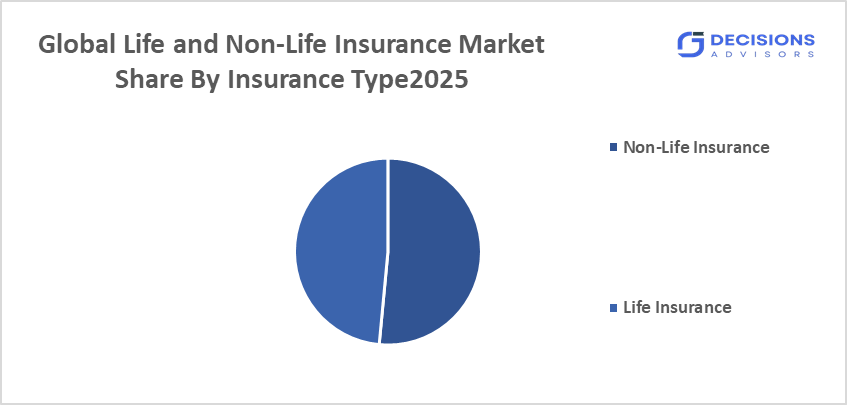
- By Insurance Type, the Non-Life Insurance segment dominated the market and holds approximately 51.5% share in 2025 and is projected to grow at a substantial CAGR during the forecast period.
- By Distribution Channel, the Agents segment dominated the market and holds approximately 34% share in 2025 and is projected to grow steadily during the forecast period.
- The compound annual growth rate of the Global Life and Non-Life Insurance Market is 5.51%.
- The market is likely to achieve a valuation of USD 12.4 Trillion by 2035.
Market Drivers
The global life and non-life insurance market is being driven by rising consumer awareness of financial protection, increasing healthcare expenditure, aging populations, retirement-planning requirements and growth in household and commercial assets. Life insurance benefits from increasing demand for income protection, savings and retirement products, while non-life insurance is supported by vehicle ownership, property ownership, commercial activity, healthcare requirements and growing exposure to natural catastrophes. Digital transformation is another important driver because online platforms, mobile applications and embedded insurance make policies easier to compare and purchase. Insurers are also using AI and predictive analytics to improve underwriting, claims management and fraud detection. In emerging economies, increasing disposable income and expanding financial inclusion are creating opportunities to raise insurance penetration. Global health insurance is particularly dynamic, with Allianz reporting 12.3% growth in global health premiums in 2025.
Restrain
The market faces several restraints, including regulatory complexity, claims inflation, catastrophic losses, cybersecurity risks and high technology-transition costs. Climate-related disasters can increase property and casualty claims and put pressure on premiums and reinsurance costs. Insurers also need to manage stringent capital, solvency, data-protection and consumer-protection requirements across different jurisdictions. Legacy IT infrastructure can make digital transformation expensive, particularly for large established insurers. In addition, affordability remains a challenge in emerging economies where insurance penetration is still relatively low and household purchasing power can limit coverage.
Competitive Analysis:
The report offers the appropriate analysis of the key organizations/companies involved within the global life and non-life insurance market, along with a comparative evaluation primarily based on their product offerings, business overviews, geographic presence, enterprise strategies, segment market share, and SWOT analysis. The report also provides an elaborative analysis focusing on the current news and developments of the companies, which includes product development, innovations, joint ventures, partnerships, mergers & acquisitions, strategic alliances, and others. This allows for the evaluation of the overall competition within the market.
Top Companies in the Global Life and Non-Life Insurance Market
- Allianz SE
- AXA
- Zurich Insurance Group
- American International Group, Inc. (AIG)
- MetLife, Inc.
- Prudential plc
- China Life Insurance Company Limited
- Ping An Insurance Group
- Assicurazioni Generali S.p.A.
- Chubb Limited.
Government Initiatives
|
Country |
Key Government Initiatives |
|
United States |
State insurance regulators are strengthening oversight of artificial intelligence and data-driven underwriting, with increasing emphasis on responsible AI governance and consumer protection |
|
Japan |
Government and regulatory policies continue to support financial-system stability, retirement preparedness, digital financial services and resilience against demographic pressures |
|
China |
Insurance-sector development is supported through financial-sector modernization, digitalization, health protection and expanding risk coverage for households and businesses |
Market Segmentation
The global life and non-life insurance market share is classified into insurance type, distribution channel and customer type.
- The Non-Life Insurance segment dominated the market and holds approximately 51.5% share in 2025 and is projected to grow at a substantial CAGR during the forecast period.
Based on insurance type, the global life and non-life insurance market is divided into life insurance and non-life insurance. Non-life insurance maintains a slight leading position because motor, property, health, commercial liability and other general insurance products address recurring protection requirements. Increasing property ownership, vehicle penetration, healthcare expenditure and exposure to natural disasters support demand. The segment also benefits from expanding commercial activity and increasing risk awareness among businesses.
- The Agents segment accounted for the largest share of approximately 34% in 2025 and is anticipated to grow at a significant CAGR during the forecast period.
Based on distribution channel, the market is divided into agents, brokers, bancassurance, direct sales and online. Agents remain important because life insurance, retirement products and complex commercial policies often require professional guidance. Their established relationships and local presence provide strong access to customers, particularly in emerging markets. However, online insurance platforms and digital aggregators are rapidly increasing their contribution by providing faster quotations, comparison and policy issuance.
- The Individual segment accounted for the largest share of approximately 52% in 2025 and is anticipated to grow at a significant CAGR during the forecast period.
Based on customer type, the market is divided into individual, group, corporate and government. Individual customers represent the largest demand base because life, health, motor, property and travel policies are directly purchased to protect households and personal assets. Rising financial awareness and increasing healthcare and retirement costs are encouraging greater coverage. Digital distribution is also making individual insurance products easier to purchase and personalize.
Regional Segment Analysis of the Global Life and Non-Life Insurance Market
- North America (U.S., Canada, Mexico)?
- Europe (Germany, U.K., France, Italy, Spain, Netherlands, Rest of Europe).
- Asia-Pacific (China, Japan, India, Australia, South Korea, Rest of Asia-Pacific).
- South America (Brazil, Argentina, Rest of South America).
- Middle East & Africa (UAE, Saudi Arabia, South Africa, Rest of MEA).
Asia Pacific is anticipated to hold approximately 43% share of the Global Life and Non-Life Insurance Market over the predicted timeframe.
Asia Pacific is the strongest long-term growth region because of its large population, expanding middle class, improving financial awareness and relatively low insurance penetration in several developing markets. China, Japan and India are major contributors, while Southeast Asia offers additional expansion opportunities. Life insurance demand is supported by aging populations and savings requirements, while health and property insurance are benefiting from rising healthcare expenditure and asset ownership. Allianz estimates that more than half of the additional global premium pool expected over the next decade will originate from Wider Asia.
North America is expected to grow at a rapid CAGR in the Global Life and Non-Life Insurance Market, holding approximately 29% of the share during the forecast period.
The region benefits from mature insurance infrastructure, high insurance penetration, sophisticated financial markets and substantial premium volumes. The U.S. is particularly strong in property and casualty insurance, where North America accounted for 52% of global P&C premiums in 2025 according to Allianz. The region is also a major adopter of AI, telematics, predictive analytics and digital claims technologies.
Europe is expected to hold approximately 18% share of the Global Life and Non-Life Insurance Market during the forecast period.
Europe represents a mature insurance market supported by strong financial institutions, established distribution networks, aging populations and substantial demand for life, health and commercial protection. Germany, France, the U.K., Italy and Spain are important contributors. Regulatory modernization and digital transformation are encouraging insurers to improve operational efficiency and develop more customer-focused products.
Future Market Trends in Global Life and Non-Life Insurance Market: -
-
- AI-Enabled Underwriting and Claims
Artificial intelligence will increasingly support risk assessment, fraud detection, claims classification and customer service. Insurers are expected to use AI to improve underwriting accuracy while reducing manual processing costs. Responsible AI governance will become increasingly important as insurers rely more heavily on automated decisions.
-
- Expansion of Embedded Insurance
Insurance products are increasingly being integrated into banking, travel, mobility, e-commerce and digital platforms. Embedded insurance reduces the friction involved in purchasing coverage and allows insurers to offer protection at the point where customers encounter a relevant risk.
-
- Digital and Direct-to-Consumer Distribution
Mobile applications, digital brokers, online comparison platforms and direct-to-consumer insurance websites are changing the traditional distribution model. These channels allow customers to obtain quotations and policies more quickly while enabling insurers to reduce certain distribution costs.
-
- Personalized and Usage-Based Insurance
Telematics, connected vehicles, wearable devices and behavioral analytics are supporting more personalized insurance products. Usage-based motor insurance and data-driven health and wellness products can enable insurers to align pricing more closely with individual risk profiles.
Recent Development
- In July 2026, Allianz announced an agreement to acquire HSBC Life Singapore and enter into an exclusive 15-year distribution partnership with HSBC Singapore, expanding access to protection, health, retirement and wealth solutions across Asia Pacific.
- In April 2026, Jio Financial Services and Allianz entered into a binding agreement to establish a 50:50 primary insurance joint venture covering general and health insurance in India.
- In March 2026, Allianz Jio Reinsurance Limited commenced operations in India after receiving final regulatory approval from IRDAI, combining Jio Financial Services' local distribution capabilities with Allianz's reinsurance expertise.
Market Segment
This study forecasts revenue at global, regional, and country levels from 2021 to 2035. Decision Advisors has segmented the Global Life and Non-Life Insurance Market based on the below-mentioned segment:
Global Life and Non-Life Insurance Market, By Insurance Type.
- Life Insurance
- Non-Life Insurance
- Health Insurance
- Property & Casualty Insurance
- Others.
Global Life and Non-Life Insurance Market, By Distribution Channel.
- Agents
- Brokers
- Bancassurance
- Direct Sales
- Online.
Global Life and Non-Life Insurance Market, By Customer Type.
- Individual
- Group
- Corporate
- Government.
Global Life and Non-Life Insurance Market, By Regional Analysis.
- North America
- US
- Canada
- Mexico
- Europe
- Germany
- UK
- France
- Italy
- Spain
- Russia
- Rest of Europe
- Asia Pacific
- China
- Japan
- India
- South Korea
- Australia
- Rest of Asia Pacific
- South America
- Brazil
- Argentina
- Rest of South America
- Middle East & Africa
- UAE
- Saudi Arabia
- Qatar
- South Africa
- Rest of the Middle East & Africa
Frequently Asked Questions (FAQ)
Q. What is driving the Global Life and Non-Life Insurance Market?
A. Major drivers include increasing demand for financial protection, healthcare and retirement coverage, rising asset ownership, climate-related risks, digital distribution and growing insurance penetration in emerging markets. Aging populations are also increasing demand for life, health and retirement products.
Q. Which insurance segment has the largest market share?
A. In this Decision Advisors market model, Non-Life Insurance holds the largest share at approximately 51.5% in 2025. Its position is supported by motor, property, health and commercial risk coverage.
Q. Why is Asia Pacific the largest regional market?
A. Asia Pacific benefits from its large population, expanding middle class, increasing financial awareness and relatively low insurance penetration in several emerging markets. Allianz's 2026 research also identifies Wider Asia as the largest contributor to future global premium growth.
Q. How is technology changing the insurance industry?
A. AI, predictive analytics, telematics, cloud platforms and digital distribution are improving underwriting, claims processing, fraud detection and customer engagement. Embedded insurance and mobile applications are also making insurance products more accessible.
Check Licence
Choose the plan that fits you best: Single User, Multi-User, or Enterprise solutions tailored for your needs.
We Have You Covered
- 24/7 Analyst Support
- Clients Across the Globe
- Tailored Insights
- Technology Tracking
- Competitive Intelligence
- Custom Research
- Syndicated Market Studies
- Market Overview
- Market Segmentation
- Growth Drivers
- Market Opportunities
- Regulatory Insights
- Innovation & Sustainability
Report Details
| Scope | Global |
| Pages | 210 |
| Delivery | PDF & Excel via Email |
| Language | English |
| Release | Aug 2026 |
| Access | Download from this page |