
Global Life Sciences BPO Market
 |
Author:
David J
|
Pages:
240
|
Author:
David J
|
Pages:
240
Global Life Sciences BPO Market Size, Share, By Service Type (Pharmaceutical Outsourcing, Medical Device Outsourcing, Contract Sales & Marketing Outsourcing, and Others), By Protocol (Development and Site Management), By Delivery Model (Onshore, Nearshore, Offshore, Hybrid, Captive/Shared Services Centre, and Remote/Virtual-First), By Application (Pharmaceuticals, Medical Device Applications, Biopharmaceuticals, Research & Development, and Others), and By Region (North America, Europe, Asia-Pacific, Latin America, Middle East & Africa), Analysis and Forecast 2026?2035.
CAGR
7.77%
REVENUE 2025
USD Billion 460.93
FORECAST 2035
USD Billion 973.91
REPORT COVERAGE
Global
The market is witnessing strong growth due to increasing outsourcing of pharmaceutical and biotechnology activities, rising costs associated with drug discovery and clinical development, growing clinical trial complexity, increasing regulatory requirements, expansion of biopharmaceutical pipelines, demand for specialized expertise, and rapid adoption of digital technologies. Life sciences BPO providers support pharmaceutical, biotechnology, and medical device companies through services such as clinical research, drug discovery, preclinical and clinical development, pharmacovigilance, regulatory affairs, medical writing, data management, contract manufacturing, sales and marketing support, and other specialized functions.
Market Snapshot
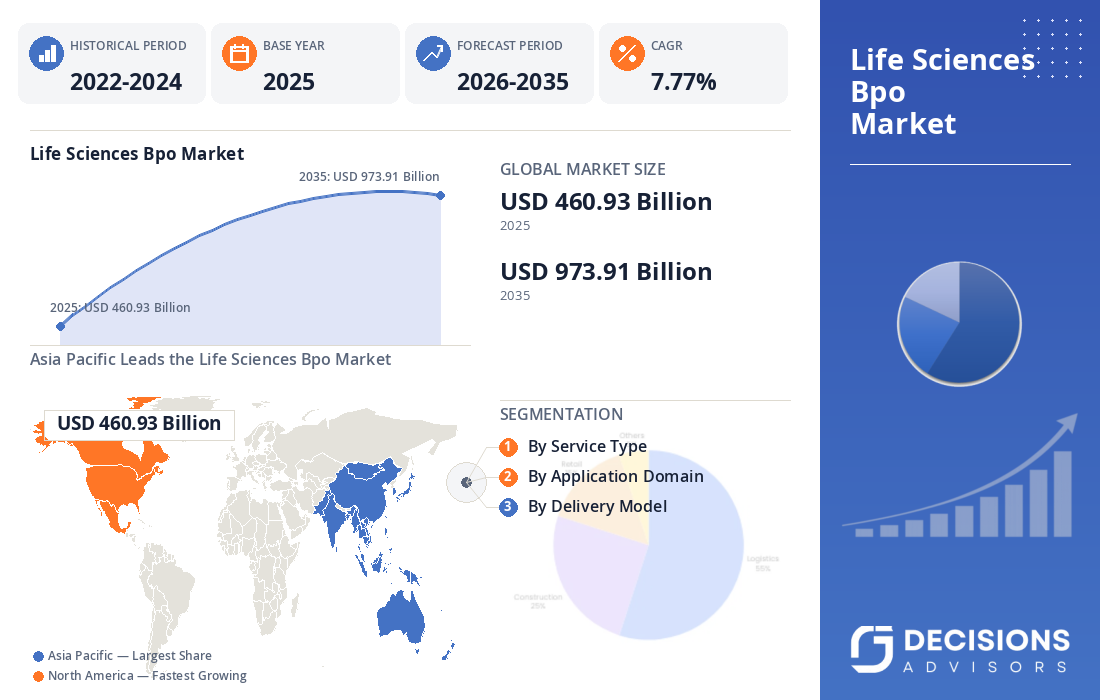
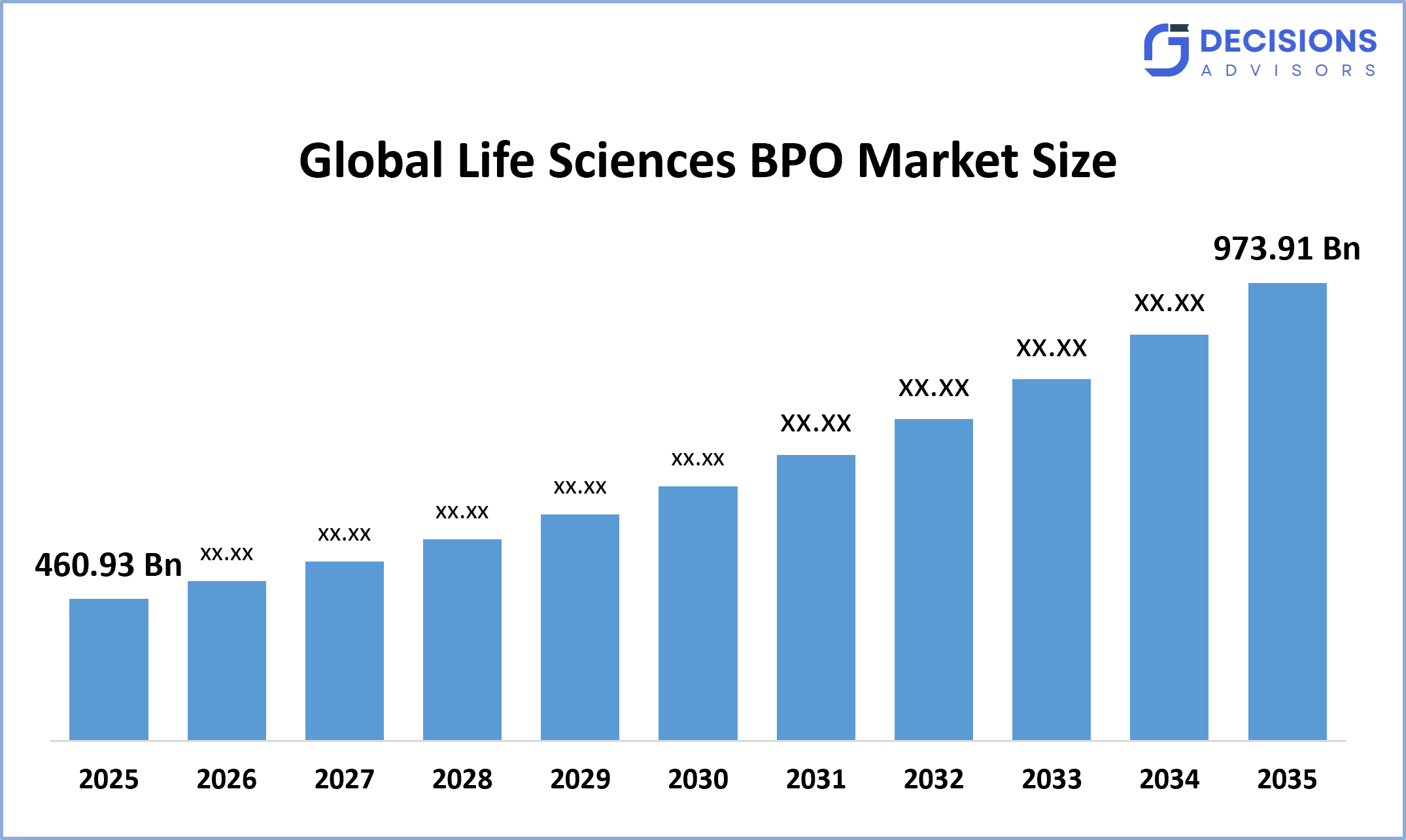
- Global Life Sciences BPO Market Size (2025): USD 460.93 Billion
- Projected Market Size (2035): USD 973.91 Billion
- Global Market CAGR (2026–2035): 7.77%
- Largest Regional Market: Asia-Pacific
- 2nd Largest Region: North America
- Fastest Growing Region: North America
- Base Year: 2025
- Historical Period: 2022–2024
- Forecast Period: 2026–2035
Market Overview/ Introduction
The Global Life Sciences BPO Market encompasses outsourced business and operational services provided to pharmaceutical companies, biotechnology companies, medical device manufacturers, and other healthcare organizations. Life sciences companies increasingly outsource non-core and specialized activities to external service providers to reduce operational costs, improve efficiency, accelerate product development, access specialized expertise, and focus on core research and commercial activities. Life sciences BPO services cover a broad range of functions, including pharmaceutical outsourcing, contract research, drug discovery, preclinical studies, clinical trial management, regulatory services, pharmacovigilance, medical writing, clinical data management, contract manufacturing, medical device outsourcing, sales and marketing support, market access, and other business-support activities.
The U.S. governments and regulatory authorities across major pharmaceutical markets are increasingly emphasizing clinical-trial quality, patient safety, data integrity, cybersecurity, regulatory compliance, and supply-chain resilience.
- Several Asia-Pacific countries are increasing investments in pharmaceutical manufacturing, biotechnology, clinical research, healthcare infrastructure, and digital healthcare technologies.
Notable Insights: -
- Asia-Pacific maintains a leading position in the Global Life Sciences BPO Market due to its large pharmaceutical manufacturing base, cost-competitive workforce, expanding biotechnology sector, increasing clinical-trial activity, and growing outsourcing capabilities.
- North America is expected to experience strong growth due to its established pharmaceutical and biotechnology ecosystem, high R&D expenditure, large clinical-trial pipeline, advanced healthcare infrastructure, and increasing adoption of specialized outsourcing services.
- Pharmaceutical outsourcing represents a major service segment because pharmaceutical companies increasingly outsource research, manufacturing, clinical development, regulatory, pharmacovigilance, and commercial activities to specialized providers.
- Contract research services are gaining importance as pharmaceutical and biotechnology companies seek to reduce clinical development costs, accelerate drug-development timelines, and access specialized research capabilities.
- Biotechnology companies represent an important end-user group because emerging biotech firms frequently lack the internal infrastructure required for clinical research, regulatory compliance, manufacturing, data management, and commercialization.
- Digital technologies are transforming life sciences BPO operations, with artificial intelligence, machine learning, cloud computing, automation, real-world data, advanced analytics, and digital clinical-trial platforms increasingly being incorporated into outsourced services.
Market Drivers
The Global Life Sciences BPO Market is primarily driven by the increasing outsourcing of pharmaceutical and biotechnology activities. Pharmaceutical companies are increasingly outsourcing non-core activities to specialized service providers to reduce operational costs, improve efficiency, access technical expertise, and accelerate product development. The growing cost and complexity of drug discovery and clinical development represent another major market driver. Pharmaceutical companies must manage extensive research, regulatory, clinical, safety, and data-management requirements before bringing new products to market. Outsourcing allows companies to access established infrastructure and specialized expertise without making equivalent investments internally.
Restrain
The Global Life Sciences BPO Market faces several challenges, including data-security concerns, regulatory complexity, quality-control requirements, dependence on third-party service providers, cybersecurity risks, shortage of skilled professionals, and challenges associated with integrating outsourced operations. Life sciences companies handle highly sensitive clinical, patient, regulatory, and commercial data. Consequently, BPO providers must maintain stringent cybersecurity, data privacy, quality management, and regulatory compliance systems.
Competitive Analysis:
The report offers the appropriate analysis of the key organizations/companies involved within the Global Life Sciences BPO Market, along with a comparative evaluation primarily based on their product offerings, business overviews, geographic presence, enterprise strategies, segment market share, and SWOT analysis. The report also provides an elaborative analysis focusing on the current news and developments of the companies, which includes product development, innovations, joint ventures, partnerships, mergers & acquisitions, strategic alliances, and others. This allows for the evaluation of the overall competition within the market.
Top Companies in the Global Life Sciences BPO Market
- IQVIA Holdings Inc.
- ICON plc
- Parexel International Corporation
- Labcorp Drug Development
- Charles River Laboratories International, Inc.
- Syneos Health
- Thermo Fisher Scientific Inc.
- Lonza Group Ltd.
- Catalent, Inc.
- Cognizant Technology Solutions Corporation
- Accenture plc
- Genpact Limited
- Infosys Limited
- Wipro Limited
- WuXi AppTec Co., Ltd.
- Boehringer Ingelheim
- Medpace Holdings, Inc.
- Fortrea Holdings Inc.
- TTEC Healthcare
- Clarivate Plc
Government Initiatives
|
Country |
Key Government Initiatives |
|
Us |
Government initiatives supporting pharmaceutical innovation, biotechnology research, clinical trials, advanced manufacturing, healthcare data infrastructure, regulatory modernization, and supply-chain resilience are supporting the domestic life sciences ecosystem. |
|
Germany |
Government and European initiatives focused on biotechnology, pharmaceutical research, healthcare innovation, digitalization, clinical research, and advanced manufacturing are supporting the European life sciences ecosystem. |
|
China |
Government programs supporting biotechnology, pharmaceutical innovation, domestic drug development, clinical research, advanced manufacturing, and healthcare infrastructure are contributing to the expansion of China's life sciences outsourcing capabilities. |
Market Segmentation
The Global Life Sciences BPO Market share is classified into service type, protocol, delivery model, application, and region.
- The Pharmaceutical Outsourcing Segment Dominates the Market
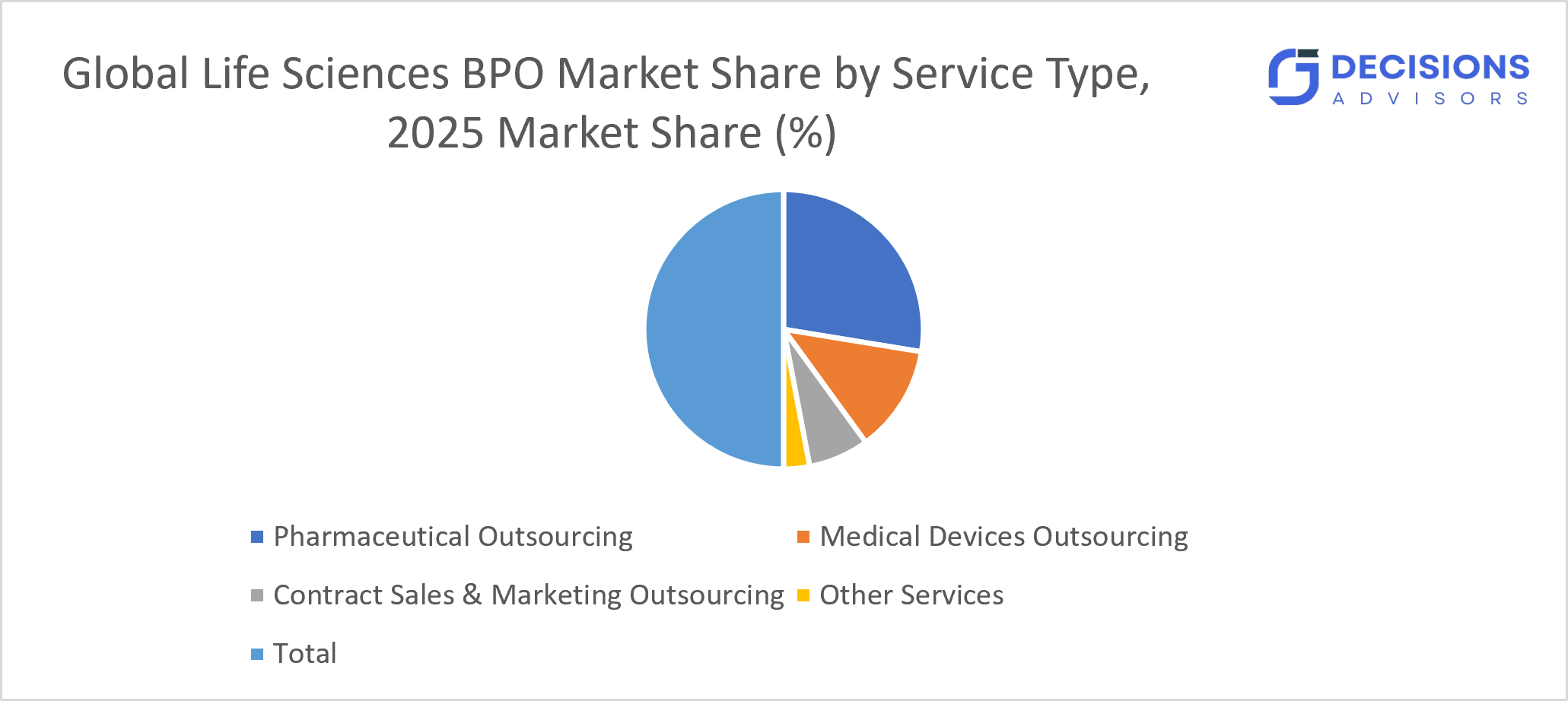
Based on service type, the market is divided into Pharmaceutical Outsourcing, Medical Device Outsourcing, Contract Sales & Marketing Outsourcing, and Others. Among these, the Pharmaceutical Outsourcing segment is expected to dominate the market due to increasing outsourcing of drug discovery, clinical development, regulatory affairs, pharmacovigilance, manufacturing, and other pharmaceutical functions.
- The Development Segment Accounts for a Significant Share
Based on protocol, the market is divided into Development and Site Management. The Development segment represents a significant share because pharmaceutical and biotechnology companies increasingly outsource activities associated with drug discovery, preclinical development, clinical trials, regulatory submissions, data management, and related development functions.
- The Offshore and Hybrid Delivery Models Gain Importance
Based on delivery model, the market is divided into Onshore, Nearshore, Offshore, Hybrid, Captive/Shared Services Centre, and Remote/Virtual-First. The Offshore and Hybrid models are gaining importance because they allow pharmaceutical and biotechnology companies to access skilled professionals and specialized services while optimizing operational costs. Hybrid delivery models are particularly attractive because they combine local expertise with offshore resources, enabling greater flexibility while maintaining regulatory and operational control.
Regional Segment Analysis of the Global Life Sciences BPO Market
- North America (U.S., Canada, Mexico)
- Europe (Germany, U.K., France, Italy, Spain, Netherlands, Rest of Europe)
- Asia-Pacific (China, Japan, India, Australia, South Korea, Rest of Asia-Pacific)
- South America (Brazil, Argentina, Rest of South America)
- Middle East & Africa (UAE, Saudi Arabia, South Africa, Rest of MEA)
Asia-Pacific Maintains a Leading Share of the Global Life Sciences BPO Market in 2025
Asia-Pacific maintains a leading position in the Global Life Sciences BPO Market due to its expanding pharmaceutical manufacturing industry, cost-competitive workforce, growing biotechnology sector, increasing clinical-trial activity, and rising investments in healthcare infrastructure.
North America Holds a Significant Share of the Global Life Sciences BPO Market in 2025
North America holds a significant share of the Global Life Sciences BPO Market, supported by its mature pharmaceutical and biotechnology ecosystem, high healthcare expenditure, extensive clinical-trial activity, advanced research infrastructure, and strong presence of global outsourcing companies. The United States remains a major hub for pharmaceutical R&D, clinical trials, biotechnology innovation, regulatory services, and healthcare technology. Increasing pressure to control drug-development costs and improve operational efficiency is encouraging pharmaceutical companies to expand their use of specialized outsourcing providers.
Europe Witnesses Strong Growth in 2025
Europe represents an important market for life sciences BPO services due to its established pharmaceutical industry, strong biotechnology research base, extensive regulatory framework, and increasing demand for specialized outsourcing. Countries including Germany, the U.K., France, Switzerland, Italy, the Netherlands, and Spain have established pharmaceutical and biotechnology ecosystems. Growing clinical-trial activity, increasing demand for regulatory and pharmacovigilance services, expansion of biologics, and adoption of digital healthcare technologies are expected to support regional market growth.
Future Market Trends in Global Life Sciences BPO Market: -
-
- Expansion of Pharmaceutical Outsourcing
Increasing numbers of pharmaceutical and biotechnology companies are expected to outsource research, clinical, manufacturing, regulatory, and commercial activities to specialized BPO providers. Outsourcing enables sponsors to access specialized infrastructure and expertise while reducing operational costs.
-
- Increasing Adoption of Artificial Intelligence
Artificial intelligence and machine learning are expected to become increasingly important in clinical research, drug discovery, pharmacovigilance, medical writing, data management, regulatory intelligence, and commercial analytics.
-
- Growth of Digital Clinical Trials
The adoption of decentralized and hybrid clinical-trial models is expected to create additional demand for remote monitoring, digital patient engagement, electronic data collection, analytics, and virtual clinical-trial support.
-
- Rising Demand for Integrated BPO Services
Pharmaceutical sponsors are increasingly seeking integrated outsourcing partners capable of providing clinical research, data management, pharmacovigilance, regulatory, manufacturing, commercial, and other services through a single platform.
Market Segment
This study forecasts revenue at global, regional, and country levels from 2026 to 2035. Decision Advisors has segmented the Global Life Sciences BPO Market based on the below-mentioned segments:
Global Life Sciences BPO Market, By Service Type
- Pharmaceutical Outsourcing
- Medical Device Outsourcing
- Contract Sales & Marketing Outsourcing
- Others
Global Life Sciences BPO Market, By Application Domain
- Development
- Site Management
- Others
Global Life Sciences BPO Market, By Delivery Model
- Onshore
- Nearshore
- Offshore
- Hybrid
- Captive/Shared Services Centre
- Organic
Global Life Sciences BPO Market, By Regional Analysis
- North America
- US
- Canada
- Mexico
- Europe
- Germany
- UK
- France
- Italy
- Spain
- Russia
- Rest of Europe
Asia Pacific
- China
- Japan
- India
- South Korea
- Australia
- Rest of Asia Pacific
- South America
- Brazil
- Argentina
- Rest of South America
- Middle East & Africa
- UAE
- Saudi Arabia
- Qatar
- South Africa
- Rest of the Middle East & Africa
Frequently Asked Questions (FAQ)
Q. What is driving the growth of the Global Life Sciences BPO Market?
A. The market is primarily driven by increasing outsourcing of pharmaceutical and biotechnology activities, rising drug-development costs, growing clinical-trial complexity, increasing regulatory requirements, expansion of biopharmaceutical pipelines, demand for specialized expertise, and adoption of digital technologies.
Q. Why are pharmaceutical companies outsourcing life sciences activities?
A. Pharmaceutical companies outsource life sciences activities to reduce operational costs, access specialized expertise and infrastructure, improve efficiency, accelerate drug development, increase flexibility, and focus internal resources on core research and commercialization activities.
Q. What role does pharmaceutical outsourcing play in the Life Sciences BPO Market?
A. Pharmaceutical outsourcing represents a major market segment because pharmaceutical companies increasingly outsource drug discovery, clinical research, manufacturing, regulatory affairs, pharmacovigilance, data management, and other specialized functions to external providers.
Q. How is artificial intelligence influencing the Life Sciences BPO Market?
A. Artificial intelligence is improving drug discovery, clinical-trial analytics, pharmacovigilance, medical writing, regulatory intelligence, data management, and commercial analytics. AI-enabled automation can improve processing efficiency and help BPO providers deliver more scalable and data-driven services.
Check Licence
Choose the plan that fits you best: Single User, Multi-User, or Enterprise solutions tailored for your needs.
We Have You Covered
- 24/7 Analyst Support
- Clients Across the Globe
- Tailored Insights
- Technology Tracking
- Competitive Intelligence
- Custom Research
- Syndicated Market Studies
- Market Overview
- Market Segmentation
- Growth Drivers
- Market Opportunities
- Regulatory Insights
- Innovation & Sustainability
Report Details
| Scope | Global |
| Pages | 240 |
| Delivery | PDF & Excel via Email |
| Language | English |
| Release | Aug 2026 |
| Access | Download from this page |