
Global Life Sciences Translation Services Market
 |
Pages:
268
|
Pages:
268
Global Life Sciences Translation Services Market Size, Share, and COVID-19 Impact Analysis, By Type (Clinical/Document Translation, Technical Translation, Labeling and Device Translation, and Corporate/Marketing Translation), By Category (Manual, and Technology), and By Region (North America, Europe, Asia-Pacific, Latin America, Middle East, and Africa), Analysis and Forecast 2025 - 2035
REPORT COVERAGE
Global
Global Life Sciences Translation Services Market Size Insights Forecasts to 2035
- The Global Life Sciences Translation Services Market Size Was Estimated at USD 2.45 Billion in 2024
- The Market Size is Expected to Grow at a CAGR of around 7.72 % from 2025 to 2035
- The Worldwide Life Sciences Translation Services Market Size is Expected to Reach USD 5.55 Billion by 2035
- North America is expected to Grow the fastest during the forecast period.
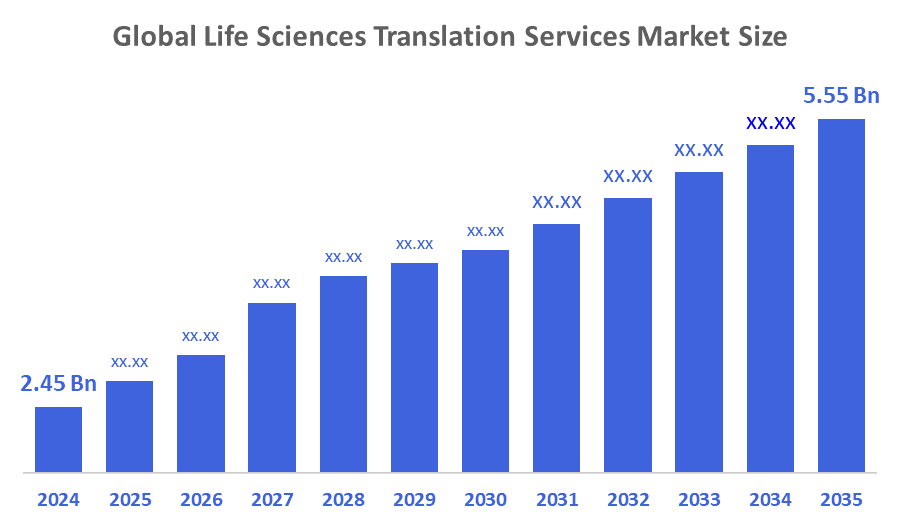
According to a Research Report Published by Decisions Advisors and Consulting, The Global Life Sciences Translation Services Market Size was worth around USD 2.45 Billion in 2024 and is predicted to Grow to around USD 5.55 Billion by 2035 with a compound annual growth rate (CAGR) of 7.72% from 2025 to 2035. Patient-centric communication is becoming more and more popular in the market for life sciences translation services. Translation of information that directly affects patient comprehension and involvement is being given top priority by organisations. The market is expanding due to several factors, including the increased need for clinical trials, the necessity for GCP and regulatory compliance, and the globalisation of the life sciences sector.
Market Overview
The worldwide life sciences translation services market includes specialised linguistic services that cater to the pharmaceutical, biotechnology, medical device, and healthcare sectors. These services provide accurate translations of challenging documents such as clinical trial protocols, regulatory submissions, patient information leaflets, scientific publications, and technical manuals, thus ensuring compliance with standards like ISO 17100 and regulatory bodies like the FDA or EMA. Core Components such as experts who are scientists or medical professionals, and advanced tools like AI, driven terminology management and computer, and computer-assisted translation (CAT) software to retain the accuracy of the text in different languages. The major segments comprise technical translations (e.g., patents), clinical/document translations, and regulatory filings that are made available to clients from pharmaceutical manufacturers to CROs. Additionally, the need for language translation services has expanded due to globalisation and the growth of virtual medical practices. Video Remote Interpretation (VRI), which offers contextual and non-verbal cues in addition to a workable solution for multilingual patient communication and on-demand access, has become indispensable. Therefore, the need for culturally appropriate medical marketing interpretations increases as life sciences companies enter foreign markets, which is anticipated to accelerate the market's growth.
Report Coverage
This research report categorises the life sciences translation services market based on various segments and regions, forecasts revenue growth, and analyzes trends in each submarket. The report analyses the key growth drivers, opportunities, and challenges influencing the life sciences translation services market. Recent market developments and competitive strategies, such as expansion, product launch, development, partnership, merger, and acquisition, have been included to draw the competitive landscape in the market. The report strategically identifies and profiles the key market players and analyzes their core competencies in each sub-segment of the life sciences translation services market.
Driving Factors
The market for life sciences translation services has been undergoing significant changes recently that are largely attributable to the increased internationalisation of the pharmaceutical and biotechnology sectors. Moreover, to meet the expanding companies' needs, which are going out into various linguistic areas, the demand for accurate and culturally relevant translations has surged. This market includes a wide range of services such as document translation, clinical trial translations, and marketing materials localisation. Furthermore, technological advances, like artificial intelligence and machine learning, are still a minor part of the picture in terms of their ability to improve translation efficiency and accuracy, with human intervention still very much required in this field. Companies are increasingly recognising the importance of communication with patients and healthcare professionals, and this, in turn, requires translations of medical documents, patient information leaflets, and educational materials of a very high standard.
Restraining Factors
The market for life sciences translation services is constrained by high prices, complicated regulations, and a lack of specialist knowledge, all of which hinder acceptance and scalability. The intricacy of the regulatory requirements in different countries makes it even more necessary to use specialised translation services capable of addressing these challenges.
Market Segmentation
The life sciences translation services market share is classified into type, and category.
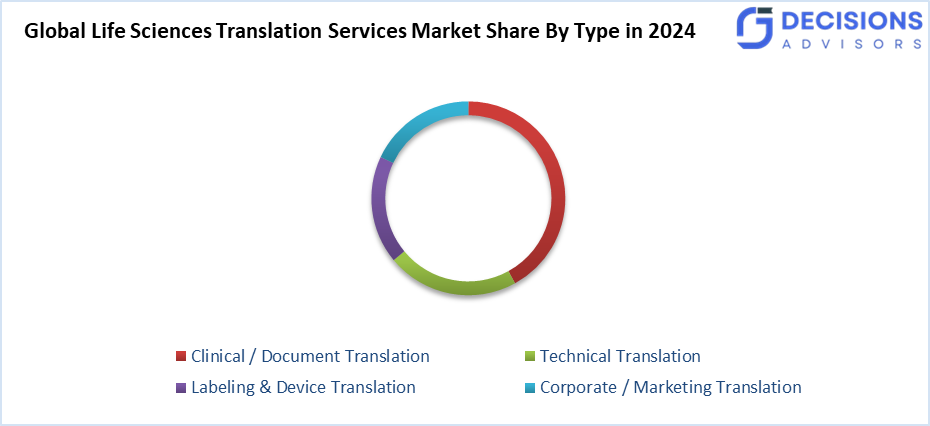
- The clinical/document translation segment accounted for a substantial share in 2024 and is projected to grow at a rapid pace over the forecast period.
Based on the type, the life sciences translation services market is segmented into clinical/document translation, technical translation, labeling and device translation, and corporate/marketing translation. Among these, the clinical/document translation segment accounted for a substantial share in 2024 and is projected to grow at a rapid pace over the forecast period. This is due to going global, and the demand for precise and culturally sensitive translations has risen. So, firms are putting more emphasis on localising their offerings to meet the needs of different markets and thus, improve their competitiveness. Further, the adoption of such a targeted method not only appeals to customers but also facilitates handling of intricate terminologies and regulatory requirements, thus, the growth of the segment.
- The technology segment accounted for the highest market revenue in 2024 and is anticipated to grow at a significant CAGR during the forecast period.
Based on the category, the life sciences translation services market is divided into manual, and technology/AI-based. Among these, the technology segment accounted for the highest market revenue in 2024 and is anticipated to grow at a significant CAGR during the forecast period. AI and machine learning technologies help and facilitate translation work with less effort and higher accuracy. AI-powered applications can manage large data with a high degree of accuracy and in a short period of time, which leads to quick and trustworthy translations of clinical trial documents, regulatory submissions, and other technical operations. This has caused the implementation of advanced services that are now more available to the public.
Regional Segment Analysis of the Life Sciences Translation Services Market
- North America (U.S., Canada, Mexico)
- Europe (Germany, France, U.K., Italy, Spain, Rest of Europe)
- Asia-Pacific (China, Japan, India, Rest of APAC)
- South America (Brazil and the Rest of South America)
- The Middle East and Africa (UAE, South Africa, Rest of MEA)
Asia Pacific is anticipated to hold the largest share of the life sciences translation services market over the predicted timeframe.
Asia Pacific is anticipated to hold the largest share of the Life Sciences Translation Services market over the predicted timeframe. The region's growth is primarily fueled by the booming healthcare infrastructure, an expanding pharmaceutical industry, and the escalating demand for clinical trials. China and India are notable leaders implementing numerous government policies that not only improve healthcare access but also stimulate innovation, thereby creating a greater need for translation services.
China stands as the biggest market in the region, followed by Japan and India. The competition includes local and international companies, such as Gengo and LanguageLine Solutions. These firms are actively seeking to utilise technology and AI to gain efficiency and accuracy in translation services while meeting the diverse linguistic needs of the region's population.
North America is expected to grow at a rapid CAGR in the life sciences translation services market during the forecast period. The expansion of the region is mainly attributed to the pharmaceutical sector, the increasing globalisation of clinical trials, and the strict regulatory requirements that demand accurate translations. The need for localisation services is also elevated by the rise of telehealth and digital health solutions, which require multilingual support to access different populations.
The United States is the largest market, followed by Canada, both presenting a competitive landscape with key players like TransPerfect, Lionbridge, and Welocalize. Besides, to fulfil the increasing need for specialised translation services, these companies use advanced technologies and a large network of linguists. The presence of regulatory bodies that ensure compliance and quality makes North America a centre for life sciences innovation.
Competitive Analysis:
The report offers the appropriate analysis of the key organizations/companies involved within the life sciences translation services market, along with a comparative evaluation primarily based on their product offering, business overviews, geographic presence, enterprise strategies, segment market share, and SWOT analysis. The report also provides an elaborative analysis focusing on the current news and developments of the companies, which includes product development, innovations, joint ventures, partnerships, mergers & acquisitions, strategic alliances, and others. This allows for the evaluation of the overall competition within the market.
List of Key Companies
- ALM Translations Ltd
- BayanTech.
- Conversis
- Crimson Interactive Inc.
- Language Scientific
- Lionbridge Technologies, LLC.
- marstranslation
- Morningside, Inc
- Stepes
- Vistatec
- Welocalize Life Sciences
- Others
Key Target Audience
- Market Players
- Investors
- End-users
- Government Authorities
- Consulting and Research Firm
- Venture capitalists
- Value-Added Resellers (VARs)
Recent Development
- In September 2025, Conversis’ new brand, website, and AI suite marked a strategic move to modernise life sciences translation services, offering faster, more scalable solutions while maintaining regulatory compliance. This positioned them strongly in a market where accuracy, speed, and compliance were non-negotiable.
- In June 2025, Sesen officially launched as a next-generation language services company dedicated exclusively to the life sciences industry, with a mission to advance global healthcare through specialised translation and localisation solutions. Sesen provides quick, precise, and completely compliant multilingual communications in more than 150 languages by fusing industry knowledge with state-of-the-art technology.
- In May 2025, PubHive launched an AI-powered translation capability within its Navigator platform to streamline global pharmacovigilance (PV), medical affairs, and regulatory workflows. This innovation enables life sciences teams to translate local-language scientific literature into English seamlessly, reducing costs and improving compliance.
Market Segment
This study forecasts revenue at global, regional, and country levels from 2020 to 2035. Decisions Advisors has segmented the life sciences translation services market based on the below-mentioned segments:
Global Life Sciences Translation Services Market, By Type
- Clinical/Document Translation
- Technical Translation
- Labelling and Device Translation
- Corporate/Marketing Translation
Global Life Sciences Translation Services Market, By Category
- Manual
- Technology
Global Life Sciences Translation Services Market, By Regional Analysis
- North America
- US
- Canada
- Mexico
- Europe
- Germany
- UK
- France
- Italy
- Spain
- Russia
- Rest of Europe
- Asia Pacific
- China
- Japan
- India
- South Korea
- Australia
- Rest of Asia Pacific
- South America
- Brazil
- Argentina
- Rest of South America
- Middle East & Africa
- UAE
- Saudi Arabia
- Qatar
- South Africa
- Rest of the Middle East & Africa
Frequently Asked Questions (FAQ)
- What is the current market size?
The market was valued at USD 2.45 billion in 2024.
- What is the projected market size by 2035?
It is expected to reach USD 5.55 billion by 2035.
- What is the forecasted CAGR?
The market is projected to grow at a CAGR of 7.72% from 2025 to 2035.
- Which region holds the largest market share?
Asia Pacific is anticipated to hold the largest share, driven by expanding healthcare and pharmaceuticals in China and India.
- Which region will grow the fastest?
North America is expected to grow at the fastest CAGR, fueled by clinical trials and regulatory demands in the US and Canada.
- What are the main market segments by type?
Segments include Clinical/Document Translation, Technical Translation, Labelling and Device Translation, and Corporate/Marketing Translation. Clinical/Document Translation held the largest share in 2024.
- What are the categories by approach?
The market is divided into Manual and Technology (AI-based). The Technology segment generated the highest revenue in 2024 and is set for strong growth.
- Who are some key players?
Major companies include Lionbridge Technologies, Welocalize Life Sciences, TransPerfect, Conversis, and Language Scientific.
Check Licence
Choose the plan that fits you best: Single User, Multi-User, or Enterprise solutions tailored for your needs.
We Have You Covered
- 24/7 Analyst Support
- Clients Across the Globe
- Tailored Insights
- Technology Tracking
- Competitive Intelligence
- Custom Research
- Syndicated Market Studies
- Market Overview
- Market Segmentation
- Growth Drivers
- Market Opportunities
- Regulatory Insights
- Innovation & Sustainability
Report Details
| Scope | Global |
| Pages | 268 |
| Delivery | PDF & Excel via Email |
| Language | English |
| Release | Jan 2026 |
| Access | Download from this page |