
Global Lighting as a Service Market
 |
Author:
Kunal M
|
Pages:
235
|
Author:
Kunal M
|
Pages:
235
Global Lighting as a Service Market, Share By Component (Luminaires and Controls, Software & Communication Systems, and Services), By Application (Indoor and Outdoor), By End Use (Commercial, Industrial, and Municipal), and By Region (North America, Europe, Asia-Pacific, Latin America, Middle East & Africa), Analysis and Forecast 2026-2035.
CAGR
23.11%
REVENUE 2025
USD Billion 2.68
FORECAST 2035
USD Billion 21.44
REPORT COVERAGE
Global
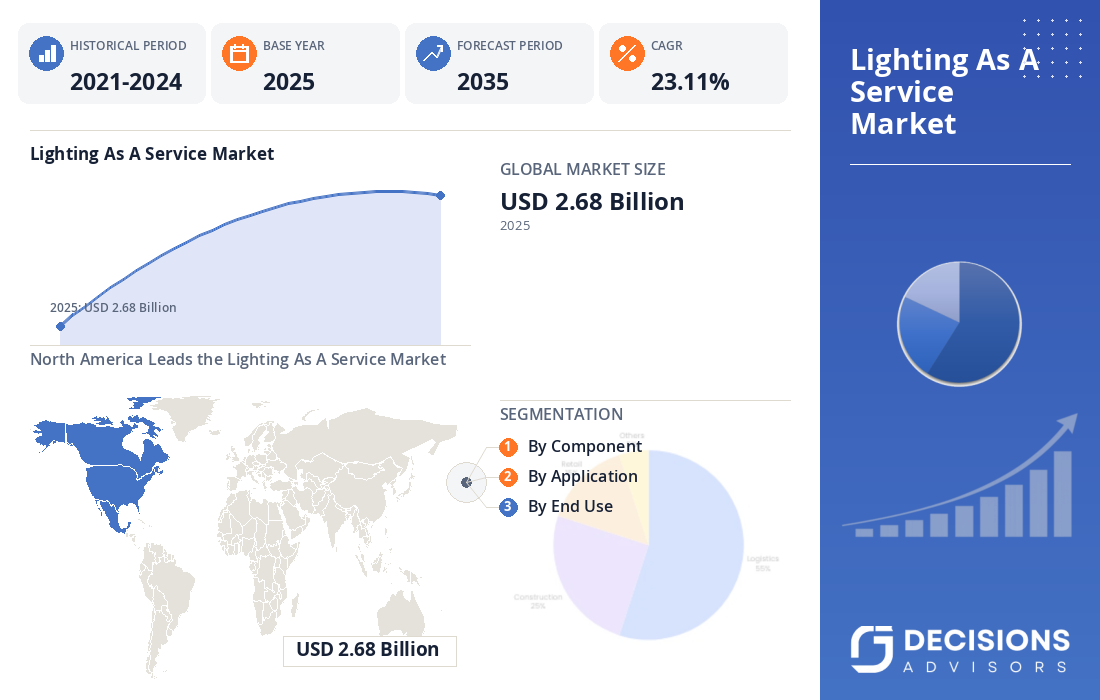
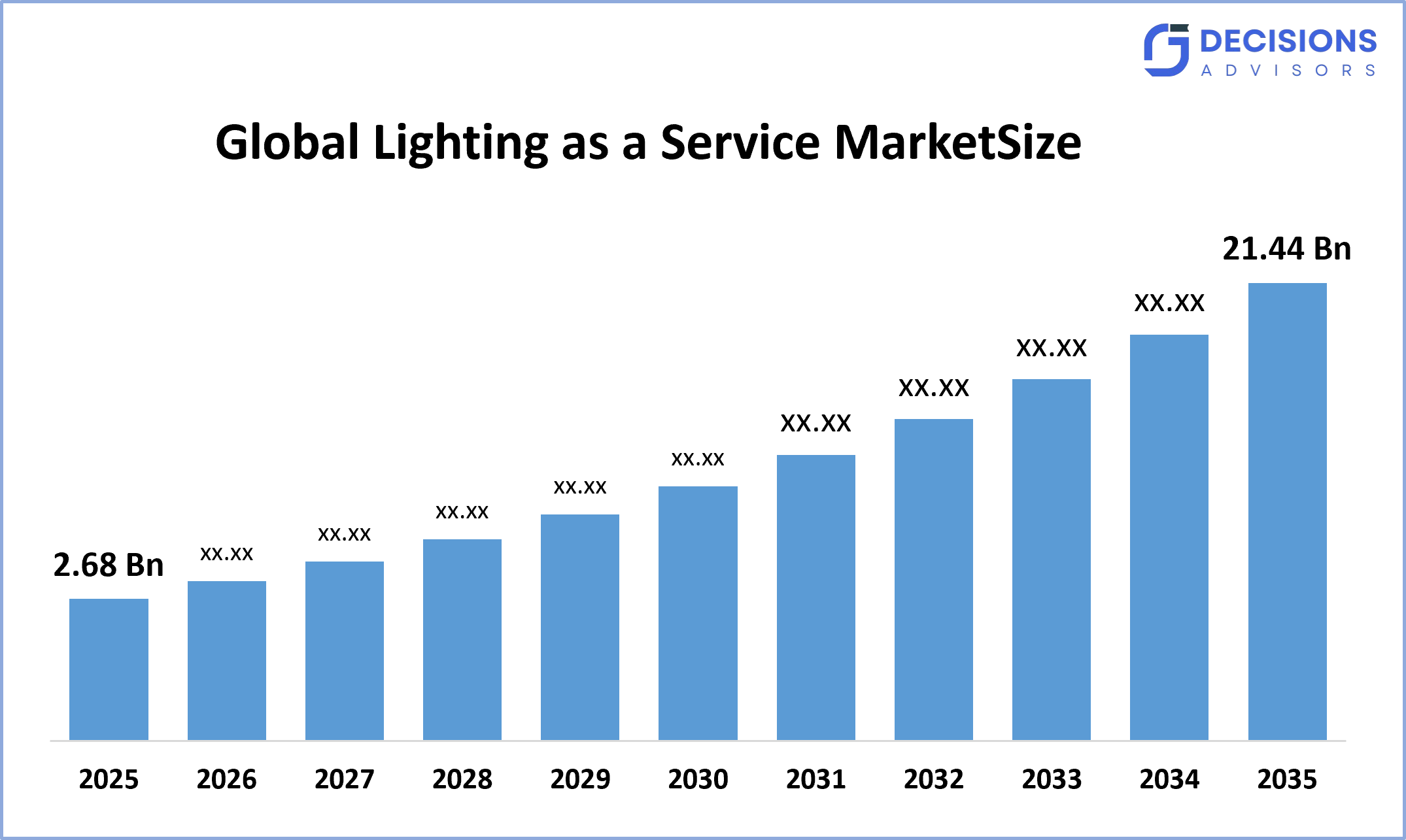
The Global Lighting as a Service Market Size is predicted to grow from USD 2.68 Billion in 2025 and is likely to reach around USD 21.44 Billion by 2035 with a CAGR of 23.11%. According to Decision Advisors, a detailed research report on the market reflects that the touchless sensing adoption trend dominates the Global Lighting as a Service Market, accounting for approximately 42% of the total share worldwide. Signify Holding leads the Global Lighting-as-a-Service Market, supported by its strong managed-services portfolio and extensive lighting solutions, making it a key contributor to the market’s development and competitive growth dynamics.
Market Snapshot
- :Global Lighting as a Service Market Size (2025): USD 2.68 Billion
- Projected Global Lighting as a Service Market Size (2035): USD 21.44 Billion
- Global Lighting as a Service Market Compound Annual Growth Rate (CAGR): 23.11%
- Largest Regional Market: North America
- 2nd Largest Region: Europe
- Fastest Growing Region: Asia Pacific
- Base Year: 2025
- Historical Period: 2021-2024
- Market Forecast Period: 2026-2035
Market Overview/ Introduction
The Global Lighting-as-a-Service Market refers to the industry that provides lighting solutions through service-based models, allowing customers to access energy-efficient lighting systems, controls, maintenance, and upgrades without making large upfront investments. The market is experiencing substantial growth because of increasing demand for energy-efficient lighting, smart building solutions, and reduced operational costs. Growing adoption of LED lighting, IoT-enabled systems, sensors, and connected lighting technologies is encouraging businesses and municipalities to shift toward service-based lighting models. Government initiatives focused on energy efficiency, carbon reduction, smart cities, and sustainable infrastructure are also creating favorable conditions for market expansion. Key companies, including Signify, Eaton, Acuity Brands, Zumtobel Group, and Cree Lighting, are developing advanced lighting solutions that integrate intelligent controls, automation, sensors, and cloud-based management platforms. The market provides customers with flexible lighting solutions that improve energy efficiency, reduce maintenance costs, and enhance lighting performance. The global market is expected to experience continued expansion through the development of smart buildings, connected infrastructure, IoT technologies, energy-management systems, and sustainable commercial and industrial facilities.
- A Government of India initiative that promotes energy-efficient LED lighting by making LED bulbs affordable and replacing conventional lighting. It supports the wider adoption of energy-efficient lighting solutions.
Notable Insights: -
- Asia Pacific is anticipated to hold approximately 38% share of the Global Lighting as a Service Market over the predicted timeframe.
- North America is expected to grow at a rapid CAGR in the Global Lighting as a Service Market by holding approximately 28% of the share during the forecast period.
- By type, the Luminaires and Controls segment dominated the market and holds approximately 42% share in 2025 and is projected to grow at a substantial CAGR during the forecast period.
- By application, the Indoor segment dominated the market and holds approximately 44% share in 2025 and is projected to grow at a substantial CAGR during the forecast period.
- The compound annual growth rate of the Global Lighting as a Service Market is 23.11%
- The market is likely to achieve a valuation of USD 21.44 Billion by 2035.
Market Drivers
The Global Lighting as a Service Market is experiencing significant growth due to the increasing demand for energy-efficient and cost-effective lighting solutions across commercial, industrial, and municipal facilities. The growing adoption of LED lighting, smart lighting systems, and connected lighting technologies encourages organizations to transition toward service-based lighting models that reduce upfront investment and maintenance expenses. The expansion of smart buildings and Internet of Things (IoT) ecosystems further supports demand for automated lighting controls, sensors, and cloud-based lighting management platforms. Government initiatives promoting energy efficiency, carbon reduction, and sustainable infrastructure are also driving market adoption. Increasing urbanization and smart-city development are creating opportunities for intelligent outdoor and municipal lighting solutions. In addition, businesses are increasingly seeking flexible lighting solutions that provide regular upgrades, maintenance, and improved energy performance. Growing awareness of operational cost savings, sustainability objectives, and advanced lighting automation is expected to further accelerate the adoption of Lighting as a Service worldwide during the forecast period.
Restrain
The Global Lighting as a Service Market faces challenges such as high initial implementation costs, complex system integration, cybersecurity concerns, and limited customer awareness of service-based lighting models.
Competitive Analysis:
The report offers the appropriate analysis of the key organizations/companies involved within the Global Lighting as a Service Market along with a comparative evaluation primarily based on their product offerings, business overviews, geographic presence, enterprise strategies, segment market share, and SWOT analysis. The report also provides an elaborative analysis focusing on the current news and developments of the companies, which includes product development, innovations, joint ventures, partnerships, mergers & acquisitions, strategic alliances, and others. This allows for the evaluation of the overall competition within the market.
Top Companies in the Global Lighting as a Service Market
- Signify Holding
- Acuity Brands, Inc.
- Eaton Corporation plc
- Zumtobel Group AG
- Honeywell International Inc.
- WESCO International, Inc.
- Cree Lighting
- Legrand SA
- Johnson Controls International plc
- GE Current, a Daintree company
Government Initiatives
|
Country |
Key Government Initiatives |
|
US |
The U.S. government, through the U.S. Department of Energy (DOE), supports energy-efficient lighting through LED research, development, and deployment initiatives. DOE programs promote improvements in LED efficiency and the adoption of advanced lighting technologies. |
|
Japan |
The Japanese government, through the Ministry of Economy, Trade and Industry (METI), is promoting the transition from fluorescent lighting to energy-efficient LED lighting. |
|
China |
Chinese government promotes energy efficiency through national energy-efficiency standards and labeling requirements for lighting products. In 2026, China's National Development and Reform Commission and State Administration for Market Regulation updated energy-efficiency labeling rules covering LED lighting products, including road. |
Market Segmentation
The Global Lighting as a Service Market share is classified into component, application, end use.
The Luminaires and Controls segment dominated the market and is expected to hold approximately 42% share in 2025 and is projected to grow at a substantial CAGR during the forecast period.
Based on component, the Global Lighting as a Service Market is divided into Luminaires and Controls, Software & Communication Systems, and Services. Among these, the Luminaires and Controls segment is expected to dominate the market, supported by the widespread transition from conventional lighting to energy-efficient LED systems and the increasing integration of controls, sensors, and connected technologies. Luminaires and controls form the core infrastructure of LaaS solutions, making them an important contributor to market growth.
The Indoor segment accounted for the largest share of approximately 51% in 2025 and is anticipated to grow at a significant CAGR during the forecast period.
Based on application, the market is divided into Indoor and Outdoor. Among these, the Indoor segment is expected to account for the largest share, driven by increasing adoption of energy-efficient and intelligent lighting solutions across offices, commercial buildings, industrial facilities, retail spaces, and other indoor environments. The growing deployment of smart building technologies, automated controls, and energy-management systems further supports segment growth.
The Commercial segment accounted for the largest share of approximately 44% in 2025 and is anticipated to grow at a significant CAGR during the forecast period.
Based on end use, the Global Lighting as a Service Market is divided into Commercial, Industrial, and Municipal. Among these, the Commercial segment is expected to dominate the market, supported by increasing adoption across offices, retail establishments, healthcare facilities, hospitality facilities, and other commercial buildings. Businesses are increasingly adopting Lighting as a Service to reduce energy consumption, lower maintenance costs, improve lighting performance, and avoid substantial upfront capital expenditure.
Regional Segment Analysis of the Global Lighting as a Service Market
- North America (U.S., Canada, Mexico)?
- Europe (Germany, France, U.K., Italy, Spain, Rest of Europe)
- Asia-Pacific (China, Japan, India, Rest of APAC)
- South America (Brazil and the Rest of South America)?
- The Middle East and Africa (UAE, South Africa, Rest of MEA)
Asia Pacific is anticipated to hold approximately 38% share of the Global Lighting as a Service Market over the predicted timeframe.
Asia Pacific holds approximately 38% share of the Global Lighting as a Service Market due to rapid urbanization, expanding commercial and industrial infrastructure, and increasing investments in smart-city development across China, Japan, India, South Korea, and other emerging economies. The region is witnessing growing adoption of energy-efficient LED lighting, connected lighting systems, and IoT-enabled building technologies. Government initiatives promoting energy conservation and sustainable infrastructure further support market expansion. In addition, the increasing development of smart buildings, industrial facilities, retail spaces, and municipal infrastructure is creating strong demand for service-based lighting solutions. The growing need to reduce energy consumption, maintenance expenses, and upfront capital expenditure is further encouraging businesses and municipalities to adopt Lighting as a Service models across the region.
North America is expected to grow at a rapid CAGR in the Global Lighting as a Service Market, holding approximately 28% of the share during the forecast period.
North America is expected to hold approximately 28% share of the Global Lighting as a Service Market during the forecast period, supported by the widespread adoption of LED lighting, smart building technologies, and connected lighting management systems. The region benefits from strong demand across commercial, industrial, and municipal facilities seeking to improve energy efficiency and reduce operational costs. Government energy-efficiency programs and sustainability initiatives further encourage organizations to upgrade conventional lighting infrastructure. Additionally, the growing deployment of IoT-enabled lighting controls, cloud-based management platforms, occupancy sensors, and automated lighting systems is supporting market growth. Increasing investments in smart buildings and energy-management solutions across the United States and Canada are expected to strengthen the adoption of Lighting as a Service.
Europe is expected to be a significant regional market in the Global Lighting as a Service Market during the forecast period, holding approximately 23% share.
Europe is expected to hold approximately 23% share of the Global Lighting as a Service Market due to strong emphasis on energy efficiency, carbon reduction, and sustainable building infrastructure. Countries such as Germany, France, the UK, and Italy are increasingly adopting LED lighting, intelligent controls, and connected lighting solutions across commercial, industrial, and municipal facilities. Stringent energy-efficiency regulations and sustainability targets are encouraging organizations to modernize conventional lighting systems and reduce electricity consumption. The growing development of smart buildings and smart cities is also increasing demand for automated lighting management and energy-monitoring solutions. Furthermore, the region's focus on reducing operational costs and improving environmental performance is expected to support continued adoption of Lighting as a Service models throughout the forecast period.
Future Market Trends in Global Lighting as a Service Market: -
-
- Expansion of Smart and Connected Lighting Systems
The adoption of smart and connected lighting systems is expected to increase as businesses and municipalities seek greater energy efficiency, automation, and operational control. IoT-enabled luminaires, sensors, wireless controls, and cloud-based platforms allow users to monitor and manage lighting remotely. Integration with building management systems is further improving energy optimization and enabling predictive maintenance. This trend is expected to accelerate the adoption of Lighting as a Service models globally.
-
- AI-Enabled Lighting Management and Automation
Artificial intelligence is increasingly being integrated into lighting management platforms to optimize energy consumption, occupancy-based lighting, maintenance schedules, and system performance. AI-enabled solutions can analyze real-time data from sensors and automatically adjust lighting according to occupancy, daylight availability, and usage patterns. This improves operational efficiency, reduces energy costs, and supports more intelligent building environments, creating new opportunities for Lighting as a Service providers.
-
- Growth in Smart Buildings and Sustainable Infrastructure
The expansion of smart buildings and sustainable infrastructure is expected to significantly increase demand for Lighting as a Service. Commercial offices, retail facilities, healthcare buildings, hotels, and industrial sites are adopting connected lighting solutions to achieve energy savings and sustainability objectives. Government policies targeting carbon reduction and energy efficiency are also encouraging organizations to modernize existing lighting infrastructure. Service-based models can help customers implement these upgrades with reduced upfront capital requirements.
-
- Rising Adoption of Energy-Efficient and Service-Based Lighting
The continued transition from conventional lighting to LED and highly efficient connected lighting is expected to remain a major market trend. Organizations are increasingly seeking solutions that combine installation, financing, maintenance, monitoring, and technology upgrades under a single service model. Lighting as a Service enables customers to access modern lighting infrastructure while reducing upfront expenditure and ongoing maintenance requirements. Growing focus on lifecycle cost savings and sustainability is expected to further strengthen demand worldwide.
Recent Development
- In August 2025, Acuity Brands highlighted the expansion of its intelligent lighting portfolio, including new lighting solutions recognized in the 2025 IES Progress Report. The developments demonstrate continued innovation in connected, efficient, and digitally managed lighting systems.
- In January 2025, Signify introduced a generative AI assistant for Philips Hue, enabling users to create personalized lighting scenes through text or voice commands based on mood, occasion, or preferred style. This development highlights the growing integration of AI with smart and connected lighting systems.
Market Segment
This study forecasts revenue at global, regional, and country levels from 2020 to 2035. Decision Advisors has segmented the Global Lighting as a Service Market based on the below-mentioned segments:
Global Lighting as a Service Market, By Component
- Luminaires and Controls
- Software & Communication Systems
- Services
Global Lighting as a Service Market, By Application
- Indoor
- Outdoor
Global Lighting as a Service Market, By End Use
- Commercial
- Industrial
- Municipal
Global Lighting as a Service Market, By Regional Analysis
- North America
- US
- Canada
- Mexico
- Europe
- Germany
- UK
- France
- Italy
- Spain
- Russia
- Rest of Europe
- Asia Pacific
- China
- Japan
- India
- South Korea
- Australia
- Rest of Asia Pacific
- South America
- Brazil
- Argentina
- Rest of South America
- Middle East & Africa
- UAE
- Saudi Arabia
- Qatar
- South Africa
- Rest of Middle East & Africa
Frequently Asked Questions (FAQ)
Q. What is Lighting as a Service (LaaS)?
A. Lighting as a Service is a service-based model in which customers obtain lighting infrastructure, installation, maintenance, monitoring, upgrades, and related services without making a large upfront investment in lighting equipment.
Q. Why are businesses adopting Lighting as a Service solutions?
A. Businesses are adopting LaaS to reduce upfront capital expenditure, lower energy and maintenance costs, improve lighting performance, and gain access to modern LED, connected, and intelligent lighting technologies.
Q. How are smart buildings driving the Lighting as a Service Market?
A. The expansion of smart buildings is increasing demand for connected luminaires, sensors, automated controls, and cloud-based lighting management systems. These technologies enable real-time monitoring, occupancy-based control, energy optimization, and remote maintenance.
Q. What role does IoT play in Lighting as a Service?
A. IoT enables lighting systems to connect with sensors, communication networks, and cloud platforms, allowing users to remotely monitor and control lighting, collect operational data, optimize energy consumption, and identify maintenance requirements.
Q. How is Lighting as a Service supporting sustainability?
A. LaaS supports sustainability by encouraging the replacement of conventional lighting with energy-efficient LED systems and intelligent controls. Reduced electricity consumption, longer equipment lifecycles, and optimized maintenance can help organizations achieve energy and carbon-reduction objectives.
Check Licence
Choose the plan that fits you best: Single User, Multi-User, or Enterprise solutions tailored for your needs.
We Have You Covered
- 24/7 Analyst Support
- Clients Across the Globe
- Tailored Insights
- Technology Tracking
- Competitive Intelligence
- Custom Research
- Syndicated Market Studies
- Market Overview
- Market Segmentation
- Growth Drivers
- Market Opportunities
- Regulatory Insights
- Innovation & Sustainability
Report Details
| Scope | Global |
| Pages | 235 |
| Delivery | PDF & Excel via Email |
| Language | English |
| Release | Aug 2026 |
| Access | Download from this page |