
Global Lighting Control System Market
 |
Author:
Shruti G
|
Pages:
220
|
Author:
Shruti G
|
Pages:
220
Global Lighting Control System Market Size, Share, By Offering (Hardware, Software, and Services), By Communication Protocol (Wired and Wireless), By Installation Type (New Installation and Retrofit), By Application (Indoor and Outdoor), By End User (Commercial, Residential, Industrial, and Public Infrastructure), and By Region (North America, Europe, Asia-Pacific, South America, and Middle East & Africa), Analysis and Forecast 2026?2035.
CAGR
14.28%
REVENUE 2025
USD Billion 41.93
FORECAST 2035
USD Billion 158.75
REPORT COVERAGE
Global
The Global Lighting Control System Market was valued at approximately USD 44.07 Billion in 2025 and is expected to reach approximately USD 158.75 Billion by 2035, expanding at a CAGR of around 14.28% during the forecast period. The market is witnessing strong growth due to increasing adoption of energy-efficient lighting technologies, rapid deployment of LED lighting, growing smart-building construction, increasing demand for connected lighting solutions, government energy-efficiency regulations, expansion of smart-city infrastructure, and rising demand for automated lighting management. Lighting control systems include hardware, software, and services that enable users to control, automate, monitor, and optimize indoor and outdoor lighting. These systems incorporate sensors, dimmers, switches, controllers, gateways, LED drivers, networked control platforms, and cloud-based software. Modern lighting control systems increasingly integrate with building management systems, HVAC systems, security infrastructure, Internet of Things platforms, and energy-management solutions.
Market Snapshot
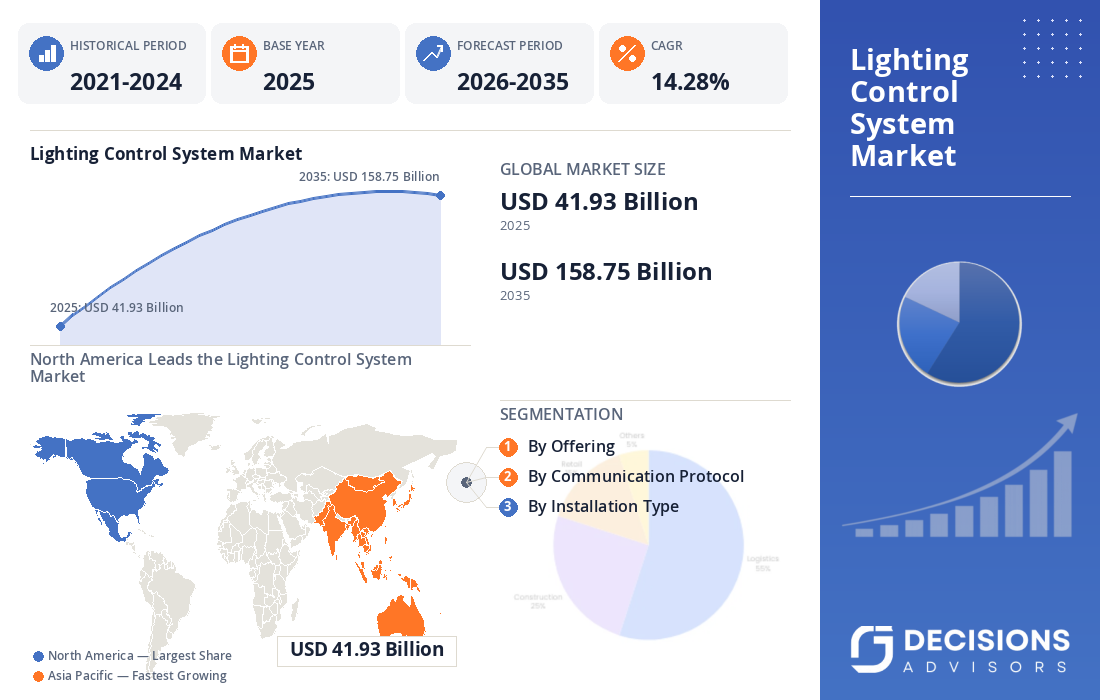
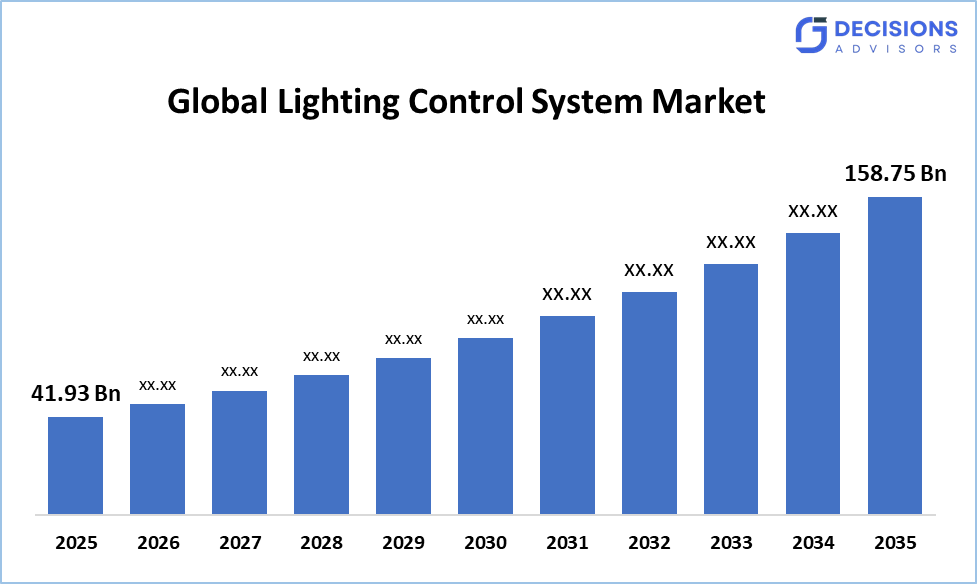
- Global Lighting Control System Market Size (2025): USD 41.93 Billion
- Projected Market Size (2035): USD 158.75 Billion
- Global Market CAGR (2026–2035): 14.28%
- Largest Regional Market: North America
- 2nd Largest Region: Europe
- Fastest Growing Region: Asia-Pacific
- Base Year: 2025
- Historical Period: 2021–2024
- Forecast Period: 2026–2035
Market Overview/ Introduction
The Global Lighting Control System Market encompasses technologies and solutions designed to automatically control, regulate, monitor, and optimize lighting systems across residential, commercial, industrial, and public environments. Lighting control systems include hardware such as sensors, dimmers, switches, relays, gateways, controllers, and LED drivers, along with software platforms and professional services. Modern lighting control systems enable functions such as automated switching, dimming, occupancy detection, daylight harvesting, scheduling, remote monitoring, energy management, scene control, and predictive maintenance. These systems can be deployed using wired or wireless communication protocols and can increasingly be integrated with smart-building platforms and building management systems. The growing adoption of LED lighting is creating additional opportunities because LED luminaires can be easily integrated with digital controls, sensors, wireless networks, and automation platforms. At the same time, building owners are increasingly investing in lighting-control retrofits to reduce electricity consumption without replacing entire building infrastructures.
- The U.S. governments and regulatory authorities across major economies are strengthening energy-efficiency standards and building-performance requirements, supporting demand for intelligent lighting technologies.
- Several Asia-Pacific countries are increasing investments in smart cities, commercial infrastructure, industrial facilities, and energy-efficient buildings, creating substantial opportunities for connected lighting controls.
Notable Insights: -
- North America maintains a leading position in the Global Lighting Control System Market due to mature smart-building infrastructure, energy-efficiency regulations, commercial retrofit activity, and strong adoption of connected lighting solutions.
- Asia-Pacific is expected to experience strong growth due to rapid urbanization, infrastructure development, smart-city investments, expanding commercial construction, and increasing adoption of LED and wireless lighting controls.
- Hardware represents a major market segment because sensors, dimmers, switches, controllers, gateways, and LED drivers form the core infrastructure of lighting control systems.
- Wireless communication is gaining importance because wireless systems can simplify installation and are particularly attractive for retrofit projects where extensive rewiring may be expensive or disruptive.
- Commercial applications represent a major end-user segment because offices, retail facilities, hotels, healthcare facilities, and other commercial buildings have substantial opportunities for energy savings and automated lighting management.
- Retrofit installations are becoming increasingly important as building owners seek to upgrade existing lighting infrastructure with smart controls, sensors, and connected management platforms.
Market Drivers
The Global Lighting Control System Market is primarily driven by increasing demand for energy-efficient buildings and growing adoption of intelligent building technologies. Lighting represents an important component of building electricity consumption, encouraging businesses and property owners to deploy automated controls that reduce unnecessary lighting usage. The rapid expansion of LED lighting is another major growth driver. LED systems offer high energy efficiency and can be combined with dimming, occupancy sensing, daylight harvesting, scheduling, and networked controls. This combination allows organizations to achieve greater energy savings while improving lighting quality and operational flexibility.
Restrain
The Global Lighting Control System Market faces several challenges, including high initial installation costs, interoperability issues, cybersecurity concerns, complex system integration, lack of skilled installation professionals, and uncertainty regarding return on investment for smaller projects. Advanced lighting control systems may require sensors, gateways, network infrastructure, software platforms, and professional installation services, increasing upfront costs compared with conventional switches and lighting systems. Integration with existing building-management infrastructure can also increase project complexity. Wireless systems may introduce additional concerns related to network reliability, cybersecurity, device interoperability, and communication standards. In addition, smaller businesses and residential customers may be reluctant to adopt advanced systems when the initial investment appears high relative to expected energy savings.
Competitive Analysis:
The report offers the appropriate analysis of the key organizations/companies involved within the Global Lighting Control System Market, along with a comparative evaluation primarily based on their product offerings, business overviews, geographic presence, enterprise strategies, segment market share, and SWOT analysis. The report also provides an elaborative analysis focusing on the current news and developments of the companies, which includes product development, innovations, joint ventures, partnerships, mergers & acquisitions, strategic alliances, and others. This allows for the evaluation of the overall competition within the market.
Top Companies in the Global Lighting Control System Market
- Signify N.V.
- Acuity Brands, Inc.
- Lutron Electronics Co., Inc.
- Schneider Electric SE
- Legrand S.A.
- Eaton Corporation plc
- Honeywell International Inc.
- Siemens AG
- Hubbell Incorporated
- ams OSRAM AG
Government Initiatives
|
Country |
Key Government Initiatives |
|
Us |
Energy-efficiency standards, building-performance initiatives, smart-building programs, and energy-saving policies are encouraging adoption of efficient lighting and connected control technologies. |
|
Germany |
European and national energy-efficiency, building decarbonization, smart-building, and digitalization initiatives are supporting intelligent lighting deployments. |
|
China |
Smart-city development, energy-efficient infrastructure, green-building programs, and modernization of public infrastructure are supporting demand for connected lighting systems. |
Market Segmentation
The Global Lighting Control System Market is classified into offering, communication protocol, installation type, application, end user, and region.
The Hardware Segment Dominates the Market
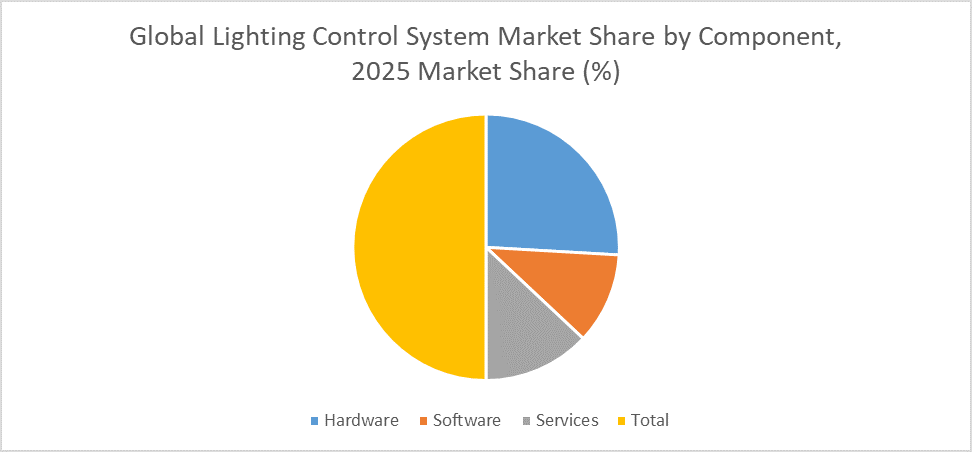
Based on offering, the market is divided into Hardware, Software, and Services. Among these, the Hardware segment represents a major portion of the market because lighting control installations require physical components such as sensors, dimmers, switches, relay units, controllers, gateways, and LED drivers. The growing installation of connected lighting infrastructure across commercial buildings, residential properties, industrial facilities, and public infrastructure continues to support hardware demand.
- The Wireless Segment is Expected to Witness Strong Growth
Based on communication protocol, the market is divided into Wired and Wireless. Wired lighting-control systems continue to have a strong installed base because of their reliability and established use in commercial and industrial buildings. However, wireless controls are expected to experience strong growth due to easier installation, reduced cabling requirements, and increasing demand for smart-building retrofits. Wireless technology is particularly attractive for existing buildings where installing new wiring can be costly and disruptive.
- The Retrofit Segment Accounts for a Significant Share
Based on installation type, the market is divided into New Installation and Retrofit. The Retrofit segment represents an important market opportunity as building owners increasingly upgrade conventional lighting systems with LED luminaires, sensors, dimmers, wireless controls, and centralized management platforms. Retrofit solutions enable energy savings and improved lighting management without requiring complete reconstruction of existing buildings.
Regional Segment Analysis of the Global Lighting Control System Market
- North America (U.S., Canada, Mexico)
- Europe (Germany, U.K., France, Italy, Spain, Netherlands, Rest of Europe)
- Asia-Pacific (China, Japan, India, Australia, South Korea, Rest of Asia-Pacific)
- South America (Brazil, Argentina, Rest of South America)
- Middle East & Africa (UAE, Saudi Arabia, South Africa, Rest of MEA)
North America Maintains a Leading Share of the Global Lighting Control System Market in 2025
North America maintains a leading position in the Global Lighting Control System Market due to the region's established smart-building ecosystem, strong commercial retrofit activity, mature LED infrastructure, energy-efficiency regulations, and high adoption of connected building technologies. The U.S. represents a particularly important market because commercial property owners, utilities, and building operators are increasingly adopting energy-management technologies that combine lighting controls with broader building automation systems. Recent market research also identifies North America as the largest regional market.
Europe Holds a Significant Share of the Global Lighting Control System Market in 2025
Europe holds a significant share of the Global Lighting Control System Market, supported by stringent energy-efficiency requirements, sustainability initiatives, smart-building development, and increasing adoption of connected infrastructure. Countries including Germany, the U.K., France, Italy, and the Netherlands are investing in energy-efficient buildings, intelligent infrastructure, and digital building-management systems. The transition toward low-energy buildings is expected to support continued demand for automated lighting systems.
Asia-Pacific Witnesses Substantial Growth in 2025
Asia-Pacific is expected to experience substantial growth due to rapid urbanization, infrastructure development, smart-city programs, expanding commercial construction, industrialization, and increasing demand for energy-efficient technologies. China, India, Japan, South Korea, and Australia are strengthening smart infrastructure and energy-efficient building capabilities. The increasing construction of commercial buildings and smart-city infrastructure is expected to create significant opportunities for lighting-control manufacturers.
Future Market Trends in Global Lighting Control System Market: -
- Expansion of Smart Building Integration
Lighting control systems are increasingly being integrated with building management systems, HVAC, security, access control, and energy-management platforms. This integration enables centralized monitoring and optimization of building operations. - Growth of Wireless Lighting Controls
Wireless controls are expected to gain greater adoption because they reduce wiring requirements and simplify installation, particularly in retrofit applications. - Rising Adoption of IoT-Enabled Lighting
Internet of Things technologies are transforming lighting from a basic illumination system into an intelligent infrastructure platform capable of collecting data and responding automatically to occupancy, daylight, schedules, and energy conditions. - Increasing Demand for AI and Data Analytics
AI-enabled lighting systems are expected to use occupancy patterns, energy consumption data, and environmental information to optimize lighting schedules and improve building efficiency.
Recent Development
- In November 2025, Acuity Brands announced the acquisition of Distech Controls for approximately USD 400 million, strengthening its building-automation capabilities and expanding integration between lighting and building-management technologies.
- In July 2025, Lutron Electronics introduced developments to its Athena lighting-control platform, incorporating advanced automation and intelligent control capabilities.
- In February 2025, ams OSRAM announced investment in an LED and sensor manufacturing facility in Penang, Malaysia, supporting the growing demand for LED and sensor technologies in Asia-Pacific.
Market Segment
This study forecasts revenue at global, regional, and country levels from 2026 to 2035. Decision Advisors has segmented the Global Lighting Control System Market based on the below-mentioned segments:
Global Lighting Control System Market, By Offering
- Hardware
- Software
- Services
- Others
Global Lighting Control System Market, By Communication Protocol
- Wired
- Wireless
- Others
Global Lighting Control System Market, By Installation Type
- New Installation
- Retrofit
Global Lighting Control System Market, By Regional Analysis
- North America
- US
- Canada
- Mexico
- Europe
- Germany
- UK
- France
- Italy
- Spain
- Russia
- Rest of Europe
- Asia Pacific
- China
- Japan
- India
- South Korea
- Australia
- Rest of Asia Pacific
- South America
- Brazil
- Argentina
- Rest of South America
- Middle East & Africa
- UAE
- Saudi Arabia
- Qatar
- South Africa
- Rest of the Middle East & Africa
Frequently Asked Questions (FAQ)
- What is driving the growth of the Global Lighting Control System Market?
The market is primarily driven by increasing demand for energy-efficient buildings, LED adoption, smart-building technologies, smart-city development, commercial building retrofits, wireless controls, and integration with building-management systems.
- Why are businesses adopting lighting control systems?
Businesses adopt lighting controls to reduce electricity consumption, lower operating costs, automate lighting operations, improve occupant comfort, enhance energy management, and support sustainability objectives.
- What role do LED technologies play in the Lighting Control System Market?
LED lighting provides an important foundation for intelligent lighting because LEDs can be easily integrated with dimming, occupancy sensors, daylight harvesting, wireless controls, and automated management platforms.
- How are wireless technologies influencing the Lighting Control System Market?
Wireless technologies simplify installation, reduce cabling requirements, and are particularly attractive for retrofit projects. They also support connected-building and IoT applications.
Check Licence
Choose the plan that fits you best: Single User, Multi-User, or Enterprise solutions tailored for your needs.
We Have You Covered
- 24/7 Analyst Support
- Clients Across the Globe
- Tailored Insights
- Technology Tracking
- Competitive Intelligence
- Custom Research
- Syndicated Market Studies
- Market Overview
- Market Segmentation
- Growth Drivers
- Market Opportunities
- Regulatory Insights
- Innovation & Sustainability
Report Details
| Scope | Global |
| Pages | 220 |
| Delivery | PDF & Excel via Email |
| Language | English |
| Release | Aug 2026 |
| Access | Download from this page |