
Global Liquefied Petroleum Gas (LPG) Market
 |
Pages:
193
|
Pages:
193
Global Liquefied Petroleum Gas (LPG) Market Size, Share, and COVID-19 Impact Analysis, By Source (Associated Gas, and Non-associated Gas), By Supply Mode (Packaged, Bulk, and On-site) By End Use (Residential, Commercial, Refinery and Petrochemical, Transportation, and Others), and By Region (North America, Europe, Asia-Pacific, Latin America, Middle East, and Africa), Analysis and Forecast 2025 - 2035
REPORT COVERAGE
Global
Global Liquefied Petroleum Gas (LPG) Market Size Insights Forecasts to 2035
- The Global Liquefied Petroleum Gas (LPG) Market Size Was Estimated at USD 120.45 Billion in 2024
- The Market Size is Expected to Grow at a CAGR of around 4.83 % from 2025 to 2035
- The Worldwide Liquefied Petroleum Gas (LPG) Market Size is Expected to Reach USD 202.45 Billion by 2035
- North America is expected to Grow the fastest during the forecast period.
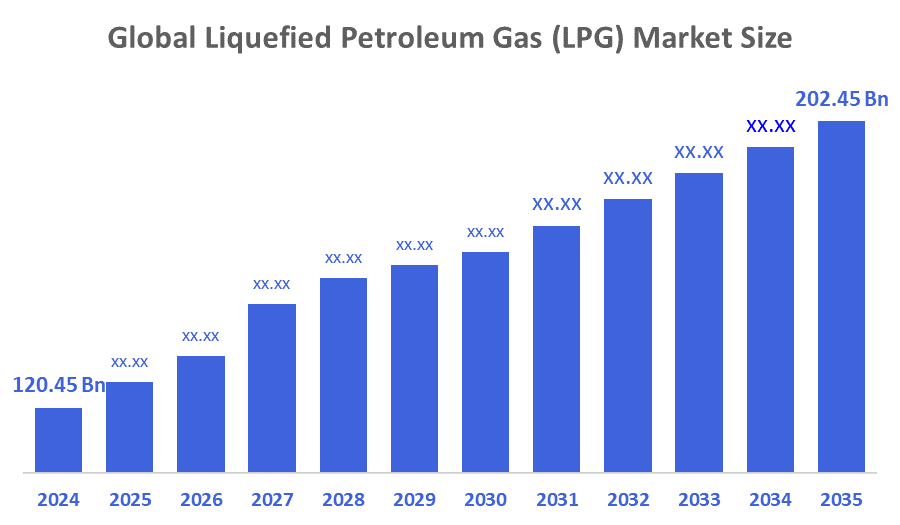
According to a Research Report Published by Decisions Advisors and Consulting, The Global Liquefied Petroleum Gas (LPG) Market Size was worth around USD 120.45 Billion in 2024 and is predicted to Grow to around USD 202.45 Billion by 2035 with a compound annual growth rate (CAGR) of 4.83 % from 2025 to 2035. The rise of the liquefied petroleum gas sector is being driven by the growing need for low-emission energy sources to reduce urban air pollution and meet carbon neutrality targets. Adoption is being accelerated by the abundance of natural gas feedstock, continuous refinery improvements, and government-led programs to increase LPG distribution infrastructure, particularly in emerging nations.
Market Overview
Propane, another name for liquefied petroleum gas, is a flammable hydrocarbon gas that is frequently used as a sulfur-free, non-toxic fuel. Propane (C3H8) and butane (C4H10) make up the majority, with trace amounts of other hydrocarbons. For enterprises situated in regions without pipeline gas supplies, LPG is a highly portable fuel and adaptable energy source due to its ease of storage. Because it burns with less carbon and sulfur emissions and is hence environmentally beneficial, it is favoured over several other energy sources. In process industries, LP gas is frequently used to power boilers that produce steam and boil water. Its high flash point and low greenhouse gas emissions also make it employed as a residential cooking gas. Artificial Intelligence (AI) integration is a game-changer in the quickly changing technological landscape. By increasing operational efficiency, improving safety and risk mitigation, boosting sustainability, and optimising supply chain logistics, AI is greatly accelerating the growth of the Liquefied Petroleum Gas (LPG) tanker market. Predictive analytics powered by AI enables ongoing cargo condition monitoring to improve efficiency and safety. AI systems effectively examine sensor data to anticipate equipment faults before they happen, which minimises maintenance expenses and downtime. Real-time analysis of weather patterns, sea currents, and vessel performance is possible with AI-powered systems.
About 3–4% of the world's primary energy consumption comes from LPG, which is a component of the oil and gas energy mix (estimated industry range).
India’s LPG production has surged by 25% in March 2026 after the government ordered refineries and petrochemical complexes to divert propane, butane, propylene, and butenes into the LPG pool. This emergency measure, taken under the Essential Commodities Act, ensures a steady household supply amid disruptions linked to the Iran–Israel conflict.
Report Coverage
This research report categorises the liquefied petroleum gas (LPG) market based on various segments and regions, forecasts revenue growth, and analyses trends in each submarket. The report analyses the key growth drivers, opportunities, and challenges influencing the liquefied petroleum gas (LPG) market. Recent market developments and competitive strategies, such as expansion, product launch, development, partnership, merger, and acquisition, have been included to draw the competitive landscape in the market. The report strategically identifies and profiles the key market players and analyses their core competencies in each sub-segment of the liquefied petroleum gas (LPG) market.
Driving Factors
The market for liquefied petroleum gas is presently going through a dynamic era marked by changing consumer demands and legal frameworks. The use of LPG as a practical substitute for conventional fuels has significantly increased as a result of the transition to greener energy sources. Additionally, technological developments are improving the effectiveness of LPG production and delivery, making it more widely available. Consequently, the market is seeing an increase in demand in a number of sectors, including commercial, industrial, and residential applications. The market for liquefied petroleum gas is impacted by supply chain dynamics and geopolitical issues in addition to environmental advantages. With the help of global clean cooking programs, the continuous transition in developing nations from biomass and kerosene to LPG continues to create important growth opportunities. Moreover, its potential for near-carbon-neutral emissions and compatibility with current infrastructure make renewable LPG (bio-LPG) a game-changing option. Furthermore, LPG's incorporation into distributed energy systems and hybrid microgrids is generating new uses in off-grid and rural markets.
Aegis Vopak Terminals Limited (AVTL) has announced a major greenfield terminal development at Mumbai’s Jawaharlal Nehru Port Authority (JNPA), with phased commissioning starting mid?2026. The project will add large-scale LPG and liquid product storage capacity, strengthening India’s energy infrastructure and serving the fast-growing western and central hinterland.
Restraining Factors
However, the market is constrained by several factors, including price volatility associated with changes in crude oil prices and geopolitical risks that impact international LPG supply chains. Access and affordability may be hampered by high distribution and transportation expenses, particularly in rural and isolated areas. Despite continuous advancements in cylinder design and safety regulations, handling and storage safety issues continue to be problems in developing countries. Regional variations in regulations, especially those about taxes, subsidies, and emission requirements, can divide markets and impede the uniformity of international trade.
Market Segmentation
The liquefied petroleum gas (LPG) market share is classified into source, supply mode, and end use.
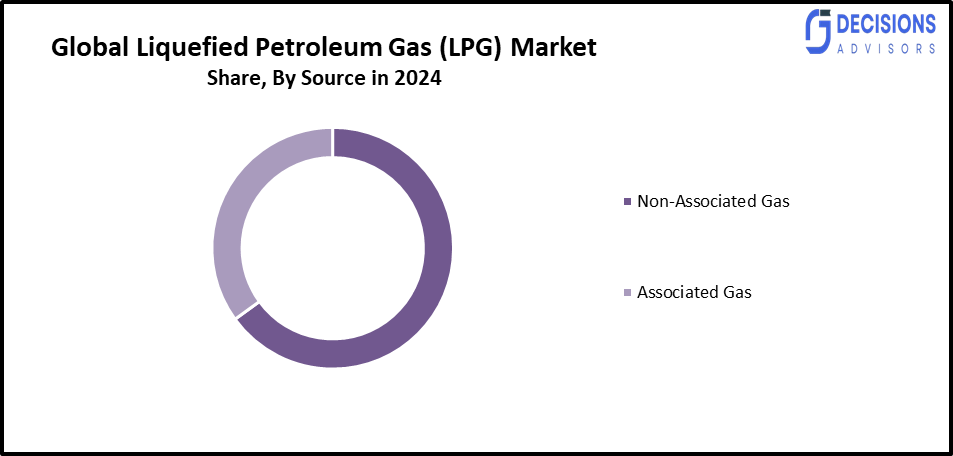
- The non-associated gas segment accounted for the largest market share in 2024 and is anticipated to grow at a notable CAGR over the forecast period.
Based on the source, the liquefied petroleum gas (LPG) market is segmented into associated gas and non-associated gas. Among these, the non-associated gas segment accounted for the largest market share in 2024 and is anticipated to grow at a notable CAGR over the forecast period. The LPG industry is dominated by non-associated gas, which is usually discovered apart from oil reservoirs. In order to collect LPG, it is extracted from natural gas reserves. As a specialised source of LPG, non-associated gas has a number of advantages and frequently produces superior purity and quality. Its dependability, efficiency, and reduced environmental effect contribute to its market dominance, which is in line with the rising demand for cleaner-burning fuels and sustainability initiatives.
BP has confirmed the start of gas production at Angola’s Quiluma field, part of the New Gas Consortium (NGC). Initial output is around 150 million standard cubic feet per day, with plans to ramp up to 330 million by the end of 2026. This marks Angola’s first non?associated gas development, strengthening its LNG export capacity.
- The packaged segment accounted for the highest share in 2024 and is anticipated to grow at a substantial CAGR over the forecast period.
Based on the supply mode, the liquefied petroleum gas (LPG) market is divided into packaged, bulk, and on-site. Among these, the packaged segment accounted for the highest share in 2024 and is anticipated to grow at a substantial CAGR over the forecast period. The packaged LPG delivery mode distributes LPG for use in homes, businesses, and small-scale industries in smaller containers, usually cylinders or tanks. The packaged supply mode is the best option for end customers who need portable and controllable amounts of LPG since it provides accessibility, ease of distribution, and convenience. It serves a wide range of consumers, guaranteeing a consistent demand for LPG and making a substantial contribution to market expansion.
- The residential segment accounted for the highest market revenue in 2024 and is anticipated to grow at a significant CAGR during the forecast period.
Based on the end use, the liquefied petroleum gas (LPG) market is divided into residential, commercial, refinery and petrochemical, transportation, and others. Among these, the residential segment accounted for the highest market revenue in 2024 and is anticipated to grow at a significant CAGR during the forecast period. The market is dominated by residential applications because LPG is widely used in homes for heating, cooking, and as a portable energy source. Because of its accessibility, ease of use, and clean-burning qualities, it is a popular choice for millions of households worldwide. LPG's position as a market leader is cemented by its dependable supply and adaptability for a range of home requirements.
The Indian government has formally ordered oil refineries and petrochemical complexes to maximise LPG production by diverting propane and butane streams, invoking the Essential Commodities Act. This move is designed to secure household cooking gas supply amid global disruptions and rising demand.
Regional Segment Analysis of the Liquefied Petroleum Gas (LPG) Market
- North America (U.S., Canada, Mexico)
- Europe (Germany, France, U.K., Italy, Spain, Rest of Europe)
- Asia-Pacific (China, Japan, India, Rest of APAC)
- South America (Brazil and the Rest of South America)
- The Middle East and Africa (UAE, South Africa, Rest of MEA)
Asia Pacific is anticipated to hold the largest share of the liquefied petroleum gas (LPG) market over the predicted timeframe.
Asia Pacific is anticipated to hold the largest share of the liquefied petroleum gas (LPG) market over the predicted timeframe. Adoption of Liquefied Petroleum Gas (LPG) is surging throughout the Asia-Pacific area due to government measures supporting cleaner fuels, urbanisation, and increased energy demands. The two biggest markets are China and India, which together account for more than 60% of the regional market, with China dominating at about 40%. With the help of advantageous laws and subsidies, LPG's expansion in these nations is being driven by the growing emphasis on lowering air pollution and dependency on conventional biomass fuels. PetroChina and Indian Oil Corporation are major participants in the Asia-Pacific LPG industry, and they are increasing their production capacity to satisfy the rising demand. Local businesses are rising to prominence alongside global behemoths like BP and Chevron as the competitive landscape changes.
The Indian government has approved a massive ?30,000 crore subsidy for public sector oil companies in FY 2025-26 to keep LPG affordable, especially for poor households under the Pradhan Mantri Ujjwala Yojana (PMUY). This ensures that eligible families will continue to receive LPG cylinders at a reduced effective price of ?613 in Delhi, compared to the market price of ?913.
North America is expected to grow at a rapid CAGR in the liquefied petroleum gas (LPG) market during the forecast period. The market for liquefied petroleum gas is expanding rapidly in North America due to rising consumer demand for greener energy sources and government support for low-emission fuels. At over 70%, the United States has the biggest market share, followed by Canada at about 15%. Infrastructure development and improvements in extraction technologies, which improve supply chain efficiency, are further factors driving this rise. Major companies like ExxonMobil and Chevron, which are making significant investments in LPG production and delivery, dominate the competitive scene. An existing infrastructure, such as vast pipeline networks and storage facilities, is advantageous to the U.S. market. Furthermore, a dynamic market environment that encourages innovation and competitive pricing tactics is ensured by the presence of major firms like BP and TotalEnergies.
South Korea has officially approved a landmark $350 billion investment program in the United States, backed by a new Korea–U.S. Strategic Investment Fund. This initiative, passed in March 2026, cements Seoul’s commitment to deepening economic ties with Washington, particularly in energy, technology, and manufacturing sectors.
Competitive Analysis:
The report offers the appropriate analysis of the key organisations/companies involved within the liquefied petroleum gas (LPG) market, along with a comparative evaluation primarily based on their product offering, business overviews, geographic presence, enterprise strategies, segment market share, and SWOT analysis. The report also provides an elaborative analysis focusing on the current news and developments of the companies, which includes product development, innovations, joint ventures, partnerships, mergers & acquisitions, strategic alliances, and others. This allows for the evaluation of the overall competition within the market.
List of Key Companies
- Bharat Petroleum Corporation Limited
- Chevron Corporation
- China Gas Holdings Ltd.
- Exxon Mobil Corporation
- Flaga Gmbh
- JGC HOLDINGS CORPORATION
- Kleenheat, bp p.l.c.
- Petroliam Nasional Berhad (PETRONAS)
- Phillips 66 Company
- Qatargas Operating Company Limited
- Reliance Industries Limited
- Repsol
- Shell group of companies
- Total Se
- Others
Key Target Audience
- Market Players
- Investors
- End-users
- Government Authorities
- Consulting and Research Firm
- Venture capitalists
- Value-Added Resellers (VARs)
Recent Development
- In March 2026, Ghana commissioned the MT Asharami Ghana, a 40,000?cubic?metre LPG tanker, to strengthen its domestic gas market and improve supply reliability. The vessel, launched in Ulsan, South Korea, in March, will expand Ghana’s LPG logistics capacity, stabilise household and industrial supply, and support cleaner cooking initiatives.
- In September 2025, GAIL (India) Limited approved a ?5,364 crore investment to double the capacity of its Jamnagar–Loni LPG pipeline from 3.25 million metric tonnes per annum (MMTPA) to 6.5 MMTPA. The expansion, authorised by the Petroleum and Natural Gas Regulatory Board (PNGRB), is scheduled for completion within 36 months and will significantly strengthen LPG supply to northern and western India, including Maharashtra.
Market Segment
This study forecasts revenue at global, regional, and country levels from 2020 to 2035. Decisions Advisors has segmented the liquefied petroleum gas (LPG) market based on the below-mentioned segments:
Global Liquefied Petroleum Gas (LPG) Market, By Source
- Associated Gas
- Non-associated Gas
Global Liquefied Petroleum Gas (LPG) Market, By Supply Mode
- Packaged
- Bulk
- On-site
Global Liquefied Petroleum Gas (LPG) Market, By End Use
- Residential
- Commercial
- Refinery and Petrochemical
- Transportation
- Others
Global Liquefied Petroleum Gas (LPG) Market, By Regional Analysis
- North America
- US
- Canada
- Mexico
- Europe
- Germany
- UK
- France
- Italy
- Spain
- Russia
- Rest of Europe
- Asia Pacific
- China
- Japan
- India
- South Korea
- Australia
- Rest of Asia Pacific
- South America
- Brazil
- Argentina
- Rest of South America
- Middle East & Africa
- UAE
- Saudi Arabia
- Qatar
- South Africa
- Rest of the Middle East & Africa
Frequently Asked Questions (FAQ)
1. How is renewable LPG (bio-LPG) influencing the future of the LPG market?
Renewable LPG, derived from biomass and waste feedstocks, is emerging as a sustainable alternative to conventional LPG. It helps reduce lifecycle carbon emissions and supports global decarbonization goals while remaining compatible with existing LPG infrastructure.
2. What role does LPG play in energy transition strategies worldwide?
LPG acts as a transitional fuel between high-emission fossil fuels and renewable energy sources. Its lower carbon intensity compared to coal and oil makes it a practical option for countries aiming to reduce emissions without overhauling existing energy systems.
3. How are digital technologies improving LPG distribution and safety?
Advanced technologies such as IoT-enabled sensors, smart meters, and AI-driven logistics platforms are improving cylinder tracking, leak detection, demand forecasting, and supply chain efficiency in LPG distribution networks.
4. What are the emerging applications of LPG beyond traditional uses?
Beyond cooking and heating, LPG is increasingly used in power generation for off-grid locations, agricultural drying processes, industrial heating, and as an alternative automotive fuel (autogas) in transportation sectors.
5. How does seasonal demand impact LPG pricing and supply?
LPG demand tends to rise during colder months due to increased heating needs, which can lead to temporary price spikes and supply constraints. Conversely, demand stabilises during warmer periods, affecting global trade flows.
6. What infrastructure developments are critical for LPG market expansion?
Investments in storage terminals, pipeline networks, bottling plants, and import/export terminals are essential to ensure a reliable LPG supply, particularly in rural and remote regions with limited energy access.
7. How are environmental regulations shaping LPG market dynamics?
Stricter emission norms and environmental policies are encouraging the adoption of cleaner fuels like LPG. Governments are promoting LPG through subsidies, tax incentives, and clean energy programs to reduce reliance on polluting fuels such as coal and kerosene.
Check Licence
Choose the plan that fits you best: Single User, Multi-User, or Enterprise solutions tailored for your needs.
We Have You Covered
- 24/7 Analyst Support
- Clients Across the Globe
- Tailored Insights
- Technology Tracking
- Competitive Intelligence
- Custom Research
- Syndicated Market Studies
- Market Overview
- Market Segmentation
- Growth Drivers
- Market Opportunities
- Regulatory Insights
- Innovation & Sustainability
Report Details
| Scope | Global |
| Pages | 193 |
| Delivery | PDF & Excel via Email |
| Language | English |
| Release | Mar 2026 |
| Access | Download from this page |