
Global Livestock Vaccines Market
 |
Author:
Disha B
|
Pages:
210
|
Author:
Disha B
|
Pages:
210
Global Livestock Vaccines Market Size, Share, By Vaccine Type (Live Attenuated Vaccines, Inactivated Vaccines, Recombinant Vaccines, and Toxoid Vaccines), By Animal Type (Poultry, Cattle, Swine, Sheep & Goats), By Route of Administration (Oral, Injectable, and Intranasal), By Distribution Channel (Veterinary Hospitals & Clinics, Retail Pharmacies, Government Supply Programs, and Online Veterinary Platforms), and By Region (North America, Europe, Asia-Pacific, Latin America, and Middle East & Africa), Analysis and Forecast 2026?2035
CAGR
5.8%
REVENUE 2025
USD Billion 13.82
FORECAST 2035
USD Billion 24.19
REPORT COVERAGE
Global
The Global Livestock Vaccines Market encompasses biological products developed to prevent infectious diseases in farm animals, including cattle, poultry, swine, sheep, and goats. Livestock vaccines play an important role in maintaining animal health, reducing mortality, improving productivity, protecting food supplies, and limiting the spread of zoonotic and transboundary animal diseases. The market is being supported by increasing livestock production, rising demand for animal protein, greater awareness of preventive animal healthcare, government vaccination programs, increasing disease outbreaks, and technological advancements in recombinant and other next-generation vaccines.
Market Snapshot
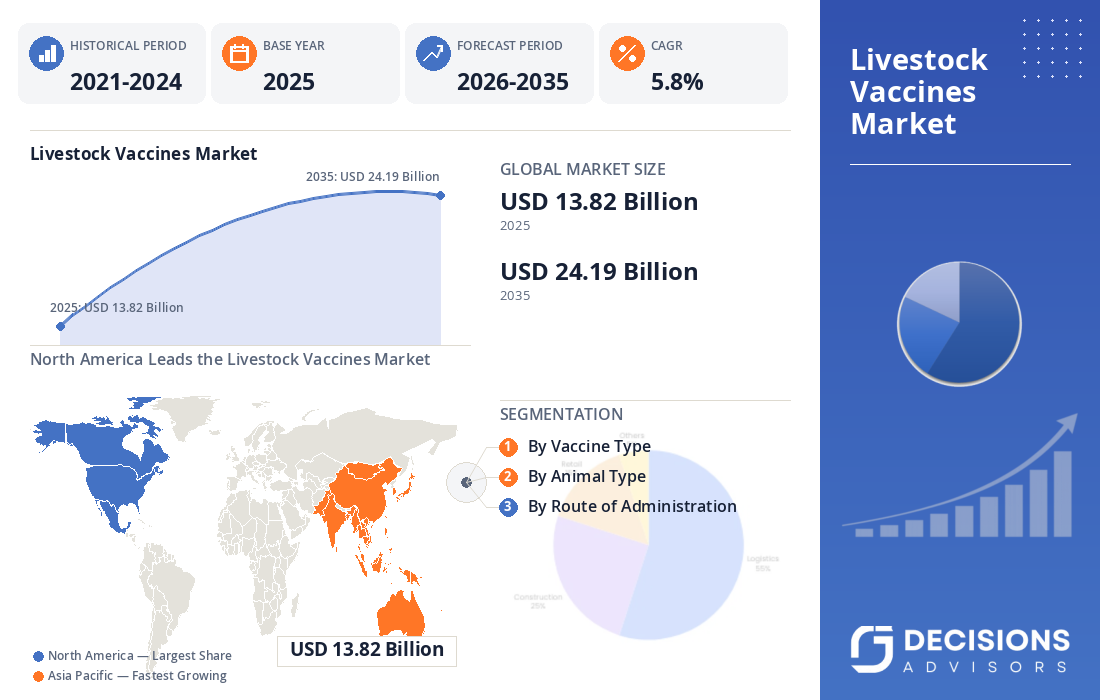
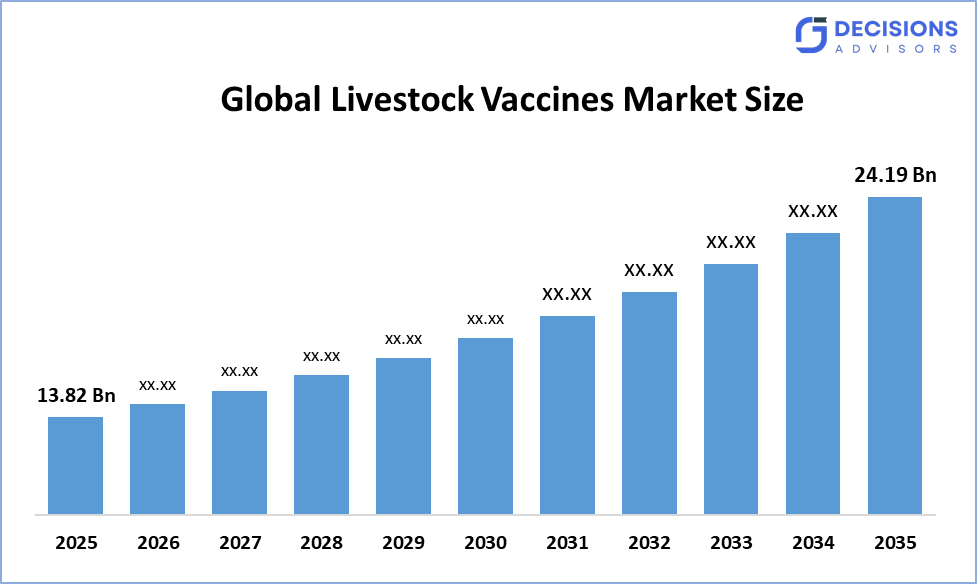
- Global Livestock Vaccines Market Size (2025): USD 13.82 Billion
- Projected Market Size (2035): USD 24.19 Billion
- Global Market CAGR (2025–2035): Approximately 5.8%
- Largest Regional Market: North America
- Fastest Growing Region: Asia-Pacific
- Major Animal Type: Poultry and Cattle
- Base Year: 2025
- Historical Period: 2021–2024
- Forecast Period: 2026–2035
Market Overview/ Introduction
The Global Livestock Vaccines Market represents an important component of the animal-health industry, providing preventive biological solutions for infectious diseases affecting cattle, poultry, swine, sheep, goats, and other farm animals. Vaccination helps livestock producers reduce disease-related mortality, improve herd and flock productivity, protect food supply chains, and reduce the economic impact of disease outbreaks. The expansion of commercial livestock farming and growing global demand for meat, milk, and eggs are increasing the need for effective disease-prevention programs. Increasing concerns regarding zoonotic diseases, antimicrobial resistance, food safety, and livestock productivity are also encouraging farmers and governments to adopt preventive vaccination strategies.
The U.S. governments and veterinary organizations are increasingly emphasizing disease surveillance, vaccination coverage, biosecurity, animal-health monitoring, and food-safety measures.
- Several Asia-Pacific countries are increasing investment in livestock production, veterinary infrastructure, animal-health services, and preventive vaccination programs.
Notable Insights: -
- North America maintains a leading position in the Global Livestock Vaccines Market due to developed veterinary infrastructure, high livestock-health expenditure, established vaccine manufacturers, and strong disease-control programs. Recent industry estimates indicate that North America accounted for approximately 46.9% of the global livestock vaccines market in 2025.
- Asia-Pacific is expected to witness strong growth because of expanding livestock populations, rising consumption of animal protein, increasing commercial farming, improving veterinary infrastructure, and growing awareness of animal vaccination.
- Live attenuated vaccines represent a major vaccine segment because of their effectiveness in generating strong immune responses against several livestock diseases.
- Cattle represent an important animal-type segment, supported by the large global cattle population and the economic importance of dairy and beef production.
- Injectable vaccines remain widely used because of their established application across cattle, swine, sheep, and other livestock.
- Government vaccination programs continue to support market demand, particularly for diseases that can cause significant economic losses or affect food security.
Market Drivers
The Global Livestock Vaccines Market is primarily driven by the increasing incidence of infectious diseases affecting livestock populations. Outbreaks of diseases such as foot-and-mouth disease, avian influenza, African swine fever, and other transboundary animal diseases can cause significant livestock losses and economic disruption, increasing demand for preventive vaccination. Another important driver is the expansion of intensive and commercial livestock farming. As farms become larger and livestock populations become more concentrated, the risk of disease transmission increases, encouraging farmers to implement structured vaccination programs.
Restrain
The Global Livestock Vaccines Market faces challenges including high vaccine-development costs, regulatory requirements, cold-chain dependence, limited veterinary infrastructure in developing regions, affordability constraints among small-scale farmers, and difficulties associated with vaccine distribution in remote agricultural areas. Vaccine storage and transportation can also be challenging because many biological products require controlled temperature conditions. Regulatory differences between countries may increase product-registration costs and extend commercialization timelines.
Competitive Analysis:
The report offers the appropriate analysis of the key organizations/companies involved within the Global Livestock Vaccines Market, along with a comparative evaluation primarily based on their product offerings, business overviews, geographic presence, enterprise strategies, segment market share, and SWOT analysis. The report also provides an elaborative analysis focusing on the current news and developments of the companies, which includes product development, innovations, joint ventures, partnerships, mergers & acquisitions, strategic alliances, and others. This allows for the evaluation of the overall competition within the market.
Top Companies in the Global Livestock Vaccines Market
- Zoetis Inc.
- Merck Animal Health
- Boehringer Ingelheim Animal Health
- Elanco Animal Health Incorporated
- Ceva Santé Animale
- HIPRA
- Virbac
- Indian Immunologicals Limited
- Phibro Animal Health Corporation
- Biogénesis Bagó
- Vetoquinol S.A.
- Hester Biosciences Limited
- Venky's
- Bioveta
- Vaxxinova
- Neogen Corporation
- SAN Group
- MSD Animal Health
- Boehringer Ingelheim
- Kemin Industries
Government Initiatives
|
Country |
Key Government Initiatives |
|
Us |
Government and veterinary authorities continue supporting livestock disease surveillance, vaccination, animal-health protection, biosecurity, and prevention of economically significant livestock diseases. |
|
Germany |
Government and European animal-health initiatives emphasize disease surveillance, livestock health, food safety, biosecurity, and control of infectious animal diseases. |
|
China |
Government programs supporting animal disease prevention, livestock production, veterinary infrastructure, and vaccination are contributing to livestock-health market development. |
Market Segmentation
The Global Livestock Vaccines Market is classified into vaccine type, animal type, route of administration, distribution channel, and region.
The Live Attenuated Vaccine Segment Accounts for a Significant Share
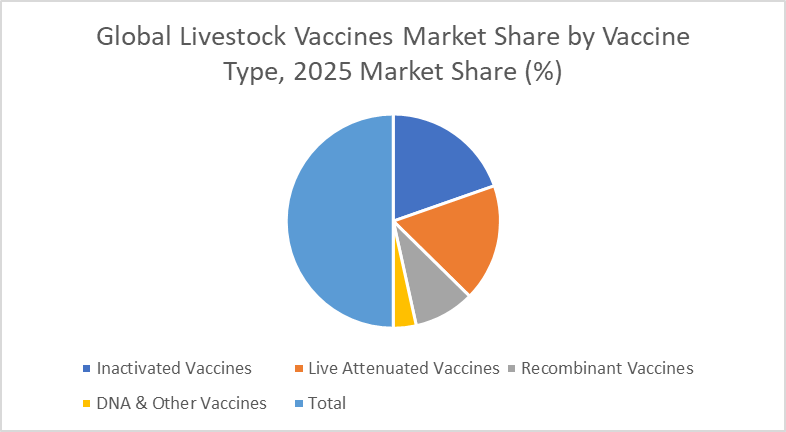
Based on vaccine type, the market is divided into Live Attenuated Vaccines, Inactivated Vaccines, Recombinant Vaccines, and Toxoid Vaccines. Among these, live attenuated vaccines represent a significant segment because they can generate strong immune responses and are widely used for preventing infectious diseases in livestock. The segment is expected to remain important throughout the forecast period.
- The Cattle and Poultry Segments Continue to Generate Significant Demand
Based on animal type, the market is divided into Poultry, Cattle, Swine, and Sheep & Goats. Cattle represent a major application area because of the large global dairy and beef industries. Poultry vaccination also represents an important market because intensive poultry production requires effective disease-control programs to protect flock health and productivity.
- The Injectable Vaccines Remain Widely Used
Based on route of administration, the market is divided into Oral, Injectable, and Intranasal. Injectable vaccines remain widely used because they provide established administration methods for several livestock species and disease-prevention programs. Oral and intranasal vaccination methods are also gaining attention because they can provide convenient administration for specific animal groups.
Regional Segment Analysis of the Global Livestock Vaccines Market
- North America (U.S., Canada, Mexico)
- Europe (Germany, U.K., France, Italy, Spain, Netherlands, Rest of Europe)
- Asia-Pacific (China, Japan, India, Australia, South Korea, Rest of Asia-Pacific)
- South America (Brazil, Argentina, Rest of South America)
- Middle East & Africa (UAE, Saudi Arabia, South Africa, Rest of MEA)
North America Maintains a Leading Share of the Global Livestock Vaccines Market
North America maintains a leading position due to developed veterinary infrastructure, high livestock-health expenditure, established vaccine manufacturers, and strong disease-control systems. The U.S. represents a particularly important market because of its large cattle, poultry, and swine industries and its established animal-health ecosystem.
Europe Holds a Significant Share of the Global Livestock Vaccines Market
Europe holds a significant share because of established veterinary healthcare systems, strong regulatory frameworks, high awareness of animal health, and emphasis on food safety and livestock disease prevention. Germany, the U.K., France, Italy, Spain, and other European markets have developed livestock and veterinary sectors.
Asia -Pacific Witnesses Substantial Growth
Asia-Pacific is expected to experience substantial growth due to expanding livestock production, increasing consumption of animal protein, growing commercial farming, rising veterinary expenditure, and improving animal-health infrastructure. China and India represent major markets because of their large livestock populations and expanding agricultural and food-production sectors.
Future Market Trends in Global Livestock Vaccines Market: -
-
- Expansion of Recombinant and Next-Generation Vaccines
Increasing investment in recombinant, vectored, subunit, and other advanced vaccine technologies is expected to improve vaccine efficacy, safety, and disease-specific protection.
-
- Increasing Focus on Zoonotic Disease Prevention
Growing concerns about diseases that can spread between animals and humans are encouraging governments and livestock producers to strengthen vaccination and disease-surveillance programs.
-
- Growth of Preventive Animal Healthcare
Farmers are increasingly shifting toward preventive healthcare to reduce mortality, improve productivity, and minimize economic losses associated with disease outbreaks.
-
- Digitalization of Livestock Health Management
Digital veterinary platforms, animal-health monitoring systems, electronic records, and data-driven disease surveillance are expected to improve vaccination planning and livestock-health management.
Market Segment
This study forecasts revenue at global, regional, and country levels from 2026 to 2035. The Global Livestock Vaccines Market has been segmented based on the following segments:
Global Livestock Vaccines Market, By Vaccine Type
- Live Attenuated Vaccines
- Inactivated Vaccines
- Recombinant Vaccines
- Toxoid Vaccines
- Others
Global Livestock Vaccines Market, By Animal Type
- Poultry
- Cattle
- Swine
- Sheep & Goats
- Others
Global Livestock Vaccines Market, By Route of Administration
- Oral
- Injectable
- Intranasal
Global Livestock Vaccines Market, By Regional Analysis
- North America
- US
- Canada
- Mexico
- Europe
- Germany
- UK
- France
- Italy
- Spain
- Russia
- Rest of Europe
- Asia Pacific
- China
- Japan
- India
- South Korea
- Australia
- Rest of Asia Pacific
- South America
- Brazil
- Argentina
- Rest of South America
- Middle East & Africa
- UAE
- Saudi Arabia
- Qatar
- South Africa
- Rest of the Middle East & Africa
Frequently Asked Questions (FAQ)
Q. What is driving the growth of the Global Livestock Vaccines Market?
A. The market is primarily driven by increasing livestock production, rising demand for meat and dairy products, growing incidence of infectious animal diseases, increasing awareness of preventive animal healthcare, government vaccination programs, and advancements in vaccine technologies.
Q. Why are livestock farmers using vaccines?
A. Livestock vaccines help prevent infectious diseases, reduce animal mortality, maintain herd and flock productivity, reduce economic losses, and support food safety.
Q. What role does vaccination play in livestock disease prevention?
A. Vaccination provides preventive protection against infectious diseases and can reduce disease transmission, mortality, and productivity losses. It is an important component of broader livestock biosecurity and animal-health programs.
Q. Which livestock species represent important market segments?
A. Poultry, cattle, swine, sheep, and goats are major livestock segments. Cattle and poultry represent particularly important application areas due to the scale of dairy, beef, and poultry production globally.
Check Licence
Choose the plan that fits you best: Single User, Multi-User, or Enterprise solutions tailored for your needs.
We Have You Covered
- 24/7 Analyst Support
- Clients Across the Globe
- Tailored Insights
- Technology Tracking
- Competitive Intelligence
- Custom Research
- Syndicated Market Studies
- Market Overview
- Market Segmentation
- Growth Drivers
- Market Opportunities
- Regulatory Insights
- Innovation & Sustainability
Report Details
| Scope | Global |
| Pages | 210 |
| Delivery | PDF & Excel via Email |
| Language | English |
| Release | Apr 2026 |
| Access | Download from this page |