
Global Long Read Sequencing Market
 |
Author:
David J
|
Pages:
200
|
Author:
David J
|
Pages:
200
Global Long Read Sequencing Market Size, Share By Technology (Nanopore Sequencing, Single-Molecule Real-Time (SMRT) Sequencing, Synthetic Long-Read Sequencing), By Application (Whole Genome Sequencing, Targeted Sequencing, Metagenomics, Epigenetics, Whole Exome Sequencing, Others), By End User (Academic & Research Institutes, Hospitals, Clinics & Diagnostic Laboratories, Pharmaceutical & Biotechnology Companies, Others), and By Region (North America, Europe, Asia-Pacific, Latin America, Middle East & Africa), Analysis and Forecast 2026-2035
CAGR
30.03%
REVENUE 2025
USD Billion 0.96
FORECAST 2035
USD Billion 13.26
REPORT COVERAGE
Global
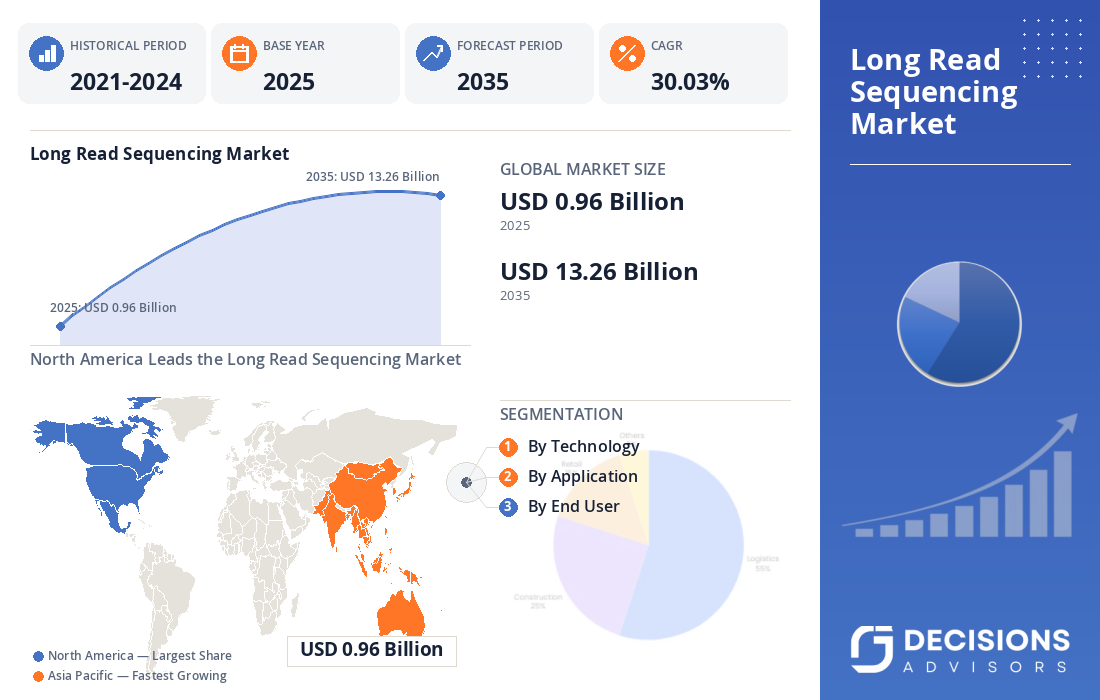
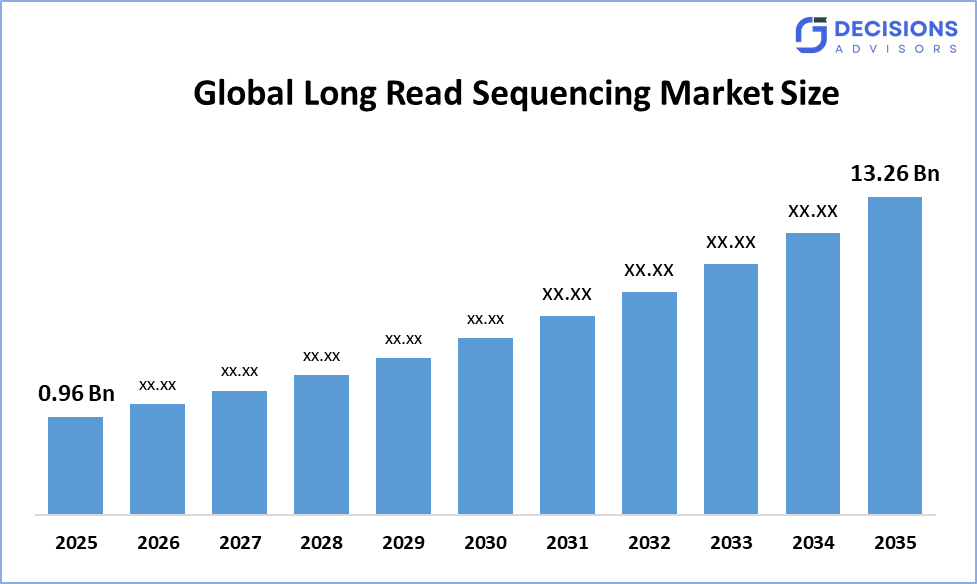
The Global Long Read Sequencing Market Size is predicted to grow from USD 0.96 Billion in 2025 and is likely to reach around USD 13.26 Billion by 2035 with a CAGR of 30.03%. According to Decision Advisors, the nanopore sequencing technique occupied the major share of the market, with 56.47% of market share in 2024 due to the increasing trend towards the use of real-time sequencing technology that is portable and scalable. The consumption segment contributed 62.17% to the market revenue due to constant demand for reagents and sequencing kits. Pacific Biosciences (PacBio) and Oxford Nanopore Technologies are the dominant players in the market with their innovative SMRT and nanopore technologies propelling market growth.
Market Snapshot
- Global Long Read Sequencing Market Size (2025): USD 0.96 Billion
- Projected Global Long Read Sequencing Market Size (2035): USD 13.26 Billion
- Global Long Read Sequencing Market Compound Annual Growth Rate (CAGR): 30.03%
- Largest Regional Market: North America
- 2nd Largest Region: Europe
- Fastest Growing Region: Asia Pacific
- Base Year: 2025
- Historical Period: 2021-2024
- Market Forecast Period: 2026-2035
Market Overview/ Introduction
The Global Long Read Sequencing Market represents advanced third-generation sequencing techniques which have the capability to sequence larger DNA/RNA fragments, allowing better detection of structural variants, repeat sequences, haplotypes, and genomic features. Schemes by governments are promoting their adoption in population genomics and precision medicine projects such as the U.S. All of Us Research Program, Genomics England projects in the UK, and the Department of Biotechnology genomics projects in India. Some recent trends in the industry are AI-powered genomic analysis, improved accuracy of the sequencing platform, greater throughput, and cheaper sequencing costs, making more applications possible. This market is expected to grow at a fast pace as there is rising demand for whole genome sequencing, rare disease diagnostics, oncology, personalized medicine, RNA sequencing, and population genomics. The biggest regional market is North America whereas the fastest-growing regional market is the Asia-Pacific region. Increased investment in biotech infrastructure, clinical application, and technology improvements is helping the market to grow globally.
- The NIHR BioResource launched a national project utilizing long-read sequencing to diagnose complex rare diseases that standard genetic testing methods failed to resolve.
- Federal precision medicine frameworks continue to inject multi-billion-dollar support into national genomic databases, encouraging clinical laboratories to adopt advanced high-throughput sequencing configurations.
Notable Insights: -
- North America is anticipated to hold approximately 50.10% share of the Global Long Read Sequencing Market over the predicted timeframe.
- Asia Pacific is expected to grow at a rapid CAGR in the Global Long Read Sequencing Market by holding approximately 25.2% of the share during the forecast period.
- By technology, the Nanopore Sequencing, segment dominated the market and holds approximately 58.83% share in 2025 and is projected to grow at a substantial CAGR during the forecast period.
- By application, the Whole Genome Sequencing segment dominated the market and holds approximately 43% share in 2025 and is projected to grow at a substantial CAGR during the forecast period.
- The compound annual growth rate of the Global Long Read Sequencing Market is 30.03%.
- The market is likely to achieve a valuation of USD 13.26 Billion by 2035.
Market Drivers
The Global Long Read Sequencing Market witness’s growth owing to the rising need for precise and comprehensive genomic analysis. The growing number of rare diseases and cancer patients drives the adoption of long read sequencing to discover genetic mutations and structural changes in genomic regions and genes. The growing use of personalized medicine and healthcare leads to increased need for more detailed genomic data to make an individualized treatment and diagnosis. Genomics projects and population genomics drives the growth of the market. The growing application in whole genome sequencing, metagenomics, epigenetics and transcriptomics provides further opportunities for the market. Improvements in terms of sequencing accuracy, read lengths, throughput, portability and bioinformatics increase the technology performance. Increased investments in biotechnologies and genomics research, pharmaceuticals' research & development and healthcare infrastructure drive the market growth as well.
Restrain
High sequencing prices, complicated data analysis, a lack of standardization, and the need for specialist bioinformatics infrastructure and knowledge are some of the obstacles facing the global long read sequencing market. Adoption among smaller research labs and healthcare facilities may be hampered by high sequencing and computing expenses.
Competitive Analysis:
The report offers the appropriate analysis of the key organizations/companies involved within the Global Long Read Sequencing Market along with a comparative evaluation primarily based on their product offerings, business overviews, geographic presence, enterprise strategies, segment market share, and SWOT analysis. The report also provides an elaborative analysis focusing on the current news and developments of the companies, which includes product development, innovations, joint ventures, partnerships, mergers & acquisitions, strategic alliances, and others. This allows for the evaluation of the overall competition within the market.
Top Companies in the Global Long Read Sequencing Market
- Oxford Nanopore Technologies
- Pacific Biosciences (PacBio)
- Illumina
- BGI Genomics
- Thermo Fisher Scientific
- Agilent Technologies
- QIAGEN
- F. Hoffmann-La Roche
- 10x Genomics
- MGI Tech
Government Initiatives
|
Country |
Key Government Initiatives |
|
India |
Funded by the Department of Biotechnology, the GenomeIndia Project completed sequencing over 10,000 diverse individual genomes, building a national genetic database for personalized medicine. |
|
China |
Industrial policy grants and heavy state support fund large-scale population genomics projects and local manufacturing of sequencing hardware to secure supply chains. |
|
United States |
The National Institutes of Health (NIH) funds the All of Us Research Program, expanding massive whole-genome sequencing datasets to uncover structural variants and power clinical precision medicine. |
Market Segmentation
The Global Long Read Sequencing Market share is classified into Technology, Application and End User
- The Nanopore Sequencing segment dominated the market and holds approximately 58.83% share in 2025 and is projected to grow at a substantial CAGR during the forecast period.
Based on the technology, the Global Long Read Sequencing Market segments are based on Nanopore Sequencing, Single-Molecule Real-Time (SMRT) Sequencing, and Synthetic Long-Read Sequencing. Out of these types, Nanopore Sequencing has grabbed the largest share in the market of 58.83% in 2025. The reason behind this is the capability of this sequencing technique which allows sequencing in real time, ultra-long reads, and portability, and scalability. Nanopore Sequencing is utilized for whole genome sequencing, infectious disease, metagenomics, and structure variant detection.
- The Whole Genome Sequencing segment accounted for the largest share of approximately 43% in 2025 and is anticipated to grow at a significant CAGR during the forecast period.
Based on the application, the Global Long Read Sequencing Market is segmented into Whole Genome Sequencing, Targeted Sequencing, Metagenomics, Epigenetics, Whole Exome Sequencing, and Others. Of these segments, the Whole Genome Sequencing category accounted for the highest market share, holding a share of roughly 43% in 2025. The reason behind this dominance is the rising requirement for complete genomic profiling, identification of structural variants, rare disease detection, and personalized medicines. Increasing use of whole genome sequencing in research, oncology, population genomics, and clinical settings drives the growth of this segment and makes it the major revenue generator of the Global Long Read Sequencing Market.
- The Academic & Research Institutes segment accounted for the largest share of approximately 42% in 2025 and is anticipated to grow at a significant CAGR during the forecast period.
Based on end user, the Global Long Read Sequencing Market is segmented into Academic & Research Institutes, Hospitals, Clinics & Diagnostic Laboratories, Pharmaceutical & Biotechnology Companies, and Others. Of all the segments, Academic & Research Institutes account for a large market share and capture around 42% of the share in 2025. This is attributed to the rising genomic studies, whole genome sequencing studies, and technological developments. The rising investment in genomics, molecular biology, and precision medicine acts as an additional boost to the segment growth, making Academic & Research Institutes the major revenue generator.
Regional Segment Analysis of the Global Long Read Sequencing Market
- Asia-Pacific (China, Japan, India, Australia, and Rest of Asia-Pacific)?
- North America (United States and Canada)
- Europe (United Kingdom, Germany, France, and Rest of Europe)
- Latin America (Brazil, Mexico, Argentina, and Rest of Latin America)?
- The Middle East and Africa (Israel, UAE, Saudi Arabia, South Africa, and Rest of MEA)
North America is anticipated to hold approximately 50.10% share of the Global Long Read Sequencing Market over the predicted timeframe.
The North America constitutes 50.10% of the Global Long Read Sequencing Market due to sophisticated genomics infrastructure, excellent research and development, and sequencing technologies being widely adopted in academics, clinical settings, and pharmaceuticals. The region receives significant government support for genomic research; it has an existing biotechnology and pharmaceutical industry base, along with the presence of key players such as Pacific Biosciences and Oxford Nanopore Technologies. Increased applications around diagnosing rare diseases, cancer, personalized medicine, and population genomics have facilitated growth in the region. It is predicted that sophisticated informatics infrastructure, increased clinical applications, and continued advancements in sequencing platforms will ensure North America’s lead in the Global Long Read Sequencing Market over the forecast period.
Asia-Pacific is expected to grow at a rapid CAGR in the Global Long Read Sequencing Market, holding approximately 25.2% of the share during the forecast period
The Asia Pacific region contributes to 25.2% share of the Global Long Read Sequencing Market, driven by growing investment in genomics, population sequencing, precision medicine, and biotechnology. Countries including China, Japan, and India have been major contributors towards growth in this region, and the increasing capabilities of healthcare in addition to genomics programs initiated by the government will drive their adoption. Asia Pacific region will also continue to be the fastest-growing regional market at 25.52% CAGR during the forecast period.
Europe is the fastest-growing region in the Global Long Read Sequencing Market during the period, holding approximately 31.82% share.
The Europe is considered one of the most important markets within the Global Long Read Sequencing Market, with 28.47% of the market share. The European region’s development is driven by high investment in genomics research, precision medicine, population genomics, and cutting-edge healthcare technology. The UK, Germany, and France contribute to the growth of the regional market. The increasing application of long read sequencing in rare disease testing, oncology, whole genome sequencing, and drug discovery boosts the market within the region. Government-sponsored genomics projects, advanced healthcare facilities, and presence of top-notch academic and biotech organizations are other factors boosting the use of long read sequencing technologies in Europe.
Future Market Trends in Global Long Read Sequencing Market: -
-
- Expansion of Whole-Genome Sequencing
Long read sequencing has become popular in whole genome sequencing since it helps in identifying structural variations, repeat sequences, and complex genomic changes. There is an increasing need for comprehensive genomic evaluation in areas such as rare diseases, oncology, population genomics, and personalized medicine; hence, many laboratories and health organizations are implementing long read sequencing technology.
-
- AI-Enabled Genomic Data Analysis
AI technologies are being incorporated into long-read sequencing pipelines to aid in interpreting genomics data and genome assembly. Bioinformatics driven by AI technologies can handle large and complicated sequencing data sets, thus enabling the identification of disease-causing variants and structural variation.
-
- Growth in Clinical and Diagnostic Applications
There have been many instances where long-read sequencing has been employed in the clinical diagnosis of rare diseases, genetic disorders, cancers, and precision medicine. The usefulness of long-read sequencing in diagnosing genetic abnormalities is an added advantage. With increased investment in health care and advancements in sequencing technology, the clinical implementation of long-read sequencing has gained momentum.
-
- Rising Adoption in Population Genomics
Long Read Sequencing is increasingly becoming part of National Genomics Initiatives and Population Sequencing Projects. Such tools help scientists in comprehending the variations in genetic diversity, susceptibilities to diseases and differences in population. More governmental funding, increased investments in biotechnologies and precision-medicine programs are likely to contribute to adoption of Long Read Sequencing worldwide.
Recent Development
- In May 2024, Oxford Nanopore Technologies and Twist Bioscience launched a Pharmacogenomics Beta Program to enhance focused long-read workflows.
- In June 2026, due to improved consensus accuracy, industry assessments (as reported by SNS Insider) identified single-molecule real-time (SMRT) sequencing as the technology segment with the quickest rate of growth.
- In August 2024, Consumables accounted for more than 60% of recurring market income, according to market research updates (via MarketsandMarkets) that measured baseline adoption.
Market Segment
This study forecasts revenue at global, regional, and country levels from 2020 to 2035. Decision Advisors has segmented the Global Long Read Sequencing Market based on the below-mentioned segments:
Global Long Read Sequencing Market, By Technology
- Nanopore Sequencing
- Single-Molecule Real-Time (SMRT) Sequencing
- Synthetic Long-Read Sequencing
Global Long Read Sequencing Market, By Application
- Whole Genome Sequencing
- Targeted Sequencing
- Metagenomics
- Epigenetics
- Whole Exome Sequencing
- Others
Global Long Read Sequencing Market, By End User
- Academic & Research Institutes
- Hospitals
- Clinics & Diagnostic Laboratories
- Pharmaceutical & Biotechnology Companies
- Others
Global Long Read Sequencing Market, By Regional Analysis
- Asia-Pacific
- China
- Japan
- India
- Australia
- Rest of Asia-Pacific
- North America
- United States
- Canada
- Europe
- United Kingdom
- Germany
- France
- Rest of Europe
- Latin America
- Brazil
- Mexico
- Argentina
- Rest of Latin America
- Middle East & Africa
- Israel
- UAE
- Saudi Arabia
- South Africa
- Rest of MEA
Frequently Asked Questions (FAQ)
Q. How is long-read sequencing improving genomic analysis?
A. Compared to traditional short-read sequencing, long-read sequencing provides more extensive genomic information by enabling thorough investigation of complex genomes, structural variants, repetitive sections, and haplotypes.
Q. Why is long-read sequencing preferred over short-read sequencing technologies?
A. It offers significantly longer readings of DNA or RNA, enhances genome assembly, finds intricate structural differences, and more efficiently resolves repetitive genomic areas.
Q. What role does long-read sequencing play in precision medicine?
A. It facilitates the precise detection of genetic variants linked to inherited disorders, cancer, and uncommon diseases, assisting medical professionals in creating more individualized diagnosis and treatment plans.
Q. How are technological advancements influencing long-read sequencing development?
A. Long-read sequencing is becoming faster, more accessible, and appropriate for growing research and clinical applications with to advancements in sequencing accuracy, throughput, portability, automation, and bioinformatics.
Check Licence
Choose the plan that fits you best: Single User, Multi-User, or Enterprise solutions tailored for your needs.
We Have You Covered
- 24/7 Analyst Support
- Clients Across the Globe
- Tailored Insights
- Technology Tracking
- Competitive Intelligence
- Custom Research
- Syndicated Market Studies
- Market Overview
- Market Segmentation
- Growth Drivers
- Market Opportunities
- Regulatory Insights
- Innovation & Sustainability
Report Details
| Scope | Global |
| Pages | 200 |
| Delivery | PDF & Excel via Email |
| Language | English |
| Release | Aug 2026 |
| Access | Download from this page |