
Global Low Emission Vehicle Market
 |
Author:
Sanket C
|
Pages:
220
|
Author:
Sanket C
|
Pages:
220
Global Low Emission Vehicle Market Size, Share, By Vehicle Type (Battery Electric Vehicles, Plug-in Hybrid Electric Vehicles, Full Hybrid Electric Vehicles, Mild Hybrid Electric Vehicles, and Fuel Cell Electric Vehicles), By Vehicle Class (Passenger Vehicles, Light Commercial Vehicles, Heavy Commercial Vehicles, and Two-Wheelers & Three-Wheelers), By Propulsion Type (Battery Electric, Hybrid Electric, Plug-in Hybrid, and Hydrogen Fuel Cell), By Application (Personal Transportation, Commercial Transportation, Public Transportation, and Fleet Operations), and By Region (North America, Europe, Asia-Pacific, South America, and Middle East & Africa), Analysis and Forecast 2026?2035.
CAGR
16.26%
REVENUE 2025
USD Billion 249.82
FORECAST 2035
USD Billion 1128.34
REPORT COVERAGE
Global
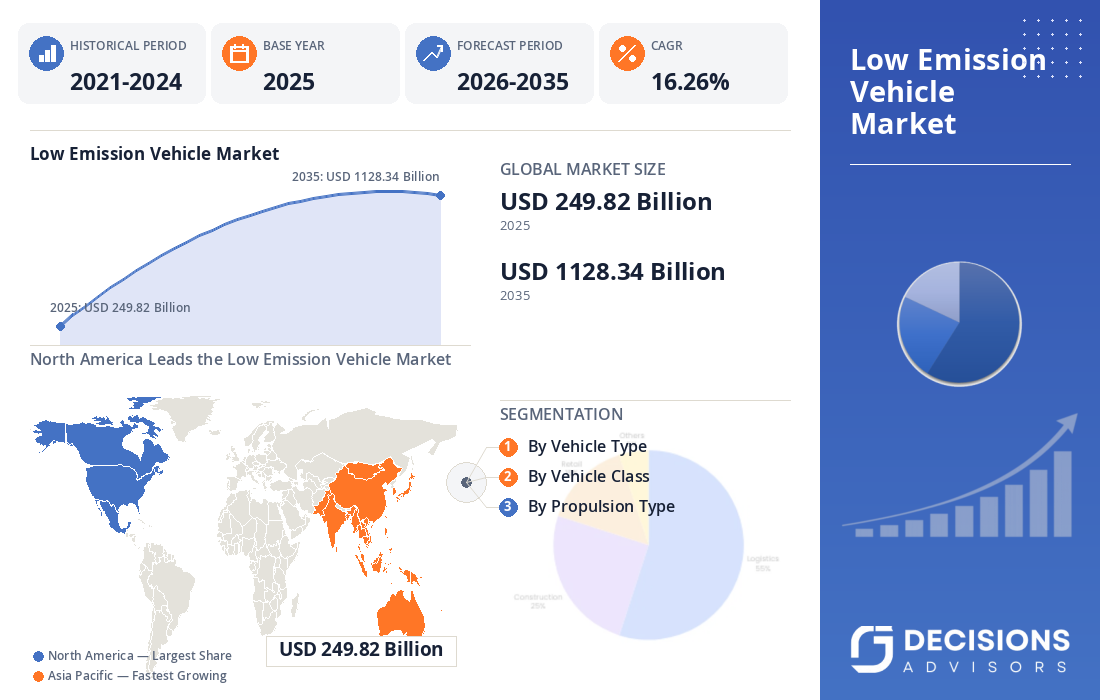
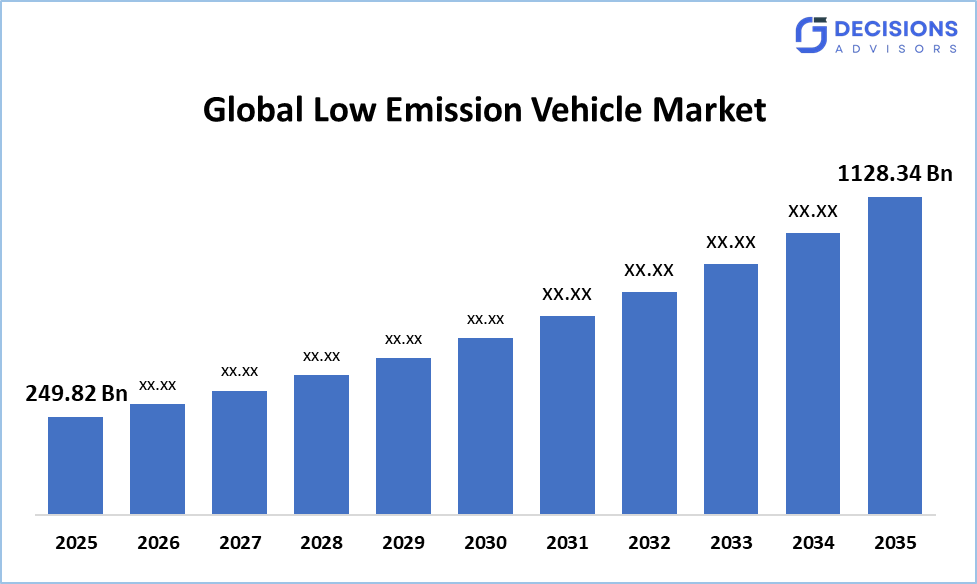
The Global Low Emission Vehicle Market Size was valued at approximately USD 249.82 Billion in 2025 and is expected to reach approximately USD 1,128.34 Billion by 2035, expanding at a CAGR of approximately 16.26% during the forecast period. The market is experiencing strong growth due to increasingly stringent vehicle-emission regulations, rising electric vehicle adoption, government incentives for clean mobility, declining battery costs, expansion of charging infrastructure, increasing consumer awareness of sustainable transportation, and growing investment by automotive manufacturers in electric and hybrid vehicle technologies.
Market Snapshot
- Global Low Emission Vehicle Market Size (2025): USD 249.82 Billion
- Projected Market Size (2035): USD 1,128.34 Billion
- Global Market CAGR (2026–2035): 16.26%
- Largest Regional Market: North America
- 2nd Largest Region: Europe
- Fastest Growing Region: Asia-Pacific
- Base Year: 2025
- Historical Period: 2021–2024
- Forecast Period: 2026–2035
Market Overview/ Introduction
The Global Low Emission Vehicle Market encompasses vehicles designed to produce substantially lower greenhouse-gas and pollutant emissions than conventional internal-combustion-engine vehicles. The market includes battery electric vehicles, plug-in hybrid electric vehicles, full hybrid vehicles, mild hybrid vehicles, and fuel-cell electric vehicles. Low emission vehicles are increasingly being adopted across passenger transportation, commercial fleets, public transportation, logistics, and last-mile delivery. Governments and automotive manufacturers are investing in electrification, alternative propulsion technologies, charging infrastructure, battery manufacturing, and clean transportation systems to reduce dependence on fossil fuels and lower road-transport emissions.
- The U.S. governments and regulatory authorities across major economies are increasingly emphasizing insurance penetration, consumer protection, financial inclusion, solvency requirements, transparency, and digital security.
- Several Asia-Pacific countries are increasing investments in digital financial infrastructure, insurance technology, financial inclusion programs, and retirement-planning initiatives.
Notable Insights: -
- North America maintains a leading position in the Global Low Emission Vehicle Market due to increasing electric vehicle adoption, technological innovation, established automotive manufacturing capabilities, government incentives, and expanding charging infrastructure. Current industry estimates identify North America as a leading regional market.
- Asia-Pacific is expected to be the fastest-growing region, supported by expanding vehicle production, rising urbanization, increasing electric mobility adoption, government policies, battery manufacturing investments, and growing demand for affordable electric vehicles.
- Battery Electric Vehicles represent a major vehicle segment because of zero tailpipe emissions, declining battery costs, improving driving ranges, and increasing availability of charging infrastructure.
- Passenger vehicles account for a significant share because consumers are increasingly adopting electric and hybrid vehicles as manufacturers introduce more affordable models with improved range and performance.
- Commercial low-emission vehicles are gaining importance as logistics companies, public transport operators, and fleet owners increasingly electrify delivery vans, buses, and trucks.
- Battery technology remains a critical market-development factor. Improvements in energy density, charging speed, durability, and manufacturing efficiency are increasing the attractiveness of low-emission vehicles.
Market Drivers
The Global Low Emission Vehicle Market is primarily driven by increasingly stringent emission regulations and government initiatives aimed at reducing transportation-related carbon emissions. Countries are introducing fuel-economy standards, CO? targets, vehicle-emission regulations, zero-emission vehicle mandates, and incentives for electric and hybrid vehicle purchases. The declining cost of batteries is another major growth driver. Battery technology improvements are enabling longer driving ranges, faster charging, improved vehicle performance, and lower total ownership costs.
Restrain
The Global Low Emission Vehicle Market faces challenges including high initial vehicle costs, battery-material price volatility, limited charging infrastructure in some developing markets, long charging times for certain vehicle categories, concerns regarding driving range, battery degradation, and supply-chain risks. The market is also dependent on the availability of lithium, nickel, cobalt, graphite, and other critical materials required for battery production. Geopolitical risks and concentration of battery-material processing can create supply-chain vulnerabilities.
Competitive Analysis:
The report offers the appropriate analysis of the key organizations/companies involved within the Global Low Emission Vehicle Market, along with a comparative evaluation primarily based on their product offerings, business overviews, geographic presence, enterprise strategies, segment market share, and SWOT analysis. The report also provides an elaborative analysis focusing on the current news and developments of the companies, which includes product development, innovations, joint ventures, partnerships, mergers & acquisitions, strategic alliances, and others. This allows for the evaluation of the overall competition within the market.
Top Companies in the Global Low Emission Vehicle Market
- Toyota Motor Corporation
- Tesla, Inc.
- Volkswagen AG
- BYD Company Limited
- Hyundai Motor Company
- Kia Corporation
- General Motors Company
- Ford Motor Company
- BMW AG
- Mercedes-Benz Group AG
Government Initiatives
|
Country |
Key Government Initiatives |
|
Us |
Federal and state initiatives supporting electric vehicles, battery manufacturing, charging infrastructure, clean transportation, and domestic critical-mineral supply chains are encouraging low-emission vehicle adoption and manufacturing. |
|
Germany |
European policies focused on reducing transport emissions, improving vehicle efficiency, expanding charging infrastructure, and increasing zero-emission vehicle adoption are supporting the transition toward clean mobility. |
|
China |
Government programs supporting new-energy vehicles, battery manufacturing, charging infrastructure, and clean transportation have strengthened China's position as a major electric and low-emission vehicle market. |
Market Segmentation
The Global Low Emission Vehicle Market share is classified into vehicle type, vehicle class, propulsion type, application, and region.
The Battery Electric Vehicle Segment Accounts for a Significant Share
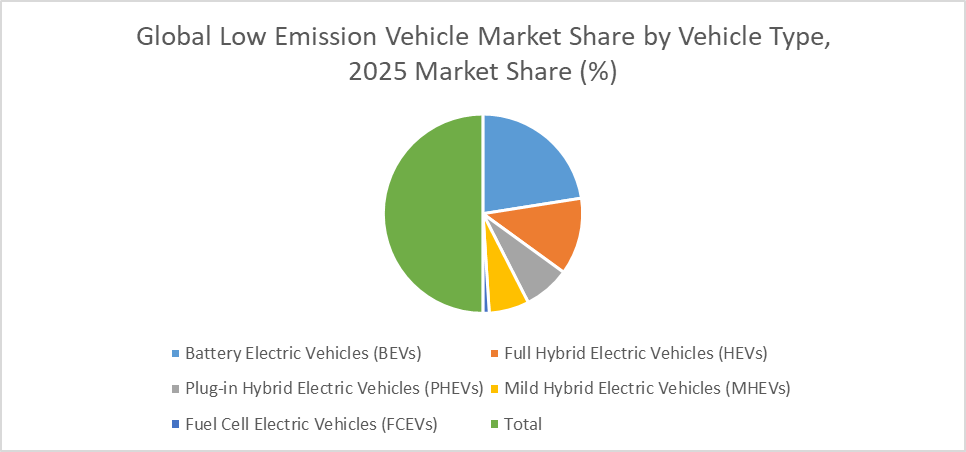
Based on vehicle type, the market is divided into Battery Electric Vehicles, Plug-in Hybrid Electric Vehicles, Full Hybrid Electric Vehicles, Mild Hybrid Electric Vehicles, and Fuel Cell Electric Vehicles. Battery electric vehicles represent a major segment because they produce zero tailpipe emissions, have increasingly competitive operating costs, and benefit from continuous improvements in battery technology and charging infrastructure.
- The Passenger Vehicle Segment Represents a Major Market Category
Based on vehicle class, the market is divided into Passenger Vehicles, Light Commercial Vehicles, Heavy Commercial Vehicles, and Two-Wheelers & Three-Wheelers. Passenger vehicles represent a significant market segment due to increasing consumer awareness, growing model availability, government incentives, and increasing demand for fuel-efficient and environmentally friendly transportation.
- The Electric Propulsion Segment Holds a Significant Share
Based on propulsion type, the market is divided into Battery Electric, Hybrid Electric, Plug-in Hybrid, and Hydrogen Fuel Cell. Battery-electric propulsion is gaining significant market share because of improvements in battery range, charging speed, performance, and cost. Hybrid and plug-in hybrid vehicles continue to provide an alternative for consumers and fleet operators transitioning away from conventional internal-combustion vehicles.
Regional Segment Analysis of the Global Low Emission Vehicle Market
- North America (U.S., Canada, Mexico)
- Europe (Germany, U.K., France, Italy, Spain, Netherlands, Rest of Europe)
- Asia-Pacific (China, Japan, India, Australia, South Korea, Rest of Asia-Pacific)
- South America (Brazil, Argentina, Rest of South America)
- Middle East & Africa (UAE, Saudi Arabia, South Africa, Rest of MEA)
North America Maintains a Leading Share of the Global Low Emission Vehicle Market in 2025
North America maintains a leading position in the Global Low Emission Vehicle Market due to strong electric vehicle adoption, technological innovation, advanced automotive manufacturing, government support, and growing charging infrastructure. The United States represents the largest market within the region, supported by increasing EV availability, investments in battery manufacturing, fleet electrification, and clean transportation infrastructure. Canada is also expanding its EV ecosystem through investments in battery production, critical minerals, and charging networks.
Europe Holds a Significant Share of the Global Low Emission Vehicle Market in 2025
Europe represents a significant market due to stringent CO? emission standards, government policies promoting vehicle electrification, environmental regulations, and increasing consumer adoption of electric vehicles. Germany, the U.K., France, Italy, Spain, and the Netherlands are important markets for low-emission vehicles. European automakers are also investing heavily in battery-electric platforms, battery manufacturing, charging infrastructure, and software-defined vehicle technologies.
Asia-Pacific is the Fastest-Growing Region in the Global Low Emission Vehicle Market
Asia -Pacific is expected to register the fastest growth during the forecast period due to expanding automotive production, rapid urbanization, increasing consumer demand for affordable electric vehicles, government incentives, and strong battery-manufacturing capabilities. China remains the largest electric vehicle market in the region and has developed an extensive EV, battery, charging, and component manufacturing ecosystem. India is also expected to experience strong growth as electric two-wheelers, three-wheelers, buses, passenger vehicles, and commercial vehicles gain market penetration.
Future Market Trends in Global Low Emission Vehicle Market: -
- Expansion of Battery Electric Vehicles
Battery electric vehicles are expected to remain one of the fastest-growing low-emission vehicle technologies. Automakers are introducing vehicles with longer driving ranges, faster charging, improved performance, and more competitive pricing.
- Growth of Electric Commercial Vehicles
Electric vans, buses, trucks, and last-mile delivery vehicles are expected to become increasingly important as fleet operators seek lower operating costs and compliance with urban emissions regulations.
- Increasing Adoption of Hybrid Vehicles
Full hybrid and plug-in hybrid vehicles are expected to maintain demand, particularly in markets where charging infrastructure remains limited. Hybrid technology provides consumers with improved fuel efficiency while reducing dependence on conventional combustion engines.
- Increasing Battery Technology Investment
Automakers and battery manufacturers are investing in higher-energy-density batteries, faster charging, improved thermal management, alternative chemistries, and battery recycling technologies.
Recent Development
- In November 2025, the International Energy Agency released its Global EV Outlook 2026, reporting that the global EV fleet could grow more than sixfold from 2025 levels by 2035 under its current-policy scenario. The IEA also expects electric vehicles to account for around half of global car sales by 2035 in its exploratory scenarios.
- In July 2025, automakers continued expanding electric and hybrid vehicle portfolios, with new models increasingly focused on affordability, longer driving ranges, improved charging performance, and software-enabled features.
- In February 2025, battery manufacturers and automotive companies continued increasing investment in battery production capacity and next-generation battery technologies to support the expanding global electric mobility market.
Market Segment
This study forecasts revenue at global, regional, and country levels from 2026 to 2035. Decision Advisors has segmented the Global Low Emission Vehicle Market based on the below-mentioned segments:
Global Low Emission Vehicle Market, By Vehicle Type
- Battery Electric Vehicles
- Plug-in Hybrid Electric Vehicles
- Full Hybrid Electric Vehicles
- Mild Hybrid Electric Vehicles
- Fuel Cell Electric Vehicles
- Others
Global Low Emission Vehicle Market, By Vehicle Class
- Passenger Vehicles
- Light Commercial Vehicles
- Heavy Commercial Vehicles
- Two-Wheelers & Three-Wheelers
- Buses
- Others
Global Low Emission Vehicle Market, By Propulsion Type
- Battery Electric
- Hybrid Electric
- Plug-in Hybrid
- Hydrogen Fuel Cell
Global Low Emission Vehicle Market, By Regional Analysis
- North America
- US
- Canada
- Mexico
- Europe
- Germany
- UK
- France
- Italy
- Spain
- Russia
- Rest of Europe
- Asia Pacific
- China
- Japan
- India
- South Korea
- Australia
- Rest of Asia Pacific
- South America
- Brazil
- Argentina
- Rest of South America
- Middle East & Africa
- UAE
- Saudi Arabia
- Qatar
- South Africa
- Rest of the Middle East & Africa
Frequently Asked Questions (FAQ)
- What is driving the growth of the Global Low Emission Vehicle Market?
The market is primarily driven by stringent vehicle-emission regulations, government incentives, growing electric vehicle adoption, declining battery costs, expansion of charging infrastructure, increasing environmental awareness, and investments by automakers in electric and hybrid vehicle technologies.
- What role does charging infrastructure play in the Low Emission Vehicle Market?
Charging infrastructure is essential for increasing consumer confidence, reducing range anxiety, supporting commercial fleets, and enabling widespread adoption of battery-electric vehicles.
- What are the major challenges facing the Low Emission Vehicle Market?
Major challenges include high upfront vehicle costs, charging infrastructure gaps, battery-material supply risks, charging time, range concerns, battery degradation, and differences in government incentives across countries.
- Which vehicle type represents a major segment of the Low Emission Vehicle Market?
Battery electric vehicles represent a major segment due to zero tailpipe emissions, increasing model availability, improvements in battery technology, and expanding charging infrastructure.
Check Licence
Choose the plan that fits you best: Single User, Multi-User, or Enterprise solutions tailored for your needs.
We Have You Covered
- 24/7 Analyst Support
- Clients Across the Globe
- Tailored Insights
- Technology Tracking
- Competitive Intelligence
- Custom Research
- Syndicated Market Studies
- Market Overview
- Market Segmentation
- Growth Drivers
- Market Opportunities
- Regulatory Insights
- Innovation & Sustainability
Report Details
| Scope | Global |
| Pages | 220 |
| Delivery | PDF & Excel via Email |
| Language | English |
| Release | Aug 2026 |
| Access | Download from this page |