
Global Low-Friction Coating Market
 |
Author:
Aditya G
|
Pages:
200
|
Author:
Aditya G
|
Pages:
200
Global Low-Friction Coating Market Size, Share By Type (Molybdenum Disulphide, Tungsten Disulphide, Polytetrafluoroethylene, and Others), By Application (Bearings, Automotive Parts, Power Transmission Items, and More), By End-User Industry (Automotive and Transportation, Aerospace and Defense, Healthcare, and More), and By Region (North America, Europe, Asia-Pacific, Latin America, Middle East & Africa), Analysis and Forecast 2026-2035
CAGR
3.68%
REVENUE 2025
USD Billion 9.75
FORECAST 2035
USD Billion 13.99
REPORT COVERAGE
Global
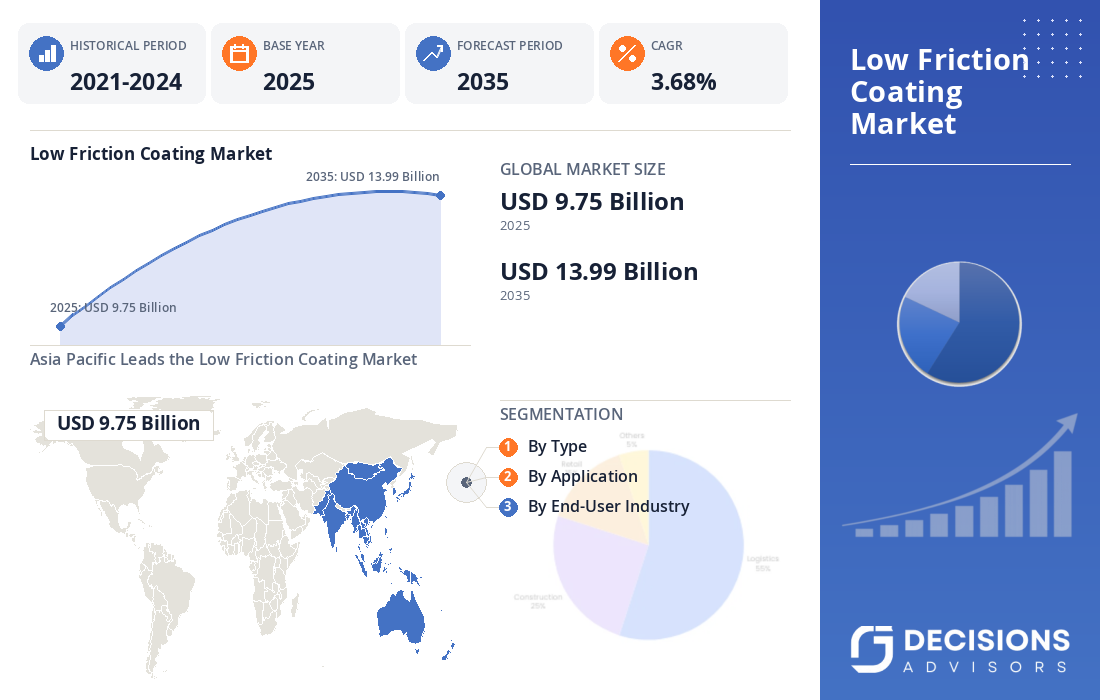
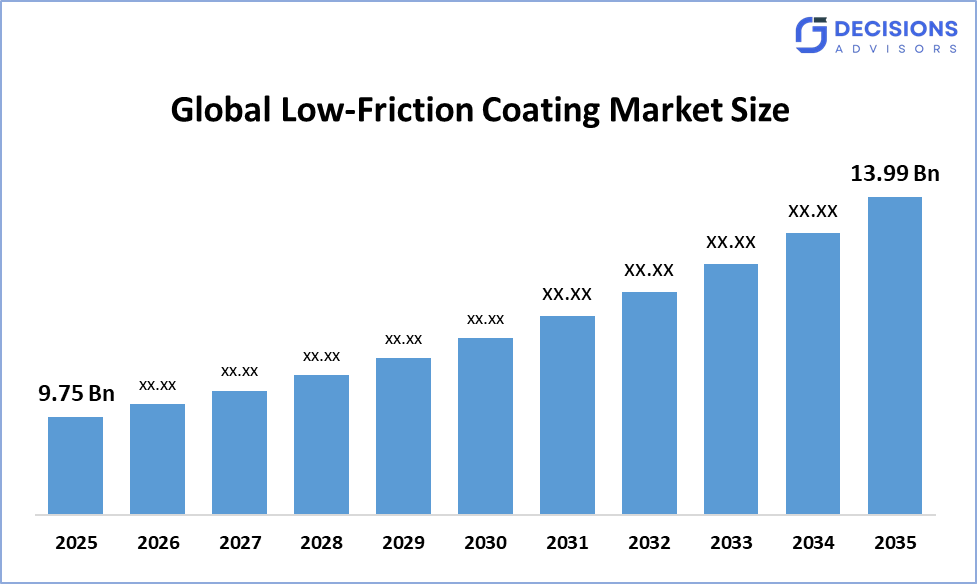
The Global Low-Friction Coating Market Size is predicted to grow from USD 9.75 Billion in 2025 and is likely to reach around USD 13.99 Billion by 2035 with a CAGR of 3.68%. According to Decision Advisors, the PTFE coatings segment leads the Global Low Friction Coatings Market and holds a market share of about 42.1% in 2025 owing to their low friction, chemical and heat resistance properties. Trends observed in the market include rising demand for energy efficient machines, automation in the industry, electric vehicles, aircraft parts, and sustainable coatings technology. The main players in the market include DuPont, Endura Coatings, VITRACOAT, Poeton Industries, and Whitford, with DuPont and Chemours accounting for more than 25% global market share.
Market Snapshot
- Global Low-Friction Coating Market Size (2025): USD 9.75 Billion
- Projected Global Low-Friction Coating Market Size (2035): USD 13.99 Billion
- Global Low-Friction Coating Market Compound Annual Growth Rate (CAGR): 3.68%
- Largest Regional Market: Asia Pacific
- 2nd Largest Region: North America
- Fastest Growing Region: Asia Pacific
- Base Year: 2025
- Historical Period: 2021-2024
- Market Forecast Period: 2026-2035
Market Overview/ Introduction
The Global Low-Friction Coating Market encompasses various coatings which are applied on the surface of an object to decrease friction, wear, heat generation, and material loss in moving/engaging parts. Low-friction coatings find widespread application in the fields of automotive, aerospace, machinery, healthcare, energy, and transportation, increasing the efficiency of machinery and extending the life of its components. Various government initiatives, including the Safer Choice Program in the USA, EU REACH regulations, and industrial sustainability policies, stimulate the introduction of coatings with reduced environmental impact and emissions. New tendencies include increased investments in formulations without PFAS, more advanced PVD/CVD deposition techniques, and highly effective coatings for electric vehicles, aerospace, and medical appliances. Drivers of the market include increased automotive production and their transition to electric vehicles, increased industrial automation, aerospace production, stricter environmental restrictions, and increasing need for energy-efficient machines. The largest market share belongs to the Asia-Pacific region, while the most rapid growth is expected in North America due to increased adoption of modern low-friction coatings.
- The EU enforces strict caps on vehicle emissions and brake dust under updated rules, compelling automakers to adopt advanced low-friction and ultra-low-wear ceramic coatings to improve mechanical efficiency.
- Regulatory bodies are tightening control over toxic per- and polyfluoroalkyl substances (PFAS), forcing manufacturers to pivot toward fluorine-free and eco-friendly low-friction alternative surface treatments.
Notable Insights: -
- Asia-Pacific is anticipated to hold approximately 36.9% share of the Global Low-Friction Coating Market over the predicted timeframe.
- Europe is expected to grow at a rapid CAGR in the Global Low-Friction Coating Market by holding approximately 16.8% of the share during the forecast period.
- By type, the Polytetrafluoroethylene (PTFE) Coatings, segment dominated the market and holds approximately 42% share in 2025 and is projected to grow at a substantial CAGR during the forecast period.
- By application, the Bearings segment dominated the market and holds approximately 38% share in 2025 and is projected to grow at a substantial CAGR during the forecast period.
- The compound annual growth rate of the Global Low-Friction Coating Market is 3.68%.
- The market is likely to achieve a valuation of USD 13.99 Billion by 2035.
Market Drivers
The market for Global Low-Friction Coatings is witnessing growth as the manufacturers need coatings that minimize friction and wear and tear of moving parts along with minimizing energy loss. The growth in the automobile industry helps in adoption in engine parts, bearings, transmissions, and parts in electric cars for increased efficiency and longevity. Growth in the manufacturing sector of aerospace leads to the requirement of high performance and light-weighted coatings for reliability during extreme conditions of operation. Growth in industrial automation and machinery helps in the adoption of low-friction coatings for reduced maintenance of machinery and its life extension. Growth in the production of renewable energy, especially wind turbines, helps in the adoption of coatings for protection of bearings and mechanical parts.
Restrain
Low-friction coating adoption may be hampered by high manufacturing costs and difficult application procedures, especially in cost-sensitive sectors. Complicated coating application procedures raise production costs and call for certain tools and knowledge.
Competitive Analysis:
The report offers the appropriate analysis of the key organizations/companies involved within the Global Low-Friction Coating Market along with a comparative evaluation primarily based on their product offerings, business overviews, geographic presence, enterprise strategies, segment market share, and SWOT analysis. The report also provides an elaborative analysis focusing on the current news and developments of the companies, which includes product development, innovations, joint ventures, partnerships, mergers & acquisitions, strategic alliances, and others. This allows for the evaluation of the overall competition within the market.
Top Companies in the Global Low-Friction Coating Market
- PPG Industries
- The Chemours Company
- DuPont
- Daikin Industries
- Klüber Lubrication
- Carl Bechem GmbH
- Endura Coatings
- Poeton Industries
- ASV Multichemie
- AGC Inc
Government Initiatives
|
Country |
Key Government Initiatives |
|
Germany |
Federal climate action plans encourage clean automotive engineering and electric mobility investments, boosting local demand for specialized low-friction coatings in high-speed e-axles. |
|
China |
National environmental standards mandate eco-friendly industrial practices and lower energy loss, prompting domestic factories to heavily utilize anti-friction treatments to upgrade machinery efficiency. |
|
United States |
Under the Clean Air Act, the U.S. Environmental Protection Agency enforces strict volatile organic compound limits, forcing manufacturers to adopt advanced water-based and solvent-free low-friction surface solutions. |
Market Segmentation
The Global Low-Friction Coating Market share is classified into Type, Application and End-User Industry
- The Polytetrafluoroethylene (PTFE) segment dominated the market and holds approximately 42% share in 2025 and is projected to grow at a substantial CAGR during the forecast period.
Based on the type, the Global Low-Friction Coating Market is divided into Molybdenum Disulphide, Tungsten Disulphide, Polytetrafluoroethylene, and Others. Of these, the Polytetrafluoroethylene (PTFE) category is the leading segment and accounted for roughly 38% of the market in 2025. This dominance is because of the low friction coefficient, excellent chemical and heat resistance, non-stick characteristic of PTFE. The PTFE coatings are widely applied in automotive parts, industrial machinery, aircraft, food-processing equipment, and various manufacturing processes. The PTFE helps in decreasing wear, reducing energy usage, and improving the longevity of the components.
- The Bearings segment accounted for the largest share of approximately 38% in 2025 and is anticipated to grow at a significant CAGR during the forecast period.
Based on the application, the Global Low-Friction Coating Market is bifurcated as Bearings, Automotive Parts, Power Transmission Components, and Others. Among these segments, Automotive Parts have been estimated to capture the major market share and is expected to occupy 36% market share in 2025. The increasing market share is credited to the increasing demand for low friction and high fuel efficiency and due to durability and enhanced vehicle performance. There are various components in vehicles including gears, engines, pistons that are using low friction coatings due to its advantages.
- The Automotive and Transportation segment accounted for the largest share of approximately 41% in 2025 and is anticipated to grow at a significant CAGR during the forecast period.
Based on end-user industry, the Global Low-Friction Coating Market is divided into Automotive and Transportation, Aerospace and Defense, Healthcare, and Others. Of all these categories, Automotive and Transportation is the largest and accounts for around 41% of the market share in 2025. Such a high market share is because of the growing demand for energy savings, less component wear and tear, enhanced vehicle performance, and greater durability. The usage of low friction coatings includes applications on engines, bearings, gears, pistons, and transmission systems.
Regional Segment Analysis of the Global Low-Friction Coating Market
- Asia-Pacific (China, Japan, India, South Korea, Australia, and Rest of Asia-Pacific)?
- North America (United States and Canada)
- Europe (Germany, France, United Kingdom, Italy, Spain, and Rest of Europe)
- Latin America (Brazil, Mexico, Argentina, Chile, and Rest of Latin America)?
- The Middle East and Africa (Saudi Arabia, UAE, South Africa, Qatar, and Rest of MEA)
Asia-Pacific is anticipated to hold approximately 36.9% share of the Global Low-Friction Coating Market over the predicted timeframe.
The Asia-Pacific region makes up about 36.9% of the Global Low-Friction Coatings Market due to its vast manufacturing capabilities and demand in automotive, industrial machinery, aerospace, electronics, and engineering segments. Nations like China, Japan, South Korea, and India have been making substantial contributions due to growing industrialization and application of high-tech surface coatings. Moreover, the existence of large-scale automobile and manufacturing industries and investments in energy-efficient equipment are aiding in the growth of the market. Growing need for durable and resistant low-friction coatings has improved regional competitiveness and the market's growth.
Europe is expected to grow at a rapid CAGR in the Global Low-Friction Coating Market, holding approximately 16.8% of the share during the forecast period
The Europe region constitutes around 16.8% of the global low friction coating market due to strong demands in the automotive, aerospace, industrial machinery, and manufacturing industries. Nations like Germany, UK, France, Italy, and Spain are some of the significant players of the regional market. Factors like the presence of advanced engineering industries along with an increased focus on energy conservation, less wear and tear of components, and enhanced equipment performance have fueled the use of low friction coatings. In addition to that, stricter environmental laws and the need for more sustainable and efficient coating solutions have also helped in driving this market.
North America is the fastest-growing region in the Global Low-Friction Coating Market during the period, holding approximately 26% share.
The North America constitutes approximately 26% of the total share of Global Low Friction Coatings Market and emerges as one of the most prominent regional markets. It is fueled by high demand from automotive, aerospace, industrial machines, and manufacturing industries. Key contributors to this market are United States, Canada, and Mexico and are benefited by having state-of-the-art manufacturing technology along with industrial giants and technology firms operating in the region. Moreover, high investments being made in energy-efficient and high-performing technologies are expected to benefit this market.
Future Market Trends in Global Low-Friction Coating Market: -
-
- Growing Demand for Advanced Wear-Resistant Coatings
Low-friction coatings are more widely used in automotive, aerospace, machinery, and manufacturing fields to minimize wear and energy loss and increase component lifetime. New materials offer enhanced performance characteristics. Increased need for high-performance equipment and maintenance intervals contributes to increased application in the global market.
-
- Development of Environmentally Friendly Coating Technologies
The manufacturing industry is producing environmentally safe, low friction, water-based, and low-VOC coatings to satisfy increased environmental regulations. They provide improved environmental conditions without compromising performance and durability. Increased awareness about environmental sustainability is leading industries to use alternative materials in place of conventional coating materials.
-
- Rising Adoption in Automotive and Aerospace Applications
Aerospace and automotive industries have resorted to using low-friction coatings for increasing fuel efficiency, reducing wear and tear, and improving performance in general. Coatings are used on engines, bearings, gears, and mechanical components. The rising number of electric cars and the need for energy-efficient planes have been driving this trend.
-
- Integration of Nanotechnology and Advanced Materials
Nanotechnology is helping develop low-friction coating solutions which offer enhanced hardness, better thermal stability, improved corrosion resistance, and lubricity. Performance improvements in challenging environments are being made possible through nanocomposite material solutions. Research advancements in graphene, diamond-like carbon, and other advanced materials can be expected to open up many opportunities.
Recent Development
- In March 2024, PPG unveiled PPG NEXEON 810, an ultra-low friction, copper-free antifouling marine paint designed to increase vessel fuel efficiency.
- In October 2024, DuPont de Nemours Inc. unveiled MOLYKOTE anti-friction coatings specifically designed to lower powertrain energy loss in electric vehicle (EV) components.
- In January 2026, the industry-wide adoption of PFAS-free low-friction substitutes was expedited by regulatory changes (such as tighter Canadian and European limits monitored by TÜV SÜD).
Market Segment
This study forecasts revenue at global, regional, and country levels from 2020 to 2035. Decision Advisors has segmented the Global Low-Friction Coating Market based on the below-mentioned segments:
Global Low-Friction Coating Market, By Type
- Molybdenum Disulphide
- Tungsten Disulphide
- Polytetrafluoroethylene
- Others
Global Low-Friction Coating Market, By Application
- Bearings
- Automotive Parts
- Power Transmission Items
- More
Global Low-Friction Coating Market, By End-User Industry
- Automotive and Transportation
- Aerospace and Defense
- Healthcare
- More
Global Low-Friction Coating Market, By Regional Analysis
- Asia-Pacific
- China
- Japan
- India
- South Korea
- Australia
- Rest of Asia-Pacific
- North America
- United States
- Canada
- Europe
- Germany
- France
- United Kingdom
- Italy
- Spain
- Rest of Europe
- Latin America
- Brazil
- Mexico
- Argentina
- Chile
- Rest of Latin America
- Middle East & Africa
- Saudi Arabia
- UAE
- South Africa
- Qatar
- Rest of MEA
Frequently Asked Questions (FAQ)
Q. How do low-friction coatings improve equipment performance?
A. In automotive, aircraft, industrial machinery, and manufacturing applications, low-friction coatings improve operational efficiency, prolong equipment lifespan, and lower maintenance requirements by lowering surface resistance, wear, and heat generation between moving components.
Q. Why are low-friction coatings increasingly preferred over conventional lubrication methods?
A. They provide persistent surface protection, reduce dependence on liquid lubricants, operate successfully under harsh conditions, and assist minimize maintenance needs, contamination concerns, and energy losses in demanding industrial applications.
Q. What role do low-friction coatings play in energy efficiency?
A. These coatings improve fuel economy, lower power consumption, and promote more sustainable operations throughout industrial and transportation equipment by lowering friction between mechanical components.
Q. How is material innovation influencing the Global Low-Friction Coating Market?
A. Coatings with improved durability, thermal stability, corrosion resistance, and wear protection are being more widely used in advanced automotive, aerospace, and industrial applications because to developments in nanotechnology, diamond-like carbon, nanocomposites, and self-lubricating materials.
Check Licence
Choose the plan that fits you best: Single User, Multi-User, or Enterprise solutions tailored for your needs.
We Have You Covered
- 24/7 Analyst Support
- Clients Across the Globe
- Tailored Insights
- Technology Tracking
- Competitive Intelligence
- Custom Research
- Syndicated Market Studies
- Market Overview
- Market Segmentation
- Growth Drivers
- Market Opportunities
- Regulatory Insights
- Innovation & Sustainability
Report Details
| Scope | Global |
| Pages | 200 |
| Delivery | PDF & Excel via Email |
| Language | English |
| Release | Aug 2026 |
| Access | Download from this page |