
Global Luxury Car Market
 |
Author:
Sanket C
|
Pages:
220
|
Author:
Sanket C
|
Pages:
220
Global Luxury Car Market Size, Share, and, By Vehicle Type (Hatchback, Sedan, Sports Utility Vehicle (SUV), Coupe, Limousine, and Sports Car), By Propulsion Type (Internal Combustion Engine (ICE), Hybrid, and Electric), By End Use (Individual/Personal, Corporate Fleet, and Rental & Chauffeur Services), By Region (North America, Europe, Asia-Pacific, Latin America, and Middle East & Africa), Analysis and Forecast 2026 ? 2035.
CAGR
7.35%
REVENUE 2025
USD Billion 750.26
FORECAST 2035
USD Billion 1524.18
REPORT COVERAGE
Global
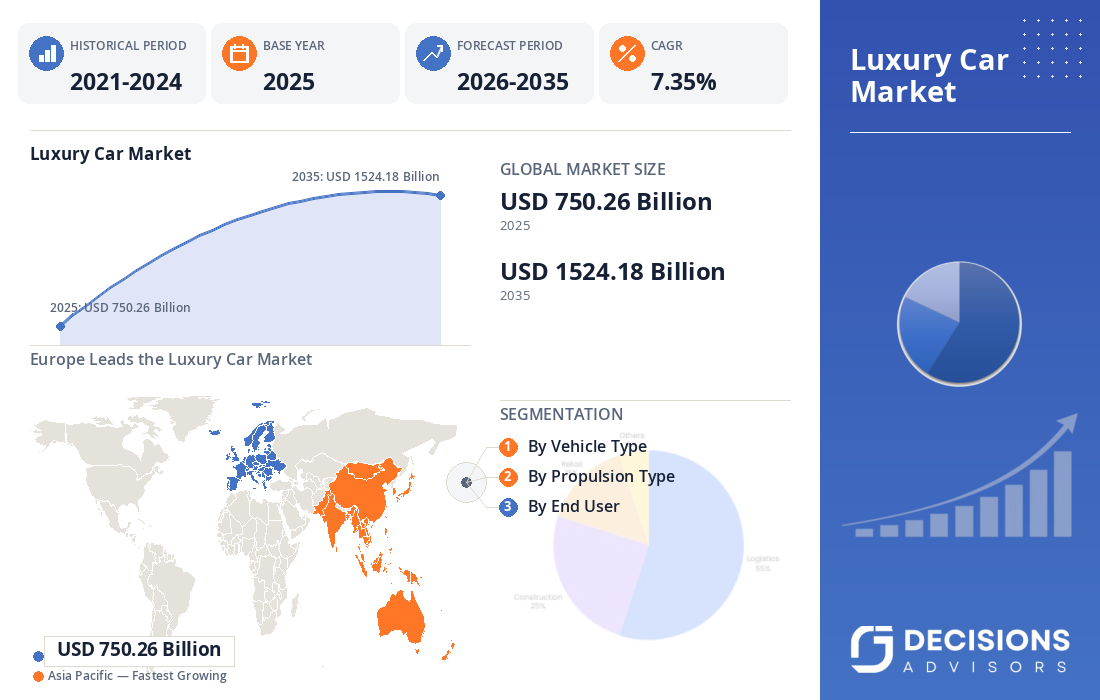
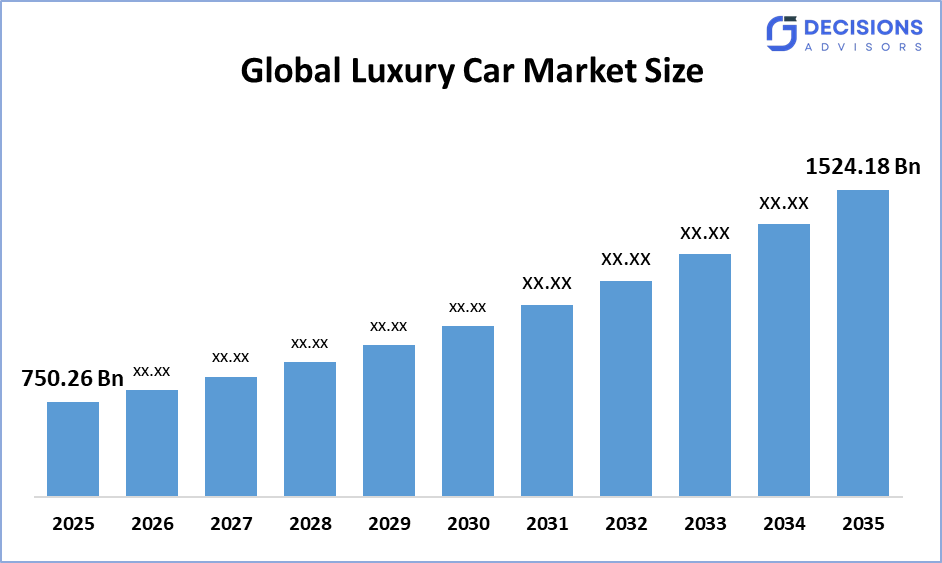
The Global Luxury Car Market Size was valued at approximately USD 750.26 Billion in 2025 and is expected to reach approximately USD 1524.18 Billion by 2035, expanding at a CAGR of 7.35% during the forecast period. The global luxury car market is experiencing significant growth due to expanding premium chauffeur and rental services, rising demand for high-performance driving experiences, growing popularity of bespoke and limited-edition vehicles, increasing consumer interest in experiential luxury, and wider availability of specialized financing and leasing options. These developments are broadening luxury vehicle applications, strengthening brand exclusivity, and enabling consumers to access premium vehicles through flexible ownership models
?Market Snapshot?
- Global Luxury Car Market Size (2025): USD 750.26 Billion
- Projected Market Size (2035): USD 1524.18 Billion
- Global Market CAGR (2026–2035): 7.35%
- Largest Regional Market: Europe
- 2nd Largest Region: North America
- Fastest Growing Region: Asia-Pacific
- Base Year: 2025
- Historical Period: 2021–2024
- Forecast Period: 2026–2035
Market?Overview/Introduction
A luxury car is a premium passenger vehicle positioned above mainstream automobiles in terms of comfort, performance, technology, design, materials, craftsmanship, brand prestige, and personalization. Luxury vehicles generally emphasize the overall ownership experience rather than transportation alone.
Luxury vehicles commonly incorporate sophisticated safety systems, including advanced driver-assistance technologies, automated parking, collision avoidance, adaptive cruise control, and enhanced driver monitoring. Premium interiors typically provide high-quality seating, improved cabin insulation, sophisticated climate-control systems, premium materials, and greater attention to passenger comfort.
Luxury sedans and SUVs are used by affluent consumers for daily commuting, long-distance travel, and family transportation. Premium vehicles are widely used by business executives and senior professionals because of their comfort, privacy, and professional image. Companies may use luxury vehicles for executive mobility, client transportation, corporate events, and employee transportation
Europe has particularly strong policy support for automotive electrification and clean-vehicle development. The European Union has established CO? performance standards for new passenger cars and vans, creating pressure on manufacturers to reduce fleet emissions and accelerate zero-emission vehicle adoption. The EU's automotive policy framework also supports battery manufacturing, clean mobility, technological development, and industrial competitiveness.
Market Drivers?
The global luxury car market is gaining momentum as consumers increasingly seek premium comfort, distinctive styling, advanced technology, and exclusive driving experiences. Rising disposable incomes and the expansion of affluent consumer groups are creating new opportunities for luxury vehicle manufacturers, particularly in developing economies. Growing interest in premium SUVs is also supporting market expansion because these vehicles combine spacious interiors, performance, comfort, and versatility. Technological innovation is another important factor, with manufacturers integrating connected systems, advanced driver-assistance features, digital cockpits, and intelligent infotainment into luxury models. The shift toward electric and hybrid vehicles is further influencing the market as premium automakers introduce high-performance electrified models. In addition, demand for personalized interiors, bespoke designs, premium materials, and exclusive ownership experiences is encouraging consumers to choose luxury vehicles.
Restrain??
The global luxury car market faces restraints such as high vehicle prices, expensive maintenance, and elevated insurance costs, which limit affordability among middle-income consumers. Economic uncertainty, inflation, and fluctuations in interest rates can reduce discretionary spending on premium automobiles. Stricter emission regulations also increase development and compliance costs for manufacturers.
Competitive Analysis:?
The report offers the appropriate analysis of the key organizations/companies involved within the Global luxury car Market, along with a comparative evaluation primarily based on their product offerings, business overviews, geographic presence, enterprise strategies, segment market share, and SWOT analysis. The report also provides an elaborative analysis focusing on the current news and developments of the companies, which includes product development, innovations, joint ventures, partnerships, mergers & acquisitions, strategic alliances, and others. This allows for the evaluation of the overall competition within the market.??
Top Companies in the Global luxury car Market
- Tesla
- BMW
- Mercedes Benz
- Audi
- Ferrari N.V
- Aston Martin
- Porsche
- McLaren
- Volvo Cars
- Bentley Motors Limited
- Automobili Lamborghini
- Maserati S.p.A.
- Jaguar Land Rover
- Lexus
- Lotus Cars Ltd.
- Pagani Automobili S.p.A
- Koenigsegg Automotive AB
Government?Initiatives?
|
Country? |
Key Government Initiatives |
|
European Union |
The European Union is supporting the automotive industry's transition toward cleaner mobility through CO? emission standards, zero- and low-emission vehicle adoption, and fleet electrification. EU fleet-wide CO? targets require manufacturers to reduce average emissions, with more stringent targets applying from 2030. In December 2025, the European Commission also introduced measures focused on clean mobility, greener corporate fleets, and maintaining the competitiveness of Europe's automotive industry. These policies encourage luxury manufacturers to accelerate electric and low-emission vehicle development. |
|
Singapore |
Under the EV Early Adoption Incentive (EEAI), fully electric cars registered in 2026 receive a rebate of up to 45% of the Additional Registration Fee (ARF), capped at S$7,500. The Vehicular Emissions Scheme (VES) also provides rebates for lower-emission vehicles, with fully electric cars receiving the most favorable treatment. These incentives remain applicable through 2026–2027, supporting the adoption of premium electric vehicles. |
|
China |
From 2026 to 2027, qualifying new-energy vehicles receive a 50% reduction in vehicle purchase tax, capped at RMB 15,000 per new passenger vehicle. The policy applies to qualifying battery-electric, plug-in hybrid, and fuel-cell vehicles. China has also introduced updated technical requirements for vehicles eligible for the 2026–2027 tax-reduction program, encouraging manufacturers to improve vehicle efficiency and technology. These measures can benefit luxury automakers developing premium electric and hybrid models for the Chinese market. |
?
Market?Segmentation?
The?Global Luxury Car Market share is classified into vehicle type, propulsion type, End Use, and region.
- The Sports Utility Vehicle (SUVs) Segment Dominates the Market
Based on vehicle type, the market is divided into Hatchback, Sedan, Sports Utility Vehicle (SUV), Coupe, Limousine, and Sports Car. Among these, the Sports Utility Vehicle (SUVs)segment is expected to dominate the market because combine luxury, spacious interiors, comfort, strong road presence, practicality, and higher seating capacity. Their versatility has made them increasingly preferred over traditional luxury sedans.
- The Internal Combustion Engine (ICE) Segment Accounts for a Significant Share
Based on propulsion type, the market is divided into Internal Combustion Engine (ICE), Hybrid, and Electric. The Internal Combustion Engine segment represents a significant share due to because of their established infrastructure, longer driving range, quick refuelling, mature technology, and strong consumer acceptance.
- The Individual/ Personal Segment Represents a Significant Share
Based on End Use, the market is divided into Individual/Personal, Corporate Fleet, and Rental & Chauffeur Services. Among these, the individual/ Personal segment is expected to dominate the market because personal ownership represents the core use of luxury cars, driven by affluent consumers seeking comfort, status, performance, personalization, and premium technology.
Regional Segment Analysis of the Global luxury car Market
- North America (U.S., Canada, Mexico)
- Europe (Germany, U.K., France, Italy, Spain, Netherlands, Rest of Europe)
- Asia-Pacific (China, Japan, India, Australia, South Korea, Rest of Asia-Pacific)
- South America (Brazil, Argentina, Rest of South America)
- Middle East & Africa (UAE, Saudi Arabia, South Africa, Rest of MEA)
Europe Maintains a Leading Share of the Global Luxury Car Market in 2025
Europe maintains a leading position in the Global Luxury Car Market due to a deeply established luxury automotive ecosystem, supported by globally recognized manufacturers such as Mercedes-Benz, BMW, Audi, Porsche, Ferrari, Aston Martin, and Lamborghini. Germany, the UK, Italy, France, and other European markets provide strong manufacturing capabilities, engineering expertise, premium dealerships, and an established customer base for luxury vehicles.
North America Holds a Significant Share of the Global Luxury Car Market in 2025
North America holds a significant share of the Global Luxury Car Market, primarily because of the exceptionally large and mature luxury-vehicle customer base. High disposable incomes, a substantial population of high-net-worth consumers, strong demand for premium SUVs and performance vehicles, and well-developed automotive financing and dealership networks support the region. The United States is particularly important for luxury manufacturers because consumers have historically shown strong interest in large SUVs, premium pickups, performance cars, and technologically advanced vehicles. Luxury brands are also expanding their electric and connected-vehicle offerings to match changing consumer preferences.
Asia-Pacific Witnesses Substantial Growth in 2025
Asia-Pacific is experiencing substantial growth because the region is benefiting from rising disposable incomes, expanding affluent and high-net-worth populations, rapid urbanization, and increasing consumer interest in premium lifestyles. China remains a major luxury-vehicle market, while India, Japan, South Korea, and Southeast Asian economies provide additional growth opportunities. The region is also undergoing rapid automotive electrification, with local EV manufacturers increasingly competing with established international luxury brands. Rising acceptance of premium electric SUVs, digitally connected vehicles, and technology-focused luxury models is expected to accelerate regional demand.
Future?Market?Trends in?Global luxury car Market: -?
- Rapid Electrification of Luxury Vehicles
Luxury automakers are accelerating the introduction of battery-electric and hybrid models as consumer expectations and emissions regulations evolve. Premium brands are using electrification not only to reduce emissions but also to deliver quiet cabins, instant acceleration, advanced technology, and distinctive driving experiences. The luxury segment is therefore becoming an important testing ground for high-performance EV technologies.
- Growing Preference of Luxury SUVs
Luxury SUVs are becoming increasingly popular because they combine premium comfort with practicality, spacious interiors, elevated driving positions, and strong road presence. Automakers are responding by expanding their SUV portfolios across both combustion and electric powertrains. Even traditionally sports-focused brands such as Ferrari and Aston Martin have entered the SUV segment, highlighting its growing importance to luxury manufacturers.
- Rise of Software-Defined Luxury Vehicles
Luxury vehicles are increasingly being transformed into software-driven platforms rather than relying solely on mechanical features. Advanced infotainment, AI-powered functions, connected services, digital cockpits, and over-the-air software updates are becoming part of the premium ownership experience. This also allows manufacturers to introduce new functions and upgrades after the vehicle has been purchased.
- Increasing Demand for Personalization and Bespoke Experiences
Affluent consumers are increasingly looking for vehicles that reflect their individual preferences rather than standardized luxury models. Manufacturers are responding with personalized interiors, exclusive materials, custom colors, limited editions, bespoke configurations, and digital personalization. This trend is particularly significant in the ultra-luxury segment, where exclusivity and craftsmanship can be as important as vehicle performance.
- Integration of AI and Advanced Driver-Assistance Technologies
Artificial intelligence and advanced driver-assistance systems are becoming important differentiators in luxury vehicles. Manufacturers are incorporating AI-enabled assistants, intelligent navigation, predictive safety functions, automated parking, driver monitoring, and personalized in-car experiences. Luxury consumers increasingly expect technology to improve not only safety but also convenience, entertainment, and overall comfort.
Market Segment?
This study forecasts revenue at global, regional, and country levels from 2026 to 2035. Decision Advisors has segmented the Global luxury car Market based on the below-mentioned segments:
Global Luxury Car Market, By Vehicle Type
- Hatchback
- Sedan
- Sports Utility Vehicle (SUV)
- Coupe
- Limousine
- Sports Car
Global Luxury Car Market, By Propulsion Type
- Internal Combustion Engine (ICE)
- Hybrid
- Electric
Global Luxury Car Market, By End User
- Individual/Personal
- Corporate Fleet
- Rental & Chauffeur Services
Global Luxury Car Market, By Regional Analysis?
North America??
- US?
- Canada?
- Mexico?
Europe??
- Germany?
- UK?
- France?
- Italy?
- Spain?
- Russia?
- Rest of Europe?
Asia Pacific??
- China?
- Japan?
- India?
- South Korea?
- Australia?
- Rest of Asia Pacific?
South America??
- Brazil
- Argentina?
- Rest of South America?
Middle East & Africa??
- UAE?
- Saudi Arabia?
- Qatar?
- South Africa?
- Rest of the Middle East & Africa?
?
Frequently?Asked Questions (FAQ)?
Q. What is driving the growth of the Global Luxury Car Market?
A. Rising disposable incomes, increasing numbers of affluent consumers, growing demand for luxury SUVs, technological advancements, vehicle personalization, and the expansion of electric and hybrid luxury vehicles are major factors supporting market growth.
Q. How is electrification shaping the Global Luxury Car Market?
A. Electrification is reshaping the competitive landscape by encouraging luxury manufacturers to introduce high-performance electric and hybrid models. Premium EVs can combine rapid acceleration, quiet operation, advanced software, and sophisticated interiors, creating new opportunities for luxury brands.
Q. What is the outlook for global luxury car market?
A. The market is expected to continue expanding as affluent consumer populations grow and demand increases for premium comfort, advanced technology, personalization, electrification, and distinctive ownership experiences. Luxury manufacturers that successfully combine traditional craftsmanship with digital innovation and sustainable mobility are likely to be better positioned for long-term growth.
Q. What are the major trends shaping the global luxury car market?
A. Key trends include vehicle electrification, growing demand for luxury SUVs, software-defined vehicles, AI integration, advanced driver-assistance systems, connected-car technologies, and increasing demand for bespoke and personalized vehicles.
Check Licence
Choose the plan that fits you best: Single User, Multi-User, or Enterprise solutions tailored for your needs.
We Have You Covered
- 24/7 Analyst Support
- Clients Across the Globe
- Tailored Insights
- Technology Tracking
- Competitive Intelligence
- Custom Research
- Syndicated Market Studies
- Market Overview
- Market Segmentation
- Growth Drivers
- Market Opportunities
- Regulatory Insights
- Innovation & Sustainability
Report Details
| Scope | Global |
| Pages | 220 |
| Delivery | PDF & Excel via Email |
| Language | English |
| Release | Aug 2026 |
| Access | Download from this page |