
Global Luxury Goods Market
 |
Author:
Rahul B
|
Pages:
210
|
Author:
Rahul B
|
Pages:
210
Global Luxury Goods Market Size, Share By Product Type (Watches & Jewelry, Perfumes & Cosmetics, Clothing, Bags & Purses, Others), By End User (Women, Men), By Distribution Channel (Online, Offline), and By Region (North America, Europe, Asia-Pacific, Latin America, Middle East & Africa), Analysis and Forecast 2026-2035.
CAGR
4.85%
REVENUE 2025
USD Billion 311.35
FORECAST 2035
USD Billion 499.72
REPORT COVERAGE
Global
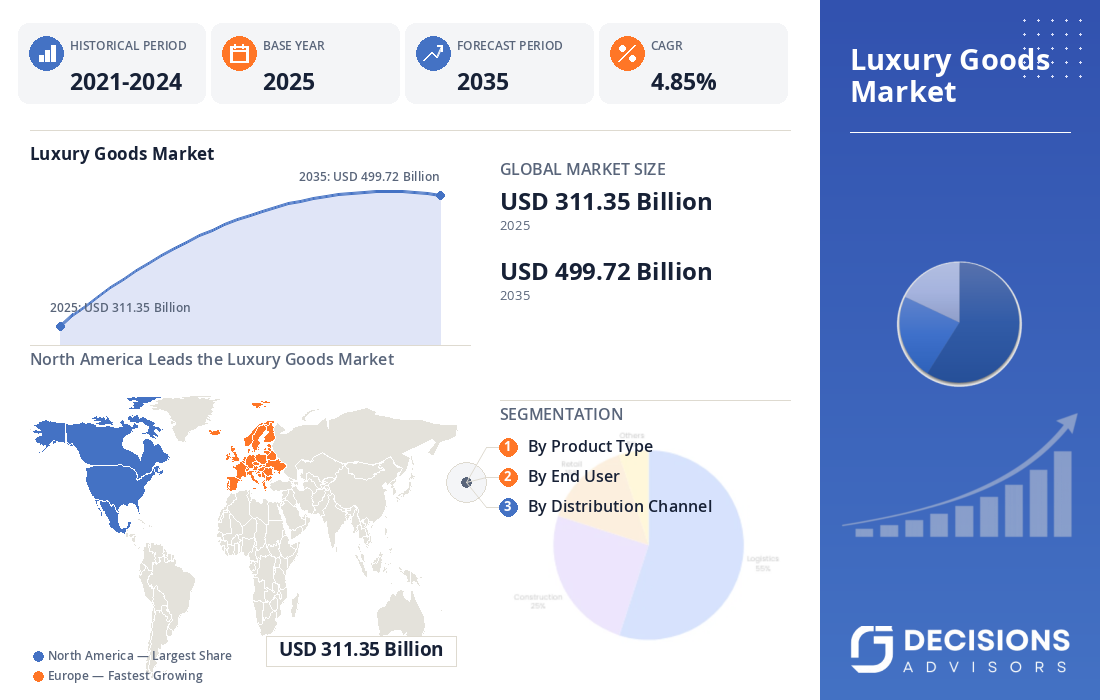
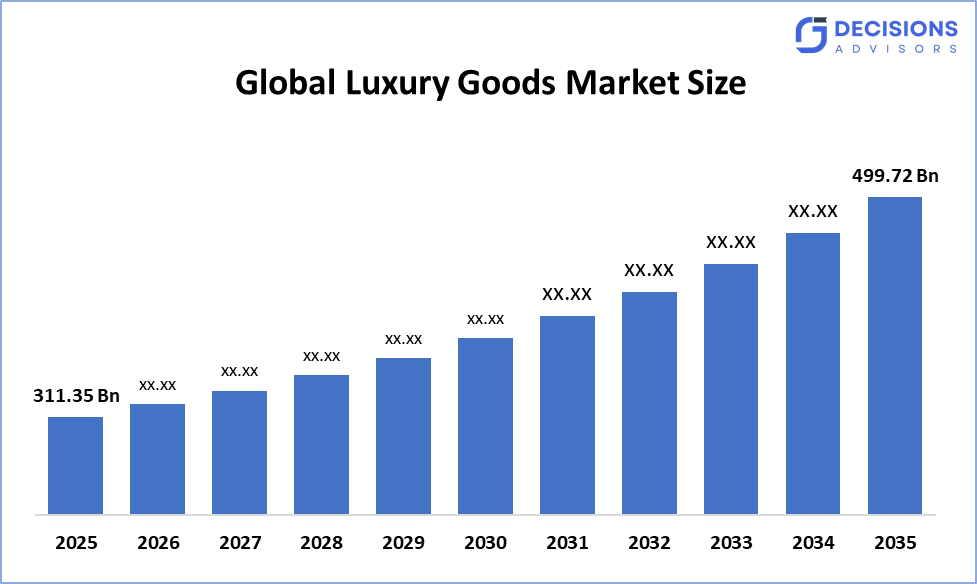
The Global Luxury Goods Market Size is predicted to grow from USD 311.35 Billion in 2025 and is likely to reach around USD 499.72 Billion by 2035 with a CAGR of 4.85%. According to Decision Advisors, a detailed research report on the market reflects that the Luxury E-Commerce trend dominates the global Luxury Goods Market, accounting for approximately 21% of the total share worldwide. LVMH leads the market with approximately annual revenue of €80.81 billion and approx 24 - 25% global market share, making it the key contributor to global market development and growth dynamics.
Market Snapshot
- Global Luxury Goods Market Size (2025): USD 311.35 Billion
- Projected Global Luxury Goods Market Size (2035): USD 499.72 Billion
- Global Luxury Goods Market Compound Annual Growth Rate (CAGR): 4.85%
- Largest Regional Market: North America
- 2nd Largest Region: Asia Pacific
- Fastest Growing Region: Europe
- Base Year: 2025
- Historical Period: 2021-2024
- Market Forecast Period: 2026-2035
Market Overview/ Introduction
The Global Luxury Goods Market represents a premium consumer goods industry that includes high-end clothing, footwear, handbags, watches, jewelry, perfumes, cosmetics, and other accessories, which are valued for quality, craftsmanship, exclusivity, and brand reputation. Market growth is driven by rising disposable income, expanding affluent consumer populations, increasing luxury tourism, and growing demand for premium and personalized products. The market is expanding as e-commerce, social media, and digital platforms make luxury products more accessible to consumers worldwide. Companies are investing in advanced retail technologies, artificial intelligence, digital personalization, and omnichannel platforms to improve customer experiences and strengthen brand engagement. The market provides important benefits, including access to premium products, personalized shopping experiences, strong brand value, and innovative product offerings. Future market growth is expected to be supported by sustainable luxury, online shopping, luxury resale, artificial intelligence, product customization, and increasing demand for exclusive consumer experiences.
- In January 2026, China’s National Bureau of Statistics reported that 2025 online retail sales reached RMB 15.97 trillion, increasing 8.6% year over year. Online retail sales of physical goods reached RMB 13.09 trillion, representing 26.1% of total retail sales of consumer goods. This supports the expansion of digital and e-commerce channels used by luxury brands.
- France’s INSEE reported that foreign tourists spent €77.5 billion in France during 2025, an increase of 7.8% from the previous year. France is a major luxury-goods market, and higher international tourist spending supports demand in luxury retail, fashion, cosmetics, jewelry, and related premium services.
Notable Insights: -
- North America is anticipated to hold approximately 35% share of the Global Luxury Goods Market over the predicted timeframe.
- Asia Pacific is expected to grow at a rapid CAGR in the Global Luxury Goods Market by holding approximately 28% of the share during the forecast period.
- By product type, the watches & jewelry segment dominated the market and holds approximately 44% share in 2025 and is projected to grow at a substantial CAGR during the forecast period.
- By end user, women segment dominated the market and holds approximately 59% share in 2025 and is projected to grow at a substantial CAGR during the forecast period.
- The compound annual growth rate of the Global Luxury Goods Market is 4.85%.
- The market is likely to achieve a valuation of USD 499.72 Billion by 2035.
What is the role of technology in grooming the market?
Technology plays an important role in developing the Global Luxury Goods Market by improving customer experiences, personalization, and digital sales. Artificial intelligence helps brands understand consumer preferences and provide personalized product recommendations. Augmented reality enables customers to virtually try products such as cosmetics, watches, and accessories. E-commerce platforms allow luxury brands to reach customers across different regions. Data analytics supports demand forecasting, inventory management, and targeted marketing. Blockchain technology can improve product authentication and traceability. Additionally, social media, mobile applications, and digital payment systems help luxury companies strengthen customer engagement, expand online presence, and provide convenient shopping experiences.
Market Driver
Rising disposable income is a major driver of the Global Luxury Goods Market. As household incomes increase, consumers have greater purchasing power for premium clothing, handbags, watches, jewelry, cosmetics, and other luxury products. The expansion of affluent and high-net-worth consumer groups, particularly in emerging economies, is creating new demand for luxury brands. Consumers increasingly view luxury products as symbols of quality, craftsmanship, exclusivity, and personal identity. In addition, growing urbanization, professional employment, and improving living standards are encouraging consumers to spend more on premium products, supporting the continued expansion of the global luxury goods market.
Restrain
High product prices can limit luxury goods adoption among middle-income consumers. Economic uncertainty, inflation, counterfeit products, changing consumer preferences, and frequent price increases can reduce demand. Additionally, competition from resale markets may challenge traditional luxury retail models.
Competitive Analysis:
The report offers the appropriate analysis of the key organizations/companies involved within the global Luxury Goods Market along with a comparative evaluation primarily based on their product offerings, business overviews, geographic presence, enterprise strategies, segment market share, and SWOT analysis. The report also provides an elaborative analysis focusing on the current news and developments of the companies, which includes product development, innovations, joint ventures, partnerships, mergers & acquisitions, strategic alliances, and others. This allows for the evaluation of the overall competition within the market.
Top Companies in the Global Luxury Goods Market
- LVMH
- Kering
- Hermès
- Compagnie Financière Richemont
- The Estée Lauder Companies
- Chow Tai Fook Jewellery Group
- The Swatch Group
- Ralph Lauren Corporation
- L'Oréal
- Shiseido
Government Initiatives
|
Country |
Key Government Initiatives |
|
US |
The U.S. Bureau of Economic Analysis reported that U.S. personal consumption expenditures (PCE) increased 0.2% in July 2026, following a 0.3% increase in June 2026. PCE measures spending by U.S. residents on goods and services and provides an official indicator of consumer demand supporting premium and luxury consumption. |
|
Japan |
Japan’s Tourism Agency reported that domestic travel consumption by Japanese residents reached ¥26.7845 trillion in 2025, increasing 6.5% from 2024 and 22.1% from 2019. Strong tourism expenditure supports premium retail, fashion, cosmetics, jewelry, and other luxury-related consumption. |
|
China |
China continues to support domestic consumption and retail activity. Official statistics reported that total retail sales of consumer goods reached 50,120.2 billion yuan in 2025, increasing 3.7% year over year. Online retail sales of physical goods reached 13,092.3 billion yuan, increasing 5.2%, supporting the wider digital retail environment in which luxury brands operate. |
Study on the Supply, Demand, Distribution, and Market Environment of the Global Luxury Goods Market
The market is supported by strong demand for premium clothing, handbags, watches, jewelry, perfumes, cosmetics, and other high-end products. Supply is provided by global luxury houses, specialist manufacturers, designers, jewelry companies, watchmakers, and premium beauty companies. Distribution primarily takes place through branded stores, department stores, specialty retailers, online stores, and luxury e-commerce platforms. Demand is particularly strong among high-income consumers and affluent younger buyers who value quality, brand reputation, exclusivity, and personalization. Digital retail is expanding access to luxury products, while physical stores continue to provide important customer experiences. The growing resale market is also changing the luxury distribution environment by providing consumers with additional ways to access premium products.
Price Analysis and Consumer Behaviour Analysis
Luxury goods are strongly influenced by product pricing, brand reputation, exclusivity, craftsmanship, and consumer income. Consumers generally associate higher prices with product quality, scarcity, heritage, and brand status. However, continuous price increases can affect aspirational consumers and encourage some customers to consider alternative brands or second-hand products. Consumers are increasingly influenced by social media, digital content, celebrity collaborations, personalized recommendations, and online reviews. Younger buyers also place greater importance on sustainability, ethical sourcing, product authenticity, and brand values. The luxury market is also experiencing a shift toward experiences, personalization, wellness, and self-reward rather than only ownership of physical products.
Market Segmentation
The Global Luxury Goods Market share is classified into equipment type of transaction, payment platform and business category.
- The watches & jewelry segment dominated the market and holds approximately 44% share in 2025 and is projected to grow at a substantial CAGR during the forecast period.
Based on product type, the Global Luxury Goods Market is divided into watches & jewelry, perfumes & cosmetics, clothing, bags & purses, and others. Among these, the watches & jewelry segment dominated the market and holds approximately 44% share in 2025 and is projected to grow at a substantial CAGR during the forecast period. This dominance is due to consumers value premium craftsmanship, brand heritage, design, exclusivity, and long-term ownership. Luxury watches and jewelry are also increasingly viewed as collectible products. Rising disposable income, expanding affluent consumer groups, and increasing demand for premium accessories are supporting the segment. Strong demand from Asia-Pacific and the Middle East is also contributing to market development.
- The women segment accounted for the largest share of approximately 59% in 2025 and is anticipated to grow at a significant CAGR during the forecast period.
Based on the end user, the market is divided into women and men. Among these, the women segment accounted for the largest share of approximately 59% in 2025 and is anticipated to grow at a significant CAGR during the forecast period. This dominance is due to increasing participation of women in professional and economic activities, higher disposable income, and growing interest in premium fashion and beauty products. At the same time, the men's luxury segment is expanding through increasing demand for premium watches, clothing, footwear, grooming products, jewelry, and accessories.
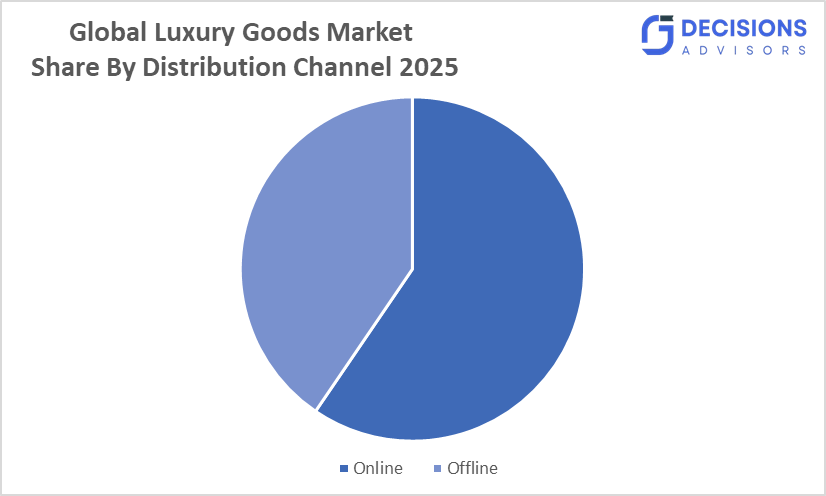
- The offline segment accounted for the largest share of approximately 57% in 2025 and is anticipated to grow at a significant CAGR during the forecast period.
Based on the distribution channel, the Global Luxury Goods Market is divided into online and offline. Among these, the offline segment accounted for the largest share of approximately 57% in 2025 and is anticipated to grow at a significant CAGR during the forecast period. This growth is driven by consumers often prefer to experience luxury products physically before purchasing. Luxury stores also provide personalized services and exclusive brand experiences. However, online channels are growing as brands develop direct-to-consumer websites, mobile applications, virtual shopping services, and omnichannel retail strategies. The growth of digital payments and improved logistics is further supporting online luxury purchases.
Strategies to Implement for Growth of the Market in Non-Leading Regions
To drive growth in non-leading regions, luxury companies should expand their digital presence and develop localized e-commerce platforms. Brands should introduce products and campaigns that reflect local consumer preferences while maintaining their global identity. Partnerships with local retailers, tourism operators, and premium shopping centers can improve market access. Companies should also invest in customer loyalty programs, personalized services, and social media marketing to attract younger consumers. Expanding premium beauty, accessories, and entry-level luxury products can help brands reach a wider consumer base. Sustainability, product authentication, resale services, and digital customer experiences can further strengthen consumer confidence and market penetration.
Regional Segment Analysis of the Global Luxury Goods Market
- North America (U.S., Canada, Mexico)?
- Europe (Germany, France, U.K., Italy, Spain, Rest of Europe)
- Asia-Pacific (China, Japan, India, Rest of APAC)
- South America (Brazil and the Rest of South America)?
- The Middle East and Africa (UAE, South Africa, Rest of MEA)
North America is anticipated to hold approximately 35% share of the Global Luxury Goods Market over the predicted timeframe.
North America is anticipated to hold approximately 35% share of the Global Luxury Goods Market during the forecast period. The region’s growth is driven by high disposable income, strong demand for premium fashion, watches, jewelry, cosmetics, and luxury accessories. The presence of leading luxury brands, developed retail infrastructure, expanding e-commerce, and growing interest in personalized products is further supporting market growth. Additionally, increasing luxury tourism, digital shopping, and demand for exclusive consumer experiences are contributing to the continued expansion of the luxury goods market in North America.
Asia Pacific is expected to grow at a rapid CAGR in the Global Luxury Goods Market, holding approximately 28% of the share during the forecast period
Asia Pacific is expected to grow at a rapid CAGR in the Global Luxury Goods Market during the forecast period. The region’s growth is driven by rising disposable income, expanding affluent consumer populations, and increasing demand for premium fashion and accessories. Countries such as China, Japan, India, and South Korea are witnessing strong luxury consumption. Rapid e-commerce growth, increasing international tourism, digital marketing, and expanding premium retail infrastructure are further supporting market expansion. Additionally, growing interest among younger consumers in luxury brands, personalization, and exclusive products is strengthening regional demand.
Europe is the fastest-growing region in the Global Luxury Goods Market during the period, holding approximately 25% share.
Europe is expected to hold a significant share of the Global Luxury Goods Market during the forecast period. The region’s strong position is supported by its established luxury fashion industry, renowned brands, skilled craftsmanship, and strong tourism sector. Countries such as France, Italy, Germany, and the UK are major luxury markets due to their strong consumer base and retail infrastructure. Increasing demand for premium clothing, handbags, watches, jewelry, perfumes, and cosmetics is further supporting growth. Additionally, international luxury tourism, online retail expansion, and growing demand for sustainable products are contributing to regional market development.
Future Market Trends in Global Atomic Layer Deposition Equipment Market: -
- Growth of Online Luxury Shopping
Luxury brands are expanding online stores, mobile applications, and digital marketplaces to reach more customers. Consumers can easily explore premium products, compare collections, and complete purchases digitally. Improved payment systems, delivery services, virtual assistance, and personalized recommendations are making online luxury shopping more convenient and accessible.
- ???????Increasing Personalization
Luxury consumers increasingly expect products and shopping experiences that reflect their individual preferences. Brands use customer data and artificial intelligence to provide personalized recommendations, customized products, targeted promotions, and tailored services. Personalization helps luxury companies strengthen customer relationships, improve satisfaction, and encourage repeat purchases across digital and physical channels.
- ???????Expansion of Sustainable Luxury
Sustainability is becoming increasingly important in luxury purchasing decisions. Luxury brands are using responsibly sourced materials, sustainable packaging, ethical production methods, and transparent supply chains. Companies are also introducing repair and recycling programs to extend product life. These initiatives help brands respond to changing environmental expectations.
- ???????Growth of Luxury Resale
The luxury resale market is expanding as consumers increasingly purchase pre-owned handbags, watches, jewelry, clothing, and accessories. Resale platforms provide access to premium products at comparatively lower prices while extending product lifecycles. Growing interest in circular consumption, sustainability, affordability, and product value is supporting the development of luxury resale.
- ???????Increasing Use of Artificial Intelligence
Artificial intelligence is becoming increasingly important across the luxury goods industry. Brands use AI for product recommendations, customer service, demand forecasting, inventory management, marketing, and fraud detection. AI helps companies understand consumer preferences, improve operational efficiency, and deliver personalized experiences while allowing luxury brands to maintain high service standards.
Recent Development
- In April 2026, Prada launched a limited-edition sandal collection inspired by Indian Kolhapuri Chappals, manufactured by artisans in Maharashtra and Karnataka. Prada also announced a three-year, fully funded training program designed to support 180 artisans and strengthen traditional craftsmanship.
- In March 2026, Kering launched Kering Jewelry, a new entity bringing together Boucheron, Pomellato, Dodo, and Qeelin with industrial capabilities. The initiative is designed to strengthen coordination and accelerate the growth of Kering’s global jewelry business.
- In January 2026, Burberry launched its Gabardine Capsule, celebrating the brand’s signature fabric through new outerwear, knitwear and layering pieces. The collection combines Burberry’s heritage with contemporary materials and was made available through stores and Burberry.com worldwide.
How is Recent Developments Helping the Market?
Recent developments are supporting the luxury goods market by improving digital shopping, personalization, customer engagement, and operational efficiency. Luxury brands are increasingly using artificial intelligence, data analytics, digital retail platforms, and omnichannel strategies to understand consumer preferences and improve shopping experiences. The growth of luxury tourism and demand for premium experiences are also creating additional opportunities. At the same time, sustainability, resale, product authentication, and personalized services are helping brands respond to changing consumer expectations.
Market Segment
This study forecasts revenue at global, regional, and country levels from 2020 to 2035. Decision Advisors has segmented the global Luxury Goods Market based on the below-mentioned segments:
Global Luxury Goods Market, By Product Type
- Watches & Jewelry
- Perfumes & Cosmetics
- Clothing
- Bags & Purses
- Others
Global Luxury Goods Market, By End User
- Women
- Men
Global Luxury Goods Market, By Distribution Channel
- Online
- Offline
Global Luxury Goods Market, By Regional Analysis
North America
- US
- Canada
- Mexico
Europe
- Germany
- UK
- France
- Italy
- Spain
- Russia
- Rest of Europe
Asia Pacific
- China
- Japan
- India
- South Korea
- Australia
- Rest of Asia Pacific
South America
- Brazil
- Argentina
- Rest of South America
Middle East & Africa
- UAE
- Saudi Arabia
- Qatar
- South Africa
- Rest of the Middle East & Africa
Frequently Asked Questions (FAQ)
Q. What factors are driving the Global Luxury Goods Market?
A. The market is mainly driven by rising disposable income, growing affluent consumer populations, increasing luxury tourism, premiumization, digital shopping, and rising demand for personalized and exclusive products.
Q. What role does e-commerce play in the luxury goods market?
A. E-commerce provides consumers with convenient access to international luxury brands and supports personalized marketing, digital payments, virtual shopping, and direct-to-consumer sales.
Q. How is artificial intelligence affecting the luxury goods market?
A. AI supports personalized recommendations, customer service, demand forecasting, inventory management, marketing, fraud detection, and operational efficiency.
Q. What are the major challenges facing the luxury goods market?
A. Major challenges include high product prices, economic uncertainty, changing consumer preferences, counterfeit products, price increases, and pressure to maintain brand exclusivity while reaching younger consumers.
Check Licence
Choose the plan that fits you best: Single User, Multi-User, or Enterprise solutions tailored for your needs.
We Have You Covered
- 24/7 Analyst Support
- Clients Across the Globe
- Tailored Insights
- Technology Tracking
- Competitive Intelligence
- Custom Research
- Syndicated Market Studies
- Market Overview
- Market Segmentation
- Growth Drivers
- Market Opportunities
- Regulatory Insights
- Innovation & Sustainability
Report Details
| Scope | Global |
| Pages | 210 |
| Delivery | PDF & Excel via Email |
| Language | English |
| Release | Sep 2026 |
| Access | Download from this page |