
Global Lyocell Fiber Market
 |
Author:
Aditya G
|
Pages:
200
|
Author:
Aditya G
|
Pages:
200
Global Lyocell Fiber Market Size, Share By Fiber Type (Regular Lyocell Fiber, High Tenacity Lyocell Fiber, Micro Lyocell Fiber), By End-Use Industry (Textiles & Apparel, Nonwovens, Medical & Hygiene Products, Automotive), By Application (Clothing & Accessories, Home Textiles, Medical & Surgical Products, Automotive Interiors, Filtration), and By Region (North America, Europe, Asia-Pacific, Latin America, Middle East & Africa), Analysis and Forecast 2026-2035
CAGR
6.66%
REVENUE 2025
USD Billion 2.97
FORECAST 2035
USD Billion 5.66
REPORT COVERAGE
Global
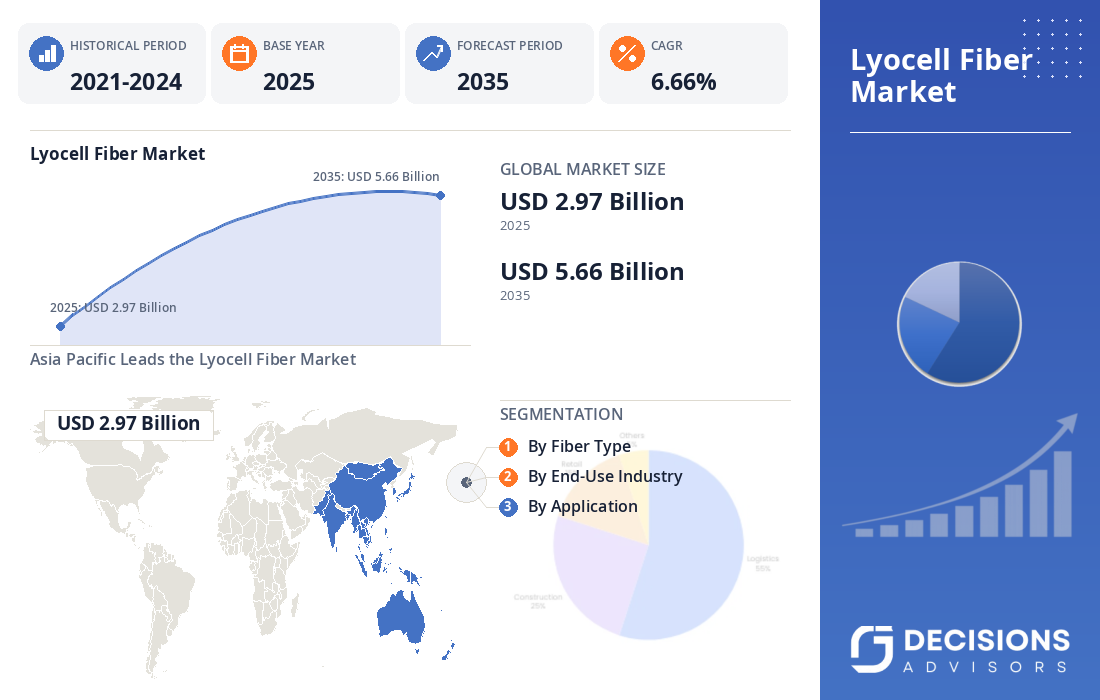
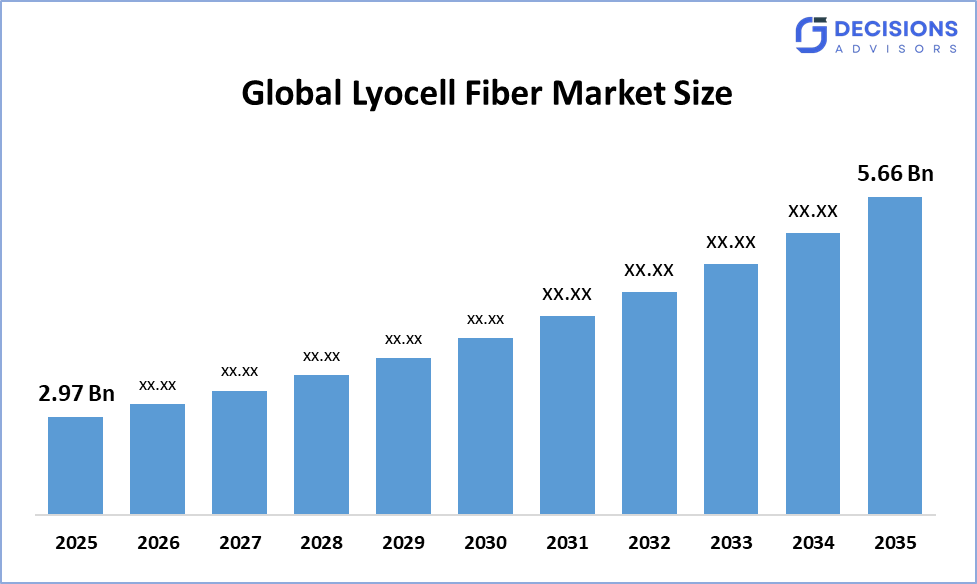
The Global Lyocell Fiber Market Size is predicted to grow from USD 2.97 Billion in 2025 and is likely to reach around USD 5.66 Billion by 2035 with a CAGR of 6.66%. According to Decision Advisors, a comprehensive research report on the market reveals that the sustainable and biodegradable textile adoption trend is the most prevalent one in the Global Lyocell Fiber Market and accounts for about 45% of the overall market share. The leading company in the market, Lenzing AG, has a significant global presence and a global market share of around 30%, which means that it plays a vital role in the development of the market.
Market Snapshot
- Global Lyocell Fiber Market Size (2025): USD 2.97 Billion
- Projected Global Lyocell Fiber Market Size (2035): USD 5.66 Billion
- Global Lyocell Fiber Market Compound Annual Growth Rate (CAGR): 6.66%
- Largest Regional Market: Asia Pacific
- 2nd Largest Region: Europe
- Fastest Growing Region: Asia Pacific
- Base Year: 2025
- Historical Period: 2021-2024
- Market Forecast Period: 2026-2035
Market Overview/ Introduction
The Global Lyocell Fiber Market includes recycled cellulose fibers made from wood pulp via a green and closed-loop process that provides features like biodegradability, softness, longevity, and sustainability. Programs by governments, especially those related to the use of circular economy and sustainability in textiles, biodegradable products, and responsible forestry, have boosted market adoption, especially through initiatives that promote the production of eco-friendly textiles. Another significant development in the Global Lyocell Fiber Market is the recent launch by Lenzing AG of the TENCEL™ Lyocell HV100 fiber. The Global Lyocell Fiber Market is witnessing growth due to factors like increasing consumer preference for eco-friendly clothes, increasing demand for biodegradable fibers, technological innovations in fiber manufacturing, and wide-ranging applications in apparels, household textiles, and technical textiles.
- China’s tightened green manufacturing mandates and chemical recycling requirements are compelling domestic chemical fiber producers to adopt high-recovery solvent systems that minimize waste during lyocell production.
- Japan’s promotion of renewable material certifications encourages greater corporate procurement of bio-based materials, boosting regional market integration for sustainable apparel and non-woven hygiene applications.
Notable Insights: -
- Asia Pacific is anticipated to hold approximately 44% share of the Global Lyocell Fiber Market over the predicted timeframe.
- Europe is expected to grow at a rapid CAGR in the Global Lyocell Fiber Market by holding approximately 29% of the share during the forecast period.
- By fiber type, the Regular Lyocell Fiber, segment dominated the market and holds approximately 55% share in 2025 and is projected to grow at a substantial CAGR during the forecast period.
- By end-use industry, the Textiles & Apparel segment dominated the market and holds approximately 58% share in 2025 and is projected to grow at a substantial CAGR during the forecast period.
- The compound annual growth rate of the Global Lyocell Fiber Market is 6.66%.
- The market is likely to achieve a valuation of USD 5.66 Billion by 2035.
Market Drivers
The Global Lyocell Fiber Market is growing due to the rising awareness among consumers about environmental sustainability, which has increased the demand for biodegradable and environment-friendly textile fibers. Sustainable fashion and preferences for clothing that is produced sustainably push the producers to substitute traditional synthetic fibers with lyocell fibers. Issues relating to textile waste, water usage, and carbon emissions favor the adoption of lyocell fibers. The increasing use of lyocell fibers in apparel, home textiles, and technical applications leads to the widening of application scope. Improvements in manufacturing processes and investment in closed-loop systems make the process more efficient. Premium and high-performance clothing drives the demand for lyocell due to its softness, breathability, moisture management, and durability. The initiatives of governments in promoting circular economy, sustainable manufacturing, and sustainable textile production are also pushing companies towards lyocell fibers adoption.
Restrain
Compared to traditional fibers, the global lyocell fiber market confronts difficulties due to high production costs and intricate processing requirements. Adoption among customers and textile manufacturers who are price conscious may be hampered by high manufacturing costs.
Competitive Analysis:
The report offers the appropriate analysis of the key organizations/companies involved within the Global Lyocell Fiber Market along with a comparative evaluation primarily based on their product offerings, business overviews, geographic presence, enterprise strategies, segment market share, and SWOT analysis. The report also provides an elaborative analysis focusing on the current news and developments of the companies, which includes product development, innovations, joint ventures, partnerships, mergers & acquisitions, strategic alliances, and others. This allows for the evaluation of the overall competition within the market.
Top Companies in the Global Lyocell Fiber Market
- Lenzing AG
- Aditya Birla Group (Birla Cellulose)
- Sateri
- Acegreen Eco-Material Technology
- Baoding Swan Fiber
- Smartfiber AG
- Acelon Chemicals & Fiber
- China Populus Textile
- Weiqiao Textile
- Chonbang Co.
Government Initiatives
|
Country |
Key Government Initiatives |
|
India |
Under the Union Budget, the National Fibre Scheme and Tex-Eco Initiative promote man-made and sustainable fibers like lyocell, reducing import reliance and driving eco-friendly domestic production. |
|
United Kingdom |
Government-backed sustainable fashion frameworks encourage local apparel retailers to adopt traceable, low-impact plant cellulose fibers, curbing reliance on conventional synthetic alternatives. |
|
Austria |
National innovation grants support pioneering biorefinery and closed-loop cellulose research, bolstering local industrial leaders like Lenzing AG in maintaining advanced, eco-friendly production benchmarks. |
Market Segmentation
The Global Lyocell Fiber Market share is classified into Fiber Type, End-Use Industry and Application
- The Regular Lyocell Fiber segment dominated the market and holds approximately 55% share in 2025 and is projected to grow at a substantial CAGR during the forecast period.
Based on the fiber type, the Global Lyocell Fiber Market has been categorized into Regular Lyocell Fiber, High Tenacity Lyocell Fiber, and Micro Lyocell Fiber. Out of all these types of fiber categories, Regular Lyocell Fiber type has a huge market share and accounts for almost 55%. The primary reason behind this huge market share is its good quality attributes including softness, breathability, moisture absorption, biodegradability, and versatility. Regular lyocell fibers are commonly used in apparels and home textiles and thus they are favorite for textile companies around the globe.
- The Textiles & Apparel segment accounted for the largest share of approximately 58% in 2025 and is anticipated to grow at a significant CAGR during the forecast period.
Based on the end-use industry, the Global Lyocell Fiber Market is segmented into Textiles & Apparel, Nonwovens, Medical & Hygiene, and Automotive. In these segments, the Textiles & Apparel segment was dominant with around 58% market share in 2025. The main reason behind the growth in the market share of this segment is the growing consumer preference for sustainable clothing, biodegradable fiber, and environmentally friendly fabrics. Increasing preferences of consumers for soft, breathable, moisture-wicking, and durable fabrics have driven the growth of the segment.
- The Offline segment accounted for the largest share of approximately 61% in 2025 and is anticipated to grow at a significant CAGR during the forecast period.
Based on application, the Global Lyocell Fiber Market can be classified into segments like Clothing & Accessories, Home Textiles, Medical & Surgical Products, Automotive Interiors, and Filtration. Out of all these, Clothing & Accessories have a dominant position in the market with 52% share in 2025. This is because of the increasing demand for eco-friendly fabrics that are sustainable, biodegradable, soft, and breathable for apparel manufacturing. Increasing consumer inclination towards eco-friendly fashion along with its ability to manage moisture and durability contributes to the segment’s growth.
Regional Segment Analysis of the Global Lyocell Fiber Market
- Asia-Pacific (China, India, Japan, Vietnam, and Rest of Asia-Pacific)?
- North America (United States and Canada)
- Europe (Germany, Austria, Italy, France, UK, and Rest of Europe)
- Latin America (Brazil, Mexico, Colombia, and Rest of Latin America)?
- The Middle East and Africa (Turkey, Egypt, Saudi Arabia, South Africa, and Rest of MEA)
Asia Pacific is anticipated to hold approximately 44% share of the Global Lyocell Fiber Market over the predicted timeframe.
The Asia Pacific region is estimated to occupy around 44% of the Global Lyocell Fiber Market owing to its extensive manufacturing base of textiles, increasing manufacturing capacity for lyocell fiber and rising demand for sustainable and biodegradable fibers. The countries like China, India, Japan, South Korea and Vietnam make up for a major part of demand and production in the region. The robust supply chain of the textile industry, availability of raw materials, increasing investments in sustainable fibers and rising preference for eco-friendly apparel among consumers bolster the market presence in the region. Asia Pacific is set to continue its dominance as well as rapid growth as the top regional market during the forecast period.
Europe is expected to grow at a rapid CAGR in the Global Lyocell Fiber Market, holding approximately 29% of the share during the forecast period
The Europe holds a share of about 29% in the Global Lyocell Fiber Market, backed by strict environmental regulations, sustainability practices, and increasing demand for biodegradable and sustainable sources of fiber. Germany, Austria, Italy, France, and the UK are some countries that drive the demand in the region. The presence of a well-established textile industry in the region, coupled with the preference for sustainable fashion among consumers, and circular economy policies, is further driving the adoption of lyocell fiber.
North American is the fastest-growing region in the Global Lyocell Fiber Market during the period, holding approximately 20.6% share.
The North American share of the Global Lyocell Fiber Market is around 20.6%, owing to the increased consumer inclination towards sustainable and eco-friendly textile fiber materials. The North American region is benefited through an increase in the demand for eco-friendly clothing, household textiles, medical products, and advanced textile usage. This region consists of the United States of America and Canada as major market players due to their well-developed textile industry and increasing consumer inclination towards sustainable material usage. Further, the increase in awareness regarding reducing textile waste and adopting a circular economy also adds to lyocell usage.
Future Market Trends in Global Lyocell Fiber Market: -
-
- Rising Adoption of Sustainable and Biodegradable Fibers
There is an increase in the use of lyocell fibers because of the need by textile companies and consumers to have sustainable and environmentally friendly materials. Lyocell fibers are made using cellulose material and have a closed-loop system that makes them more environmentally friendly compared to other fibers.
-
- Expansion of Eco-Friendly and Circular Textile Production
The move to circular fashion is making manufacturers turn to lyocell fabric owing to its use of renewable resources and its recyclable nature. Manufacturers are incorporating closed-loop processes, sustainable forestry, and efficient production. There is also mounting regulatory pressure to cut down on textile waste and carbon emissions, making sustainable production of lyocell possible.
-
- Growing Demand for Premium and Performance Apparel
Increasing consumer demand for high-end clothing will lead to an increase in the use of lyocell due to the fabric’s properties such as softness, breathability, moisture control, durability, and drape. The fashion industry has been using lyocell in their products such as shirts, dresses, exercise wear, underwear, and designer clothing.
-
- Increasing Applications in Medical and Hygiene Products
The usage of lyocell fibers is becoming a growing trend in the field of medical and hygiene applications due to the qualities of softness, moisture absorption, breathability, and skin-friendliness. The use of lyocell fibers in the manufacture of non-woven fabric for such purposes is being investigated by producers.
Recent Development
- In March 2026, Birla Cellulose introduced LivaecoTM Lyocell at Confluence 2026 in Coimbatore. This product uses molecular tracer technology and digital mapping to provide complete supply chain transparency.
- In January 2026, to improve the life cycles of luxury home textiles, CiCLO Technology introduced cutting-edge eco-blends at Heimtextil 2026 in Frankfurt that combine TENCELTM lyocell with biodegradable synthetic components.
- In September 2024, Strength, softness, and liquid management were enhanced by advanced lyocell fiber engineering, which expanded applications in technical nonwovens, sportswear, hygiene products, and sustainable clothing.
Market Segment
This study forecasts revenue at global, regional, and country levels from 2020 to 2035. Decision Advisors has segmented the Global Lyocell Fiber Market based on the below-mentioned segments:
Global Lyocell Fiber Market, By Fiber Type
- Regular Lyocell Fiber
- High Tenacity Lyocell Fiber
- Micro Lyocell Fiber
Global Lyocell Fiber Market, By End-Use Industry
- Textiles & Apparel
- Nonwovens
- Medical & Hygiene Products
- Automotive
Global Lyocell Fiber Market, By Application
- Clothing & Accessories
- Home Textiles
- Medical & Surgical Products
- Automotive Interiors
- Filtration
Global Lyocell Fiber Market, By Regional Analysis
- Asia-Pacific
- China
- India
- Japan
- Vietnam
- Rest of Asia-Pacific
- North America
- United States
- Canada
- Europe
- Germany
- Austria
- Italy
- France
- UK
- Rest of Europe
- Latin America
- Brazil
- Mexico
- Colombia
- Rest of Latin America
- Middle East & Africa
- Turkey
- Egypt
- Saudi Arabia
- South Africa
- Rest of MEA
Frequently Asked Questions (FAQ)
Q. What is driving the growth of the Global Lyocell Fiber Market?
A. The use of lyocell fiber in clothing, household textiles, medical items, and other applications is being driven by the growing need for eco-friendly, biodegradable, and sustainable textiles.
Q. Why is lyocell fiber preferred over conventional textile fibers?
A. Lyocell is appealing for sustainable textile production because of its softness, breathability, moisture absorption, durability, biodegradability, and reduced environmental impact.
Q. What role does sustainability play in the lyocell fiber market?
A. Because closed-loop production, renewable cellulose supplies, and biodegradable qualities enable manufacturers to lessen their influence on the environment and textile waste, sustainability is a key growth factor.
Q. Which industry is the largest end-user of lyocell fiber?
A. The biggest end-user is the textiles and apparel sector, which is fueled by rising demand for eco-friendly fashion items, high-end materials, activewear, and sustainable apparel.
Check Licence
Choose the plan that fits you best: Single User, Multi-User, or Enterprise solutions tailored for your needs.
We Have You Covered
- 24/7 Analyst Support
- Clients Across the Globe
- Tailored Insights
- Technology Tracking
- Competitive Intelligence
- Custom Research
- Syndicated Market Studies
- Market Overview
- Market Segmentation
- Growth Drivers
- Market Opportunities
- Regulatory Insights
- Innovation & Sustainability
Report Details
| Scope | Global |
| Pages | 200 |
| Delivery | PDF & Excel via Email |
| Language | English |
| Release | Aug 2026 |
| Access | Download from this page |