
Global Magnet-Free Electric Axle System Market
 |
Author:
Atul K
|
Pages:
230
|
Author:
Atul K
|
Pages:
230
Global Magnet-Free Electric Axle System Market Size, Share By Motor Type (Externally Excited Synchronous Motors (EESM), Induction Motors and Switched Reluctance Motors), By Drive Type (Fully Electric Drive, Hybrid Drive, and Plug-in Hybrid Drive), By E-Axle Configuration (Single E-Axle, Dual E-Axle, and Integrated E-Axle), and By Region (North America, Europe, Asia-Pacific, Latin America, Middle East & Africa), Analysis and Forecast 2026-2035.
CAGR
11.33%
REVENUE 2025
USD Billion 3.87
FORECAST 2035
USD Billion 11.32
REPORT COVERAGE
Global
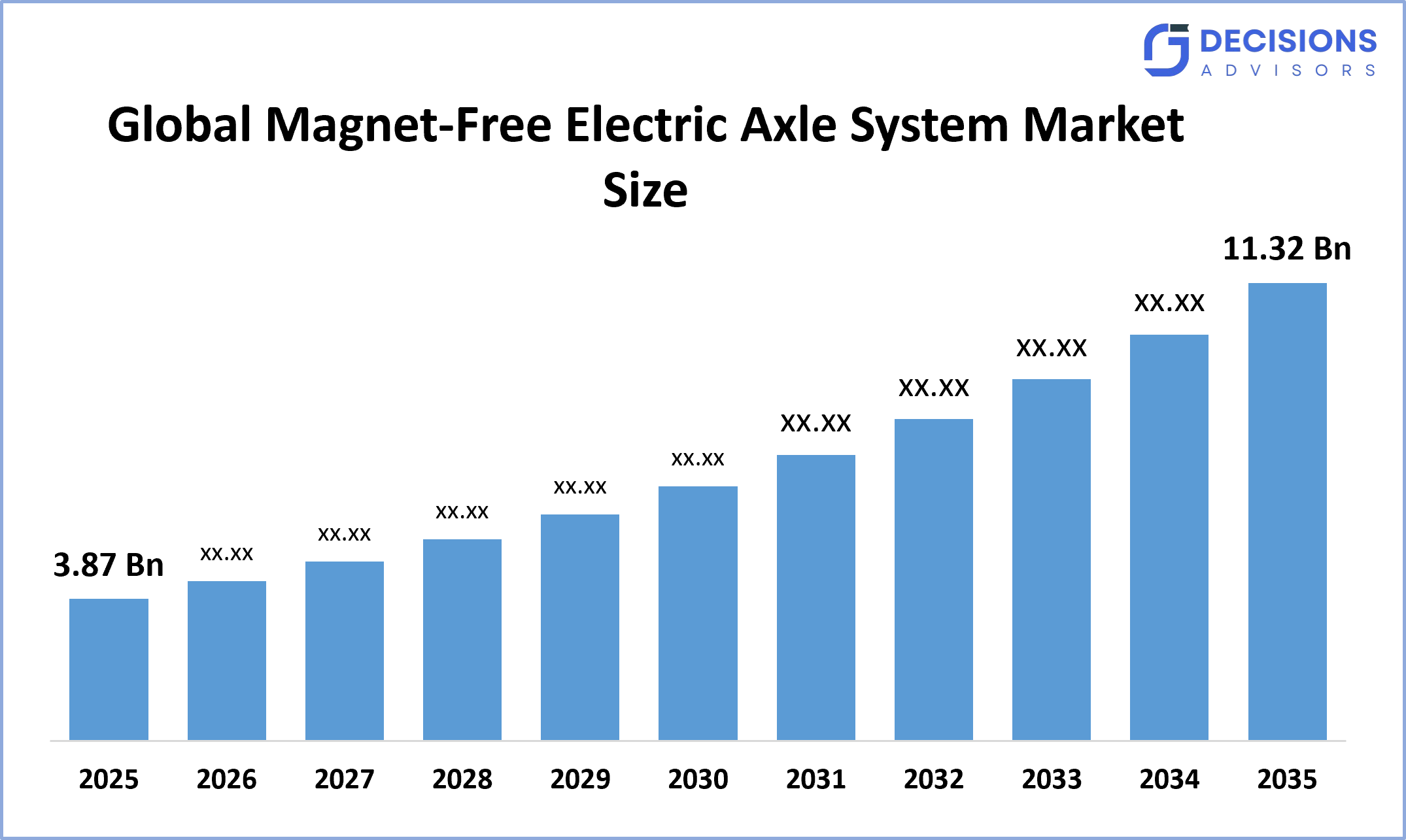
The global magnet-free electric axle system market size is predicted to grow from USD 3.87 Billion in 2025 and is likely to reach around USD 11.32 Billion by 2035 with a CAGR of 11.33%. According to Decision Advisors, the increasing adoption of rare-earth-free electric powertrains dominates the market, supported by automakers seeking to reduce dependence on permanent rare-earth magnets and strengthen supply-chain resilience. ZF Friedrichshafen is among the leading technology contributors, supported by its development of magnet-free electric motor technology and broad global automotive drivetrain presence.
Market Snapshot
- Global Magnet-Free Electric Axle System Market Size (2025): USD 3.87 Billion.
- Projected Global Magnet-Free Electric Axle System Market Size (2035): USD 11.32 Billion.
- Global Magnet-Free Electric Axle System Market CAGR: 11.33%.
- Largest Regional Market: Asia Pacific
- 2nd Largest Region: Europe
- Fastest Growing Region: Europe
- Base Year: 2025
- Historical Period: 2021-2024
- Market Forecast Period: 2026-2035
Market Overview/ Introduction
The global magnet-free electric axle system market represents the automotive powertrain segment focused on integrated electric axle systems using motor technologies that eliminate permanent rare-earth magnets. These systems generally employ externally excited synchronous motors, induction motors, or switched-reluctance architectures. The market is expanding as automakers seek alternatives to permanent-magnet motors because of rare-earth supply risks, raw-material price volatility, geopolitical concentration, and increasing requirements for sustainable vehicle manufacturing. Major automotive suppliers such as ZF Friedrichshafen, Dana, Schaeffler, Magna, BorgWarner, Valeo, Nidec, and Hyundai Mobis are participating in advanced electric-drive development. The technology also benefits from the broader transition toward battery-electric vehicles and integrated e-axles that combine the motor, transmission, differential, inverter, and associated power electronics into compact drivetrain modules. Magnet-free architectures can reduce dependence on neodymium and other rare-earth materials while providing manufacturers with greater flexibility in sourcing.
- United States, Federal support for domestic EV and battery supply chains, semiconductor manufacturing, and critical-mineral resilience is encouraging automotive suppliers to investigate alternative motor architectures that reduce dependence on concentrated rare-earth supply chains.
- China, Large-scale EV production, strong automotive component manufacturing, and domestic electric-drive development provide a major production base for magnet-free and rare-earth-reduced drivetrain technologies.
- India, The PM E-DRIVE program, automotive manufacturing incentives, and research initiatives are supporting domestic EV component development. India is also accelerating alternative motor technologies because of concerns over rare-earth availability.
Notable Insights: -
- Asia Pacific is anticipated to hold approximately 42% share of the Global Magnet-Free Electric Axle System Market over the predicted timeframe.
- Europe is expected to grow at a rapid CAGR, holding approximately 25% share during the forecast period.
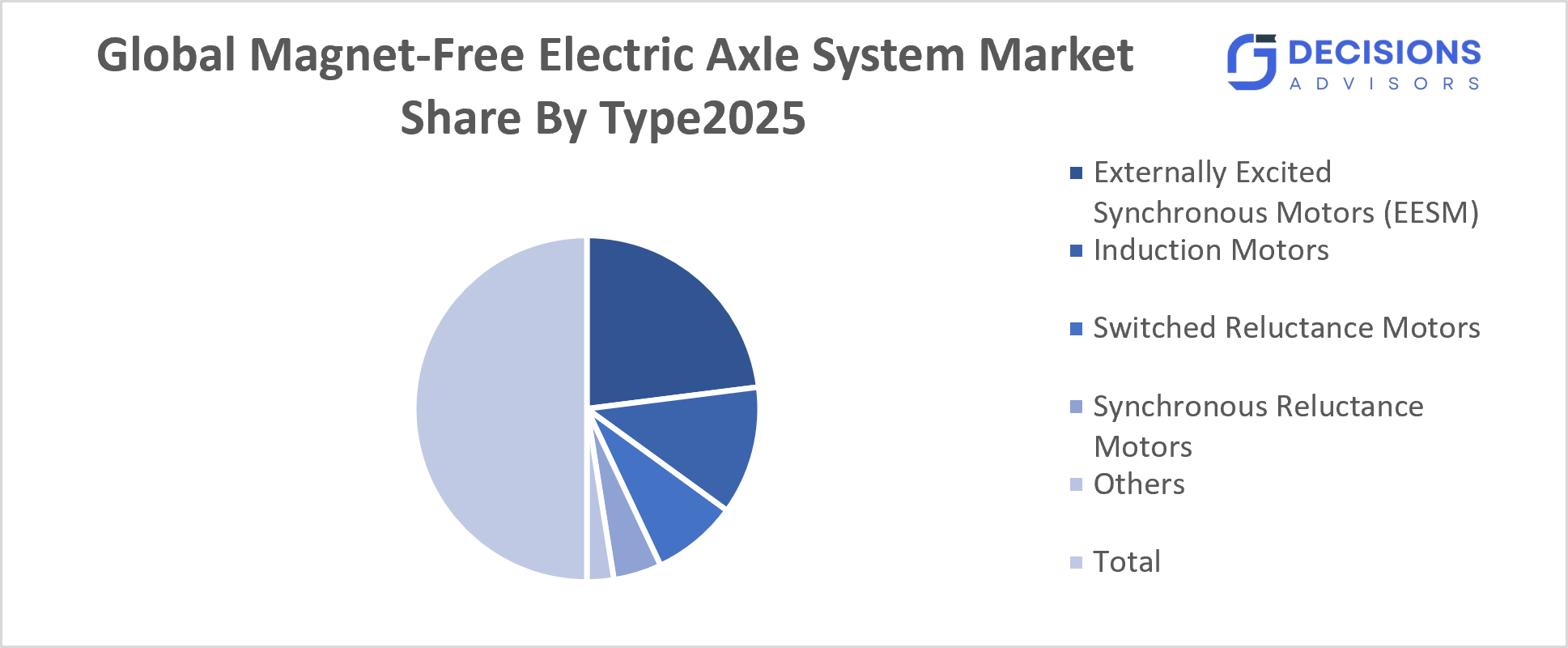
- By Motor Type, the Externally Excited Synchronous Motors (EESM) segment dominated the market and holds approximately 46% share in 2025, supported by its ability to eliminate permanent magnets while maintaining strong efficiency and controllability.
- By Drive Type, the Fully Electric Drive segment dominated the market and holds approximately 61% share in 2025, reflecting increasing BEV production and fleet electrification.
- The compound annual growth rate of the Global Magnet-Free Electric Axle System Market is 11.33%.
- The market is likely to achieve a valuation of approximately USD 11.32 Billion by 2035.
Market Drivers
The primary market driver is the global automotive industry's effort to reduce dependence on rare-earth permanent magnets used in conventional electric motors. China's dominant position in rare-earth mining and refining and the introduction of export restrictions have increased supply-chain concerns among automakers and Tier-1 suppliers. This is encouraging companies to develop externally excited synchronous, induction, and switched-reluctance motors. EV production is another major driver because integrated e-axles simplify vehicle assembly by combining the electric motor, gearbox, differential, and inverter into a compact module. Increasing electric commercial-vehicle adoption is particularly important because fleet operators value efficiency, lower operating costs, durability, and simplified maintenance. Government incentives for EV manufacturing, localization of powertrain components, and domestic technology development further support investment in magnet-free drivetrain systems. India, for example, is accelerating testing of alternative EV motors because of rare-earth supply concerns.
Restrain
The market faces several technical and commercial restraints. Magnet-free motors can require sophisticated control systems and power electronics to achieve efficiency, torque density, noise performance, and thermal characteristics comparable with permanent-magnet motors. Some architectures may also require additional copper windings, more complex excitation systems, or advanced controllers, increasing engineering and manufacturing costs.
Competitive Analysis:
The report offers the appropriate analysis of the key organizations/companies involved within the global magnet-free electric axle system market, along with a comparative evaluation primarily based on their product offerings, business overviews, geographic presence, enterprise strategies, segment market share, and SWOT analysis. The report also provides an elaborative analysis focusing on the current news and developments of the companies, which includes product development, innovations, joint ventures, partnerships, mergers & acquisitions, strategic alliances, and others. This allows for the evaluation of the overall competition within the market.
Top Companies in the Global Magnet-Free Electric Axle System Market
- ZF Friedrichshafen AG
- Dana Incorporated
- Schaeffler AG
- Magna International Inc.
- GKN Automotive
- BorgWarner Inc.
- Nidec Corporation
- Valeo SE
- Hyundai Mobis Co., Ltd.
- Aisin Corporation.
Government Initiatives
|
Country |
Key Government Initiatives |
|
United States |
Federal investments in EV manufacturing, critical minerals, domestic supply chains, and advanced automotive technologies are encouraging manufacturers to reduce dependence on imported rare-earth materials |
|
Japan |
Government and industry programs supporting EV technology, energy efficiency, and critical-material supply-chain resilience are encouraging development of alternative electric motor technologies |
|
China |
EV industrial policies, advanced manufacturing programs, and domestic electric-powertrain development support large-scale production and technological advancement of electric axle systems |
Market Segmentation
The Global Magnet-Free Electric Axle System Market share is classified into motor type, drive type, and e-axle configuration.
- The Externally Excited Synchronous Motors (EESM) segment dominated the market and holds approximately 46% share in 2025 and is projected to grow at a substantial CAGR during the forecast period.
Based on motor type, the global magnet-free electric axle system market is divided into externally excited synchronous motors, induction motors, and switched reluctance motors. Among these, EESM dominates because it eliminates permanent magnets while maintaining high efficiency and strong torque characteristics. The architecture provides manufacturers with greater control over the magnetic field and reduces exposure to rare-earth material costs. Its suitability for passenger vehicles and high-performance EV platforms is supporting increasing adoption. Industry data for India also identifies EESM as the leading motor architecture, with a 48.12% share in 2024.
- The Fully Electric Drive segment accounted for the largest share of approximately 61% in 2025 and is anticipated to grow at a significant CAGR during the forecast period.
Based on drive type, the market is divided into fully electric drive, hybrid drive, and plug-in hybrid drive. Fully electric drive systems dominate because battery-electric vehicles are the primary application for next-generation integrated e-axles. Automakers are increasingly developing dedicated EV platforms in which compact e-axles provide efficient propulsion while freeing vehicle packaging space. Commercial fleets are also adopting battery-electric drivetrains because of lower energy and maintenance costs. The India market provides further evidence of this trend, with fully electric drives holding 58.66% share in 2024.
- The Integrated E-Axle segment accounted for the largest share of approximately 45% in 2025 and is anticipated to grow at a significant CAGR during the forecast period.
Based on e-axle configuration, the market is divided into Single E-Axle, Dual E-Axle, and Integrated E-Axle. Integrated e-axles combine multiple drivetrain components into a compact system, reducing vehicle assembly complexity and improving packaging efficiency. This architecture can also simplify thermal management and provide manufacturers with a factory-ready propulsion module. The growing demand for compact EV platforms and higher system integration is expected to maintain the segment's leading position. India market data similarly shows integrated units as the leading configuration, with a 44.38% share in 2024.
Regional Segment Analysis of the Global Magnet-Free Electric Axle System Market
- North America (U.S., Canada, Mexico)?
- Europe (Germany, U.K., France, Italy, Spain, Netherlands, Rest of Europe).
- Asia-Pacific (China, Japan, India, Australia, South Korea, Rest of Asia-Pacific).
- South America (Brazil, Argentina, Rest of South America).
- Middle East & Africa (UAE, Saudi Arabia, South Africa, Rest of MEA).
Asia Pacific is anticipated to hold approximately 42% share of the Global Magnet-Free Electric Axle System Market over the predicted timeframe.
Asia Pacific represents the largest regional market because China, Japan, South Korea, and India collectively have substantial EV manufacturing capabilities and automotive component supply chains. China provides significant scale in electric vehicles and electric powertrain production, while Japan and South Korea possess advanced automotive and motor technologies. India is rapidly developing indigenous alternatives to rare-earth-dependent motors because of supply-chain concerns. Domestic companies and technology developers are increasingly testing reluctance-based and other magnet-free architectures, strengthening the region's long-term position.
North America is expected to grow at a rapid CAGR in the Global Magnet-Free Electric Axle System Market, holding approximately 21% of the share during the forecast period.
The region benefits from strong EV investment, advanced automotive engineering capabilities, and the presence of major drivetrain suppliers. The United States is also emphasizing domestic manufacturing and resilient critical-material supply chains, encouraging OEMs and Tier-1 suppliers to investigate alternatives to rare-earth permanent magnets. Companies such as Dana, BorgWarner, Magna, and other drivetrain specialists provide a strong industrial foundation for advanced e-axle development.
Europe is the fastest-growing region in the Global Magnet-Free Electric Axle System Market during the forecast period, holding approximately 25% share.
Europe's growth is supported by stringent vehicle-emission requirements, increasing EV production, and strong investment by German, French, and other European automotive manufacturers. ZF, Schaeffler, Valeo, GKN Automotive, and other suppliers are investing in electric drivetrain technologies. Renault has also pursued rare-earth-free motor technology, while Valeo continues development of its magnet-free iBEE motor with Mahle, highlighting the region's focus on reducing dependence on rare-earth materials.
Future Market Trends in Global Magnet-Free Electric Axle System Market: -
-
- Shift Toward Rare-Earth-Free Powertrains
Automakers and Tier-1 suppliers are increasingly developing electric motors that eliminate or substantially reduce dependence on rare-earth materials. Supply-chain risks and price volatility surrounding neodymium, praseodymium, and other critical materials are accelerating research into EESM, synchronous-reluctance, induction, and other alternative motor architectures.
-
- Integration of Magnet-Free Motors With High-Voltage E-Axles
Future e-axles are expected to integrate the motor, inverter, reduction gear, differential, thermal management, and control electronics into increasingly compact modules. Higher-voltage 800-V architectures will support faster charging, improved power density, and better performance in passenger and commercial EVs. Schaeffler already offers electric-axle solutions spanning 400–800 V and 90–304 kW.
-
- Increasing Use of Synchronous-Reluctance and Electrically Excited Motors
Synchronous-reluctance and externally excited synchronous motor architectures are gaining attention because they can eliminate permanent rare-earth magnets while maintaining competitive efficiency and controllability. Astemo developed a BEV motor using a synchronous-reluctance architecture combined with rare-earth-free magnets, with its main drive motor reaching 180 kW.
-
- Expansion Into Commercial Vehicles and Off-Highway Applications
Magnet-free propulsion systems are likely to expand beyond passenger EVs into light commercial vehicles, trucks, buses, agricultural machinery, and off-highway equipment. The ability to avoid rare-earth materials can improve supply-chain resilience for high-volume fleets.
Recent Development
- In October 2025, Astemo developed a new rare-earth-free BEV motor using a synchronous-reluctance architecture with rare-earth-free magnets. The main propulsion motor achieved 180 kW, demonstrating a pathway toward reducing rare-earth dependence in electric drivetrains.
- In January 2026, Niron Magnetics and MATTER announced a collaboration to explore Niron's rare-earth-free iron-nitride magnet technology and variable-flux motor designs for MATTER's electric mobility platforms.
- In July 2026, Niron Magnetics and ASPINA announced a collaboration to develop next-generation motor technologies using Niron's high-performance rare-earth-free Iron Nitride magnets across global end markets. The agreement supports broader commercialization of rare-earth-free motor solutions.
Market Segment
This study forecasts revenue at global, regional, and country levels from 2021 to 2035. Decision Advisors has segmented the global magnet-free electric axle system market based on the below-mentioned segment:
Global Magnet-Free Electric Axle System Market, By Motor Type.
- Externally Excited Synchronous Motors (EESM)
- Induction Motors
- Switched Reluctance Motors
- Synchronous Reluctance Motors
- Others.
Global Magnet-Free Electric Axle System Market, By Drive Type.
- Fully Electric Drive
- Hybrid Drive
- Plug-in Hybrid Drive
- Commercial Electric Drive
- Off-Highway Electric Drive.
Global Magnet-Free Electric Axle System Market, By E-Axle Configuration.
- Single E-Axle
- Dual E-Axle
- Integrated E-Axle
- Multi-Motor E-Axle.
Global Magnet-Free Electric Axle System Market, By Regional Analysis.
- North America
- US
- Canada
- Mexico
- Europe
- Germany
- UK
- France
- Italy
- Spain
- Russia
- Rest of Europe
- Asia Pacific
- China
- Japan
- India
- South Korea
- Australia
- Rest of Asia Pacific
- South America
- Brazil
- Argentina
- Rest of South America
- Middle East & Africa
- UAE
- Saudi Arabia
- Qatar
- South Africa
- Rest of the Middle East & Africa
Frequently Asked Questions (FAQ)
Q. What is a magnet-free electric axle system?
A. A magnet-free electric axle system is an integrated EV propulsion unit that uses an electric motor without conventional rare-earth permanent magnets. It can combine the motor, reduction gear, differential, inverter, and associated electronics into a compact drivetrain assembly.
Q. Why are automakers developing magnet-free electric motors?
A. Automakers are developing these motors to reduce dependence on rare-earth materials such as neodymium and praseodymium. Magnet-free architectures can improve supply-chain resilience and reduce exposure to fluctuations in rare-earth prices and availability. Schaeffler specifically highlights the elimination of neodymium and praseodymium in its EESM axle-drive solution.
Q. Which motor technology is expected to dominate the magnet-free electric axle system market?
A. Externally excited synchronous motors are expected to remain a leading technology because they can eliminate permanent magnets while providing strong efficiency, high-speed performance, and controllable excitation. Synchronous-reluctance and switched-reluctance technologies are also gaining importance as automakers search for scalable rare-earth-free alternatives.
Q. Are magnet-free motors suitable for commercial vehicles?
A. Yes. Magnet-free propulsion systems can be attractive for commercial vehicles because fleet operators require durable, efficient, and supply-chain-resilient drivetrains. Ricardo's 214-kW Alumotor development specifically targets light commercial vehicles and off-highway applications.
Check Licence
Choose the plan that fits you best: Single User, Multi-User, or Enterprise solutions tailored for your needs.
We Have You Covered
- 24/7 Analyst Support
- Clients Across the Globe
- Tailored Insights
- Technology Tracking
- Competitive Intelligence
- Custom Research
- Syndicated Market Studies
- Market Overview
- Market Segmentation
- Growth Drivers
- Market Opportunities
- Regulatory Insights
- Innovation & Sustainability
Report Details
| Scope | Global |
| Pages | 230 |
| Delivery | PDF & Excel via Email |
| Language | English |
| Release | Aug 2026 |
| Access | Download from this page |