
Global Male Hypogonadism Market
 |
Author:
Disha B
|
Pages:
230
|
Author:
Disha B
|
Pages:
230
Global Male Hypogonadism Market Size, Share, and COVID-19 Impact Analysis, By Treatment Type (Testosterone Replacement Therapy, Hormone Therapy, and Medications), By Diagnosis Type (Blood Tests, Physical Examination, and Medical History Assessment), By Route of Administration (Injectable, Transdermal, and Oral), and By Region (North America, Europe, Asia-Pacific, Latin America, Middle East, and Africa), Analysis and Forecast 2025-2035
CAGR
5.11%
REVENUE 2024
USD Billion 4.25
FORECAST 2035
USD Billion 7.35
REPORT COVERAGE
Global
Global Male Hypogonadism Market Size Insights Forecasts to 2035
- The Global Male Hypogonadism Market Size Was Estimated at USD 4.25 Billion in 2024
- The Market Size is Expected to Grow at a CAGR of around 5.11 % from 2025 to 2035
- The Worldwide Male Hypogonadism Market Size is Expected to Reach USD 7.35 Billion by 2035
- North America is expected to grow the fastest during the forecast period.
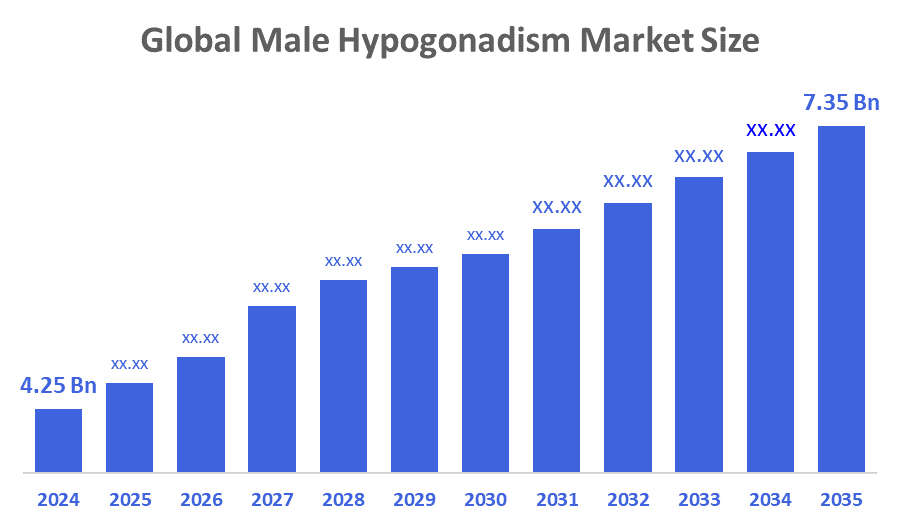
According to a research report published by Decisions Advisors and Consulting, The Global Male Hypogonadism Market Size Was Worth Around USD 4.25 Billion In 2024 And Is Predicted To Grow To Around USD 7.35 Billion By 2035 With A Compound Annual Growth Rate (CAGR) Of 5.11 % From 2025 To 2035. A considerable rise in the prevalence of testosterone deficiency in males, the rising awareness of male hypogonadism treatment choices among the patient population, and increasing health consciousness represent some of the key factors driving the market.
Market Overview
Male hypogonadism is a condition where the testes do not make testosterone. This leads to numerous problems, including difficulty building muscle and improper hair growth. Men can even develop breasts. The voice also does not get deeper. The main issue with hypogonadism is that it affects testosterone production in men and also the production of sperm. It occurs due to problems with the testes, known as male hypogonadism, or it can be caused by issues with the hypothalamic-pituitary axis, referred to as secondary male hypogonadism. An individual with hypogonadism may suffer from a variety of organ dysfunctions as well as a reduction in quality of life since it originates from a testicular problem or disorder that affects the hypothalamus and pituitary gland. Hypogonadism in men can be genetic or acquired, caused by hormonal imbalances, medications or ageing. Several congenital enzyme abnormalities are responsible for causing different degrees of androgen resistance throughout the body. Hypogonadism is most common in men over the age of 60, and the symptoms and indications of the deficiency vary accordingly.
Report Coverage
This research report categorizes the male hypogonadism market based on various segments and regions, forecasts revenue growth, and analyzes trends in each submarket. The report analyses the key growth drivers, opportunities, and challenges influencing the male hypogonadism market. Recent market developments and competitive strategies, such as expansion, product launch, development, partnership, merger, and acquisition, have been included to draw the competitive landscape in the market. The report strategically identifies and profiles the key market players and analyzes their core competencies in each sub-segment of the male hypogonadism market.
Driving Factors
The global market is growing, largely because more men face testosterone deficiency and infertility. These problems often come from rising rates of chronic lifestyle disorders, like obesity and diabetes. An expanding elderly population, more prone to male hypogonadism, also helps drive the market. What's more, as patients learn about available hypogonadism treatments – including testosterone replacement therapy (TST) – demand grows. Many governments are even promoting awareness of these options. Beyond this, ongoing technological improvements in medical infrastructure worldwide also look promising. Other factors helping the market include rapid urbanisation, increased health consciousness, higher medical spending, and extensive research and development (R&D). The male hypogonadism market is propelling due to the increasing awareness of the health issues that men face, like problems with their hormones. This is causing a lot of men to look for ways to diagnose and treat these issues. Doctors and other healthcare professionals are starting to realise how important it is to deal with male hypogonadism, which's which drives the market expansion.
Restraining Factors
Safety concerns restrain the male hypogonadism market. FDA warnings highlight risks of heart attack, stroke, and death with testosterone therapy, supported by adverse event data. The TRAVERSE trial showed no increased composite risk, elevated blood pressure and thromboembolic signals persist, reducing physician confidence, increasing monitoring, and slowing market adoption.
Market Segmentation
The male hypogonadism market share is classified into treatment type, diagnosis type, and route of administration.
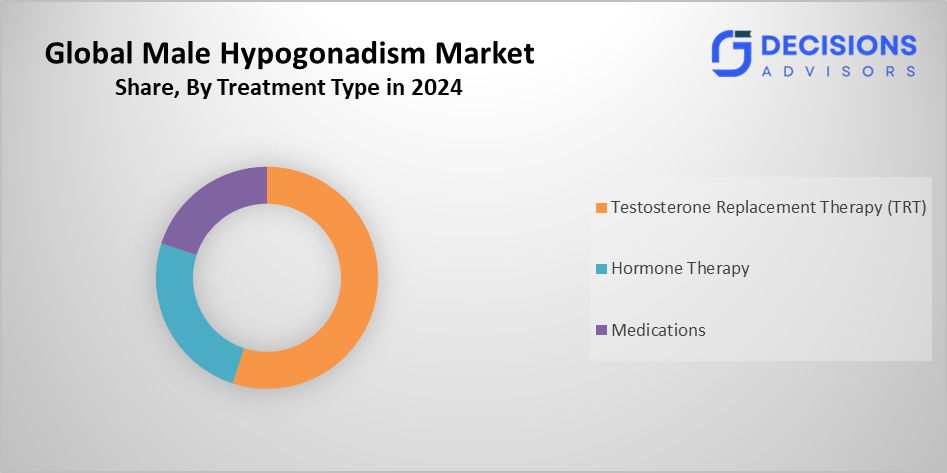
- The testosterone replacement therapy segment accounted for the largest share in 2024 and is anticipated to grow at a significant CAGR during the forecast period.
Based on the treatment type, the male hypogonadism market is divided into testosterone replacement therapy, hormone therapy, and medications. Among these, the testosterone replacement therapy segment accounted for the largest share in 2024 and is anticipated to grow at a significant CAGR during the forecast period. It has extensive application and proven efficacy in restoring testosterone levels. It remains the most prescribed treatment due to its direct impact on improving patient quality of life and reversing symptoms associated with low testosterone.
- The blood tests segment accounted for the largest market share in 2024 and is projected to grow at a notable CAGR during the forecast period.
Based on the diagnosis type, the male hypogonadism market is divided into blood tests, physical examination, and medical history assessment. Among these, the blood tests segment accounted for the largest market share in 2024 and is projected to grow at a notable CAGR during the forecast period. Their reliability in evaluating hormone levels. They remain the go-to method for doctors due to their precise diagnostic capabilities.
- The injectable segment accounted for the highest market share in 2024 and is anticipated to grow at a substantial CAGR during the forecast period.
Based on the route of administration, the male hypogonadism market is divided into injectable, transdermal, and oral. Among these, the injectable segment accounted for the highest market share in 2024 and is anticipated to grow at a substantial CAGR during the forecast period. This is primarily due to its wide acceptance and proven effectiveness. It typically involves intramuscular or subcutaneous injections, allowing for sustained testosterone levels over extended periods, reducing the frequency of administration.
Regional Segment Analysis of the Male Hypogonadism Market
- North America (U.S., Canada, Mexico)
- Europe (Germany, France, U.K., Italy, Spain, Rest of Europe)
- Asia-Pacific (China, Japan, India, Rest of APAC)
- South America (Brazil and the Rest of South America)
- The Middle East and Africa (UAE, South Africa, Rest of MEA)
Asia Pacific is anticipated to hold the largest share of the male hypogonadism market over the predicted timeframe.
Asia Pacific is anticipated to hold the largest share of the male hypogonadism market over the predicted timeframe. Japan has a big problem with people getting older. Japan is dealing with a large number of older people, and this number is very high. The ageing society in Japan is an issue. That is going to have a big impact on the health problems people have there soon. Japan will see cases of late-onset hypogonadism because of this. That means Japan will need ways to diagnose and treat late-onset hypogonadism. Japan needs these solutions for the onset of hypogonadism to help people. Additionally, the Japanese pharmaceutical market has adopted advanced testosterone replacement therapy (TRT) options, including formulations that offer heightened safety and patient compliance. These advancements have gained acceptance among patients and healthcare providers, contributing to market expansion.
North America is expected to grow at a rapid CAGR in the male hypogonadism market during the forecast period. The growth of this problem is mainly because the population of the United States is getting older. Men over 40 years old in the United States are experiencing a lot of changes in their hormones. This is a reason for the growth of this issue. The United States population is getting older. This is causing a lot of problems, especially for men over 40 years old who are going through significant hormonal changes. In addition to this, the U.S. Food and Drug Administration (FDA) has implemented rigorous standards for treatment options such as testosterone replacement therapy or other pharmaceutical solutions, driving the development of high-quality products with enhanced safety, efficacy, and stability to meet the growing demand for effective treatments.
Competitive Analysis:
The report offers the appropriate analysis of the key organizations/companies involved within the male hypogonadism market, along with a comparative evaluation primarily based on their product offering, business overviews, geographic presence, enterprise strategies, segment market share, and SWOT analysis. The report also provides an elaborative analysis focusing on the current news and developments of the companies, which includes product development, innovations, joint ventures, partnerships, mergers & acquisitions, strategic alliances, and others. This allows for the evaluation of the overall competition within the market.
List of Key Companies
- AbbVie
- Antares Pharma
- Bayer
- Eli Lilly and Company
- Endo Pharmaceuticals
- Simple Pharma
- Pfizer
- Sanofi
- Teva Pharmaceutical Industries
- Viatris
- Others
Key Target Audience
- Market Players
- Investors
- End-users
- Government Authorities
- Consulting and Research Firm
- Venture capitalists
- Value-Added Resellers (VARs)
Market Segment
This study forecasts revenue at global, regional, and country levels from 2020 to 2035. Decisions Advisors has segmented the male hypogonadism market based on the below-mentioned segments:
Global Male Hypogonadism Market, By Treatment Type
- Testosterone Replacement Therapy
- Hormone Therapy
- Medications
Global Male Hypogonadism Market, By Diagnosis Type
- Blood Tests
- Physical Examination
- Medical History Assessment
Global Male Hypogonadism Market, By Route of Administration
- Injectable
- Transdermal
- Oral
Global Male Hypogonadism Market, By Regional Analysis
- North America
- US
- Canada
- Mexico
- Europe
- Germany
- UK
- France
- Italy
- Spain
- Russia
- Rest of Europe
- Asia Pacific
- China
- Japan
- India
- South Korea
- Australia
- Rest of Asia Pacific
- South America
- Brazil
- Argentina
- Rest of South America
- Middle East & Africa
- UAE
- Saudi Arabia
- Qatar
- South Africa
- Rest of the Middle East & Africa
Frequently Asked Questions (FAQ)
- What is the projected size and growth rate of the global male hypogonadism market?
The market was valued at USD 4.25 billion in 2024 and is expected to reach USD 7.35 billion by 2035, growing at a CAGR of 5.11% from 2025 to 2035. ?
- What is male hypogonadism, and what are its key symptoms?
Male hypogonadism occurs when the testes produce insufficient testosterone, leading to primary (testicular) or secondary (hypothalamic-pituitary) issues. Symptoms include reduced muscle mass, poor hair growth, gynecomastia, infertility, and undeveloped voice deepening, often worsening after age 60.?
- Which treatment type leads the market?
Testosterone replacement therapy (TRT) holds the largest share in 2024 and is projected to grow at a significant CAGR. It effectively restores testosterone levels, improves quality of life, and dominates due to proven efficacy across formats like injectables and gels.
- What is the primary diagnosis method in the market?
Blood tests accounted for the largest market share in 2024 and are expected to grow at a notable CAGR. They reliably measure hormone levels like total/free testosterone, LH, and FSH to confirm deficiency and distinguish primary from secondary causes.?
- Which route of administration has the highest share?
Injectable routes led the market in 2024 and are anticipated to grow at a substantial CAGR. They provide sustained testosterone release via intramuscular/subcutaneous methods, ensuring stable levels with less frequent dosing.
- Which regions dominate or grow fastest?
Asia-Pacific is expected to hold the largest share, driven by ageing populations in Japan (late-onset hypogonadism) and advanced TRT adoption. North America will grow at the fastest CAGR, boosted by US ageing demographics, FDA standards, and high treatment demand.
- What drives growth in the male hypogonadism market?
Rising testosterone deficiency from obesity, diabetes, chronic diseases, and ageing; greater awareness of treatments like TRT; urbanisation; higher healthcare spending; and R&D in safer formulations fuel expansion.
- What restrains market growth, and what are the key companies?
Safety concerns like cardiovascular risks from TRT (e.g., FDA warnings, TRAVERSE trial signals) reduce adoption despite no overall increased composite risk. Leading firms include AbbVie, Endo Pharmaceuticals, Pfizer, Teva, and Bayer.
Check Licence
Choose the plan that fits you best: Single User, Multi-User, or Enterprise solutions tailored for your needs.
We Have You Covered
- 24/7 Analyst Support
- Clients Across the Globe
- Tailored Insights
- Technology Tracking
- Competitive Intelligence
- Custom Research
- Syndicated Market Studies
- Market Overview
- Market Segmentation
- Growth Drivers
- Market Opportunities
- Regulatory Insights
- Innovation & Sustainability
Report Details
| Scope | Global |
| Pages | 230 |
| Delivery | PDF & Excel via Email |
| Language | English |
| Release | Feb 2026 |
| Access | Download from this page |