
Global Managed Detection and Response (MDR) Market
 |
Author:
Kunal M
|
Pages:
240
|
Author:
Kunal M
|
Pages:
240
Global Managed Detection and Response (MDR) Market Size, Share By Service Type (Threat Intelligence, Incident Management, Monitoring Services, Vulnerability Management), By Deployment Type (Cloud-based, On-premises), By End User (Small and Medium Enterprises, Large Enterprises, Government Agencies, Financial Institutions), and By Region (North America, Europe, Asia-Pacific, Latin America, Middle East & Africa), Analysis and Forecast 2026-2035.
CAGR
22.0%
REVENUE 2025
USD Billion 5.98
FORECAST 2035
USD Billion 43.67
REPORT COVERAGE
Global
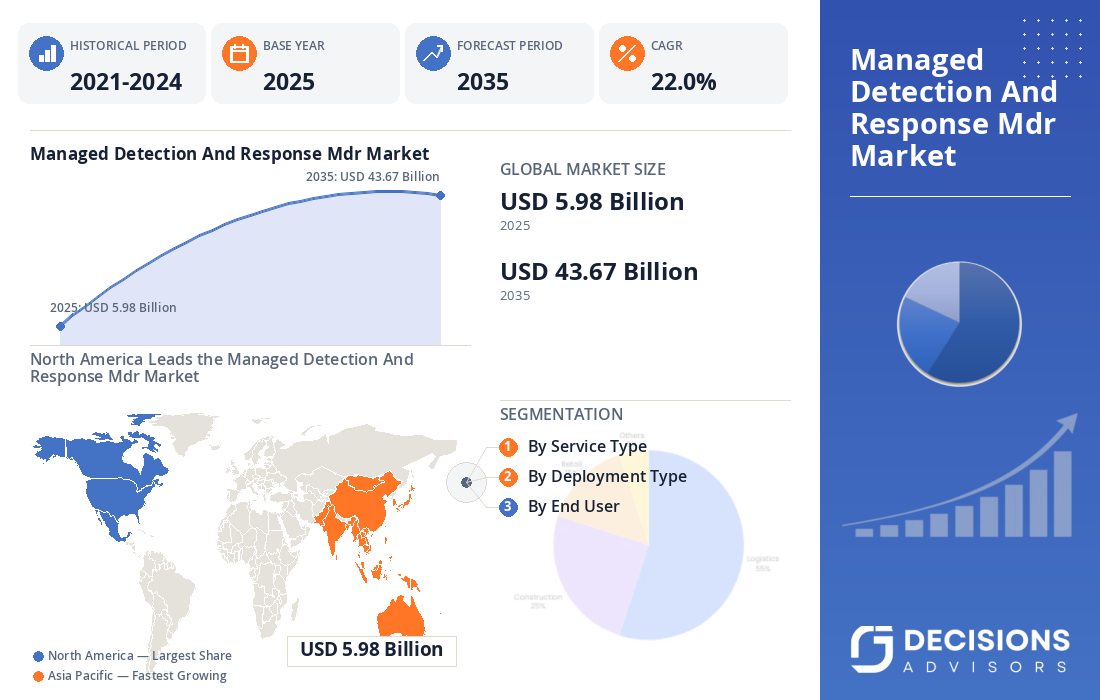
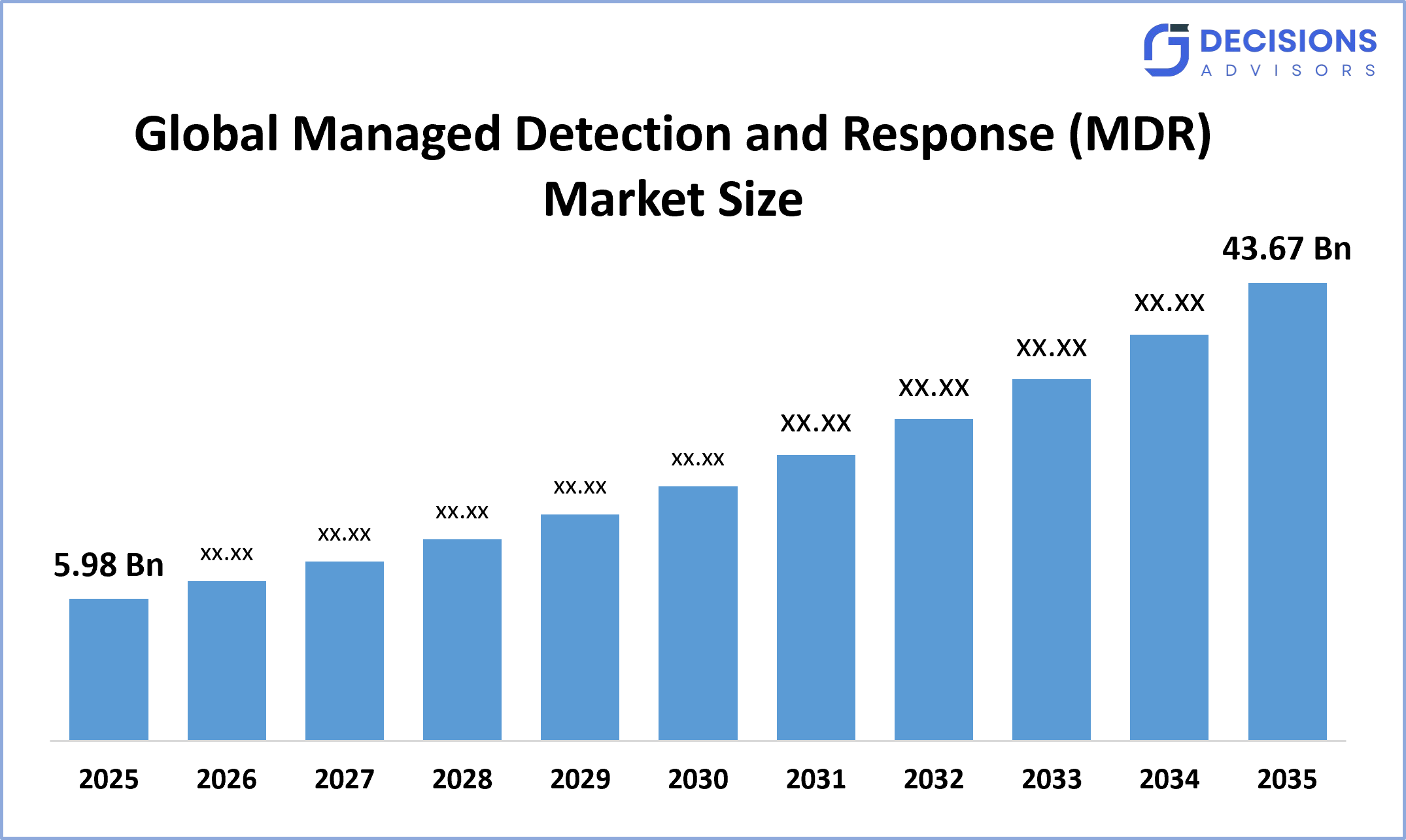
The Global Managed Detection and Response (MDR) Market Size is predicted to grow from USD 5.98 Billion in 2025 and is likely to reach around USD 43.67 Billion by 2035 with a CAGR of 22%. According to Decision Advisors, a detailed research report reveals that endpoint security continues to be a leading component in the Global Managed Detection and Response (MDR) Market, contributing up to 34% of the total share. Cloud-based MDR solution implementation is another trend seen in the market, which contributes to around 48% of the deployment share. CrowdStrike is leading in the market due to its Falcon Complete Next-Gen MDR offering, whereas Arctic Wolf, SentinelOne, Rapid7, Palo Alto Networks, and Sophos continue to make significant contributions.
Market Snapshot
- Global Managed Detection and Response (MDR) Market Size (2025): USD 5.98 Billion
- Projected Global Managed Detection and Response (MDR) Market Size (2035): USD 43.67 Billion
- Global Managed Detection and Response (MDR) Market Compound Annual Growth Rate (CAGR): 22%
- Largest Regional Market: North America
- 2nd Largest Region: Europe
- Fastest Growing Region: Asia Pacific
- Base Year: 2025
- Historical Period: 2021-2024
- Market Forecast Period: 2026-2035
Market Overview/ Introduction
The Global Managed Detection and Response (MDR) Market means outsourcing cybersecurity solutions that constantly detect, investigate, and respond to cyber threats through professionals, automation, threat intelligence, and analytics. Such government initiatives like European Union’s EUMSS certification scheme and U.S. cybersecurity initiatives are tightening the security standards and encouraging the adoption of MDRs. In July 2026, ENISA has started its public consultation on its proposed EUMSS certification scheme. The market is expected to develop rapidly because of increasing instances of ransomware attacks, artificial intelligence-based attacks, cloud-based security threats, need for compliance, and shortage of cybersecurity professionals. Furthermore, increasing digital transformation, cloud infrastructure, the need for around-the-clock monitoring of security, automation of threat detection, and outsourcing of cybersecurity services are creating ample opportunities for MDR companies across the globe.
- The Ministry of Electronics and Information Technology is guiding state governments to establish dedicated Security Operations Centers (SOCs) to improve regional cyber resilience and protect growing citizen databases.
- Japan leverages a structured public-private partnership model through national cybersecurity strategies, setting clear operational guidelines for active cyber defense and professional threat detection services.
Notable Insights: -
- North America is anticipated to hold approximately 40.9% share of the Global Lea Managed Detection and Response (MDR) Market over the predicted timeframe.
- Asia Pacific is expected to grow at a rapid CAGR in the Global Managed Detection and Response (MDR) Market by holding approximately 23% of the share during the forecast period.
- By service type, the Monitoring Services, segment dominated the market and holds approximately 38% share in 2025 and is projected to grow at a substantial CAGR during the forecast period.
- By deployment type, the Cloud-based segment dominated the market and holds approximately 68% share in 2025 and is projected to grow at a substantial CAGR during the forecast period.
- The compound annual growth rate of the Global Managed Detection and Response (MDR) Market is 22%.
- The market is likely to achieve a valuation of USD 43.67 Billion by 2035.
Market Drivers
The Global Managed Detection and Response (MDR) Market grows since there is an increase in the number of cyberattacks, ransomware, phishing, and advanced persistent threats which necessitate real-time security monitoring and response. Cloud computing, hybrid environment, and remote working environments have led to a greater need for MDR solutions due to distributed IT ecosystems. The lack of skilled cybersecurity professionals makes companies turn to MDR service providers for the purpose of conducting investigations and responding to the cyberthreats. Regulatory demands and data protection policies contribute to market growth by motivating companies to enhance their cybersecurity capabilities and monitor them in a continuous manner. The use of artificial intelligence, machine learning, automation, and advanced analytics improves threat detection and response processes. In addition, increased digital transformation, adoption of Internet of Things (IoT), extended attack surfaces, and cybersecurity spending are the factors driving the growth of MDR solution adoption globally.
Restrain
Smaller businesses are less likely to join the global managed detection and response (MDR) market due to high service prices and reliance on qualified cybersecurity specialists. Smaller businesses find it challenging to pay for ongoing MDR services because to their limited cybersecurity expenditures.
Competitive Analysis:
The report offers the appropriate analysis of the key organizations/companies involved within the Global Managed Detection and Response (MDR) Market along with a comparative evaluation primarily based on their product offerings, business overviews, geographic presence, enterprise strategies, segment market share, and SWOT analysis. The report also provides an elaborative analysis focusing on the current news and developments of the companies, which includes product development, innovations, joint ventures, partnerships, mergers & acquisitions, strategic alliances, and others. This allows for the evaluation of the overall competition within the market.
Top Companies in the Global Managed Detection and Response (MDR) Market
- CrowdStrike
- Sophos (including Secureworks)
- Arctic Wolf Networks
- Palo Alto Networks
- Microsoft
- Rapid7
- SentinelOne
- Expel
- Red Canary
- eSentire
Government Initiatives
|
Country |
Key Government Initiatives |
|
India |
The Ministry of Electronics and Information Technology (MeitY) deploys endpoint detection tools across ministries, backed by CERT-In, encouraging state-level security operations and boosting regional market demand. |
|
United Kingdom |
The National Cyber Security Centre (NCSC) enforces strict operational resilience guidelines, compelling essential services and corporate entities to utilize outsourced managed security services for compliance. |
|
United States |
The Cybersecurity and Infrastructure Security Agency (CISA) drive federal directives and public-private partnerships requiring continuous threat monitoring, incident reporting, and zero-trust architectures, directly accelerating commercial MDR adoption across critical infrastructure. |
Market Segmentation
The Global Managed Detection and Response (MDR) Market share is classified into Service Type, Deployment Type and End User
- The Monitoring Services segment dominated the market and holds approximately 38% share in 2025 and is projected to grow at a substantial CAGR during the forecast period.
Based on the service type, The Global Managed Detection and Response (MDR) Market is segmented into Threat Intelligence, Incident Management, Monitoring Services, and Vulnerability Management. Out of all these segments, the Monitoring Services segment leads the market with an estimated share of around 38% in 2025. The reason behind this leading position of the Monitoring Services segment is the increasing requirement of continuous monitoring, real-time detection, and security response. The Monitoring Services are extensively used to detect and investigate any unusual activity that helps protect the organizations against any cyber threats.
- The Cloud-based segment accounted for the largest share of approximately 68% in 2025 and is anticipated to grow at a significant CAGR during the forecast period.
Based on the deployment type, the Global Managed Detection and Response (MDR) Market is segmented into Cloud-based and On-Premises. Of these segments, the Cloud-based market held the leading market share, capturing around 68% share in 2025. The reasons for its dominance include the rising preference for cloud-based infrastructure, scalability, easy deployment, and low costs of managing cybersecurity. More companies are adopting hybrid and multi-cloud deployments, contributing to the growth of the market segment. Cloud-based MDR solutions offer continuous monitoring, quick threat detection, automated response, and security management capabilities.
- The Large Enterprises segment accounted for the largest share of approximately 48% in 2025 and is anticipated to grow at a significant CAGR during the forecast period.
Based on end user, the Global Managed Detection and Response (MDR) Market segmentation consists of Small and Medium Enterprises, Large Enterprises, Government Agencies, Financial Institutions, Biotechnology Companies, and Others. Among these categories, the segment of Large Enterprises is the leading one with around 48% share in 2025. The reason for that is the presence of an IT infrastructure, bigger attack surface, and enhanced cybersecurity needs among them. The increasing use of cloud computing, remote working, and digitalization is making more MDR solutions necessary for large companies.
Regional Segment Analysis of the Global Managed Detection and Response (MDR) Market
- Asia-Pacific (China, Japan, India, South Korea, Australia, and Rest of Asia-Pacific)?
- North America (United States and Canada)
- Europe (United Kingdom, Germany, France, Italy, and Rest of Europe)
- Latin America (Brazil, Mexico, Argentina, and Rest of Latin America)?
- The Middle East and Africa (Saudi Arabia, UAE, South Africa, Israel, and Rest of MEA)
North America is anticipated to hold approximately 40.9% share of the Global Managed Detection and Response (MDR) Market over the predicted timeframe.
The North America is expected to contribute around 40.9% of the Global Managed Detection and Response (MDR) Market share during the forecast period. This dominance is backed by robust cybersecurity infrastructure, strict regulations, heavy investment in enterprise cybersecurity, wide adoption of cloud computing, and presence of key players in MDR services. The US continues to be the largest market in North America, fueled by the growing need for real-time threat detection and effective cyber-risk management.
Asia Pacific is expected to grow at a rapid CAGR in the Global Managed Detection and Response (MDR) Market, holding approximately 23% of the share during the forecast period
The Asia Pacific contributes around 23% share to the Global Managed Detection and Response (MDR) Market on the back of increasing digital transformation, growing cloud adoption, higher cyber risks, and increasing cybersecurity spending. Countries including China, India, Japan, South Korea, and Singapore are investing heavily in building their cybersecurity capabilities and have increased demand for real-time threat monitoring and response services. The increasing dearth of cybersecurity experts, growth of SMEs, government initiatives in the field of cybersecurity, and adoption of cloud-based MDR services are adding further impetus to the regional market growth.
Europe is the fastest-growing region in the Global Managed Detection and Response (MDR) Market during the period, holding approximately 27% share.
The European region accounts for roughly 27% of the Global Managed Detection and Response (MDR) Market owing to tough cybersecurity laws like GDPR and NIS2, rising cyber-attacks, and fast-paced digitalization. The use of cloud-based security systems, artificial intelligence for threat detection, and outsourcing of cybersecurity services is contributing to regional growth. Major nations include Germany, UK, France, and Italy with businesses in various sectors including finance, healthcare, manufacturing, and government sectors making use of MDR services.
Future Market Trends in Global Managed Detection and Response (MDR) Market: -
-
- AI-Powered Threat Detection and Response
Artificial intelligence and machine learning are now commonly used in MDR systems to detect advanced cyber threats, analyze massive amounts of data related to security and automate the response to threats. AI-based features increase the effectiveness of detection and decrease response times when detecting new ransomware, phishing and other advanced persistent threats.
-
- Expansion of Cloud-Based MDR Services
As more companies transition their operations into cloud and hybrid cloud infrastructure, cloud-based MDR services are becoming more popular. Cloud-based MDRs offer scalable security monitoring, centralization of visibility, flexibility in deployment, and less need for infrastructure. The increasing use of multi-cloud infrastructures and remote operations is encouraging more companies to use cloud-based MDR services.
-
- Sales Increasing Demand for Extended Detection and Response
MDR service providers are extending their functionalities in the domains of endpoint, network, cloud workload, identity, and applications. The use of several sources of security information enhances visibility and helps correlate threats. Businesses today are more interested in an integrated security operation that can detect and react to complex attacks on interlinked IT ecosystems.
-
- Growth in Proactive Threat Hunting Services
It is becoming increasingly crucial that proactive threat hunting be carried out so that hidden dangers can be detected before they do serious damage. There is an ongoing effort by MDR vendors to leverage threat intelligence, behavioral analytics, and investigations to detect any suspicious activity. An increase in attack complexity and dwell time makes this necessary.
Recent Development
- In June 2024, Darktrace unveiled an improved Managed Detection and Response solution that combines 24/7 human expert analysis with AI-powered autonomous threat containment.
- In July 2024, Palo Alto Networks aligned regional cloud defenses with managed XDR solutions by expanding threat telemetry integration throughout the Asia-Pacific region through sophisticated Unit 42 Threat Reports.
- In March 2025, to reduce stay times, CrowdStrike integrated automated containment playbooks and generative AI threat-hunting modules into the Falcon platform.
Market Segment
This study forecasts revenue at global, regional, and country levels from 2020 to 2035. Decision Advisors has segmented the Global Managed Detection and Response (MDR) Market based on the below-mentioned segments:
Global Managed Detection and Response (MDR) Market, By Service Type
- Threat Intelligence
- Incident Management
- Monitoring Services
- Vulnerability Management
Global Managed Detection and Response (MDR) Market, By Deployment Type
- Cloud-based
- On premises
Global Managed Detection and Response (MDR) Market, By End User
- Small and Medium Enterprises
- Large Enterprises
- Government Agencies
- Financial Institutions
Global Managed Detection and Response (MDR) Market, By Regional Analysis
- Asia-Pacific
- China
- Japan
- India
- South Korea
- Australia
- Rest of Asia-Pacific
- North America
- United States
- Canada
- Europe
- United Kingdom
- Germany
- France
- Italy
- Rest of Europe
- Latin America
- Brazil
- Mexico
- Argentina
- Rest of Latin America
- Middle East & Africa
- Saudi Arabia
- UAE
- South Africa
- Israel
- Rest of MEA
Frequently Asked Questions (FAQ)
Q. How is MDR improving cybersecurity for modern organizations?
A. MDR helps businesses swiftly identify complex assaults and lower security risks across IT environments by offering continuous threat monitoring, detection, investigation, and response.
Q. Why are organizations adopting MDR services instead of managing security internally?
A. MDR lessens the strain of keeping sizable internal security teams while giving access to cutting-edge technologies, cybersecurity specialists, round-the-clock monitoring, and quick incident response.
Q. What role does artificial intelligence play in the MDR market?
A. MDR providers can evaluate security data, spot unusual activity, spot new risks, automate investigations, and speed up incident response with the aid of AI and machine learning.
Q. How is cloud adoption influencing the Global Managed Detection and Response (MDR) Market?
A. Organizations are encouraged to implement scalable MDR solutions for ongoing monitoring, threat detection, and prevention across cloud environments as the use of cloud and hybrid infrastructure grows.
Check Licence
Choose the plan that fits you best: Single User, Multi-User, or Enterprise solutions tailored for your needs.
We Have You Covered
- 24/7 Analyst Support
- Clients Across the Globe
- Tailored Insights
- Technology Tracking
- Competitive Intelligence
- Custom Research
- Syndicated Market Studies
- Market Overview
- Market Segmentation
- Growth Drivers
- Market Opportunities
- Regulatory Insights
- Innovation & Sustainability
Report Details
| Scope | Global |
| Pages | 240 |
| Delivery | PDF & Excel via Email |
| Language | English |
| Release | Aug 2026 |
| Access | Download from this page |