
Global Maple Syrup Market
 |
Author:
Sayali T
|
Pages:
240
|
Author:
Sayali T
|
Pages:
240
Global Maple Syrup Market Size, Share By Product Type (Grade A Maple Syrup, Grade B Maple Syrup, Organic Maple Syrup, Flavored Maple Syrup, and Others), By Application (Bakery & Confectionery, Dairy & Frozen Desserts, Beverages, Breakfast Cereals, and Foodservice), By Distribution Channel (Supermarkets/Hypermarkets, Specialty Stores, Convenience Stores, Online Retail, and Direct-to-Consumer), and By Region (North America, Europe, Asia-Pacific, Latin America, Middle East & Africa), Analysis and Forecast 2026-2035.
CAGR
7.07%
REVENUE 2025
USD Billion 1.64
FORECAST 2035
USD Billion 3.03
REPORT COVERAGE
Global
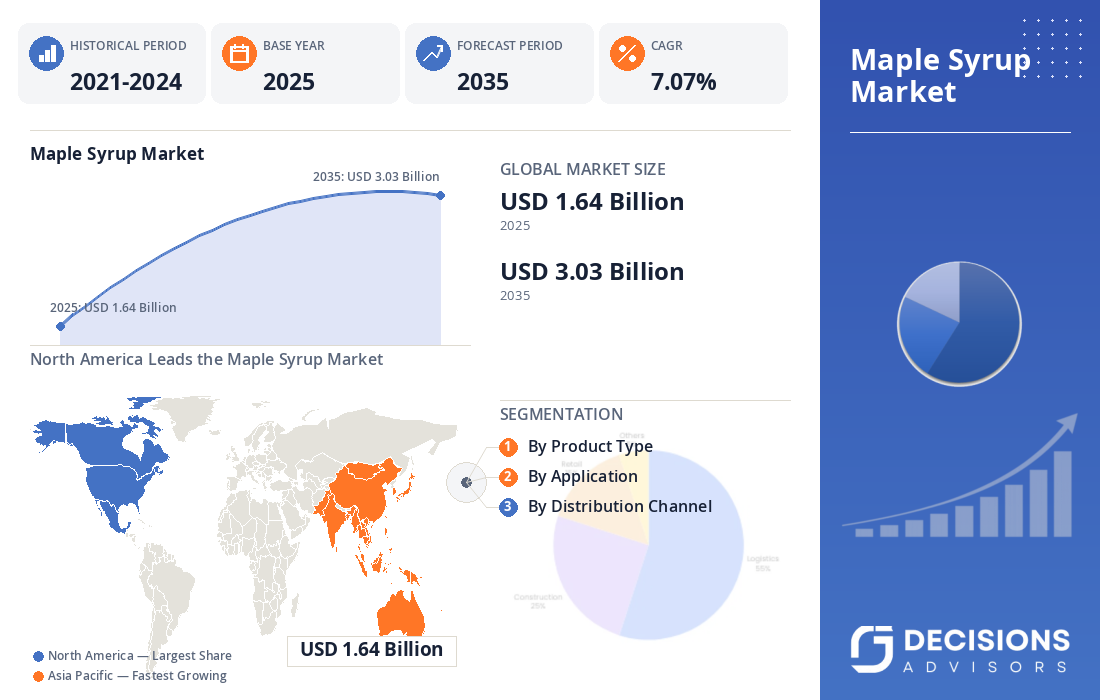
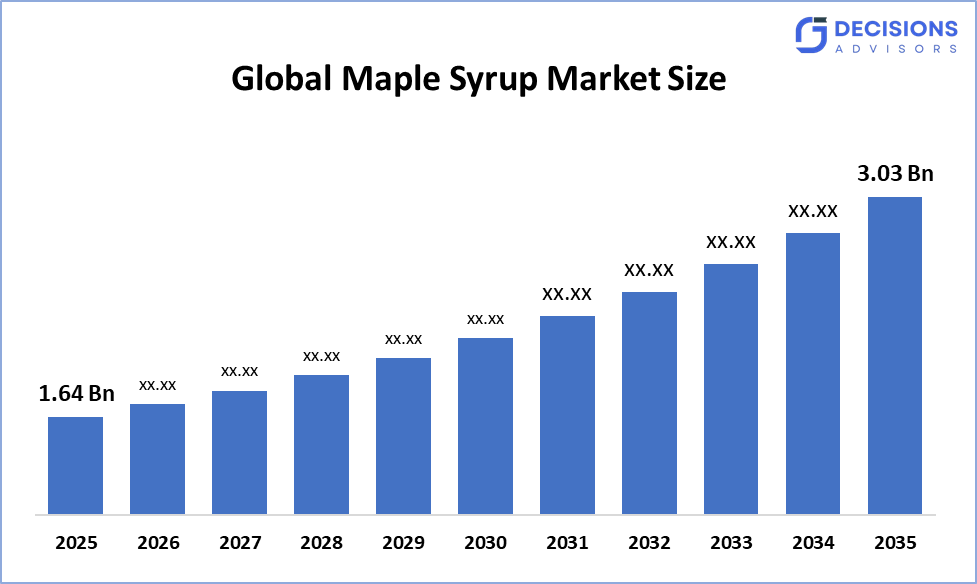
The Global Maple Syrup Market Size is predicted to grow from USD 1.64 Billion in 2025 and is likely to reach around USD 3.03 Billion by 2035 with a CAGR of 7.07%. According to Decision Advisors, the market is being driven by increasing consumer preference for natural and clean-label sweeteners, growing demand for premium and organic food products, and expanding use of maple syrup across bakery, confectionery, beverages, dairy products, breakfast foods, and foodservice. North America remains the leading regional market because of its strong production base and established consumer demand, while Asia-Pacific is expected to experience faster growth as premium imported foods, bakery products, cafés, and Western-style breakfast consumption expand.
Market Snapshot
- Global Maple Syrup Market Size (2025): USD 1.64 Billion
- Projected Global Maple Syrup Market Size (2035): USD 3.03 Billion
- Global Maple Syrup Market Compound Annual Growth Rate (CAGR): 7.07%
- Largest Regional Market: North America
- 2nd Largest Region: Europe
- Fastest Growing Region: Asia-Pacific
- Base Year: 2025
- Historical Period: 2021-2024
- Market Forecast Period: 2026-2035.
Market Overview/ Introduction
the global maple syrup market includes the production, processing, packaging, distribution, and sale of maple syrup obtained primarily from maple tree sap. Maple syrup is traditionally consumed with pancakes, waffles, and breakfast foods but has expanded into bakery, confectionery, dairy, beverages, sauces, desserts, cereals, and foodservice applications. The market is benefiting from growing consumer awareness of naturally sourced ingredients and increasing demand for clean-label and premium sweetening products. Organic, pure, flavored, and specialty maple products are also creating additional opportunities for producers and brands. North America remains the center of the global maple syrup industry because Canada and the United States account for virtually all commercial-scale production.
- United States, USDA programs support maple producers through research, statistics, market development, and the Acer Access and Development Program, helping strengthen the domestic maple industry.
- Canada, Government food standards establish requirements for maple products, including grades, labeling, composition, and food safety, supporting product quality and consumer confidence.
- Asia-Pacific, Rising premium-food consumption, café culture, bakery products, e-commerce, and demand for imported natural sweeteners are creating new opportunities for maple syrup suppliers.
Notable Insights: -
- North America is anticipated to hold approximately 46% share of the Global Maple Syrup Market over the predicted timeframe.
- Asia-Pacific is expected to be the fastest-growing region, with its share reaching approximately 14% during the forecast period.
- By Product Type, the Grade A Maple Syrup segment dominated the market and holds approximately 53% share in 2025 and is projected to grow at a substantial CAGR during the forecast period.
- By Application, the Bakery & Confectionery segment dominated the market and holds approximately 31% share in 2025 and is projected to grow at a substantial CAGR during the forecast period.
- By Distribution Channel, Supermarkets/Hypermarkets accounted for approximately 39% share in 2025.
- The compound annual growth rate of the Global Maple Syrup Market is 7.07%.
- The market is likely to achieve a valuation of USD 3.03 Billion by 2035.
Market Drivers
The Global Maple Syrup Market is experiencing growth because of increasing consumer preference for naturally sourced and recognizable sweeteners. Consumers are becoming more interested in clean-label and minimally processed food products, supporting demand for pure and organic maple syrup. The expanding use of maple syrup in bakery products, confectionery, breakfast cereals, yogurt, ice cream, beverages, sauces, and premium foodservice is increasing its addressable market. Growth in premium breakfast foods and café culture is further supporting demand. E-commerce and direct-to-consumer platforms allow small and specialty maple producers to reach consumers outside traditional production regions. In addition, rising disposable incomes in emerging economies are creating opportunities for premium imported food ingredients.
Restrain
The Global Maple Syrup Market faces several supply-side challenges because production depends heavily on suitable weather conditions and the annual freeze-thaw cycle. Changes in temperature, shorter tapping seasons, extreme weather, and changing forest conditions can affect sap collection and production yields. The geographic concentration of production in Canada and the United States also creates supply-chain exposure. Furthermore, maple syrup generally has a higher retail price than conventional sugar and corn-based sweeteners, which can limit adoption among price-sensitive consumers. Packaging, transportation, certification, grading, and food-safety requirements can also increase operating costs.
Competitive Analysis:
The report offers the appropriate analysis of the key organizations/companies involved within the Global Maple Syrup Market, along with a comparative evaluation primarily based on their product offerings, business overviews, geographic presence, enterprise strategies, segment market share, and SWOT analysis. The report also provides an elaborative analysis focusing on the current news and developments of the companies, which includes product development, innovations, joint ventures, partnerships, mergers & acquisitions, strategic alliances, and others. This allows for the evaluation of the overall competition within the market.
Top Companies in the Global Maple Syrup Market
- B&G Foods, Inc.
- The J.M. Smucker Company
- The Kraft Heinz Company
- Lantic Maple Inc.
- Bascom Maple Farms, Inc.
- Coombs Family Farms
- Butternut Mountain Farm
- Crown Maple
- Federation of Quebec Maple Syrup Producers
- Escuminac.
Government Initiatives
|
Country |
Key Government Initiatives |
|
United States |
USDA supports maple-sector research, producer information, market development, and the Acer Access and Development Program to strengthen maple production and market opportunities |
|
Japan |
Japan maintains dedicated customs classification and tariff treatment for maple sugar and maple syrup, supporting transparent import administration for international suppliers |
|
China |
China's expanding imported-food, premium grocery, modern retail, and e-commerce sectors are creating opportunities for imported natural sweeteners such as maple syrup |
Market Segmentation
The Global Maple Syrup Market share is classified into Product Type, Application, and Distribution Channel.
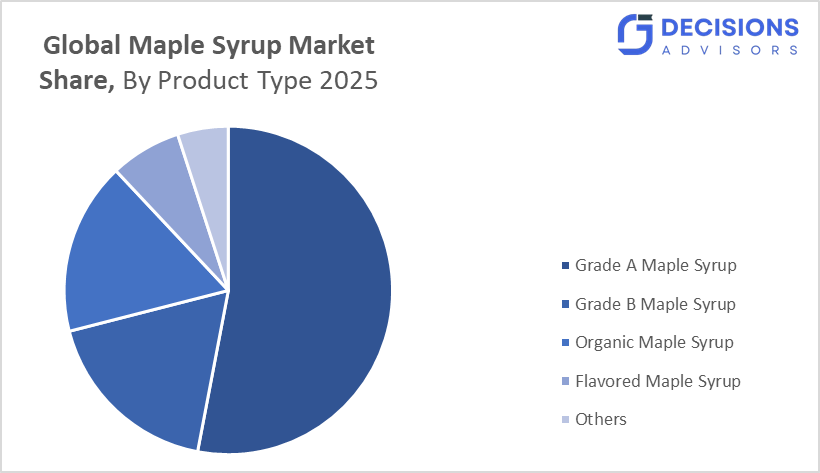
- The Grade A Maple Syrup segment dominated the market and holds approximately 53% share in 2025 and is projected to grow at a substantial CAGR during the forecast period.
Based on the Product Type, the Global Maple Syrup Market is divided into Grade A Maple Syrup, Grade B Maple Syrup, Organic Maple Syrup, Flavored Maple Syrup, and Others. Among these, Grade A Maple Syrup dominates the market and holds approximately 53% share in 2025. Its dominance is supported by strong consumer recognition, widespread retail availability, and its suitability for direct consumption. Grade A syrup is extensively used with pancakes, waffles, cereals, yogurt, desserts, and beverages. Its premium positioning also allows producers to generate higher value from packaged products.
- The Bakery & Confectionery segment accounted for the largest share of approximately 31% in 2025 and is anticipated to grow at a significant CAGR during the forecast period.
Based on Application, the market is divided into Bakery & Confectionery, Dairy & Frozen Desserts, Beverages, Breakfast Cereals, and Foodservice. Among these, Bakery & Confectionery accounted for the largest share and holds approximately 31% share in 2025. Maple syrup provides both sweetness and a distinctive flavor profile, making it attractive for cookies, cakes, pastries, dessert toppings, confectionery products, and snack bars. Increasing demand for premium and natural ingredients in artisanal and packaged bakery products further supports this segment.
- The Supermarkets/Hypermarkets segment accounted for the largest share of approximately 39% in 2025 and is anticipated to grow at a significant CAGR during the forecast period.
Based on Distribution Channel, the market is divided into Supermarkets/Hypermarkets, Specialty Stores, Convenience Stores, Online Retail, and Direct-to-Consumer. Among these, Supermarkets/Hypermarkets dominate because they provide broad product visibility, established distribution networks, and multiple maple syrup brands and grades in a single location. Consumers can easily compare package sizes, grades, organic certifications, and prices. However, online retail is expected to expand rapidly as specialty and premium maple syrup brands increasingly use digital channels to reach consumers.
Regional Segment Analysis of the Global Maple Syrup Market
- North America (U.S., Canada, Mexico)?
- Europe (Germany, U.K., France, Italy, Spain, Netherlands, Rest of Europe).
- Asia-Pacific (China, Japan, India, Australia, South Korea, Rest of Asia-Pacific).
- South America (Brazil, Argentina, Rest of South America).
- Middle East & Africa (UAE, Saudi Arabia, South Africa, Rest of MEA).
North America is anticipated to hold approximately 46% share of the Global Maple Syrup Market over the predicted timeframe.
North America is anticipated to hold approximately 46% share of the Global Maple Syrup Market over the predicted timeframe. The region remains the dominant production and consumption center because of Canada's large-scale maple industry and the United States' substantial production and consumption base. Strong consumer familiarity with maple syrup, extensive supermarket distribution, established processing infrastructure, and high demand for breakfast foods support regional growth. Canada also maintains a strong export position, while U.S. consumers provide a large and mature domestic market. Premium, organic, flavored, and small-batch maple products are expected to provide additional growth opportunities.
Europe is expected to hold approximately 20% share of the Global Maple Syrup Market during the forecast period.
Europe is expected to hold approximately 20% share of the Global Maple Syrup Market during the forecast period. Demand is being supported by consumer interest in natural sweeteners, organic foods, premium breakfast products, and clean-label ingredients. Germany, the United Kingdom, France, and other Western European countries provide important opportunities for imported maple syrup. The region's established bakery and confectionery industry also creates strong demand for maple-based ingredients. Increasing specialty-food consumption and e-commerce penetration are expected to improve access to premium maple products.
Asia-Pacific is expected to be the fastest-growing region in the Global Maple Syrup Market, with its market share reaching approximately 14% over the forecast period.
Asia-Pacific is expected to be the fastest-growing region in the Global Maple Syrup Market, with its market share reaching approximately 14% over the forecast period. Rising disposable income, premium food consumption, expanding bakery and café culture, and growing interest in Western-style breakfast foods are increasing demand. Japan represents an established market, while China, India, South Korea, and Australia provide substantial long-term growth opportunities. Online grocery platforms are also making imported maple syrup more accessible to consumers across major Asian cities.
Future Market Trends in Global Maple Syrup Market: -
- Expansion of Organic and Clean-Label Maple Syrup.
Organic and clean-label maple syrup is expected to gain increasing consumer attention. Consumers are looking for products with simple ingredient lists and recognizable natural origins. Producers are therefore expected to expand certified organic offerings and emphasize sustainable forest management, traceability, and responsible production.
- ???????Growth of Flavored and Premium Maple Products.
Maple producers are expanding beyond conventional syrup through flavored and infused varieties. Vanilla, cinnamon, coffee, fruit, and barrel-aged maple products provide opportunities to attract premium consumers and expand maple syrup into beverages, desserts, sauces, cocktails, and gourmet cooking.
- ???????E-Commerce and Direct-to-Consumer Expansion.
Online channels are expected to become increasingly important for specialty maple producers. E-commerce enables smaller producers to reach consumers across national and international markets while supporting subscription programs, gift packages, seasonal products, and premium product launches.
- ???????Climate-Resilient Maple Production.
Climate variability will encourage greater investment in forest management, sap collection technology, monitoring systems, and improved tapping strategies. Producers are expected to adopt techniques designed to improve productivity and reduce the impact of changing weather conditions on annual maple syrup production.
Recent Development
- In March 2025, New Water Capital acquired Dutch Gold Honey and related businesses, expanding its portfolio into a company involved in honey and maple syrup products serving retail, foodservice, institutional, and ingredient markets.
- In April 2026, The Maple Treat Corporation completed its transition to Lantic Maple Inc., strengthening its identity within the Lantic natural-sweeteners group and continuing its international maple product operations.
- In June 2026, Runamok Maple returned to the Summer Fancy Food Show to celebrate its tenth year, highlighting product innovation, foodservice development, and its portfolio of infused and barrel-aged maple products.
Market Segment
This study forecasts revenue at global, regional, and country levels from 2021 to 2035. Decision Advisors has segmented the Global Maple Syrup Market based on the below-mentioned segment:
Global Maple Syrup Market, By Product Type.
- Grade A Maple Syrup
- Grade B Maple Syrup
- Organic Maple Syrup
- Flavored Maple Syrup
- Others.
Global Maple Syrup Market, By Application.
- Bakery & Confectionery
- Dairy & Frozen Desserts
- Beverages
- Breakfast Cereals
- Foodservice.
Global Maple Syrup Market, By Distribution Channel.
- Supermarkets/Hypermarkets
- Specialty Stores
- Convenience Stores
- Online Retail
- Direct-to-Consumer.
Global Maple Syrup Market, By Regional Analysis.
North America
- US
- Canada
- Mexico
Europe
- Germany
- UK
- France
- Italy
- Spain
- Russia
- Rest of Europe
Asia Pacific
- China
- Japan
- India
- South Korea
- Australia
- Rest of Asia Pacific
South America
- Brazil
- Argentina
- Rest of South America
Middle East & Africa
- UAE
- Saudi Arabia
- Qatar
- South Africa
- Rest of the Middle East & Africa
Frequently Asked Questions (FAQ)
Q. What is driving the growth of the Global Maple Syrup Market?
A. Growth is primarily driven by increasing demand for natural and clean-label sweeteners, rising consumption of premium and organic foods, and expanding use of maple syrup in bakery, confectionery, beverages, dairy products, cereals, and foodservice. E-commerce is also improving access to premium and specialty maple products.
Q. Which region dominates the Global Maple Syrup Market?
A. North America is expected to remain the dominant regional market because Canada and the United States have highly developed maple production, processing, distribution, and consumption ecosystems. The region also benefits from strong consumer familiarity and established retail channels.
Q. Why is Asia-Pacific expected to grow rapidly in the maple syrup market?
A. Asia-Pacific is benefiting from increasing disposable income, premium food consumption, Western-style breakfast trends, bakery and café expansion, and growing e-commerce penetration. Japan, China, South Korea, Australia, and India provide important opportunities for international maple syrup suppliers.
Q. What are the major applications of maple syrup?
A. Major applications include bakery and confectionery, dairy and frozen desserts, beverages, breakfast cereals, and foodservice. Maple syrup is increasingly used as both a natural sweetener and a distinctive flavor ingredient.
Check Licence
Choose the plan that fits you best: Single User, Multi-User, or Enterprise solutions tailored for your needs.
We Have You Covered
- 24/7 Analyst Support
- Clients Across the Globe
- Tailored Insights
- Technology Tracking
- Competitive Intelligence
- Custom Research
- Syndicated Market Studies
- Market Overview
- Market Segmentation
- Growth Drivers
- Market Opportunities
- Regulatory Insights
- Innovation & Sustainability
Report Details
| Scope | Global |
| Pages | 240 |
| Delivery | PDF & Excel via Email |
| Language | English |
| Release | Aug 2026 |
| Access | Download from this page |