
Global Marine Deck Coatings Market
 |
Author:
Aditya G
|
Pages:
230
|
Author:
Aditya G
|
Pages:
230
Global Marine Deck Coatings Market Size, Share By Technology (Waterborne, Solventborne, Powder Coatings, and UV-Cured Coatings), By End Use (New Build and Repair & Maintenance), By Application (Commercial Vessels, Naval Vessels, Offshore Platforms, and Recreational Boats), and By Region (North America, Europe, Asia-Pacific, Latin America, Middle East & Africa), Analysis and Forecast 2026-2035.
CAGR
5.24%
REVENUE 2025
USD Billion 5.35
FORECAST 2035
USD Billion 8.92
REPORT COVERAGE
Global
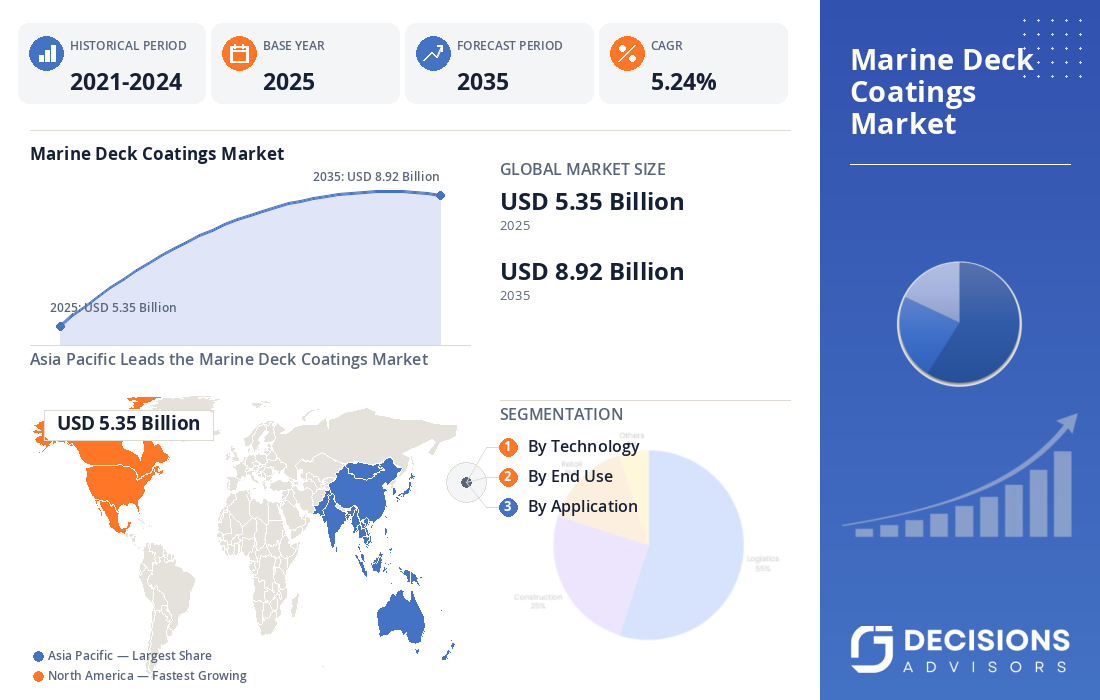
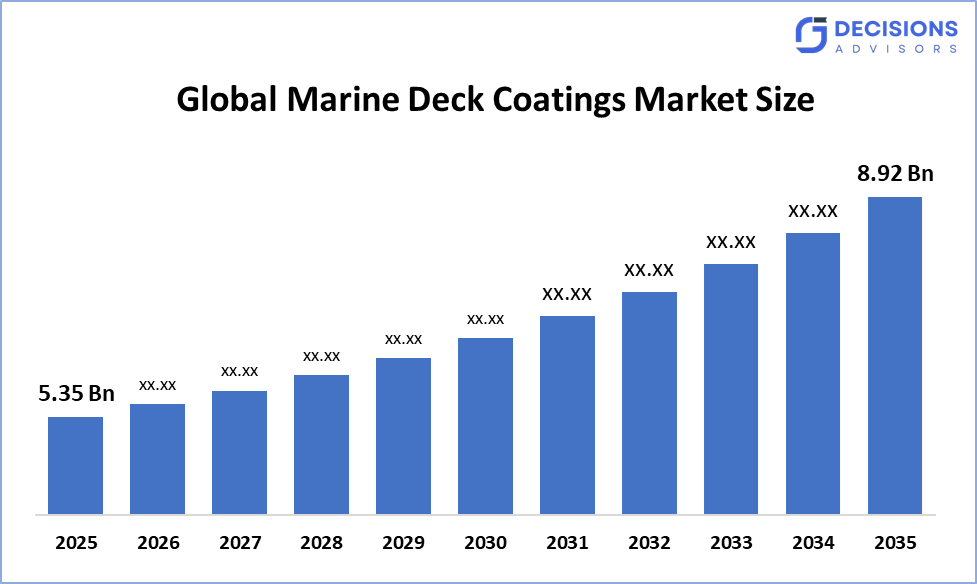
The global marine deck coatings market size is predicted to grow from USD 5.35 Billion in 2025 and is likely to reach around USD 8.92 Billion by 2035, with a CAGR of 5.24%. The market encompasses specialized coating systems applied to marine decks to provide corrosion protection, abrasion resistance, weather resistance, durability, and anti-slip performance. Industry research identifies increasing shipbuilding activity in Asia-Pacific and recurring professional maintenance as important growth factors.
Market Snapshot
- Global Marine Deck Coatings Market Size (2025): USD 5.35 Billion
- Projected Global Marine Deck Coatings Market Size (2035): USD 8.92 Billion
- Global Marine Deck Coatings Market Compound Annual Growth Rate (CAGR): 5.24%
- Largest Regional Market: Asia-Pacific
- 2nd Largest Region: Europe
- Fastest Growing Region: North America
- Base Year: 2025
- Historical Period: 2021-2024
- Market Forecast Period: 2026-2035.
Market Overview/ Introduction
The global marine deck coatings market comprises protective and functional coating systems designed for marine deck surfaces exposed to seawater, humidity, ultraviolet radiation, chemicals, heavy equipment, foot traffic, and mechanical abrasion. These coatings are used across commercial vessels, naval vessels, offshore platforms, cruise and passenger ships, and recreational boats. Marine deck coating systems commonly provide corrosion protection, anti-slip performance, abrasion resistance, weatherability, and longer surface-maintenance intervals. Demand is closely connected with vessel construction, fleet expansion, drydock activity, ship repair, and offshore infrastructure investment. Market research identifies Asia-Pacific shipbuilding activity and increasing leisure-boat and cruise-ship production as important market drivers. The market is also being influenced by environmental regulation and the maritime industry's broader decarbonization objectives. Coating manufacturers are increasingly developing products that lower emissions, improve durability, reduce maintenance frequency, and support vessel efficiency.
- United States, EPA requirements for shipbuilding and ship-repair surface coating operations establish hazardous-air-pollutant standards for marine coating activities, encouraging compliant coating formulations and application practices.
- Japan, Japan is supporting next-generation low-emission vessels through its Green Innovation Fund and NEDO programs, including hydrogen and ammonia-powered vessel development.
- Asia-Pacific, The concentration of shipbuilding, vessel repair, offshore infrastructure, and marine manufacturing in China, Japan, South Korea, and India creates a strong regional customer base for protective deck coatings.
Notable Insights: -
- Asia-Pacific is anticipated to hold approximately 39% share of the Global Marine Deck Coatings Market over the predicted timeframe.
- Europe is expected to hold approximately 24% share during the forecast period, supported by its mature maritime industry and emphasis on environmental compliance.
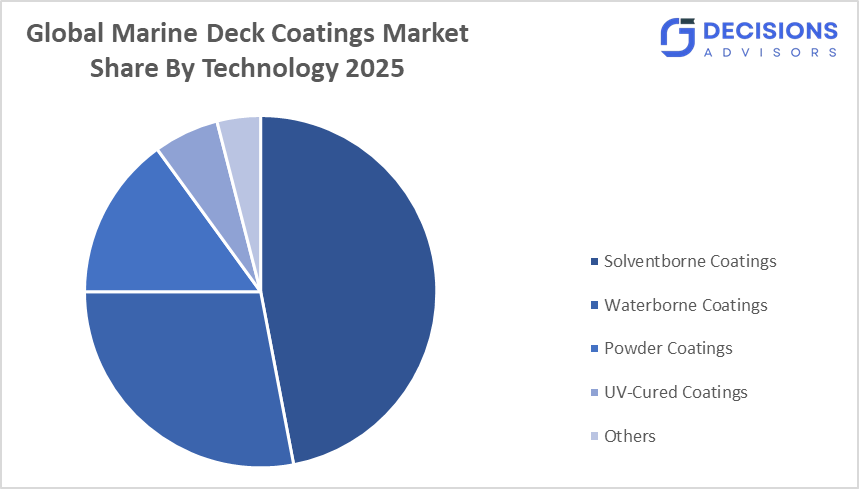
- By Technology, the Solventborne segment dominated the market and holds approximately 47% share in 2025 and is projected to grow at a substantial CAGR during the forecast period.
- By End Use, the Repair & Maintenance segment dominated the market and holds approximately 61% share in 2025 and is projected to grow at a substantial CAGR during the forecast period.
- The compound annual growth rate of the Global Marine Deck Coatings Market is 5.24%.
- The market is likely to achieve a valuation of USD 8.92 Billion by 2035.
Market Drivers
The global marine deck coatings market is driven by expanding commercial shipping fleets, increased shipbuilding activity, growing offshore infrastructure, and recurring vessel repair and maintenance. Marine deck surfaces are continuously exposed to seawater, salt, humidity, UV radiation, chemicals, impact, and abrasion, creating recurring requirements for protective coatings. The growth of commercial vessels and cruise ships increases new-build coating consumption, while the existing global fleet creates recurring demand during drydock and refurbishment operations. Asia-Pacific is particularly important because of its concentration of major shipbuilding and marine-repair facilities. Technological development is another important driver. Coating suppliers are focusing on longer service life, faster curing, improved adhesion, anti-slip characteristics, lower VOC emissions, and improved resistance to mechanical damage. The maritime industry's focus on fuel efficiency and decarbonization also creates demand for coating systems that can reduce maintenance requirements and contribute to vessel-performance optimization. Jotun reported double-digit growth in its Marine Coatings segment in 2025, supported by newbuilding, drydock, and seastock activity, illustrating the strength of demand for advanced marine coating solutions.
Restrain
The Global Marine Deck Coatings Market faces several constraints, including volatile raw-material prices, environmental compliance costs, complex application conditions, and skilled-labor requirements. Marine coatings rely on resins, pigments, solvents, additives, and other specialty chemicals whose prices can fluctuate with crude-oil, energy, and chemical-market conditions. At the same time, coating manufacturers and shipyards face increasing pressure to reduce VOC and hazardous-air-pollutant emissions. The U.S. EPA's NESHAP requirements specifically regulate hazardous air pollutants associated with shipbuilding and ship-repair surface coating operations. Application conditions also create operational challenges. Marine decks require proper surface preparation, environmental control, mixing, application, and curing to achieve the intended performance. High humidity, low temperatures, salt contamination, and restricted drydock schedules can affect coating quality. Shipowners increasingly seek faster-curing and longer-lasting systems, increasing technical requirements and development costs for manufacturers.
Competitive Analysis:
The report offers the appropriate analysis of the key organizations/companies involved within the global marine deck coatings market, along with a comparative evaluation primarily based on their product offerings, business overviews, geographic presence, enterprise strategies, segment market share, and SWOT analysis. The report also provides an elaborative analysis focusing on the current news and developments of the companies, which includes product development, innovations, joint ventures, partnerships, mergers & acquisitions, strategic alliances, and others. This allows for the evaluation of the overall competition within the market.
Top Companies in the Global Marine Deck Coatings Market
- PPG Industries, Inc.
- Akzo Nobel N.V.
- Hempel A/S
- Jotun A/S
- The Sherwin-Williams Company
- Nippon Paint Marine Coatings Co., Ltd.
- Kansai Paint Co., Ltd.
- Chugoku Marine Paints, Ltd.
- BASF SE
- RPM International Inc.
Government Initiatives
|
Country |
Key Government Initiatives |
|
United States |
The U.S. EPA's Shipbuilding and Ship Repair Surface Coating NESHAP requires covered major sources to control hazardous-air-pollutant emissions using maximum achievable control technology. The standard applies to various marine coating categories and influences formulation and application practices |
|
Japan |
Japan's NEDO Green Innovation Fund supports next-generation ship development, including hydrogen- and ammonia-powered vessels, as part of the country's maritime decarbonization strategy |
|
China |
China's large shipbuilding industry and government-backed maritime manufacturing policies support vessel construction and modernization, creating continued demand for protective marine coatings. The country's shipbuilding sector remains a major component of Asia-Pacific marine-coating demand |
Market Segmentation
The Global Marine Deck Coatings Market share is classified into Technology, End Use, and Application.
- The Solventborne segment dominated the market and holds approximately 47% share in 2025 and is projected to grow at a substantial CAGR during the forecast period.
Based on technology, the global marine deck coatings market is divided into waterborne, solventborne, powder coatings, and UV-cured coatings. Among these, Solventborne coatings dominate because of their established use in demanding marine environments and their strong adhesion, durability, and resistance to water and chemicals. They remain widely used across commercial vessels and maintenance operations because shipyards and coating contractors have extensive experience with these systems. Nevertheless, environmental requirements are encouraging greater adoption of waterborne and other lower-emission alternatives.
- The Repair & Maintenance segment accounted for the largest share of approximately 61% in 2025 and is anticipated to grow at a significant CAGR during the forecast period.
Based on end use, the market is divided into new build and repair & maintenance. among these, repair & maintenance accounted for the largest share because operating vessels require periodic recoating, corrosion repair, surface refurbishment, and anti-slip renewal. Existing vessels generate repeat coating demand throughout their operational lives, making maintenance a recurring source of revenue. Increasing drydock activity and fleet maintenance requirements are therefore expected to sustain the segment's leadership.
- The Commercial Vessels segment accounted for the largest share of approximately 57% in 2025 and is anticipated to grow at a significant CAGR during the forecast period.
Based on application, the market is divided into commercial vessels, naval vessels, offshore platforms, and recreational boats. Commercial vessels dominate because cargo ships, tankers, bulk carriers, container ships, and passenger vessels represent a substantial installed asset base. These vessels require durable deck surfaces capable of handling continuous exposure to saltwater, cargo operations, equipment movement, and heavy foot traffic. Expansion of commercial shipping and ongoing fleet maintenance therefore provides a strong recurring demand base.
Regional Segment Analysis of the Global Marine Deck Coatings Market
- North America (U.S., Canada, Mexico)?
- Europe (Germany, U.K., France, Italy, Spain, Netherlands, Rest of Europe).
- Asia-Pacific (China, Japan, India, Australia, South Korea, Rest of Asia-Pacific).
- South America (Brazil, Argentina, Rest of South America).
- Middle East & Africa (UAE, Saudi Arabia, South Africa, Rest of MEA).
Asia Pacific is anticipated to hold approximately 39% share of the Global Marine Deck Coatings Market over the predicted timeframe.
Asia-Pacific represents the largest regional market because China, Japan, South Korea, India, and Southeast Asian countries have substantial shipbuilding, marine-repair, commercial shipping, and offshore infrastructure capabilities. China, Japan, and South Korea are particularly important because of their large shipyard networks and high vessel-production volumes. India and Southeast Asia are creating additional growth opportunities through shipbuilding expansion, port development, and maritime infrastructure investment.
Europe is expected to hold approximately 24% share of the global marine deck coatings market during the forecast period.
Europe maintains a mature maritime ecosystem covering commercial shipping, shipbuilding, offshore wind, naval vessels, cruise ships, and marine repair. Sustainability is increasingly important because European shipowners and operators are under pressure to improve energy efficiency and reduce environmental impact. The IMO's global decarbonization objectives further reinforce interest in technologies that improve vessel performance and extend maintenance intervals.
North America is expected to grow at a steady CAGR in the global marine deck coatings market, holding approximately 18% of the share during the forecast period.
North America has a well-established maritime ecosystem covering commercial vessels, naval fleets, offshore energy assets, cruise and recreational boats, and ship-repair facilities. The United States also has stringent environmental requirements governing marine surface coating operations, encouraging demand for compliant formulations and improved application processes.
Future Market Trends in global marine deck coatings market: -
- ???????Shift Toward Low-VOC and Environmentally Compliant Coatings.
Environmental requirements will continue to encourage the development of waterborne, high-solids, powder, and UV-curable coating technologies. Shipyards and coating manufacturers will increasingly prioritize systems that reduce VOC emissions while maintaining corrosion resistance, abrasion resistance, adhesion, and service life.
- ???????Faster-Curing and Reduced-Drydock-Time Systems.
Faster-curing coatings are expected to gain importance as vessel operators seek to reduce drydock periods. A shorter coating application and curing cycle can reduce vessel downtime, improve shipyard productivity, and lower total maintenance costs.
- ???????Advanced Anti-Slip and Abrasion-Resistant Deck Systems.
Demand for high-performance anti-slip deck systems will increase across commercial vessels, naval vessels, offshore platforms, and cruise ships. Future products are expected to combine anti-slip properties with corrosion resistance, UV stability, chemical resistance, impact resistance, and longer maintenance intervals.
??????? - Performance-Based Marine Coating Solutions.
Marine coating suppliers are increasingly moving beyond individual products toward integrated solutions combining coatings, technical service, condition monitoring, performance measurement, and maintenance planning.
Recent Development
- In June 2025, Jotun launched Hull Performance Solutions 2.0 at Nor-Shipping, introducing an enhanced marine-performance solution combining new coating products, technical service, hull-condition management, data, and performance guarantees.
- In June 2025, Hempel launched Hempaguard NB, a silicone hull coating specifically developed for newbuild vessels. The product brings silicone-coating performance to vessels during the shipbuilding phase and is designed to provide up to 20% fuel savings.
- In September 2025, Jotun launched Hardtop XP II, the next generation of its Hardtop XP product, with improvements in durability, efficiency, aesthetics, curing, and resistance to UV and chemical exposure.
Market Segment
This study forecasts revenue at global, regional, and country levels from 2021 to 2035. Decision Advisors has segmented the global marine deck coatings market based on the below-mentioned segment:
Global Marine Deck Coatings Market, By Technology.
- Waterborne
- Solventborne
- Powder Coatings
- UV-Cured Coatings
- Others.
Global Marine Deck Coatings Market, By End Use.
- New Build
- Repair & Maintenance
- Commercial Fleet Maintenance
- Offshore Maintenance
- Others.
Global Marine Deck Coatings Market, By Application.
- Commercial Vessels
- Naval Vessels
- Offshore Platforms
- Recreational Boats.
Global Marine Deck Coatings Market, By Regional Analysis.
North America
- US
- Canada
- Mexico
Europe
- Germany
- UK
- France
- Italy
- Spain
- Russia
- Rest of Europe
Asia Pacific
- China
- Japan
- India
- South Korea
- Australia
- Rest of Asia Pacific
South America
- Brazil
- Argentina
- Rest of South America
Middle East & Africa
- UAE
- Saudi Arabia
- Qatar
- South Africa
- Rest of the Middle East & Africa
Frequently Asked Questions (FAQ)
Q. What are marine deck coatings used for?
A. Marine deck coatings protect vessel deck surfaces against corrosion, abrasion, seawater, chemicals, UV exposure, and heavy traffic. Many systems also provide anti-slip properties to improve crew and passenger safety.
Q. Why does repair and maintenance represent the largest end-use segment?
A. Existing vessels require recurring drydock maintenance and recoating throughout their operating lives. Exposure to seawater, weather, impact, chemicals, and mechanical abrasion continuously creates requirements for deck refurbishment and protective coating renewal.
Q. How are environmental regulations affecting the marine deck coatings market?
A. Environmental requirements are encouraging manufacturers to develop coatings with lower VOC and hazardous-air-pollutant emissions. At the same time, shipowners are increasingly interested in durable products that reduce maintenance frequency and support broader vessel-efficiency objectives.
Q. Which region dominates the Global Marine Deck Coatings Market?
A. Asia-Pacific is expected to remain the largest regional market because of its major shipbuilding and ship-repair industries, particularly in China, Japan, and South Korea. High newbuilding activity and a large installed fleet support both new-build and recurring maintenance demand.
Check Licence
Choose the plan that fits you best: Single User, Multi-User, or Enterprise solutions tailored for your needs.
We Have You Covered
- 24/7 Analyst Support
- Clients Across the Globe
- Tailored Insights
- Technology Tracking
- Competitive Intelligence
- Custom Research
- Syndicated Market Studies
- Market Overview
- Market Segmentation
- Growth Drivers
- Market Opportunities
- Regulatory Insights
- Innovation & Sustainability
Report Details
| Scope | Global |
| Pages | 230 |
| Delivery | PDF & Excel via Email |
| Language | English |
| Release | Aug 2026 |
| Access | Download from this page |