
Global Marine Propulsion Engine Market
 |
Author:
Mayuri S
|
Pages:
180
|
Author:
Mayuri S
|
Pages:
180
Global Marine Propulsion Engine Market Size, Share By Product Type (Diesel, Wind & Solar, Gas Turbine, Fuel Cell, Steam Turbine, and Natural Gas), By Application (Commercial Shipping, Offshore & Support Vessels, Naval & Defense, Passenger & Recreational Vessels, and Inland Waterway Vessels), By Power Rating (Low Power, Medium Power, and High Power), and By Region (North America, Europe, Asia-Pacific, Latin America, Middle East & Africa), Analysis and Forecast 2026-2035
CAGR
4.14%
REVENUE 2025
USD Billion 29.2
FORECAST 2035
USD Billion 43.8
REPORT COVERAGE
Global
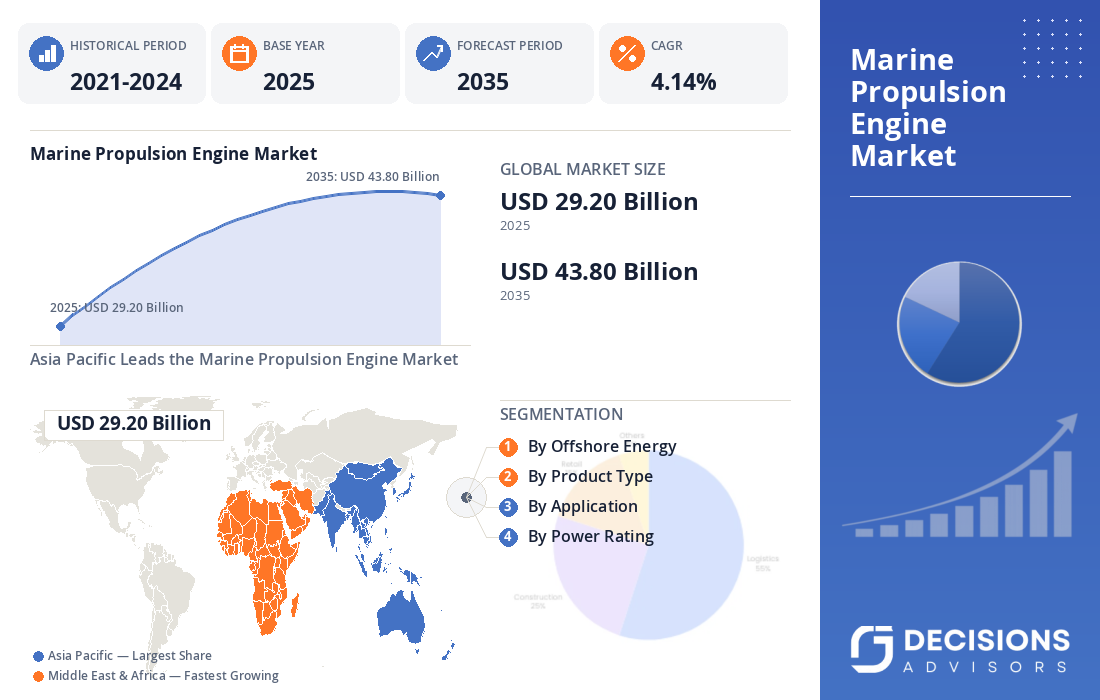
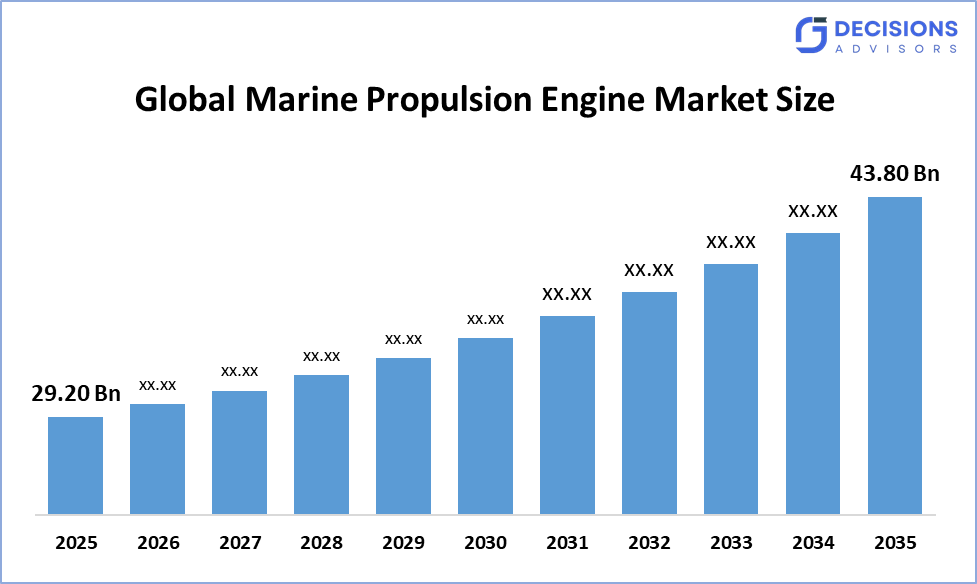
The Global Marine Propulsion Engine Market Size is predicted to grow from USD 29.20 Billion in 2025 and is likely to reach around USD 43.80 Billion by 2035, with a CAGR of 4.14%. According to Decision Advisors, the market is being driven by continued growth in maritime transportation, fleet modernization, shipbuilding activity, propulsion efficiency improvements, and the transition toward lower-emission marine fuels. Asia Pacific represents the largest regional market because of its strong shipbuilding ecosystem, extensive merchant fleet, and high concentration of maritime manufacturing.
Market Snapshot
- Global Marine Propulsion Engine Market Size (2025): USD 29.20 Billion
- Projected Global Marine Propulsion Engine Market Size (2035): USD 43.80 Billion
- Global Marine Propulsion Engine Market CAGR: 4.14%
- Largest Regional Market: Asia Pacific
- 2nd Largest Region: North America
- Fastest Growing Region: Middle East & Africa
- Base Year: 2025
- Historical Period: 2021-2024
- Market Forecast Period: 2026-2035.
Market Overview/ Introduction
The Global Marine Propulsion Engine Market includes engines and propulsion technologies used to generate thrust for commercial ships, offshore vessels, naval platforms, passenger vessels, recreational boats, and inland-waterway vessels. Marine propulsion engines remain essential to global maritime transportation because they provide the continuous power required for vessel movement, maneuvering, cargo transportation, offshore operations, and naval missions. Market growth is supported by expansion in global seaborne trade, new vessel construction, fleet replacement, offshore energy activity, and modernization of aging vessels. The market is also evolving from conventional diesel propulsion toward dual-fuel, LNG, methanol, ammonia-ready, hybrid-electric, battery-electric, and fuel-cell-based systems.
- Japan, Japan's maritime authorities are supporting zero-emission vessel development through a dedicated roadmap and collaborative programs focused on alternative fuels and next-generation propulsion technologies.
- China, China is promoting green and intelligent shipping, including cleaner vessel technologies, alternative-energy vessels, and digital maritime infrastructure.
- Europe, The EU's FuelEU Maritime Regulation has applied since January 1, 2025, promoting renewable and low-carbon fuels and clean-energy technologies for vessels.
Notable Insights: -
- Asia Pacific is anticipated to hold approximately 57% share of the Global Marine Propulsion Engine Market over the predicted timeframe.
- Middle East & Africa is expected to be the fastest-growing region, supported by offshore energy, energy transportation, port development, and maritime infrastructure investments.
- By Product Type, the Diesel segment dominated the market and holds approximately 56% share in 2025 and is projected to grow at a substantial CAGR during the forecast period. The reference industry study reports diesel at 57.2%, providing a basis for this Decision Advisors estimate.
- By Application, the Commercial Shipping segment dominated the market and holds approximately 61% share in 2025 because container ships, tankers, bulk carriers, cargo ships, and Ro-Ro vessels represent the largest concentration of marine propulsion demand.
- By Power Rating, the High Power segment dominated the market and holds approximately 62% share in 2025 because ocean-going commercial vessels require high continuous propulsion output.
- The compound annual growth rate of the Global Marine Propulsion Engine Market is 4.14%.
- The market is likely to achieve a valuation of USD 43.80 Billion by 2035.
Market Drivers
The expansion of global maritime trade is a fundamental driver of the marine propulsion engine market because increasing transportation of containers, crude oil, LNG, chemicals, minerals, agricultural products, and manufactured goods requires additional vessel capacity and continued utilization of existing fleets. Shipbuilding and fleet-renewal activity creates demand for new propulsion engines, while aging vessels generate a substantial retrofit and replacement market. Offshore oil and gas operations, offshore wind development, naval modernization, passenger transportation, ferries, and inland waterway logistics further broaden demand. Technological development is simultaneously changing the composition of the market. Engine manufacturers are introducing dual-fuel engines, hybrid propulsion packages, battery systems, advanced power-management systems, digital engine monitoring, predictive maintenance, and alternative-fuel-ready platforms. Decarbonization regulations are particularly important because the IMO's 2023 strategy requires a substantial reduction in shipping carbon intensity and increased use of zero- and near-zero-emission technologies.
Restrain
The market faces several restraints, including the high capital cost of advanced propulsion systems, uncertainty regarding future marine-fuel availability, and the complexity of integrating alternative-fuel technologies into existing vessels. LNG, methanol, ammonia, hydrogen, batteries, and fuel-cell systems can require specialized storage, fuel-handling, safety equipment, bunkering infrastructure, and crew training. Regulatory differences between regions can further complicate technology selection and vessel deployment. In addition, supply-chain constraints affecting specialized engine components, semiconductors, batteries, and power electronics can increase project costs and delivery times.
Competitive Analysis:
The report offers the appropriate analysis of the key organizations/companies involved within the Global Marine Propulsion Engine Market, along with a comparative evaluation primarily based on their product offerings, business overviews, geographic presence, enterprise strategies, segment market share, and SWOT analysis. The report also provides an elaborative analysis focusing on the current news and developments of the companies, which includes product development, innovations, joint ventures, partnerships, mergers & acquisitions, strategic alliances, and others. This allows for the evaluation of the overall competition within the market.
Top Companies in the Global Marine Propulsion Engine Market
- Wärtsilä
- Caterpillar Inc.
- Cummins Inc.
- AB Volvo Penta
- Rolls-Royce
- Mitsubishi Heavy Industries
- HD Hyundai Heavy Industries
- Yanmar Marine International
- DEUTZ AG
- Anglo Belgian Corporation.
Government Initiatives
|
Country |
Key Government Initiatives |
|
United States |
Federal maritime and energy programs support vessel modernization, cleaner marine technologies, alternative fuels, and advanced propulsion research |
|
Japan |
Japan's maritime authorities are supporting zero-emission vessel development and alternative-fuel propulsion through its maritime decarbonization roadmap |
|
China |
China is promoting green and intelligent navigation, cleaner vessels, alternative-energy propulsion, and modernization of maritime infrastructure |
Market Segmentation
The Global Marine Propulsion Engine Market share is classified into Product Type, Application, and Power Rating.
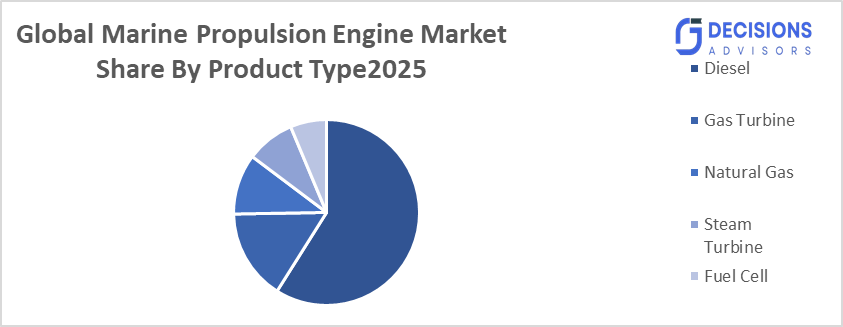
- The Diesel segment dominated the market and holds approximately 56% share in 2025 and is projected to grow at a substantial CAGR during the forecast period.
Based on Product Type, the Global Marine Propulsion Engine Market is divided into Diesel, Wind & Solar, Gas Turbine, Fuel Cell, Steam Turbine, and Natural Gas. Among these, Diesel dominates the market because diesel propulsion provides high torque, reliable continuous operation, mature technology, and established global fueling infrastructure. Diesel engines are extensively used in commercial shipping, offshore vessels, workboats, and naval applications. Although alternative fuels are expanding, diesel and diesel-derived dual-fuel systems are expected to retain a significant installed-base advantage through 2035.
- The Commercial Shipping segment accounted for the largest share of approximately 61% in 2025 and is anticipated to grow at a significant CAGR during the forecast period.
Based on Application, the market is divided into Commercial Shipping, Offshore & Support Vessels, Naval & Defense, Passenger & Recreational Vessels, and Inland Waterway Vessels. Commercial shipping dominates because container vessels, bulk carriers, tankers, Ro-Ro ships, and other cargo vessels represent the largest concentration of marine propulsion requirements. Expansion in international trade and vessel fleet modernization supports continuous engine demand. Decarbonization requirements are also encouraging commercial operators to replace older engines with more efficient and alternative-fuel-capable systems.
- The High Power segment accounted for the largest share of approximately 62% in 2025 and is anticipated to grow at a significant CAGR during the forecast period.
Based on Power Rating, the market is divided into Low Power, Medium Power, and High Power. High-power engines dominate because large ocean-going vessels require substantial continuous propulsion output. Container ships, crude-oil tankers, LNG carriers, bulk carriersm, and major offshore vessels depend on high-output engines for long-distance operations. Increasing vessel size and emphasis on fuel efficiency further support advanced high-power propulsion platforms.
Regional Segment Analysis of the Global Marine Propulsion Engine Market
- North America (U.S., Canada, Mexico)?
- Europe (Germany, U.K., France, Italy, Spain, Netherlands, Rest of Europe).
- Asia-Pacific (China, Japan, India, Australia, South Korea, Rest of Asia-Pacific).
- South America (Brazil, Argentina, Rest of South America).
- Middle East & Africa (UAE, Saudi Arabia, South Africa, Rest of MEA).
Asia Pacific is anticipated to hold approximately 57% share of the Global Marine Propulsion Engine Market over the predicted timeframe.
Asia Pacific is the dominant regional market because China, Japan, and South Korea collectively represent some of the world's most important shipbuilding and maritime-manufacturing centers. The region has extensive commercial fleets, major container ports, large-scale shipyards, and significant offshore and coastal shipping activity. China, Japan, India, South Korea, Singapore, and other maritime economies are investing in vessel modernization and cleaner propulsion. The region is also expected to become increasingly important for LNG, methanol, ammonia-ready, hybrid, and electric propulsion as international environmental regulations tighten.
North America is expected to grow at a steady CAGR in the Global Marine Propulsion Engine Market, holding approximately 14% share during the forecast period.
The U.S. represents the largest demand center in the region due to commercial shipping, inland waterways, offshore activity, naval programs, passenger transportation, and fleet modernization. Demand is increasingly shifting toward efficient engines, hybrid propulsion, electric systems, and alternative fuels. North America also benefits from strong R&D capabilities and the presence of major global engine manufacturers such as Caterpillar and Cummins.
Future Market Trends in Global Marine Propulsion Engine Market: -
-
- Expansion of Alternative-Fuel and Dual-Fuel Engines.
The marine propulsion industry is increasingly moving toward engines capable of operating with LNG, methanol, ammonia, and other alternative fuels. Dual-fuel technology allows shipowners to maintain operational flexibility while preparing for stricter emission standards.
-
- Growth of Hybrid and Battery-Electric Propulsion.
Hybrid propulsion systems combining combustion engines, batteries, electric motors, and intelligent energy-management systems are expanding, particularly in ferries, passenger vessels, offshore support vessels, harbor craft, and short-distance shipping.
-
- Digitalization and Predictive Maintenance.
Digital engine monitoring, remote diagnostics, AI-based analytics, and predictive maintenance will increasingly become integrated into marine propulsion systems. These technologies help operators monitor engine condition, optimize fuel consumption, identify component degradation, and minimize unplanned downtime.
-
- Retrofitting and Fleet Modernization.
The large global installed base of older vessels creates significant opportunities for engine replacement and propulsion retrofits. Shipowners can extend vessel operating lives by installing more efficient engines, alternative-fuel systems, hybrid components, advanced controls.
Recent Development
- In May 2025, Cummins received DNV Approval in Principle for methanol-ready QSK60 marine engines, supporting future lower-emission vessel applications.
- In May 2025, Caterpillar Marine announced progress on methanol-capable dual-fuel Cat 3500E marine engines through an agreement with Damen Shipyards Group.
- In November 2025, Everllence introduced its B&W ME-LGIA ammonia dual-fuel two-stroke engine for the global maritime industry.
Market Segment
This study forecasts revenue at global, regional, and country levels from 2021 to 2035. Decision Advisors has segmented the global marine propulsion engine market based on the below-mentioned segment:
Global Marine Propulsion Engine Market, By Product Type.
- Diesel
- Wind & Solar
- Gas Turbine
- Fuel Cell
- Steam Turbine
- Natural Gas.
Global Marine Propulsion Engine Market, By Application.
- Commercial Shipping
- Offshore & Support Vessels
- Naval & Defense
- Passenger & Recreational Vessels
- Inland Waterway Vessels.
Global Marine Propulsion Engine Market, By Power Rating.
- Low Power
- Medium Power
- High Power.
Global Marine Propulsion Engine Market, By Regional Analysis.
- North America
- US
- Canada
- Mexico
- Europe
- Germany
- UK
- France
- Italy
- Spain
- Russia
- Rest of Europe
- Asia Pacific
- China
- Japan
- India
- South Korea
- Australia
- Rest of Asia Pacific
- South America
- Brazil
- Argentina
- Rest of South America
- Middle East & Africa
- UAE
- Saudi Arabia
- Qatar
- South Africa
- Rest of the Middle East & Africa
Frequently Asked Questions (FAQ)
Q. What is driving the Global Marine Propulsion Engine Market?
A. Growth in global seaborne trade, fleet modernization, shipbuilding, offshore activities, and replacement of aging propulsion systems are major drivers. Increasing decarbonization requirements are additionally accelerating investment in fuel-efficient, dual-fuel, hybrid, electric, and alternative-fuel propulsion.
Q. Why does diesel remain the dominant marine propulsion technology?
A. Diesel engines offer high power density, proven reliability, long operating life, and established global fueling infrastructure. They are particularly suited to heavy-duty commercial and offshore vessels, although alternative-fuel and hybrid propulsion systems are gradually increasing their presence.
Q. How are IMO regulations affecting marine propulsion engines?
A. The 2023 IMO GHG Strategy calls for at least a 40% reduction in shipping carbon intensity by 2030 and net-zero GHG emissions from international shipping by or around 2050. It is encouraging manufacturers and shipowners to develop and adopt alternative fuels, higher-efficiency engines, hybrid systems, and zero- or near-zero-emission technologies.
Q. Which region dominates the Global Marine Propulsion Engine Market?
A. Asia Pacific is the largest region because of its shipbuilding capacity, extensive merchant fleets, major ports, and large maritime manufacturing ecosystem. China, Japan, South Korea, and India are particularly important contributors.
Check Licence
Choose the plan that fits you best: Single User, Multi-User, or Enterprise solutions tailored for your needs.
We Have You Covered
- 24/7 Analyst Support
- Clients Across the Globe
- Tailored Insights
- Technology Tracking
- Competitive Intelligence
- Custom Research
- Syndicated Market Studies
- Market Overview
- Market Segmentation
- Growth Drivers
- Market Opportunities
- Regulatory Insights
- Innovation & Sustainability
Report Details
| Scope | Global |
| Pages | 180 |
| Delivery | PDF & Excel via Email |
| Language | English |
| Release | Aug 2026 |
| Access | Download from this page |