
Global Maritime Security Market
 |
Author:
Sanket C
|
Pages:
230
|
Author:
Sanket C
|
Pages:
230
Global Maritime Security Market Size, Share By Security Type (Port & Critical Infrastructure Security, Vessel Security, Coastal Surveillance & Border Security, Cargo & Container Security, and Others), By System (Surveillance & Tracking Systems, Screening & Scanning Systems, Communication Systems, Access Control & Cybersecurity Solutions), By Application (Port & .Harbor Security, Offshore Platform Security, Naval & Defense Operations, Commercial Shipping Security and By Region (North America, Europe, Asia-Pacific, Latin America, Middle East & Africa), Analysis and Forecast 2026-2035.
CAGR
4.31%
REVENUE 2025
USD Billion 32.53
FORECAST 2035
USD Billion 49.6
REPORT COVERAGE
Global
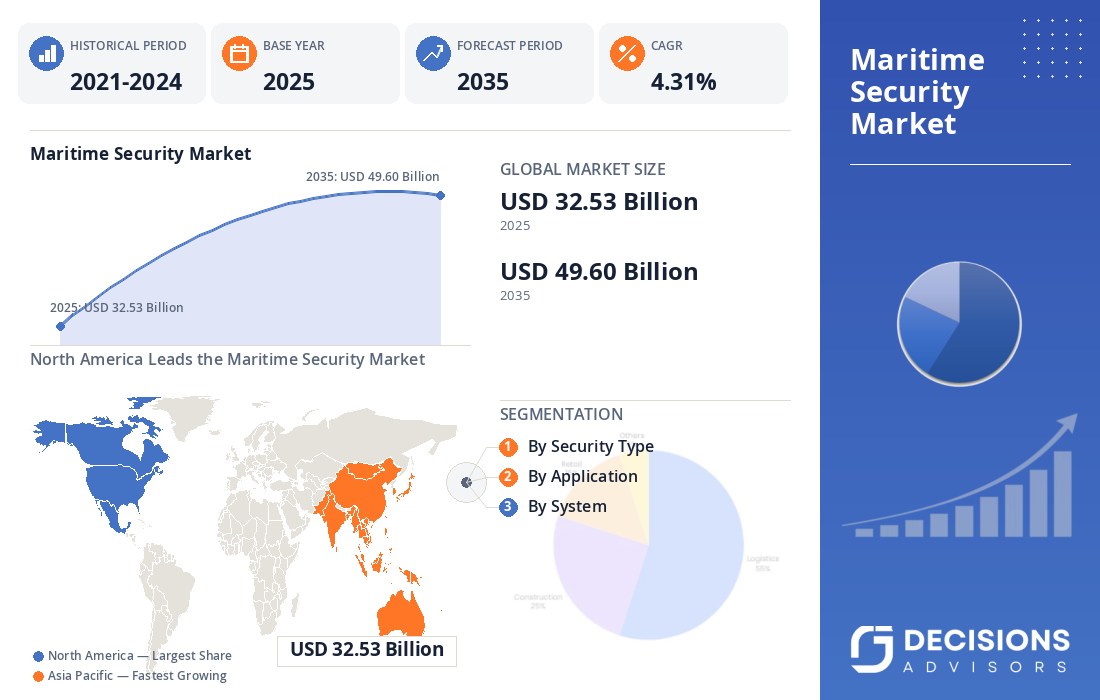
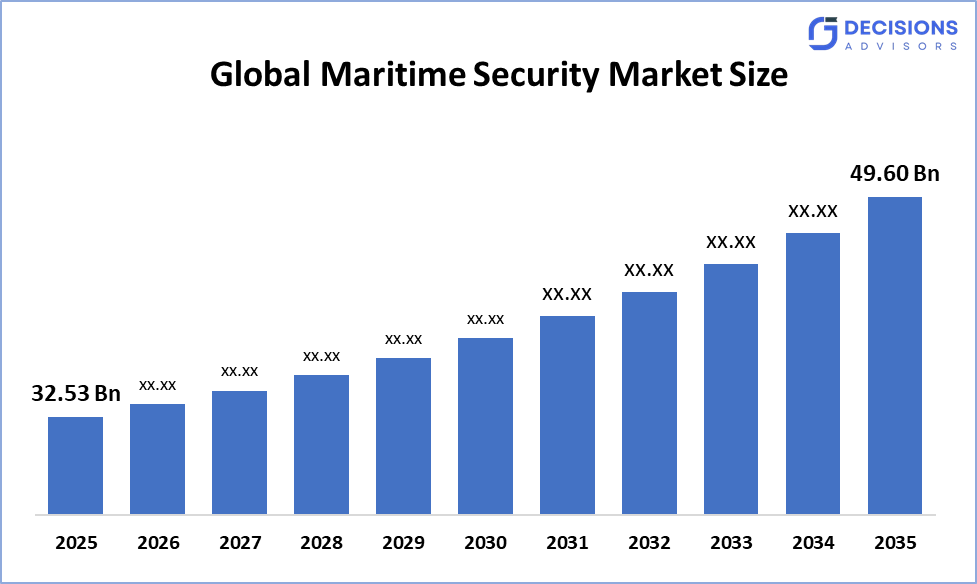
The Global Maritime Security Market Size is predicted to grow from USD 32.53 Billion in 2025 and is likely to reach around USD 49.60 Billion by 2035 with a CAGR of 4.31%. According to Decision Advisors, a detailed research report on the market reflects that the touchless sensing adoption trend dominates the Global Maritime Security Market, accounting for approximately 35% of the total share worldwide. Lockheed Martin remains one of the leading solution providers in the market, supplying advanced sonar, radar, and command-and-control systems for naval and coast guard modernization programs, with approximately USD 71.0 billion in net sales in 2025, making it a key contributor to global market development and growth dynamics.
Market Snapshot
- Global Maritime Security Market Size (2025): USD 32.53 Billion
- Projected Global Maritime Security Market Size (2035): USD 49.60 Billion
- Global Maritime Security Market Compound Annual Growth Rate (CAGR): 4.31%
- Largest Regional Market: North America
- 2nd Largest Region: Europe
- Fastest Growing Region: Asia Pacific
- Base Year: 2025
- Historical Period: 2021-2024
- Market Forecast Period: 2026-2035
Market Overview/ Introduction
The Global Maritime Security Market refers to the industry that develops surveillance, screening, communication, and access-control systems used to protect ports, vessels, offshore installations, and coastal borders from piracy, terrorism, smuggling, and cyberattacks. The market is experiencing substantial growth because of escalating geopolitical tensions across key shipping lanes, rising piracy incidents in high-risk corridors such as the Red Sea and the Strait of Malacca, and the mandatory adoption of the ISPS Code by ports and vessels engaged in international trade. Government programs like the U.S. Port Security Grant Program, Japan's Coast Guard modernization plan, and India's Maritime Security Strategy are creating better conditions for naval capacity building and port infrastructure protection. Key companies, including Lockheed Martin, Thales Group, BAE Systems, Northrop Grumman, and L3Harris Technologies are developing integrated surveillance, radar, and command-and-control solutions that combine wide-area detection with rapid response capability. The market provides customers with products that combine high situational awareness through compact sensor fusion designs which provide long-lasting durability and low false-alarm rates. The global market will experience future expansion through the development of unmanned surface vehicles, AI-enabled threat detection, satellite-linked maritime domain awareness, and offshore energy security solutions.
- The UK government supports the National Shipbuilding Strategy and Royal Navy maritime domain awareness programs through funding and procurement, promoting the adoption of advanced radar and surveillance systems in coastal defense and offshore protection.
- Smart port and maritime domain awareness initiatives in Japan, backed by a record Coast Guard budget, are driving the adoption of advanced surveillance radar and unmanned aerial systems, supporting the development of connected, intelligent coastal security infrastructure.
Notable Insights: -
- North America is anticipated to hold approximately 38% share of the Global Maritime Security Market over the predicted timeframe.
- Asia Pacific is expected to grow at a rapid CAGR in the Global Maritime Security Market by holding approximately 22% of the share during the forecast period.
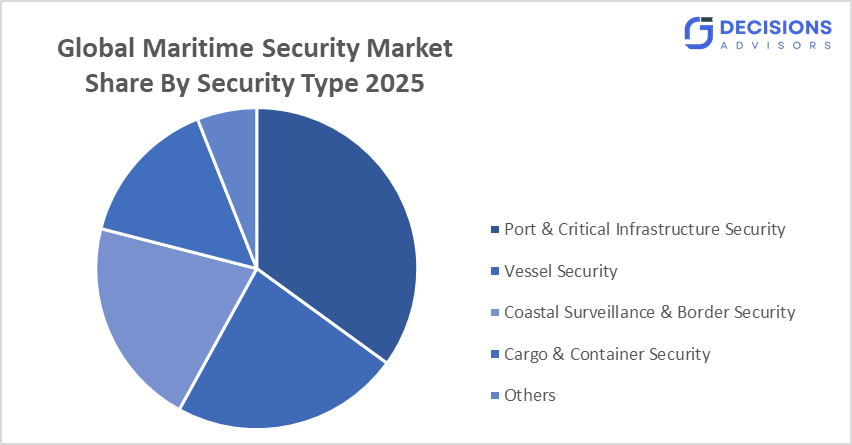
- By security type, the Port & Critical Infrastructure Security segment dominated the market and holds approximately 35% share in 2025 and is projected to grow at a substantial CAGR during the forecast period.
- By application, the Port & Harbor Security segment dominated the market and holds approximately 33% share in 2025 and is projected to grow at a substantial CAGR during the forecast period.
- The compound annual growth rate of the Global Maritime Security Market is 4.31%
- The market is likely to achieve a valuation of USD 49.60 Billion by 2035.
Market Drivers
The Global Maritime Security Market experiences growth because of escalating geopolitical tensions and piracy risks across major shipping corridors, including the Red Sea, the Gulf of Guinea, and the Strait of Malacca. The expansion of global maritime trade and containerized cargo volumes drives increased adoption of surveillance, screening, and cargo-inspection technologies at ports and terminals. Mandatory compliance with the ISPS Code and IMO cybersecurity guidelines drives the adoption of access-control and cyber-hardening solutions across vessels and port facilities. The naval and defense sector shows increasing demand because of rising investment in coast guard modernization, unmanned surface vehicles, and satellite-linked maritime domain awareness. The market expands because the offshore oil & gas sector uses perimeter security and remote monitoring systems to protect deepwater platforms. The global maritime industry moves towards integrated, AI-enabled situational awareness drives manufacturers to implement multi-sensor fusion and real-time threat detection systems.
Restrain
The Global Maritime Security Market faces challenges such as high capital costs associated with naval assets, radar networks, and satellite surveillance infrastructure. Lack of standardized regulatory frameworks across regions and difficulty integrating legacy port systems with new digital and cybersecurity platforms also increase deployment costs and slow adoption.
Competitive Analysis:
The report offers the appropriate analysis of the key organizations/companies involved within the Global Maritime Security Market along with a comparative evaluation primarily based on their product offerings, business overviews, geographic presence, enterprise strategies, segment market share, and SWOT analysis. The report also provides an elaborative analysis focusing on the current news and developments of the companies, which includes product development, innovations, joint ventures, partnerships, mergers & acquisitions, strategic alliances, and others. This allows for the evaluation of the overall competition within the market.
Top Companies in the Global Maritime Security Market
- Lockheed Martin
- Thales Group
- BAE Systems
- Northrop Grumman
- L3Harris Technologies
- General Dynamics
- Leonardo S.p.A.
- Elbit Systems
- Kongsberg Gruppen
- Raytheon Technologies (RTX)
Government Initiatives
|
Country |
Key Government Initiatives |
|
US |
The U.S. Department of Homeland Security, through FEMA's Port Security Grant Program (PSGP), released a USD 95 million Notice of Funding Opportunity for FY2026 to strengthen port-wide risk management and protect critical maritime infrastructure from terrorism and cyber threats. |
|
Japan |
The Japan Coast Guard requested a record fiscal 2026 budget of approximately USD 2.15 billion, a 14% increase, to fund MQ-9B SeaGuardian drones and new large patrol vessels, driving the adoption of advanced maritime surveillance and unmanned monitoring systems. |
|
India |
India's Navy Maritime Security Strategy (INMSS-2026) and the Quad's Indo-Pacific Maritime Surveillance Collaboration are driving investment in coastal radar networks, satellite-linked domain awareness, and coast guard modernization across the Indian Ocean Region. |
Market Segmentation
The Global Maritime Security Market share is classified into security type, system and application
- The Port & Critical Infrastructure Security segment dominated the market and holds approximately 35% share in 2025 and is projected to grow at a substantial CAGR during the forecast period.
Based on security type, the Global Maritime Security Market is divided into Port & Critical Infrastructure Security, Vessel Security, Coastal Surveillance & Border Security, Cargo & Container Security, and Others. Among these, the Port & Critical Infrastructure Security segment dominates the market and holds approximately 35% share in 2025. This dominance is due to its broad scope covering perimeter control, access management, surveillance, and vessel traffic management. These systems are widely used at container terminals, oil and LNG terminals, and multipurpose ports, making them the most preferred choice across critical maritime infrastructure protection globally.
- The Port & Harbor Security segment accounted for the largest share of approximately 33% in 2025 and is anticipated to grow at a significant CAGR during the forecast period.
Based on the application, the market is divided into Port & Harbor Security, Offshore Platform Security, Naval & Defense Operations, Commercial Shipping Security, and Others. Among these, Port & Harbor Security accounted for the largest share and holds approximately 33% share in 2025. This dominance is due to rising containerized trade volumes, mandatory ISPS Code compliance, and continuous investment in terminal access control and screening. Increasing adoption of integrated surveillance and non-intrusive inspection technologies further supports segment growth, making port and harbor security the primary revenue contributor in the Global Maritime Security Market.
- The Surveillance & Tracking Systems segment accounted for the largest share of approximately 31% in 2025 and is anticipated to grow at a significant CAGR during the forecast period.
Based on system, the market is divided into Surveillance & Tracking Systems, Screening & Scanning Systems, Communication Systems, and Access Control & Cybersecurity Solutions. Among these, Surveillance & Tracking Systems, which include radar, AIS, and sonar, dominate the market and hold approximately 31% share in 2025. This dominance is due to their role as the foundational domain picture on which all other maritime security decisions depend. Their high detection range, all-weather reliability, and integration with command-and-control platforms make them essential for modern maritime operations, driving strong global adoption across ports, navies, and commercial fleets.
Regional Segment Analysis of the Global Maritime Security Market
- North America (U.S., Canada, Mexico)?
- Europe (Germany, France, U.K., Italy, Spain, Rest of Europe)
- Asia-Pacific (China, Japan, India, Rest of APAC)
- South America (Brazil and the Rest of South America)?
- The Middle East and Africa (UAE, South Africa, Rest of MEA)
North America accounted for approximately 38% share of the Global Maritime Security Market in 2025 and is projected to grow at a steady CAGR through 2035.
North America accounted for approximately 38% share of the Global Maritime Security Market in 2025, valued at around USD 11.83 billion, and is projected to reach approximately USD 15.32 billion by 2035 at a CAGR of 2.65%. The region benefits from the scale of U.S. federal maritime security programs run by the Coast Guard, the Navy, and the Department of Homeland Security, along with port security grant programs that finance terminal improvements at major oil and container ports. High adoption of radar, AIS, and satellite-linked surveillance systems, along with continuous investment in naval modernization, further strengthens market growth. Canada supports Arctic and Atlantic maritime security through satellite surveillance and NORAD collaboration, while Mexico prioritizes port and coastal security along its Pacific and Gulf terminals.
Asia Pacific is expected to grow at the fastest CAGR in the Global Maritime Security Market, holding approximately 22% of the share during the forecast period
Asia Pacific is expected to grow at the fastest CAGR of approximately 7.25% in the Global Maritime Security Market, expanding from approximately USD 6.83 billion in 2025 to around USD 13.77 billion by 2035. Government and commercial security investment in the region are driven concurrently by territorial disputes in the South China Sea, piracy pressure in the Strait of Malacca, and the scale of Asia's container port infrastructure. Rising defense budgets in Japan, India's coastal security modernization under INMSS-2026, and China's expanding coast guard fleet further support sustained demand across the region.
Europe holds the second-largest share of the Global Maritime Security Market, accounting for approximately 21% during the forecast period.
Europe holds the second-largest share of the Global Maritime Security Market, accounting for approximately 21% in 2025, supported by advanced port infrastructure, strong naval forces, and close cross-border security cooperation. The region benefits from heightened maritime threat awareness following Baltic Sea infrastructure incidents and continued regional tensions, which have accelerated NATO maritime patrols and undersea cable protection efforts. The United Kingdom leads the European market, driven by its strategic maritime position and Royal Navy investment, while Germany, France, and Italy continue to expand port surveillance, coast guard, and offshore energy security programs across the region.
Future Market Trends in Global Maritime Security Market: -
- Expansion of Unmanned Surface and Underwater Vehicles
Unmanned surface vessels, underwater vehicles, and drones are increasingly incorporated into maritime surveillance and patrol operations due to their extended detection coverage, lower personnel cost, and reduced risk profile. They enable continuous monitoring of large maritime zones, improved response times, and innovative patrol designs. Growing demand for cost-effective, persistent maritime domain awareness is accelerating adoption globally.
- ???????AI-Enabled Threat Detection and Situational Awareness
AI integration enhances maritime security by enabling intelligent anomaly detection, automated vessel classification, and context-aware threat prioritization. It improves accuracy, reduces false alerts, and personalizes response protocols across ports, navies, and commercial fleets. This trend is driving more intuitive, responsive, and efficient maritime domain awareness systems worldwide.
- ???????Growth in Port Digitalization and Cybersecurity Integration
Port operators are increasingly integrating cybersecurity solutions with physical access control, vessel traffic management, and cargo-screening systems to enhance operational resilience and reduce vulnerabilities. These integrated platforms offer better durability, faster incident response, and improved regulatory compliance. Rising digitalization of port operations and IMO cybersecurity guidelines are significantly boosting this trend globally.
- ???????Rising Investment in Offshore Energy and Critical Infrastructure Protection
Maritime security systems are widely used to protect offshore oil and gas platforms, subsea pipelines, and undersea cables from sabotage and unauthorized access. Their remote monitoring capability and integration with satellite communication make them ideal for deepwater and remote maritime environments. Growing offshore energy investment is accelerating market expansion globally.
Recent Development
- In May 2026, The Quad nations launched the Indo-Pacific Maritime Surveillance Collaboration to enhance real-time maritime domain awareness across the Indian Ocean region.
- In February 2025, Lockheed Martin received a contract for additional AN/AQS-22 Airborne Low Frequency Sonar systems for the U.S. Navy's MH-60S helicopter fleet, extending maritime surveillance and submarine detection capability in the Indo-Pacific theater.
Market Segment
This study forecasts revenue at global, regional, and country levels from 2020 to 2035. Decision Advisors has segmented the Global Maritime Security Market based on the below-mentioned segments:
Global Maritime Security Market, By Security Type
- Port & Critical Infrastructure Security
- Vessel Security
- Coastal Surveillance & Border Security
- Cargo & Container Security
- Others
Global Maritime Security Market, By Application
- Port & Harbor Security
- Offshore Platform Security
- Naval & Defense Operations
- Commercial Shipping Security
- Others
Global Maritime Security Market, By System
- Surveillance & Tracking Systems (Radar, AIS, Sonar)
- Screening & Scanning Systems (X-ray, Cargo Inspection)
- Communication Systems
- Access Control & Cybersecurity Solutions
Global Maritime Security Market, By Regional Analysis
North America
- US
- Canada
- Mexico
Europe
- Germany
- UK
- France
- Italy
- Spain
- Russia
- Rest of Europe
Asia Pacific
- China
- Japan
- India
- South Korea
- Australia
- Rest of Asia Pacific
South America
- Brazil
- Argentina
- Rest of South America
Middle East & Africa
- UAE
- Saudi Arabia
- Qatar
- South Africa
- Rest of the Middle East & Africa
Frequently Asked Questions (FAQ)
Q. How is maritime security technology improving port and vessel protection?
A. Maritime security systems enable faster threat detection, streamlined access control, and highly accurate vessel tracking, allowing port operators to design layered perimeter defenses, automated screening, and fully integrated command-and-control centers with improved response times and regulatory compliance.
Q. Why are integrated surveillance systems preferred over standalone security equipment?
A. They offer higher situational awareness, multi-sensor fusion, longer operational uptime, and better data correlation, making them more suitable for modern ports, navies, and commercial fleets operating in high-risk maritime corridors.
Q. What role does maritime security play in offshore energy protection?
A. It helps detect unauthorized vessel approaches, monitor subsea infrastructure, and enable rapid incident response, reducing sabotage risk and downtime for offshore oil, gas, and renewable energy installations.
Q. How are government initiatives influencing maritime security market growth?
A. Increased defense and coast guard budgets, port security grant programs, and multilateral maritime surveillance collaborations are enabling more advanced, interoperable, and rapidly deployable maritime security solutions across commercial and government end-users.
Check Licence
Choose the plan that fits you best: Single User, Multi-User, or Enterprise solutions tailored for your needs.
We Have You Covered
- 24/7 Analyst Support
- Clients Across the Globe
- Tailored Insights
- Technology Tracking
- Competitive Intelligence
- Custom Research
- Syndicated Market Studies
- Market Overview
- Market Segmentation
- Growth Drivers
- Market Opportunities
- Regulatory Insights
- Innovation & Sustainability
Report Details
| Scope | Global |
| Pages | 230 |
| Delivery | PDF & Excel via Email |
| Language | English |
| Release | Aug 2026 |
| Access | Download from this page |