
Global Mass Notification Systems Market
 |
Author:
Piya P
|
Pages:
190
|
Author:
Piya P
|
Pages:
190
Global Mass Notification Systems Market Size, Share By Application (Emergency Response, Business Continuity & Disaster Recovery, Public Safety, Infrastructure Security, Weather Alerts & Critical Event Management), By Deployment Mode (On-Premise, Cloud-Based, and Hybrid), By End-Use (Government, Education, Healthcare, Industrial, Commercial, Transportation & Logistics, and Energy & Utilities), and By Region (North America, Europe, Asia-Pacific, Latin America, Middle East & Africa), Analysis and Forecast 2026-2035
CAGR
9.4%
REVENUE 2025
USD Billion 17.43
FORECAST 2035
USD Billion 42.86
REPORT COVERAGE
Global
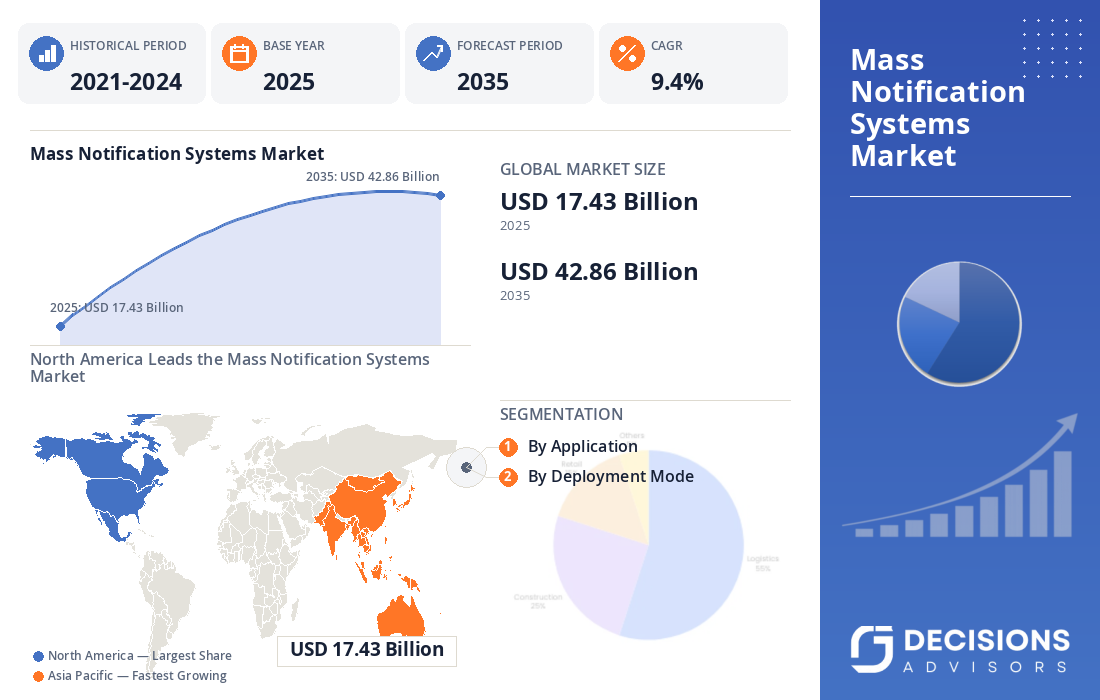
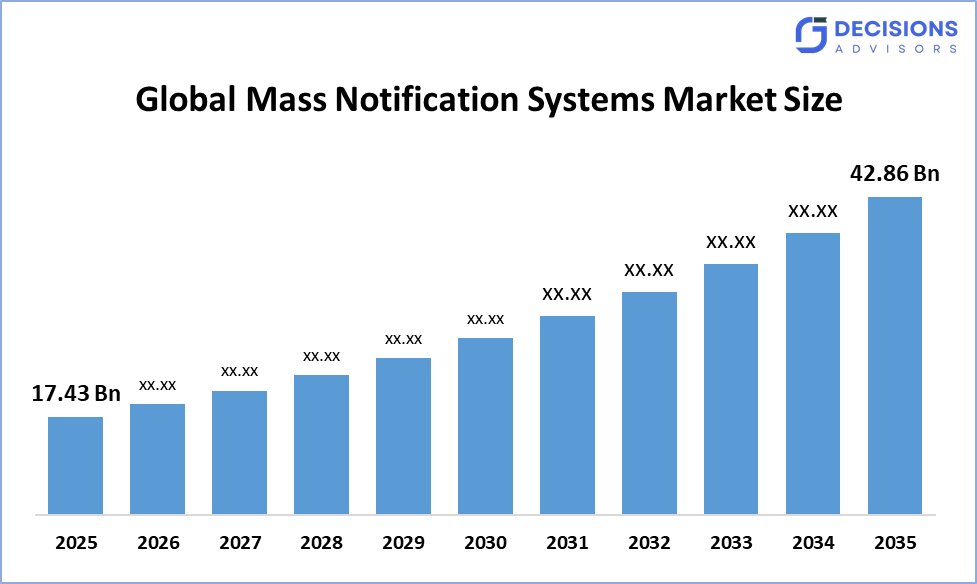
The Global Mass Notification Systems Market Size is predicted to grow from USD 17.43 Billion in 2025 and is likely to reach around USD 42.86 Billion by 2035 with a CAGR of 9.4%. According to Decision Advisors, the market is experiencing strong expansion as governments, enterprises, educational institutions, healthcare organizations, transportation operators, and critical infrastructure providers increasingly require rapid, reliable, and multi-channel communication during emergencies and operational disruptions. Emergency response represents the leading application area, while cloud-based platforms are gaining significant adoption because they provide centralized control, scalability, remote accessibility, and integration with multiple communication channels.
Market Snapshot
- Global Mass Notification Systems Market Size (2025): USD 17.43 Billion
- Projected Global Mass Notification Systems Market Size (2035): USD 42.86 Billion
- Global Mass Notification Systems Market Compound Annual Growth Rate (CAGR): 9.4%
- Largest Regional Market: North America
- 2nd Largest Region: Europe
- Fastest Growing Region: Asia-Pacific
- Base Year: 2025
- Historical Period: 2021-2024
- Market Forecast Period: 2026-2035.
Market Overview/ Introduction
The Global Mass Notification Systems Market comprises software, hardware, communication platforms, and services designed to deliver urgent or critical information to large populations through multiple channels. Modern mass notification systems can integrate SMS, voice, email, mobile applications, desktop notifications, digital signage, public-address systems, sirens, and other communication infrastructure. Adoption is increasing as organizations place greater emphasis on emergency preparedness, employee and public safety, business continuity, disaster recovery, and protection of critical infrastructure. The market is also benefiting from rapid digitalization and the transition from isolated notification systems toward cloud-connected, intelligent communication platforms.
- United States, FEMA's Integrated Public Alert and Warning System and Wireless Emergency Alerts support nationwide emergency communication and provide infrastructure for distributing alerts through participating wireless providers.
- Japan, The J-ALERT system enables rapid dissemination of high-priority information, including earthquake, tsunami, and missile-related warnings, to local authorities and public facilities.
- China, Emergency-management modernization and smart-city initiatives are encouraging investment in coordinated disaster-warning, communication, and response infrastructure.
Notable Insights: -
- North America is anticipated to hold approximately 39% share of the Global Mass Notification Systems Market over the predicted timeframe.
- Asia-Pacific is expected to be the fastest-growing region, holding approximately 24% share during the forecast period.
- By Application, the Emergency Response segment dominated the market and holds approximately 34% share in 2025 and is projected to grow at a substantial CAGR during the forecast period.
- By Deployment Mode, the Cloud-Based segment dominated the market and holds approximately 48% share in 2025 and is projected to grow at a substantial CAGR during the forecast period.
- By End-Use, the Government segment dominated the market and holds approximately 29% share in 2025 and is projected to grow at a substantial CAGR during the forecast period.
- The compound annual growth rate of the Global Mass Notification Systems Market is 9.4%.
- The market is likely to achieve a valuation of USD 42.86 Billion by 2035.
Market Drivers
The Global Mass Notification Systems Market is driven by increasing requirements for rapid communication during natural disasters, fires, security incidents, severe weather events, cyberattacks, workplace emergencies, and operational disruptions. Government agencies and enterprises are increasingly recognizing that conventional communication methods are insufficient for reaching large populations quickly. Mass notification platforms provide centralized communication capabilities that can simultaneously reach employees, students, patients, residents, travelers, emergency personnel, and other affected groups. The increasing adoption of cloud computing, mobile communications, artificial intelligence, IoT, geolocation, and analytics is further supporting market growth. Organizations can automate notification workflows, identify affected geographic areas, prioritize emergency messages, and communicate through several channels simultaneously. Growing investment in smart cities, critical infrastructure, healthcare facilities, industrial plants, airports, universities, and transportation networks is creating additional demand for integrated emergency communication solutions.
Restrain
The Global Mass Notification Systems Market faces challenges associated with deployment costs, integration complexity, cybersecurity, interoperability, and system reliability. Large organizations often operate legacy public-address systems, access-control infrastructure, fire alarms, databases, and communication platforms that must be integrated with newer cloud-based notification systems. This can increase installation, customization, testing, training, and maintenance expenses.
Competitive Analysis:
The report offers the appropriate analysis of the key organizations/companies involved within the global mass notification systems market, along with a comparative evaluation primarily based on their product offerings, business overviews, geographic presence, enterprise strategies, segment market share, and SWOT analysis. The report also provides an elaborative analysis focusing on the current news and developments of the companies, which includes product development, innovations, joint ventures, partnerships, mergers & acquisitions, strategic alliances, and others. This allows for the evaluation of the overall competition within the market.
Top Companies in the Global Mass Notification Systems Market
- Motorola Solutions, Inc.
- Everbridge, Inc.
- Honeywell International Inc.
- Siemens AG
- Eaton Corporation plc
- AlertMedia, Inc.
- Singlewire Software, LLC
- OnSolve, LLC
- NEC Corporation
- Johnson Controls International plc.
Government Initiatives
|
Country |
Key Government Initiatives |
|
United States |
FEMA's Integrated Public Alert and Warning System and Wireless Emergency Alerts support emergency communication through participating wireless providers and strengthen nationwide public-warning capabilities |
|
Japan |
J-ALERT enables rapid dissemination of high-priority warnings, including earthquake, tsunami, and missile information, to local authorities and public facilities |
|
China |
Emergency-management modernization programs support disaster prevention, mitigation, response, and coordinated emergency communication infrastructure |
Market Segmentation
The Global Mass Notification Systems Market share is classified into Application, Deployment Mode and End-Use.
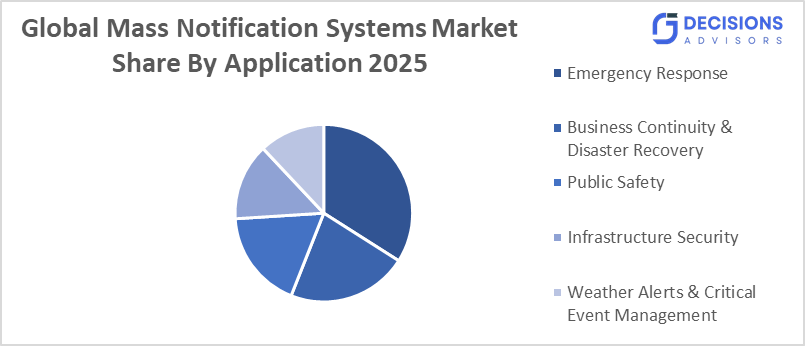
- The Emergency Response segment dominated the market and holds approximately 34% share in 2025 and is projected to grow at a substantial CAGR during the forecast period.
Based on Application, the Global Mass Notification Systems Market is divided into Emergency Response, Business Continuity & Disaster Recovery, Public Safety, Infrastructure Security, and Weather Alerts & Critical Event Management. Emergency Response accounts for the largest share because rapid communication is essential during fires, severe weather, security threats, industrial accidents, and other emergencies. Organizations increasingly require automated notification workflows capable of delivering instructions to specific groups or geographic areas. Integration with incident-management and emergency-response systems is further supporting segment expansion.
- The Cloud-Based segment accounted for the largest share of approximately 48% in 2025 and is anticipated to grow at a significant CAGR during the forecast period.
Based on Deployment Mode, the market is divided into On-Premise, Cloud-Based, and Hybrid. Cloud-based platforms are gaining preference because they provide centralized management, remote access, scalability, automatic software updates, and easier integration with mobile and enterprise applications. They are particularly attractive for organizations operating multiple facilities or geographically dispersed workforces. Hybrid deployment will continue to maintain demand among organizations requiring local infrastructure and greater control over sensitive systems.
- The Government segment accounted for the largest share of approximately 29% in 2025 and is anticipated to grow at a significant CAGR during the forecast period.
Based on End-Use, the market is divided into Government, Education, Healthcare, Industrial, Commercial, Transportation & Logistics, and Energy & Utilities. Government organizations use mass notification systems for public warnings, civil defense, disaster response, emergency coordination, and critical infrastructure protection. Growing exposure to severe weather and other emergencies is encouraging governments to modernize their communication infrastructure. Integration with national and regional warning systems is expected to support continued demand.
Regional Segment Analysis of the Global Mass Notification Systems Market
- North America (U.S., Canada, Mexico)?
- Europe (Germany, U.K., France, Italy, Spain, Netherlands, Rest of Europe).
- Asia-Pacific (China, Japan, India, Australia, South Korea, Rest of Asia-Pacific).
- South America (Brazil, Argentina, Rest of South America).
- Middle East & Africa (UAE, Saudi Arabia, South Africa, Rest of MEA).
North America is anticipated to hold approximately 39% share of the Global Mass Notification Systems Market over the predicted timeframe.
North America remains the largest regional market due to strong demand from government agencies, educational institutions, healthcare organizations, enterprises, and critical infrastructure operators. The United States represents the principal contributor because of its mature emergency-management infrastructure and high adoption of cloud-based communication technologies. Wireless Emergency Alerts, enterprise emergency communication programs, workplace safety requirements, and investments in public-safety technologies continue to support adoption. Canada is also generating demand through emergency preparedness and disaster-response requirements, including responses to wildfires and severe weather.
Asia-Pacific is expected to grow at the fastest CAGR in the Global Mass Notification Systems Market, holding approximately 24% of the share during the forecast period.
China, Japan, India, South Korea, and Australia are major contributors to regional growth. Rapid urbanization, smart-city development, expanding transportation infrastructure, disaster preparedness, and increasing digital connectivity are creating significant opportunities. Japan's J-ALERT demonstrates the importance of integrated public-warning systems, while China is investing in emergency-management modernization. India represents an important emerging market because of its large population, expanding smart-city programs, digital infrastructure, industrial development, and increasing requirements for disaster communication.
Europe is expected to hold approximately 25% share of the Global Mass Notification Systems Market during the forecast period.
The region benefits from strong public-safety standards, critical infrastructure investment, cybersecurity requirements, and increasing demand for business continuity solutions. Germany, the U.K., France, Italy, and Spain represent important markets. Organizations are increasingly integrating notification platforms with security, building management, emergency response, and enterprise continuity systems. Severe weather events and the need to strengthen resilience across energy, transportation, healthcare, and public infrastructure are also supporting demand.
Future Market Trends in Global Mass Notification Systems Market: -
-
- AI-Enabled Emergency Communication.
Artificial intelligence is expected to become increasingly important in mass notification systems. AI can analyze information from security systems, weather feeds, threat intelligence, IoT devices, and incident-management platforms to identify potential emergencies and support faster response.
-
- Expansion of Cloud-Based Platforms.
Cloud deployment will remain a major growth trend as organizations seek scalable and remotely accessible notification platforms. Cloud architecture allows administrators to manage communication workflows, contact databases, templates, user permissions, and analytics from centralized environments.
-
- Integration with Critical Event Management.
Mass notification is increasingly becoming part of broader critical-event-management platforms. Integration with physical security, cybersecurity, business continuity, emergency management, access control, video surveillance, and threat intelligence allows organizations to coordinate the complete incident lifecycle rather than simply sending an alert.
-
- Location-Based and Multi-Channel Alerts.
Geolocation-based communication will become increasingly important for targeted emergency messaging. Organizations can identify affected employees, customers, students, travelers, or residents and send geographically relevant instructions.
Recent Development
- In July 2025, AlertMedia partnered with Riskonnect to integrate emergency communication capabilities into Riskonnect's Business Continuity & Resilience platform, connecting emergency notification with broader continuity workflows.
- In April 2025, AlertMedia acquired Pyrra Technologies to strengthen its risk-intelligence and employee-safety capabilities through AI-powered social intelligence.
- In June 2025, Motorola Solutions expanded its safety and security technology deployment at Northwell Health, integrating technologies including mass notification, communications, video security, analytics, and panic-button capabilities.
Market Segment
This study forecasts revenue at global, regional, and country levels from 2021 to 2035. Decision Advisors has segmented the global mass notification systems market based on the below-mentioned segment:
Global Mass Notification Systems Market, By Application.
- Emergency Response
- Business Continuity & Disaster Recovery
- Public Safety
- Infrastructure Security
- Weather Alerts & Critical Event Management.
Global Mass Notification Systems Market, By Deployment Mode.
- On-Premise
- Cloud-Based
- Hybrid.
Global Mass Notification Systems Market, By End-Use.
- Government
- Education
- Healthcare
- Industrial
- Commercial
- Transportation & Logistics
- Energy & Utilities.
Global Mass Notification Systems Market, By Regional Analysis.
- North America
- US
- Canada
- Mexico
- Europe
- Germany
- UK
- France
- Italy
- Spain
- Russia
- Rest of Europe
- Asia Pacific
- China
- Japan
- India
- South Korea
- Australia
- Rest of Asia Pacific
- South America
- Brazil
- Argentina
- Rest of South America
- Middle East & Africa
- UAE
- Saudi Arabia
- Qatar
- South Africa
- Rest of the Middle East & Africa
Frequently Asked Questions (FAQ)
Q. What are the major factors driving the Global Mass Notification Systems Market?
A. Increasing requirements for emergency preparedness, public safety, business continuity, disaster recovery, and critical infrastructure protection are major market drivers. The adoption of cloud computing, mobile communications, geolocation, IoT, and AI is further increasing the capabilities and value of modern mass notification systems.
Q. Why are cloud-based mass notification systems gaining adoption?
A. Cloud-based systems provide centralized administration, scalability, remote accessibility, and easier integration with enterprise and mobile applications. They are particularly useful for organizations with geographically distributed facilities because administrators can manage emergency communications through a unified platform.
Q. Which end-use sector represents the largest opportunity for mass notification systems?
A. Government is expected to remain the leading end-use sector because government agencies require mass notification for public warnings, disaster response, civil defense, emergency coordination, and critical infrastructure protection.
Q. How is AI changing mass notification systems?
A. AI is enabling systems to analyze threat information, prioritize incidents, automate workflows, identify affected populations, and support more context-specific communications. Over time, AI is expected to help MNS platforms evolve from basic alerting systems into intelligent critical-event-management solutions.
Check Licence
Choose the plan that fits you best: Single User, Multi-User, or Enterprise solutions tailored for your needs.
We Have You Covered
- 24/7 Analyst Support
- Clients Across the Globe
- Tailored Insights
- Technology Tracking
- Competitive Intelligence
- Custom Research
- Syndicated Market Studies
- Market Overview
- Market Segmentation
- Growth Drivers
- Market Opportunities
- Regulatory Insights
- Innovation & Sustainability
Report Details
| Scope | Global |
| Pages | 190 |
| Delivery | PDF & Excel via Email |
| Language | English |
| Release | Aug 2026 |
| Access | Download from this page |