
Global Mechanical Control Cables Market
 |
Author:
Sanket C
|
Pages:
200
|
Author:
Sanket C
|
Pages:
200
Global Mechanical Control Cables Market Size, Share By Cable Type (Push-Pull Cables and Pull-Only Cables), By Application (Automotive, Aerospace & Defense, Marine, Industrial Machinery, and Construction & Agricultural Equipment), By Material (Steel, Stainless Steel, Aluminum, and Plastic & Composite), and By Region (North America, Europe, Asia-Pacific, Latin America, Middle East & Africa), Analysis and Forecast 2026-2035
CAGR
6.2%
REVENUE 2025
USD Billion 15.3
FORECAST 2035
USD Billion 28.0
REPORT COVERAGE
Global
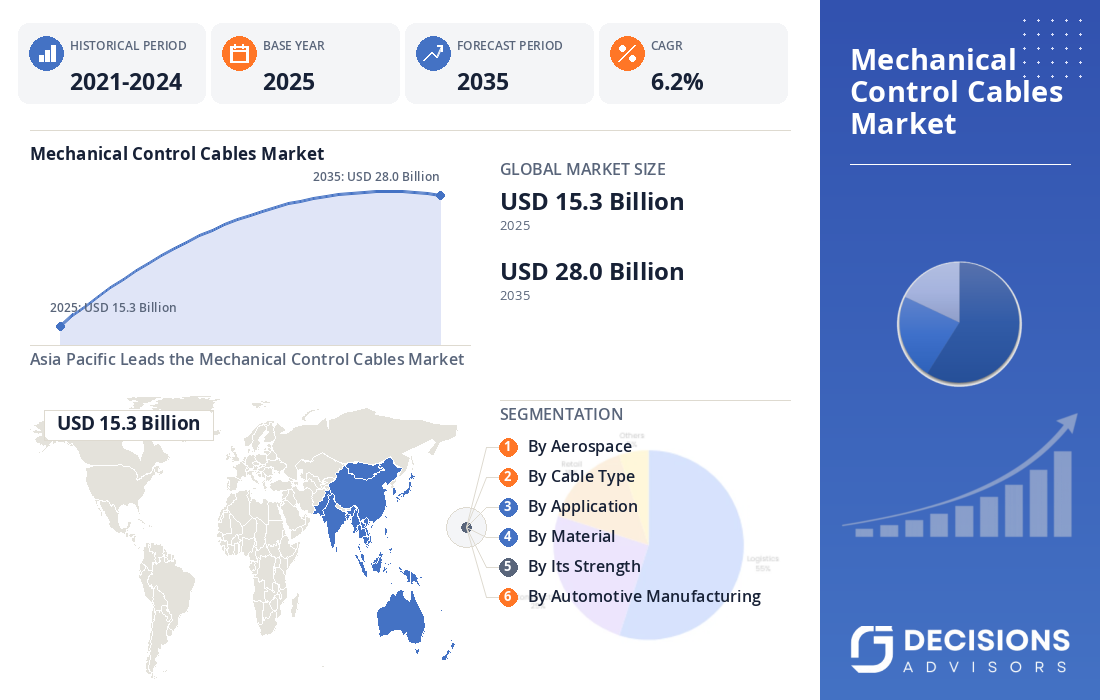
The Global Mechanical Control Cables Market Size is predicted to grow from USD 15.3 Billion in 2025 and is likely to reach around USD 28.0 Billion by 2035 with a CAGR of 6.2%. According to Decision Advisors, the market is supported by the continued requirement for reliable mechanical force transmission in automotive, aerospace, marine, construction, agricultural, and industrial equipment. Automotive applications represent the largest demand center, while Asia-Pacific remains the most important manufacturing region because of its extensive vehicle-production base, industrial machinery ecosystem, and expanding component supply chains. Current industry research similarly identifies automotive applications and Asia-Pacific manufacturing as major market drivers.
Market Snapshot
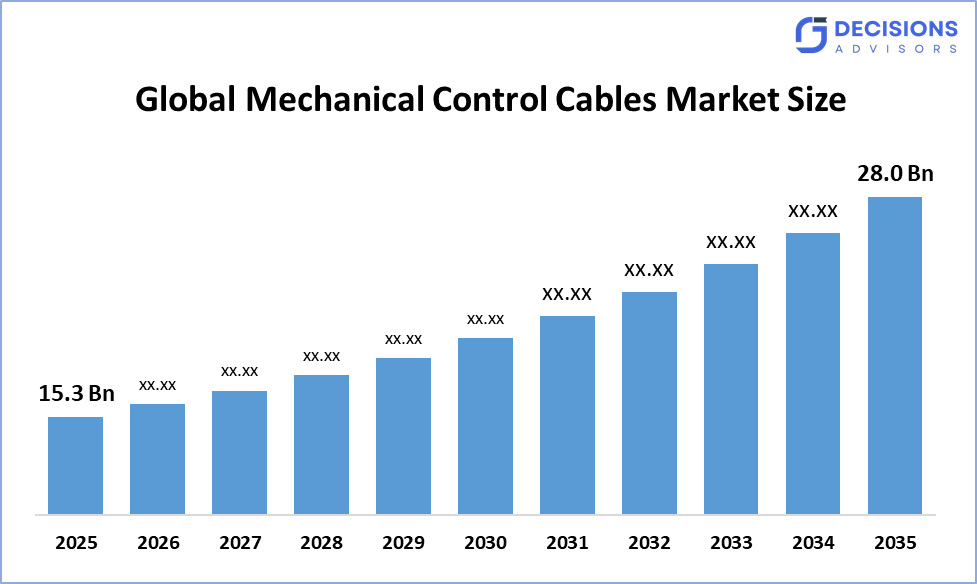
- Global Mechanical Control Cables Market Size (2025): USD 15.3 Billion
- Projected Global Mechanical Control Cables Market Size (2035): USD 28.0 Billion
- Global Mechanical Control Cables Market Compound Annual Growth Rate (CAGR): 6.2%
- Largest Regional Market: Asia-Pacific
- 2nd Largest Region: North America
- Fastest Growing Region: Asia-Pacific
- Base Year: 2025
- Historical Period: 2021-2024
- Market Forecast Period: 2026-2035.
Market Overview/ Introduction
The Global Mechanical Control Cables Market comprises cable-based mechanical transmission systems that transfer force and movement between a control input and a remotely positioned mechanical component. These systems include push-pull and pull-only configurations and are used for gear shifting, throttle operation, braking, transmission control, hood and trunk release, seat adjustment, door mechanisms, marine controls, and industrial equipment. HI-LEX, for example, describes push-pull cables as systems capable of transmitting force and displacement in both directions, while its pull cables transmit force in the pull direction. Demand continues to benefit from global vehicle production, increasing use of commercial and off-highway equipment, industrial machinery expansion, and replacement requirements from the installed vehicle and equipment base. Mechanical cables remain attractive because they provide dependable force transmission, relatively simple construction, serviceability, and application flexibility.
- India, Increasing automotive manufacturing and localization of component production are strengthening the country's role in the control-cable supply chain. Kongsberg Automotive's Faridabad facility, opened in April 2025, manufactures cable gearshift systems, transmission cables and related drive-control products and has a reported localization level of nearly 85%.
- Japan, Japan remains a major engineering and manufacturing center for automotive cable systems. HI-LEX reports a dominant position in Japanese automotive products and offers push-pull, pull and specialized cable systems.
- Asia-Pacific, China, India, Japan, South Korea and Southeast Asia benefit from large automotive production volumes and expanding industrial and transportation infrastructure. Industry research identifies Asia-Pacific as the leading and fastest-growing region for mechanical control cables.
Notable Insights: -
- Asia-Pacific is anticipated to hold approximately 38% share of the Global Mechanical Control Cables Market over the predicted timeframe.
- North America is expected to hold approximately 27% share during the forecast period, supported by aerospace, defense, automotive, industrial and aftermarket applications.
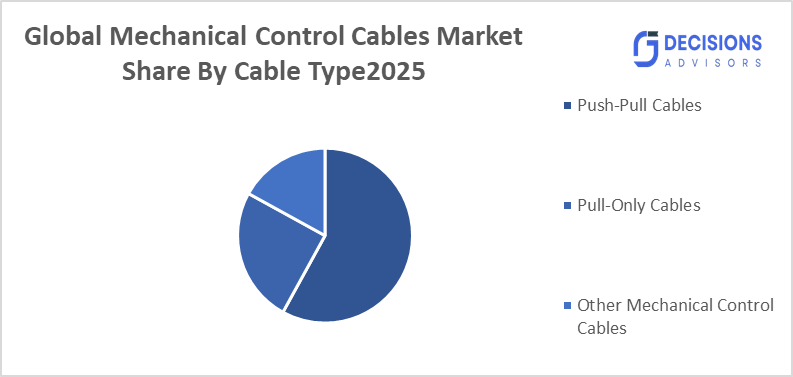
- By Cable Type, the Push-Pull Cables segment dominated the market and holds approximately 58% share in 2025 and is projected to grow at a substantial CAGR during the forecast period.
- By Application, the Automotive segment dominated the market and holds approximately 54% share in 2025 and is projected to grow at a substantial CAGR during the forecast period.
- By Material, Steel accounted for approximately 52% share in 2025, supported by its strength, durability and broad use in demanding mechanical applications.
- The compound annual growth rate of the Global Mechanical Control Cables Market is 6.2%.
- The market is likely to achieve a valuation of USD 28.0 Billion by 2035.
Market Drivers
The expansion of global vehicle manufacturing remains the primary driver of mechanical control cable demand. Passenger cars, light commercial vehicles, heavy commercial vehicles, two-wheelers, agricultural vehicles and off-highway machinery use cable assemblies for numerous mechanical-control functions. The replacement market provides an additional source of recurring demand because cables are exposed to friction, bending, temperature changes, vibration and repeated operating cycles. Industry research specifically identifies continued vehicle production, aftermarket demand and the selective retention of cables in both internal-combustion and electric vehicles as important demand factors. Industrial machinery, construction equipment and agricultural equipment provide another important growth avenue. Control cables enable operators to remotely actuate transmissions, throttles, valves, brakes and other components without requiring complex electronic architecture. Expansion of construction activity, agricultural mechanization, material-handling equipment and industrial automation therefore creates demand for high-cycle and heavy-duty cable assemblies.
Restrain
The primary restraint is substitution by electronic and electromechanical actuation. Increasing adoption of drive-by-wire, shift-by-wire and electronically controlled vehicle architectures can reduce the number of conventional mechanical cables required in certain applications. This creates pressure on cable manufacturers to diversify toward hybrid mechanical-electronic systems and specialized high-value applications.
Competitive Analysis:
The report offers the appropriate analysis of the key organizations/companies involved within the global mechanical control cables market, along with a comparative evaluation primarily based on their product offerings, business overviews, geographic presence, enterprise strategies, segment market share, and SWOT analysis. The report also provides an elaborative analysis focusing on the current news and developments of the companies, which includes product development, innovations, joint ventures, partnerships, mergers & acquisitions, strategic alliances, and others. This allows for the evaluation of the overall competition within the market.
Top Companies in the Global Mechanical Control Cables Market
- HI-LEX Corporation
- Suprajit Engineering Limited
- Kongsberg Automotive ASA
- DURA Automotive Systems
- KÜSTER Group
- Cablecraft Motion Controls
- Crane Aerospace & Electronics
- Orscheln Products
- Parker Hannifin Corporation
- TE Connectivity.
Government Initiatives
|
Country |
Key Government Initiatives |
|
United States |
Automotive manufacturing, infrastructure investment, aerospace and defense procurement, and industrial modernization programs support demand for transportation and industrial components, including mechanical control systems |
|
Japan |
Automotive technology, manufacturing modernization, safety and mobility initiatives support continued development of precision vehicle components and control systems |
|
China |
Intelligent manufacturing, automotive industrial development and supply-chain localization policies support domestic production of automotive and industrial components |
Market Segmentation
The Global Mechanical Control Cables Market share is classified into Cable Type, Application and Material.
- The Push-Pull Cables segment dominated the market and holds approximately 58% share in 2025 and is projected to grow at a substantial CAGR during the forecast period.
Based on Cable Type, the Global Mechanical Control Cables Market is divided into Push-Pull Cables and Pull-Only Cables. Among these, Push-Pull Cables dominate the market and hold approximately 58% share in 2025. Their ability to transmit force in both directions makes them suitable for gear shifting, throttle operation, transmission control, industrial machinery and other applications. Their versatility also allows manufacturers to use a single cable architecture for applications requiring controlled movement in both directions. HI-LEX identifies push-pull cables as a core product capable of transmitting force and displacement in both directions with high accuracy and durability.
- The Automotive segment accounted for the largest share of approximately 54% in 2025 and is anticipated to grow at a significant CAGR during the forecast period.
Based on Application, the market is divided into Automotive, Aerospace & Defense, Marine, Industrial Machinery, and Construction & Agricultural Equipment. Among these, Automotive accounted for the largest share and holds approximately 54% share in 2025. High global vehicle production creates substantial OEM demand, while the installed vehicle base supports replacement and aftermarket requirements. Control cables continue to be used across vehicle body, transmission, braking, seating, release and auxiliary mechanisms. Industry research also identifies automotive as the dominant application segment.
- The Steel segment accounted for the largest share of approximately 52% in 2025 and is anticipated to grow at a significant CAGR during the forecast period.
Based on Material, the market is divided into Steel, Stainless Steel, Aluminum, Plastic & Composite. Steel dominates because it combines high tensile strength, fatigue resistance, cost effectiveness and durability. It is particularly suitable for applications exposed to repeated tensile and bending loads. Nevertheless, stainless steel, aluminum, engineered plastics and composite materials are gaining importance where corrosion resistance and weight reduction are prioritized.
Regional Segment Analysis of the Global Mechanical Control Cables Market
- North America (U.S., Canada, Mexico)?
- Europe (Germany, U.K., France, Italy, Spain, Netherlands, Rest of Europe).
- Asia-Pacific (China, Japan, India, Australia, South Korea, Rest of Asia-Pacific).
- South America (Brazil, Argentina, Rest of South America).
- Middle East & Africa (UAE, Saudi Arabia, South Africa, Rest of MEA).
Asia Pacific is anticipated to hold approximately 38% share of the Global Mechanical Control Cables Market over the predicted timeframe.
Asia Pacific represents the largest regional market because of its extensive automotive manufacturing ecosystem, large two-wheeler and commercial-vehicle production, industrial machinery base and expanding construction-equipment sector. China, Japan, India and South Korea remain major contributors, while Southeast Asian markets such as Thailand and Indonesia provide additional automotive manufacturing opportunities. Current industry research specifically identifies Asia-Pacific as the leading region and indicates that vehicle production and regional supply chains are major drivers.
North America is expected to grow at a rapid CAGR in the Global Mechanical Control Cables Market, holding approximately 27% of the share during the forecast period.
The region benefits from a mature automotive aftermarket, aerospace and defense manufacturing, industrial machinery, agricultural equipment and construction applications. Demand for specialized cable assemblies is supported by requirements for reliability, durability and application-specific engineering. Aerospace and defense applications are particularly attractive because they require high-performance mechanical actuation systems and stringent qualification standards.
Europe is expected to remain a significant regional market, holding approximately 21% share during the forecast period.
European demand is supported by automotive manufacturing, commercial vehicles, industrial machinery, agriculture, marine equipment and specialized transportation systems. The region's emphasis on vehicle efficiency and lightweight engineering is encouraging suppliers to develop lower-friction and lighter cable systems. European OEMs also maintain strong requirements for product quality, traceability and long operating life.
Future Market Trends in Global Mechanical Control Cables Market: -
-
- Lightweight and Low-Friction Cable Systems.
Manufacturers are focusing on cable assemblies with reduced friction, lower mass and improved operating efficiency. Lightweight materials and optimized cable routing can reduce mechanical losses and improve operating feel.
-
- Hybrid Mechanical-Electronic Actuation.
Mechanical cables are increasingly being combined with electronic sensors, actuators and control systems. Hybrid architectures can retain the reliability and fail-safe characteristics of mechanical transmission while adding electronic control and monitoring capabilities.
-
- EV-Compatible Mechanical Cable Applications.
EV adoption is changing the mix of cable applications rather than eliminating mechanical cables completely. Emergency-release, door, seating, parking-brake and other auxiliary mechanisms continue to provide opportunities.
-
- Smart Monitoring and Predictive Maintenance.
IoT-enabled equipment is creating opportunities to monitor operating conditions and predict maintenance requirements. Although conventional cables remain passive components, intelligent equipment architectures can use sensors and operating data to identify abnormal force, travel or wear patterns.
Recent Development
- In April 2025, Kongsberg Automotive inaugurated its new 6,947-square-meter facility in Faridabad, India, strengthening its manufacturing capabilities for drive-control products, including cable gear shifters, transmission cables, gear shifters, shift towers, and related systems.
- In April 2025, Suprajit Engineering completed the second tranche of its Stahlschmidt Cable Systems (SCS) acquisition, adding SCS operations in China and Canada and expanding its global control-cable manufacturing footprint. The transaction added approximately €15 million in annual revenue to Suprajit's business
- In May 2025, Remsons Industries secured a contract worth more than INR 300 crore from Stellantis North America for the supply of automotive control cables, with the agreement covering a seven-year period and deliveries scheduled to begin from the following financial year.
Market Segment
This study forecasts revenue at global, regional, and country levels from 2021 to 2035. Decision Advisors has segmented the Global Mechanical Control Cables Market t based on the below-mentioned segment:
Global Mechanical Control Cables Market, By Cable Type.
- Push-Pull Cables
- Pull-Only Cables
- Others.
Global Mechanical Control Cables Market, By Application.
- Automotive
- Aerospace & Defense
- Marine
- Industrial Machinery
- Construction & Agricultural Equipment.
Global Mechanical Control Cables Market, By Material.
- Steel
- Stainless Steel
- Aluminum
- Plastic & Composite.
Global Mechanical Control Cables Market, By Regional Analysis.
- North America
- US
- Canada
- Mexico
- Europe
- Germany
- UK
- France
- Italy
- Spain
- Russia
- Rest of Europe
- Asia Pacific
- China
- Japan
- India
- South Korea
- Australia
- Rest of Asia Pacific
- South America
- Brazil
- Argentina
- Rest of South America
- Middle East & Africa
- UAE
- Saudi Arabia
- Qatar
- South Africa
- Rest of the Middle East & Africa
Frequently Asked Questions (FAQ)
Q. What are mechanical control cables used for?
A. Mechanical control cables transfer force and movement between an operator control and a remotely located mechanism. Typical applications include gear shifting, throttle control, braking, transmission, hood and trunk release, seating, doors, marine controls and industrial machinery.
Q. Why are mechanical control cables still used as vehicles become electrified?
A. Electrification eliminates some traditional powertrain cable applications but does not eliminate mechanical actuation entirely. EVs can still use cables for emergency release, doors, seats, parking-brake mechanisms and other auxiliary functions. HI-LEX specifically identifies cable-operated emergency unlocking as an application that remains functional even when vehicle power is unavailable.
Q. Which cable type dominates the Global Mechanical Control Cables Market?
A. Push-pull cables represent the leading cable-type segment because they can transmit force and displacement in both directions. This makes them suitable for gear shifting, transmission, throttle and various industrial control applications.
Q. Which application represents the largest demand for mechanical control cables?
A. Automotive represents the largest application because control cables are extensively used across passenger cars, commercial vehicles, two-wheelers and off-highway equipment. Both OEM installation and aftermarket replacement contribute to demand.
Check Licence
Choose the plan that fits you best: Single User, Multi-User, or Enterprise solutions tailored for your needs.
We Have You Covered
- 24/7 Analyst Support
- Clients Across the Globe
- Tailored Insights
- Technology Tracking
- Competitive Intelligence
- Custom Research
- Syndicated Market Studies
- Market Overview
- Market Segmentation
- Growth Drivers
- Market Opportunities
- Regulatory Insights
- Innovation & Sustainability
Report Details
| Scope | Global |
| Pages | 200 |
| Delivery | PDF & Excel via Email |
| Language | English |
| Release | Aug 2026 |
| Access | Download from this page |