
Global Medical Biomimetics Market
 |
Author:
David J
|
Pages:
200
|
Author:
David J
|
Pages:
200
Global Medical Biomimetics Market Size, Share By Type (Cardiovascular, Orthopedic, Ophthalmology, Dental, and Others), By Application (Wound Healing, Tissue Engineering, Drug Delivery, and Other Applications), By Material (Natural Biomaterials, Synthetic Biomaterials),and By Region (North America, Europe, Asia-Pacific, Latin America, Middle East & Africa), Analysis and Forecast 2026-2035
CAGR
7.98%
REVENUE 2025
USD Billion 39.17
FORECAST 2035
USD Billion 84.42
REPORT COVERAGE
Global
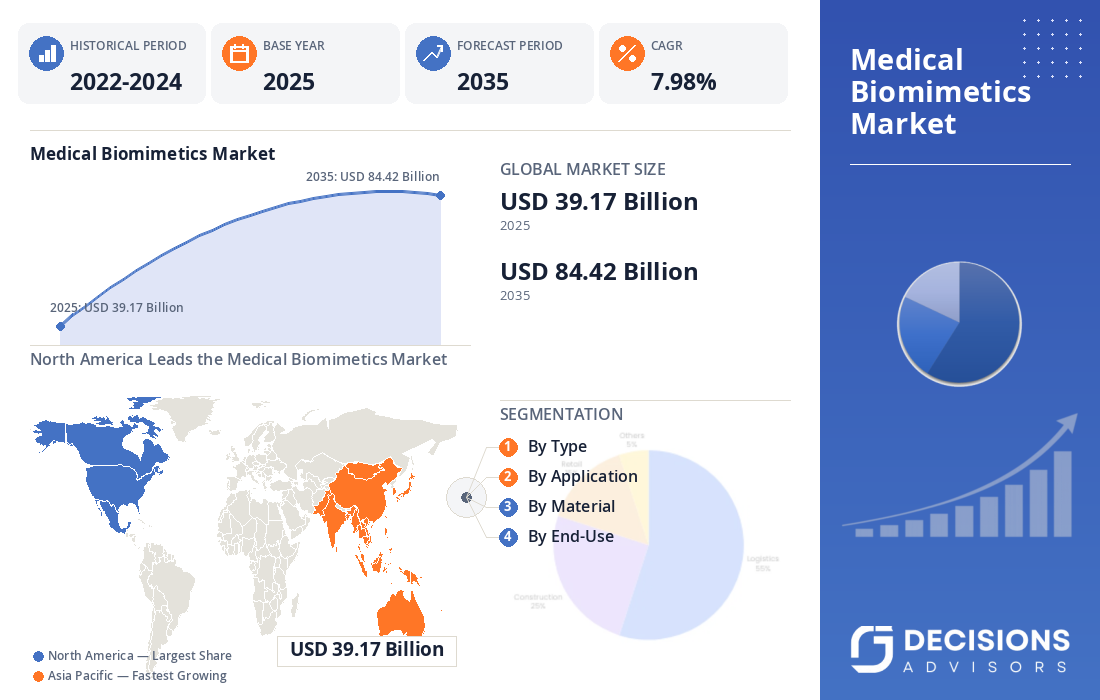
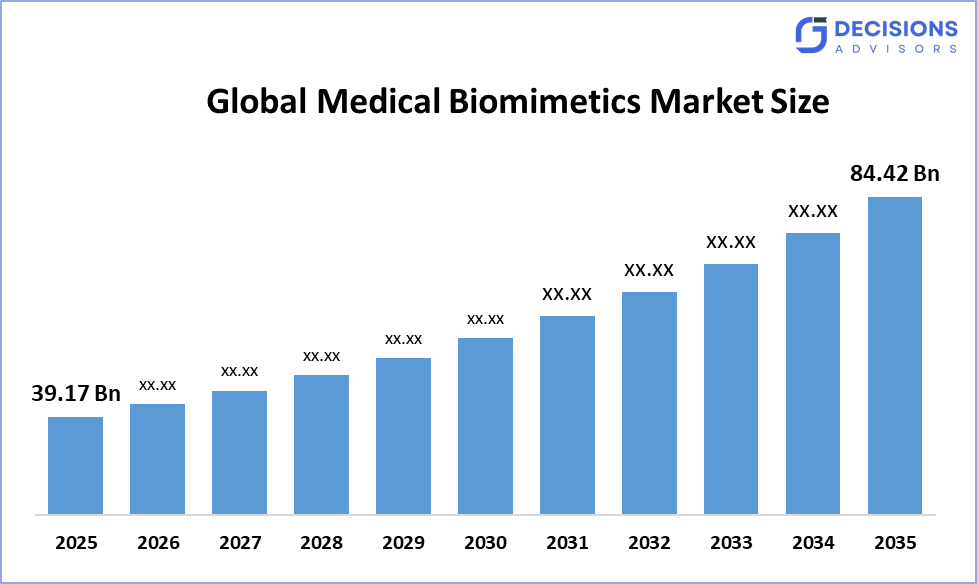
The Global Medical Biomimetics Market Size is predicted to grow from USD 39.17 Billion in 2025 and is likely to reach around USD 84.42 Billion by 2035 with a CAGR of 7.98%. According to Decision Advisors, a detailed research report on the market reflects that the touchless sensing adoption trend dominates the Global Medical Biomimetics Market, with wound-healing applications accounting for approximately 42% of the total share worldwide. Abbott Laboratories leads the market with USD 21.39 billion as one of the key contributors to global market development, supported by its broad portfolio of biomimetic cardiovascular and tissue-engineered technologies and its strong global healthcare footprint.
Market Snapshot
- Global Medical Biomimetics Market Size (2025): USD 39.17 Billion
- Projected Global Medical Biomimetics Market Size (2035): USD 84.42 Billion
- Global Medical Biomimetics Market Compound Annual Growth Rate (CAGR): 7.87%
- Largest Regional Market: North America
- 2nd Largest Region: Europe
- Fastest Growing Region: Asia Pacific
- Base Year: 2025
- Historical Period: 2022-2024
- Market Forecast Period: 2026-2035
Market Overview/ Introduction
The Global Medical Biomimetics Market refers to the industry that develops bio-inspired materials, implants, and devices designed to replicate the structure and function of natural tissues and biological systems for use in healthcare. The market is experiencing substantial growth because of the rising prevalence of chronic diseases, growing demand for regenerative medicine, and increasing research into tissue engineering and advanced biomaterials. Government programs supporting regenerative medicine research, streamlined regulatory pathways for innovative medical devices, and rising healthcare investment across major economies are creating favourable conditions for market expansion. Key companies, including Abbott Laboratories, Johnson & Johnson, Medtronic plc, Zimmer Biomet Holdings, and Stryker Corporation, are developing biomimetic implants, scaffolds, and drug delivery systems that combine biocompatibility with improved clinical outcomes. The market provides healthcare providers with solutions that support faster tissue repair, reduced rejection risk, and better patient recovery. The global market will experience future expansion through advancements in tissue engineering, nanotechnology-enabled drug delivery, 3D-printed patient-specific implants, and wearable regenerative devices.
Notable Insights: -
- North America is anticipated to hold approximately 39% share of the Global Medical Biomimetics Market over the predicted timeframe.
- Asia Pacific is expected to grow at the fastest CAGR of approximately 9.97% in the Global Medical Biomimetics Market during the forecast period.
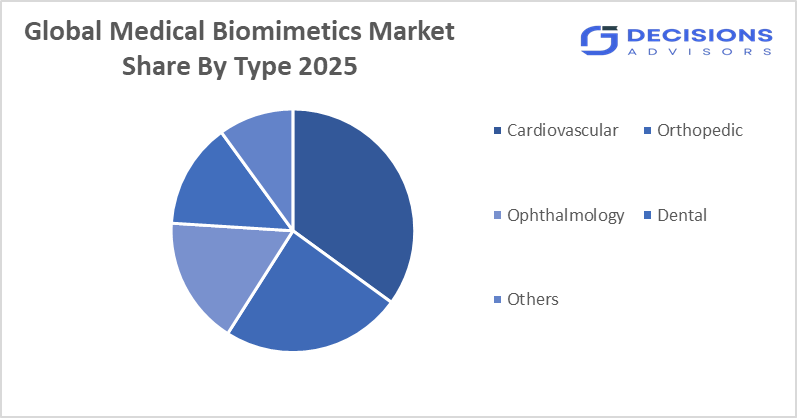
- By type, the Cardiovascular segment dominated the market and holds approximately 35% share in 2025 and is projected to grow at a substantial CAGR during the forecast period.
- By application, the Wound Healing segment dominated the market and holds approximately 42% share in 2025 and is projected to grow at a substantial CAGR during the forecast period.
- The compound annual growth rate of the Global Medical Biomimetics Market is 7.98%
- The market is likely to achieve a valuation of USD 84.42 Billion by 2035.
Market Drivers
The Global Medical Biomimetics Market experiences growth because of the rising prevalence of chronic diseases such as cardiovascular disorders, diabetes, and orthopedic conditions, which is fuelling demand for materials that mimic natural tissue properties. Continuous advancements in biomaterials, nanotechnology, and 3D printing are enabling more precise, biocompatible, and patient-specific implants and scaffolds. Growing research and development activity in tissue engineering and regenerative medicine is supporting new applications in wound healing, drug delivery, and organ repair. The expanding geriatric population and rising incidence of orthopedic and cardiovascular disorders are further increasing demand for biomimetic implants that improve patient recovery and reduce complication rates. Rising healthcare investment and expanding hospital infrastructure across developed and emerging economies are also supporting the adoption of advanced biomimetic solutions.
Restrain
The Global Medical Biomimetics Market faces challenges such as high research and development costs associated with material science, testing, and clinical validation, which limit commercialization for smaller manufacturers. Complex and time-consuming regulatory approval processes for biomimetic implants and devices also extend time-to-market and increase compliance expenses.
Competitive Analysis:
The report offers the appropriate analysis of the key organizations/companies involved within the Global Medical Biomimetics Market along with a comparative evaluation primarily based on their product offerings, business overviews, geographic presence, enterprise strategies, segment market share, and SWOT analysis. The report also provides an elaborative analysis focusing on the current news and developments of the companies, which includes product development, innovations, joint ventures, partnerships, mergers & acquisitions, strategic alliances, and others. This allows for the evaluation of the overall competition within the market.
Top Companies in the Global Medical Biomimetics Market
- Abbott Laboratories
- Johnson & Johnson
- Medtronic plc
- Zimmer Biomet Holdings, Inc.
- Stryker Corporation
- Biomimetics Technologies, Inc.
- Avinent Science & Technology
- Applied Biomimetic A/S
- Veryan Medical Ltd
- SynTouch LLC
Government Initiatives
|
CountryCountry |
Key Government Initiatives KeyKey Government Initiatives es |
|
US |
The NIH's Regenerative Medicine Innovation Project, established under the 21st Century Cures Act, together with NSF-backed bioengineering and tissue-scaffold research programs, is supporting development of biomimetic materials, implants, and regenerative therapies across the country. |
|
Japan |
Japan's Act on the Safety of Regenerative Medicine and the PMDA's SAKIGAKE expedited-review pathway are accelerating clinical translation of biomimetic and regenerative medical products, encouraging faster approval of bio-inspired implants and tissue-engineered devices. |
|
China |
Initiatives under the 14th Five-Year Plan for drug and medical device development, along with NMPA's special review procedure for innovative medical devices, are promoting research into biomaterials, tissue-engineered products, and next-generation biomimetic technologies. |
Market Segmentation
The Global Medical Biomimetics Market share is classified into type, application and material
- The Cardiovascular segment dominated the market and holds approximately 35% share in 2025 and is projected to grow at a substantial CAGR during the forecast period.
Based on the type, the Global Medical Biomimetics Market is divided into Cardiovascular, Orthopedic, Ophthalmology, Dental, and Others. Among these, the Cardiovascular segment dominates the market and holds approximately 35% share in 2025. This dominance is due to the rising prevalence of heart-related disorders, growing demand for advanced cardiovascular implants, and increasing adoption of biomimetic technologies for minimally invasive procedures. These devices are widely used in stents, vascular grafts, and heart valves, making cardiovascular applications the leading contributor to biomimetic technology adoption globally.
- The Wound Healing segment accounted for the largest share of approximately 42% in 2025 and is anticipated to grow at a significant CAGR during the forecast period.
Based on the application, the market is divided into Wound Healing, Tissue Engineering, Drug Delivery, and Other Applications. Among these, Wound Healing accounted for the largest share and holds approximately 42% share in 2025. This dominance is due to the rising incidence of chronic wounds, diabetic ulcers, and burns, along with increasing use of biomimetic dressings and hydrogel-based scaffolds. Growing demand for faster tissue repair and improved patient recovery outcomes further supports segment growth, making wound healing the primary revenue contributor in the Global Medical Biomimetics Market.
- The Synthetic Biomaterials segment accounted for the largest share of approximately 80% in 2025 and is anticipated to grow at a significant CAGR during the forecast period.
Based on material, the market is divided into Natural Biomaterials and Synthetic Biomaterials. Among these, Synthetic Biomaterials dominate the market and hold approximately 80% share in 2025. This dominance is due to superior mechanical properties, durability, and ease of mass production, which support widespread use across implants, prosthetics, and tissue engineering. Natural Biomaterials are expected to register the fastest growth as demand rises for biocompatible and biodegradable options in regenerative medicine.
Regional Segment Analysis of the Global Medical Biomimetics Market
- North America (U.S., Canada)
- Europe (Germany, U.K., France, Italy, Spain, Russia, Poland, Rest of Europe)
- Asia-Pacific (China, Japan, India, South Korea, Australia, Rest of APAC)
- Latin America (Brazil, Argentina, Rest of Latin America)
- The Middle East and Africa (UAE, Saudi Arabia, South Africa, Rest of MEA)
North America dominated the Global Medical Biomimetics Market and is anticipated to hold approximately 39% share over the predicted timeframe.
North America holds approximately 39% share of the Global Medical Biomimetics Market due to advanced healthcare infrastructure, strong research and development capabilities, and high adoption of biomimetic medical devices. The region benefits from the presence of leading manufacturers such as Abbott Laboratories, Johnson & Johnson, and Zimmer Biomet, along with favourable reimbursement policies that support the use of advanced wound-healing, cardiovascular, and orthopedic solutions. Rising healthcare spending, an ageing population, and increasing prevalence of chronic diseases further strengthen North America's position as the leading regional market.
Europe holds the second-largest share of the Global Medical Biomimetics Market, supported by well-established healthcare systems and strong research capabilities.
Europe holds a significant share of the Global Medical Biomimetics Market due to well-established healthcare systems, strong research and manufacturing capabilities, and high adoption of advanced medical devices. Growing focus on minimally invasive procedures, rising prevalence of chronic diseases, and favourable regulatory frameworks across countries such as Germany, France, and the UK further strengthen Europe's position. Government-backed research funding for regenerative medicine and biomaterials also continues to support regional market growth.
Asia Pacific is the fastest-growing region in the Global Medical Biomimetics Market, registering a CAGR of approximately 9.97% during the forecast period.
Asia Pacific is expected to grow at the fastest CAGR of approximately 9.97% in the Global Medical Biomimetics Market during the forecast period due to rising healthcare investments, a growing prevalence of chronic diseases, and expanding adoption of advanced biomimetic technologies. China, Japan, and India are investing heavily in regenerative medicine and biomaterial research, supported by government initiatives promoting healthcare modernization. Increasing medical infrastructure development and rising awareness of innovative treatment options further accelerate market growth across the region.
Future Market Trends in Global Medical Biomimetics Market: -
- Expansion of Biomimetic Materials in Tissue Engineering and Regenerative Medicine
Biomimetic scaffolds and biomaterials are increasingly used in tissue engineering, regenerative medicine, and wound care due to their ability to mimic natural tissue structures. They support faster healing, improved biocompatibility, and better long-term patient outcomes. Growing demand for advanced regenerative therapies is accelerating adoption globally.
- AI and 3D Printing Enabled Personalized Biomimetic Devices
Integration of artificial intelligence and 3D printing allows manufacturers to design highly precise, patient-specific implants and scaffolds. This improves surgical outcomes, reduces rejection risk, and shortens development time. The trend is driving more customized and efficient biomimetic solutions across cardiovascular, orthopedic, and dental applications.
- Growth in Biomimetic Drug Delivery Systems
Biomimetic nanoparticles and carriers are gaining traction for targeted drug delivery, enhancing therapeutic efficiency while minimizing side effects. These systems mimic natural biological transport mechanisms, improving precision medicine outcomes. Rising focus on personalized treatment is significantly boosting this trend globally.
- Rising Adoption of Biomimetic Wound-Healing Scaffolds and Hydrogels
Biomimetic dressings, scaffolds, and hydrogel-based technologies are widely used to accelerate healing of chronic wounds, diabetic ulcers, and burns. Their biocompatibility and ability to support natural tissue regeneration make them increasingly preferred in advanced wound care. Growing incidence of chronic wounds is driving expansion of this segment worldwide.
Recent Development
- In April 2024, Abbott Laboratories received FDA approval for its TriClip transcatheter edge-to-edge repair system to treat tricuspid regurgitation, expanding minimally invasive treatment options for structural heart disease.
- In March 2025, Johnson & Johnson MedTech unveiled a new generation of data-driven orthopedic implants and surgical solutions spanning joint reconstruction, trauma, and spine care.
- In October 2025, Zimmer Biomet secured FDA Breakthrough Device Status for a total hip implant featuring a controlled-release iodine layer designed to reduce post-surgical joint infections.
Market Segment
This study forecasts revenue at global, regional, and country levels from 2022 to 2035. Decision Advisors has segmented the Global Medical Biomimetics Market based on the below-mentioned segments:
Global Medical Biomimetics Market, By Type
- Cardiovascular
- Orthopedic
- Ophthalmology
- Dental
- Others
Global Medical Biomimetics Market, By Application
- Wound Healing
- Tissue Engineering
- Drug Delivery
- Other Applications
Global Medical Biomimetics Market, By Material
- Natural Biomaterials
- Synthetic Biomaterials
Global Medical Biomimetics Market, By End-Use
- Hospitals & Clinics
- Research & Academic Institutes
- Diagnostic & Therapeutic Centers
- Others
Global Medical Biomimetics Market, By Regional Analysis
- North America
- US
- Canada
- Europe
- Germany
- UK
- France
- Italy
- Spain
- Russia
- Rest of Europe
- Asia Pacific
- China
- Japan
- India
- South Korea
- Australia
- Rest of Asia Pacific
- Latin America
- Brazil
- Argentina
- Rest of Latin America
- Middle East & Africa
- UAE
- Saudi Arabia
- South Africa
- Rest of the Middle East & Africa
Frequently Asked Questions (FAQ)
Q. What was the size of the Global Medical Biomimetics Market in 2025?
A. The Global Medical Biomimetics Market was valued at approximately USD 38.17 Billion in 2025, reflecting rising adoption of bio-inspired implants, scaffolds, and drug delivery systems.
Q. What is the expected CAGR of the Global Medical Biomimetics Market from 2026 to 2035?
A. The market is expected to grow at a CAGR of approximately 7.87% from 2026 to 2035, reaching around USD 81.42 Billion by 2035.
Q. Which region leads the Global Medical Biomimetics Market?
A. North America leads the market, holding approximately 39% share in 2025, supported by advanced healthcare infrastructure and strong adoption of biomimetic devices.
Q. Which segment dominates the Global Medical Biomimetics Market by application?
A. The Wound Healing segment dominates the market by application, holding approximately 42% share in 2025 due to rising incidence of chronic wounds and increasing use of biomimetic dressings and scaffolds.
Check Licence
Choose the plan that fits you best: Single User, Multi-User, or Enterprise solutions tailored for your needs.
We Have You Covered
- 24/7 Analyst Support
- Clients Across the Globe
- Tailored Insights
- Technology Tracking
- Competitive Intelligence
- Custom Research
- Syndicated Market Studies
- Market Overview
- Market Segmentation
- Growth Drivers
- Market Opportunities
- Regulatory Insights
- Innovation & Sustainability
Report Details
| Scope | Global |
| Pages | 200 |
| Delivery | PDF & Excel via Email |
| Language | English |
| Release | Aug 2026 |
| Access | Download from this page |