
Global Medical Devices and Equipment Logistics Market
 |
Author:
David J
|
Pages:
235
|
Author:
David J
|
Pages:
235
Global Medical Devices and Equipment Logistics Market Size, Share, By Product Type (Medical Devices and Medical Equipment), By Service Type (Transportation, Warehousing & Storage, Distribution, Inventory Management, and Others), By End User (Medical Device Manufacturers, Hospitals & Clinics, Pharmaceutical Companies, Research Laboratories, and Others), and By Region (North America, Europe, Asia-Pacific, South America, and Middle East & Africa), Analysis and Forecast 2026?2035.
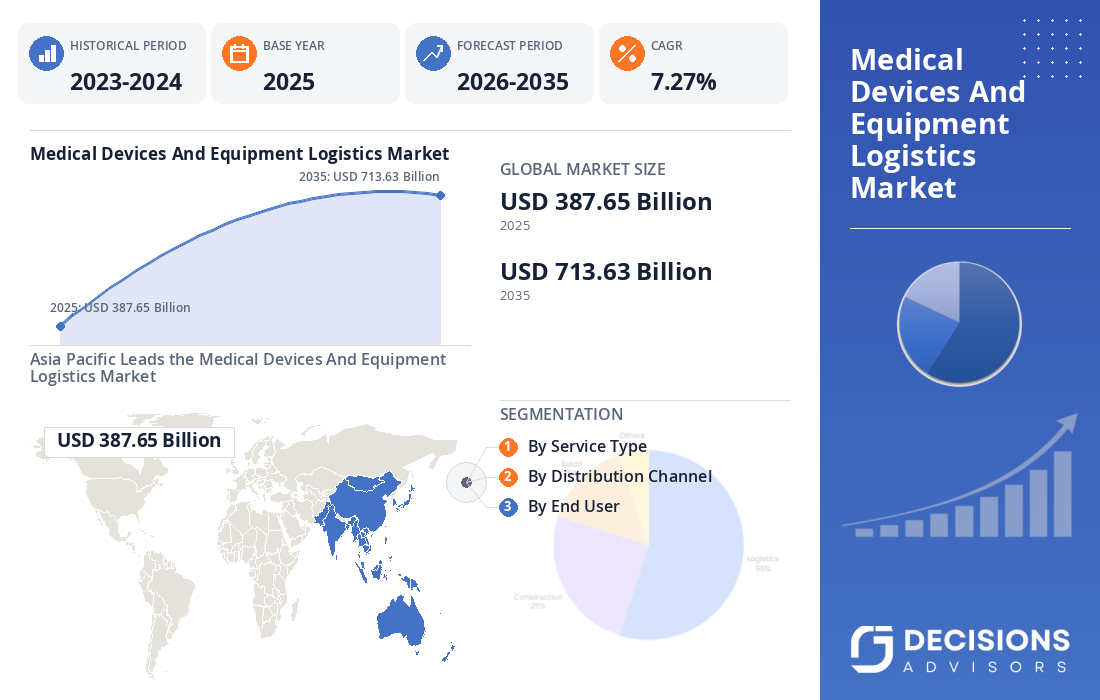
CAGR
7.27%
REVENUE 2025
USD Billion 387.65
FORECAST 2035
USD Billion 713.63
REPORT COVERAGE
Global
The Global Medical Devices and Equipment Logistics Market encompasses logistics services and supply-chain solutions used for the transportation, warehousing, storage, distribution, inventory management, and delivery of medical devices and healthcare equipment. The market supports the movement of diagnostic equipment, surgical instruments, implants, monitoring devices, laboratory equipment, hospital equipment, and other medical products. Increasing healthcare expenditure, expansion of medical device manufacturing, growing demand for advanced healthcare equipment, internationalization of medical device supply chains, regulatory requirements, and increasing outsourcing to specialized healthcare logistics providers are supporting market growth.
Market Snapshot
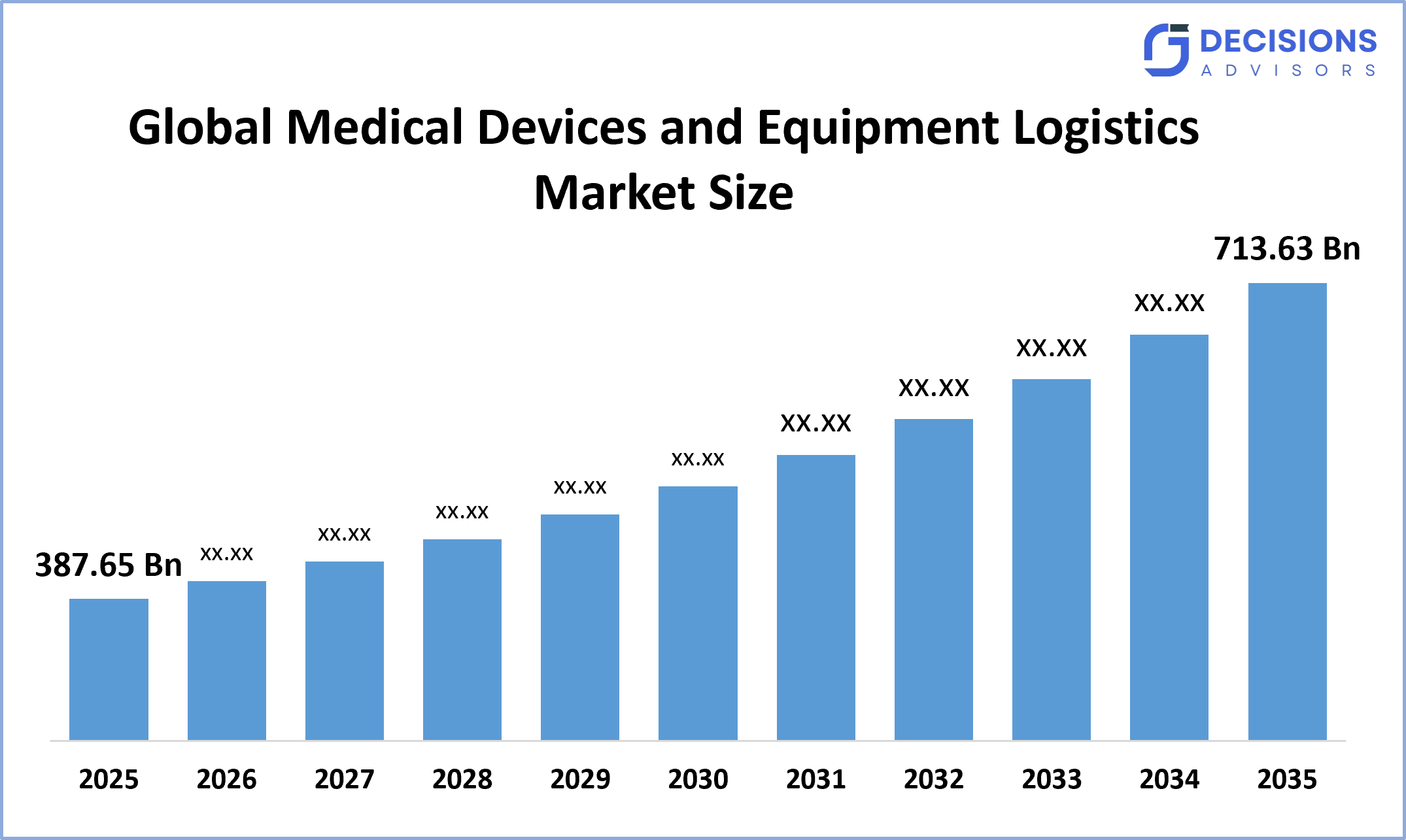
- Global Medical Devices and Equipment Logistics Market Size (2025): USD 387.65 Billion
- Projected Market Size (2035): USD 713.63 Billion
- Global Market CAGR (2026–2035): Approximately 7.27%
- Largest Regional Market: Asia-Pacific
- Fastest Growing Region: Asia-Pacific
- Base Year: 2025
- Historical Period: 2023–2024
- Forecast Period: 2026–2035
Market Overview/ Introduction
The Global Medical Devices and Equipment Logistics Market represents the logistics infrastructure and services required to efficiently move medical devices and healthcare equipment from manufacturers and suppliers to hospitals, clinics, distributors, laboratories, and other healthcare facilities. Medical device logistics involves specialized transportation, warehousing, inventory management, order fulfillment, distribution, reverse logistics, and last-mile delivery. The increasing complexity and globalization of medical device supply chains are creating demand for specialized logistics providers. Advanced surgical equipment, diagnostic systems, implants, laboratory instruments, and other high-value medical products often require careful handling, secure transportation, traceability, and regulatory compliance. The increasing outsourcing of distribution and logistics activities to healthcare-focused third-party logistics providers is further supporting market expansion.
The U.S. governments and healthcare regulatory authorities are increasingly emphasizing product traceability, quality management, transportation standards, supply-chain security, and timely availability of medical equipment.
- Several Asia-Pacific countries are increasing investments in healthcare infrastructure, domestic medical-device manufacturing, distribution networks, logistics infrastructure, and digital supply-chain technologies.
Notable Insights: -
- Asia-Pacific maintains a leading position in the Global Medical Devices and Equipment Logistics Market, supported by expanding healthcare infrastructure, medical device manufacturing, and demand for efficient distribution networks. Mordor Intelligence also identifies Asia-Pacific as the largest and fastest-growing regional market.
- Medical devices represent a major product segment because of increasing demand for diagnostic, monitoring, surgical, therapeutic, and implantable devices.
- Transportation and warehousing services remain important logistics activities because medical devices require secure, timely, and compliant movement through the healthcare supply chain.
- Third-party logistics providers are gaining importance as manufacturers increasingly outsource warehousing, transportation, inventory management, and distribution activities.
- Digital logistics technologies are becoming increasingly important, including real-time tracking, RFID, IoT sensors, warehouse-management systems, and cloud-based supply-chain platforms.
- Regulatory compliance and product traceability remain major considerations because medical devices must be handled and distributed according to applicable healthcare and quality requirements.
Market Drivers
The Global Medical Devices and Equipment Logistics Market is primarily driven by the expansion of healthcare infrastructure and increasing demand for medical devices and equipment. Rising healthcare expenditure, increasing hospital capacity, growth in diagnostic services, and technological advancements in medical equipment are generating greater demand for efficient logistics services. Another important driver is the increasing globalization of medical device manufacturing. Medical device manufacturers increasingly operate international supply chains, requiring specialized transportation, warehousing, inventory management, customs handling, and distribution services.
Restrain
The Global Medical Devices and Equipment Logistics Market faces challenges including high transportation and warehousing costs, complex regulatory requirements, supply-chain disruptions, product-damage risks, customs and cross-border compliance requirements, and the need for specialized handling. High-value medical equipment may require secure transportation and careful handling, increasing logistics costs. Shortages of specialized logistics infrastructure and skilled personnel can also create challenges, particularly in developing markets. In addition, geopolitical disruptions, trade restrictions, fuel-price fluctuations, and transportation delays can affect international medical-device supply chains.
Competitive Analysis:
The report offers the appropriate analysis of the key organizations/companies involved within the Global Medical Devices and Equipment Logistics Market, along with a comparative evaluation primarily based on their product offerings, business overviews, geographic presence, enterprise strategies, segment market share, and SWOT analysis. The report also provides an elaborative analysis focusing on the current news and developments of the companies, which includes product development, innovations, joint ventures, partnerships, mergers & acquisitions, strategic alliances, and others. This allows for the evaluation of the overall competition within the market.
Top Companies in the Global Medical Devices and Equipment Logistics Market
- DHL Supply Chain Healthcare
- UPS Healthcare
- FedEx Healthcare
- Cardinal Health, Inc.
- McKesson Corporation
- Cencora, Inc.
- Kuehne+Nagel International AG
- DB Schenker
- XPO Logistics
- Medline Industries, LP
- Owens & Minor, Inc.
- CEVA Logistics
- AmerisourceBergen
- GEODIS
- Nippon Express Holdings, Inc.
Government Initiatives
|
Country |
Key Government Initiatives |
|
Us |
Government initiatives supporting healthcare supply-chain resilience, medical-device safety, product traceability, transportation standards, emergency preparedness, and domestic medical-device manufacturing are supporting the development of medical-device logistics infrastructure. |
|
Germany |
Government and European initiatives supporting healthcare supply-chain resilience, medical-device regulation, product quality, digitalization, and efficient distribution networks are strengthening the medical devices and equipment logistics ecosystem. |
|
China |
Government programs supporting domestic medical-device manufacturing, healthcare infrastructure, logistics modernization, digital supply chains, and expansion of healthcare distribution networks are contributing to market development. |
Market Segmentation
The Global Medical Devices and Equipment Logistics Market is classified into product type, service type, end user, and region.
The Medical Devices Segment Accounts for a Significant Share
Based on product type, the market is divided into Medical Devices and Medical Equipment. Medical devices represent a significant segment because of increasing demand for diagnostic devices, surgical instruments, implants, patient-monitoring systems, therapeutic equipment, and other healthcare products. The growing international distribution of medical devices is increasing demand for specialized transportation, warehousing, inventory management, and last-mile delivery.
- The Transportation and Warehousing Segments Remain Important
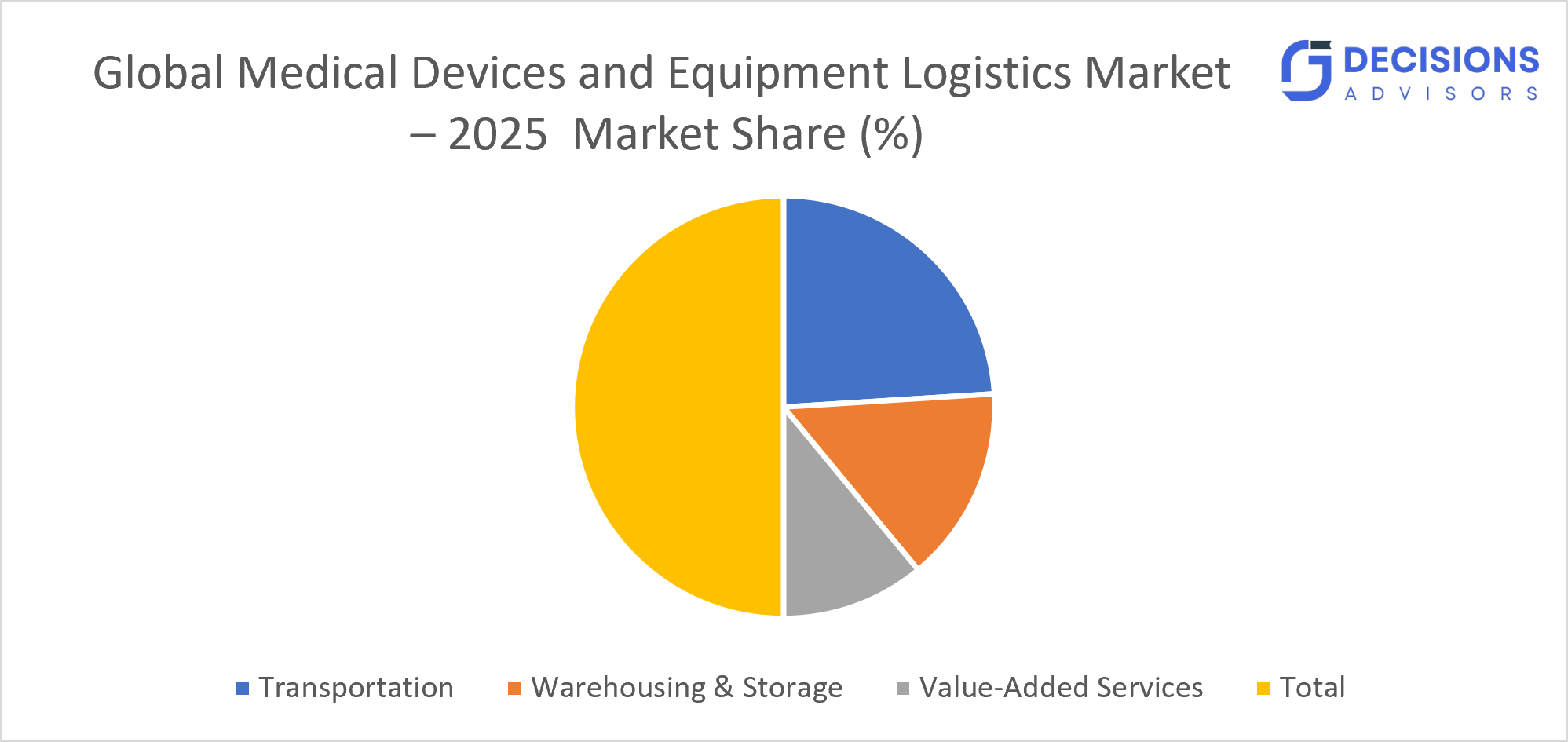
Based on service type, the market is divided into Transportation, Warehousing & Storage, Distribution, Inventory Management, and Others. Transportation remains critical because medical devices must be delivered safely and efficiently to hospitals, clinics, distributors, and healthcare providers. Warehousing and storage services are also gaining importance as manufacturers and healthcare organizations seek better inventory control, centralized distribution, and supply-chain visibility.
- The Medical Device Manufacturers Represent a Major End User
Based on end user, the market is divided into Medical Device Manufacturers, Hospitals & Clinics, Pharmaceutical Companies, Research Laboratories, and Others. Medical device manufacturers represent a major end-user group because they require logistics services to move products from manufacturing facilities to distributors and healthcare providers across domestic and international markets.
Regional Segment Analysis of the Global Medical Devices and Equipment Logistics Market
- North America (U.S., Canada, Mexico)
- Europe (Germany, U.K., France, Italy, Spain, Netherlands, Rest of Europe)
- Asia-Pacific (China, Japan, India, Australia, South Korea, Rest of Asia-Pacific)
- South America (Brazil, Argentina, Rest of South America)
- Middle East & Africa (UAE, Saudi Arabia, South Africa, Rest of MEA)
North America Holds a Significant Share
North America represents a significant market due to its developed healthcare infrastructure, large medical-device industry, sophisticated logistics networks, and high adoption of outsourced healthcare logistics services. The United States remains an important market because of its large healthcare system, extensive medical-device manufacturing base, and established logistics providers.
Europe Maintains Strong Market Potential
Europe is supported by established healthcare systems, advanced medical-device manufacturing, sophisticated logistics infrastructure, and stringent regulatory requirements. Germany, the U.K., France, Italy, Spain, and other European countries are investing in digital supply chains, healthcare logistics, and efficient distribution networks.
Asia-Pacific Maintains a Leading Share of the Global Medical Devices and Equipment Logistics Market
Asia-Pacific represents a leading regional market, supported by the expansion of healthcare infrastructure, increasing medical-device manufacturing, rising healthcare expenditure, and growing demand for advanced medical equipment. China, India, Japan, South Korea, and other Asian economies are strengthening domestic healthcare and medical-device supply chains. Current market research identifies Asia-Pacific as both the largest and fastest-growing region.
Future Market Trends in Global Medical Devices and Equipment Logistics Market: -
-
- Expansion of Digital Healthcare Logistics
Digital platforms, cloud-based supply-chain management, real-time tracking, RFID, and IoT technologies are expected to improve visibility and efficiency throughout medical-device logistics networks.
-
- Growth of Third-Party Logistics
Medical device manufacturers are increasingly outsourcing logistics and distribution activities to specialized 3PL providers to reduce costs and improve supply-chain flexibility.
-
- Increasing Demand for Real-Time Tracking
Real-time shipment monitoring and asset tracking are expected to become increasingly important for high-value medical devices and equipment.
-
- Rising Focus on Sustainable Logistics
Logistics providers are increasingly investing in energy-efficient warehouses, optimized transportation routes, electric vehicles, and lower-emission supply-chain solutions.
Recent Development
- In November 2025, medical-device logistics providers continued expanding specialized healthcare supply-chain capabilities in response to increasingly complex medical-device supply chains and growing demand for outsourced logistics services.
- In July 2025, healthcare logistics companies continued investing in transportation, warehousing, inventory management, tracking, and digital supply-chain technologies to improve medical-device distribution.
- In February 2025, the growing complexity of medical-device storage and distribution, increasing compliance requirements, and demand for efficient handling continued supporting the expansion of specialized medical-device logistics services.
Market Segment
This study forecasts revenue at global, regional, and country levels from 2026 to 2035. The Global Medical Devices and Equipment Logistics Market can be segmented based on Service Type, Mode of Transportation, Temperature, Device Category, End User, and Region
Global Medical Devices and Equipment Logistics Market, By Service Type
- Medical Devices
- Medical Equipment
- Others
Global Medical Devices and Equipment Logistics Market, By Distribution Channel
- Transportation
- Warehousing & Storage
- Distribution
- Inventory Management
- Last-Mile Delivery
- Reverse Logistics
- Others
Global Medical Devices and Equipment Logistics Market, By End User
- Medical Device Manufacturers
- Hospitals and Clinics
- Pharmaceutical Companies
- Research Laboratories
- Medical Distributors
Global Medical Devices and Equipment Logistics Market, By Regional Analysis
- North America
- US
- Canada
- Mexico
- Europe
- Germany
- UK
- France
- Italy
- Spain
- Russia
- Rest of Europe
- Asia Pacific
- China
- Japan
- India
- South Korea
- Australia
- Rest of Asia Pacific
- South America
- Brazil
- Argentina
- Rest of South America
- Middle East & Africa
- UAE
- Saudi Arabia
- Qatar
- South Africa
- Rest of the Middle East & Africa
Frequently Asked Questions (FAQ)
Q. What is driving the growth of the Global Medical Devices and Equipment Logistics Market?
A. The market is primarily driven by increasing healthcare expenditure, growing medical-device manufacturing, internationalization of healthcare supply chains, rising demand for advanced medical equipment, regulatory requirements, and increasing outsourcing to specialized logistics providers.
Q. What is the Global Medical Devices and Equipment Logistics Market size in 2025?
A. The Global Medical Devices and Equipment Logistics Market is estimated at approximately USD 96.42 Billion in 2025.
Q. Why is third-party logistics important for medical devices?
A. Third-party logistics providers help medical-device manufacturers manage transportation, warehousing, inventory, distribution, regulatory compliance, and supply-chain visibility while allowing manufacturers to focus on product development and healthcare innovation.
Q. Which region dominates the Medical Devices and Equipment Logistics Market?
A. Asia-Pacific is identified as the largest regional market and is also expected to be the fastest-growing region.
Check Licence
Choose the plan that fits you best: Single User, Multi-User, or Enterprise solutions tailored for your needs.
We Have You Covered
- 24/7 Analyst Support
- Clients Across the Globe
- Tailored Insights
- Technology Tracking
- Competitive Intelligence
- Custom Research
- Syndicated Market Studies
- Market Overview
- Market Segmentation
- Growth Drivers
- Market Opportunities
- Regulatory Insights
- Innovation & Sustainability
Report Details
| Scope | Global |
| Pages | 235 |
| Delivery | PDF & Excel via Email |
| Language | English |
| Release | Sep 2026 |
| Access | Download from this page |