
Global Medical Devices Reimbursement Market
 |
Author:
Disha B
|
Pages:
200
|
Author:
Disha B
|
Pages:
200
Global Medical Devices Reimbursement Market Size, Share By Payer (Public Payers and Private Payers), By Healthcare Setting (Hospitals, Outpatient Facilities, and Other Settings), By Reimbursement Approach (Fee-for-Service and Value-Based Reimbursement and Bundled Payments), and By Region (North America, Europe, Asia-Pacific, Latin America, and Middle East & Africa), Analysis and Forecast 2026-2035
CAGR
7.26%
REVENUE 2025
USD Billion 685.4
FORECAST 2035
USD Billion 1.38
REPORT COVERAGE
Global
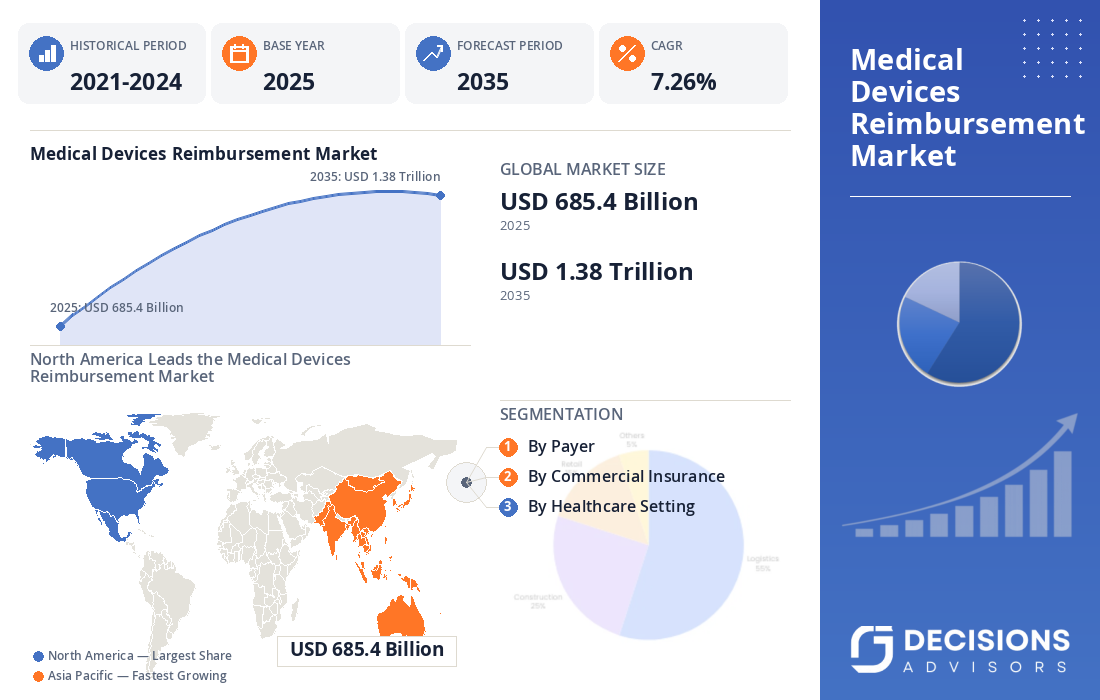
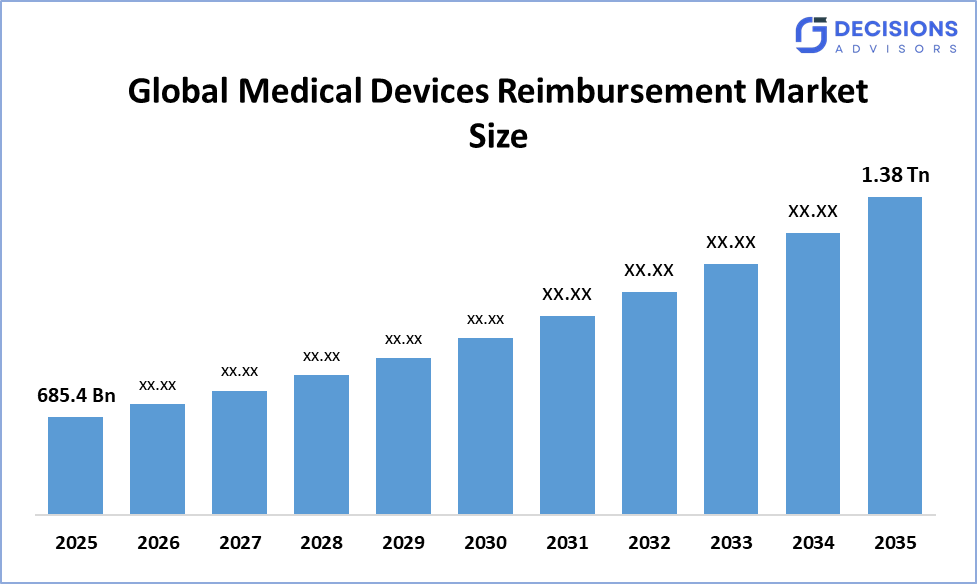
The Global Medical Devices Reimbursement Market Size is predicted to grow from USD 685.4 Billion in 2025 and is likely to reach around USD 1.38 Trillion by 2035, with a CAGR of 7.26%. According to Decision Advisors, the market is experiencing strong expansion because of the increasing prevalence of chronic diseases, rising healthcare expenditure, growing utilization of advanced medical devices, expansion of public and private health insurance, and increasing adoption of value-based healthcare models. Private payers represent the leading payer segment, while North America remains the largest regional market.
Market Snapshot
- Global Medical Devices Reimbursement Market Size (2025): USD 685.4 Billion
- Projected Global Medical Devices Reimbursement Market Size (2035): USD 1.38 Trillion
- Global Medical Devices Reimbursement Market Compound Annual Growth Rate (CAGR): 7.26%
- Largest Regional Market: North America
- 2nd Largest Region: Europe
- Fastest Growing Region: Asia-Pacific
- Base Year: 2025
- Historical Period: 2021-2024
- Market Forecast Period: 2026-2035.
Market Overview/ Introduction
The global medical devices reimbursement market represents the financial ecosystem through which healthcare providers and medical-device users receive payment or coverage for eligible medical devices and related services. The reimbursement ecosystem includes public health programs, private insurers, healthcare providers, employers, patients, medical-device manufacturers, claims administrators, and healthcare technology platforms. Reimbursement may be associated with diagnostic devices, implantable technologies, surgical equipment, monitoring systems, durable medical equipment, connected devices, and other medical technologies. Market growth is being supported by the rising prevalence of cardiovascular diseases, diabetes, cancer, respiratory disorders, neurological diseases, and other chronic conditions that require continuous monitoring and long-term treatment. Healthcare systems are also increasingly evaluating medical technologies based on clinical effectiveness and economic value.
- United States, Medicare and private insurance programs provide important reimbursement channels for medical technologies. Remote patient monitoring is increasingly integrated into chronic and acute-care management, supporting demand for connected medical devices and digital monitoring systems.
- Japan, Japan operates an Insured Medical Materials System for medical devices used in insured medical treatment. The system requires new medical devices to go through insurance-coverage procedures and is periodically revised alongside the medical-fee system.
- China, China's healthcare reforms emphasize broader healthcare access, centralized procurement of high-value medical consumables, and greater cost control, increasing the importance of reimbursement and pricing mechanisms for medical devices.
Notable Insights: -
- North America is anticipated to hold approximately 47.2% share of the Global Medical Devices Reimbursement Market during the forecast period, supported by extensive public and private insurance coverage and high healthcare expenditure.
- Asia-Pacific is expected to be the fastest-growing region, supported by expanding healthcare coverage, rising medical expenditure, improving reimbursement infrastructure, and increasing adoption of advanced medical technologies.
- By Payer, the Private Payers segment dominated the market and holds approximately 63.3% share in 2025, supported by commercial insurance, employer-sponsored plans, individual policies, and supplemental coverage.
- By Healthcare Setting, the Hospitals segment dominated the market and holds approximately 50.8% share in 2025, reflecting high surgical volumes and extensive utilization of advanced medical devices.
- The compound annual growth rate of the Global Medical Devices Reimbursement Market is 7.26%.
- The market is likely to achieve a valuation of approximately USD 1.38 Trillion by 2035.
Market Drivers
The global medical devices reimbursement market is being driven by the increasing prevalence of chronic diseases and the corresponding requirement for advanced diagnostic, therapeutic, monitoring, and implantable medical devices. Cardiovascular disease, diabetes, cancer, and respiratory diseases require long-term monitoring and treatment, increasing healthcare utilization and creating sustained demand for reimbursed technologies. As healthcare costs increase, payers are also placing greater emphasis on technologies capable of reducing hospitalization, improving treatment outcomes, and lowering total cost of care. The transition from traditional fee-for-service reimbursement toward value-based healthcare is another major driver. Under value-based arrangements, reimbursement is increasingly connected to clinical outcomes, patient satisfaction, cost efficiency, and quality of care. This creates opportunities for medical-device manufacturers that can demonstrate measurable clinical and economic benefits. Outcome-based contracts and risk-sharing arrangements are particularly relevant for high-cost innovative technologies.
Restrain
The global medical devices reimbursement market faces challenges from complex reimbursement frameworks, lengthy coding and coverage procedures, fragmented payer requirements, and increasing pressure to control healthcare expenditure. New medical devices frequently require substantial clinical and economic evidence before payers establish favorable coverage policies. Differences in reimbursement systems between countries can also increase market-access costs for manufacturers. High-cost innovative devices represent another challenge. Payers must balance patient access to advanced technologies with affordability and healthcare-budget constraints.
Competitive Analysis:
The report offers the appropriate analysis of the key organizations/companies involved within the global medical devices reimbursement market, along with a comparative evaluation primarily based on their product offerings, business overviews, geographic presence, enterprise strategies, segment market share, and SWOT analysis. The report also provides an elaborative analysis focusing on the current news and developments of the companies, which includes product development, innovations, joint ventures, partnerships, mergers & acquisitions, strategic alliances, and others. This allows for the evaluation of the overall competition within the market.
Top Companies in the Global Medical Devices Reimbursement Market
- UnitedHealth Group
- Allianz
- The Cigna Group
- CVS Health
- Humana Inc.
- Anthem Insurance Companies, Inc.
- Aviva
- BNP Paribas
- Experian Health
- Nippon Life Insurance Company
- WellCare Health Plans.
Government Initiatives
|
Country |
Key Government Initiatives |
|
United States |
CMS Medicare reimbursement and telehealth/remote-monitoring programs support connected medical technologies and remote patient management. CMS has continued updating telehealth and remote-monitoring policies for 2026 |
|
Japan |
Japan's Ministry of Health, Labour and Welfare maintains the Insured Medical Materials System, through which medical devices require insurance-coverage procedures to be used within insured medical treatment |
|
China |
China's healthcare authorities are expanding centralized procurement and cost-management mechanisms for high-value medical consumables, encouraging more structured pricing and reimbursement processes |
Market Segmentation
The Global Medical Devices Reimbursement Market share is classified into Payer, Healthcare Setting, and Reimbursement Approach.
- The Private Payers segment dominated the market and holds approximately 63.3% share in 2025 and is projected to grow at a significant CAGR during the forecast period.
Based on payer, the global medical devices reimbursement market is divided into public payers and private payers. Among these, the Private Payers segment dominates the market and holds approximately 63.3% share in 2025. Private payers include commercial medical insurers, employer-sponsored health plans, individual policies, and supplemental insurance products. Their dominance is supported by broad coverage of medical services and technologies and comparatively flexible approaches to innovative medical-device reimbursement. Private payers are also increasingly participating in risk-sharing arrangements with manufacturers for high-cost technologies.
- The Hospitals segment accounted for the largest share of approximately 50.8% in 2025 and is anticipated to grow at a significant CAGR during the forecast period.
Based on Healthcare Setting, the market is divided into Hospitals, Outpatient Facilities, and Other Settings. Among these, Hospitals accounted for the largest share and held approximately 50.8% share in 2025. Hospitals utilize a broad range of reimbursed technologies across inpatient admissions, emergency departments, hospital outpatient departments, surgical procedures, diagnostic services, and intensive-care environments. Increasing surgical volumes and adoption of sophisticated technologies are supporting reimbursement activity.
- The Global Medical Devices Reimbursement Market is segmented into Fee-for-Service, Value-Based Reimbursement, and Bundled Payments.
The Fee-for-Service segment remains a significant component because healthcare providers continue to receive payment based on eligible procedures and services delivered. However, its relative importance is gradually being challenged by models that emphasize outcomes and cost efficiency. The Value-Based Reimbursement segment is expected to expand strongly because payers increasingly evaluate medical technologies based on clinical outcomes, total cost of care, and patient benefits. Manufacturers that demonstrate reductions in hospitalizations, improved treatment adherence, better disease management, or improved patient outcomes can strengthen their reimbursement position.
Regional Segment Analysis of the Global Medical Devices Reimbursement Market
- North America (U.S., Canada, Mexico)?
- Europe (Germany, U.K., France, Italy, Spain, Netherlands, Rest of Europe).
- Asia-Pacific (China, Japan, India, Australia, South Korea, Rest of Asia-Pacific).
- South America (Brazil, Argentina, Rest of South America).
- Middle East & Africa (UAE, Saudi Arabia, South Africa, Rest of MEA).
North America is anticipated to hold approximately 47.2% share of the Global Medical Devices Reimbursement Market.
North America is anticipated to hold approximately 47.2% share of the Global Medical Devices Reimbursement Market. The region remains the dominant market because of the scale of the U.S. healthcare system, extensive private insurance coverage, Medicare and Medicaid programs, high healthcare expenditure, and strong adoption of advanced medical technologies. The U.S. alone was valued at approximately USD 269.7 billion in 2025 in the underlying market source.
Europe is expected to represent approximately 23.7% of the global market under the Decision Advisors regional allocation.
Europe is expected to represent approximately 23.7% of the global market under the Decision Advisors regional allocation. The region benefits from established public healthcare systems, broad health insurance coverage, aging populations, increasing chronic-disease prevalence, and continued investment in advanced medical technologies. Germany, France, the U.K., Italy, Spain, and the Netherlands are major contributors. European healthcare systems increasingly emphasize health technology assessment, cost-effectiveness, and evidence-based coverage decisions.
Asia-Pacific is anticipated to be the fastest-growing regional market and represents approximately 17.6% of the global market under the Decision Advisors allocation.
China, Japan, India, South Korea, and Australia are key contributors. Rising healthcare expenditure, expanding insurance coverage, increasing medical-device utilization, healthcare infrastructure development, and a growing middle-class population are creating significant opportunities. Japan has an established insurance framework for medical devices, while China is strengthening healthcare cost-management and procurement mechanisms. India is also expanding healthcare infrastructure and insurance coverage, supporting longer-term demand for reimbursed medical technologies.
Future Market Trends in Global Medical Devices Reimbursement Market: -
-
- Expansion of Remote Patient Monitoring Reimbursement.
Remote patient monitoring is becoming one of the most important growth areas for reimbursement of connected medical devices. Devices such as blood-pressure monitors, glucose monitors, pulse oximeters, weight scales, and cardiac-monitoring systems allow providers to collect patient information outside conventional healthcare facilities.
-
- Shift Toward Value-Based Reimbursement.
Value-based reimbursement is expected to become increasingly important as payers seek to connect payments with clinical outcomes and total healthcare value. Medical-device manufacturers will increasingly need to provide real-world evidence, health-economic data, patient-outcome information, and post-market evidence to support favorable reimbursement.
-
- Growth of Bundled Payment Models.
Bundled reimbursement is gaining importance because it combines multiple services and associated device costs into a single episode or procedure payment. This approach can improve cost predictability for payers while encouraging hospitals to optimize device utilization.
-
- Digitalization and AI in Claims Management.
Digital claims processing, AI-supported administrative systems, electronic prior authorization, healthcare APIs, and interoperability platforms are expected to improve reimbursement efficiency. Payers are increasingly using technology to reduce administrative friction and simplify communication between providers, patients, and insurers.
Recent Development
- In June 2025, UnitedHealthcare published reimbursement policy updates covering device, implant, and skin-substitute policies, demonstrating continued refinement of reimbursement rules and coding requirements.
- In September 2025, CVS Health launched integrated diabetes-management programs combining continuous glucose-monitor reimbursement with pharmacy services, clinical counseling, and predictive analytics, according to the underlying market source.
- In November 2025, The Cigna Group joined the CMS Health Technology Ecosystem to support greater interoperability and exchange of claims, prior-authorization, and clinical information.
Market Segment
This study forecasts revenue at global, regional, and country levels from 2021 to 2035. Decision Advisors has segmented the global medical devices reimbursement market based on the below-mentioned segment:
Global Medical Devices Reimbursement Market, By Payer.
- Public Payers
- Private Payers.
Global Medical Devices Reimbursement Market, By Healthcare Setting.
- Hospitals
- Outpatient Facilities
- Other Settings.
Global Medical Devices Reimbursement Market, By Reimbursement Approach.
- Fee-for-Service
- Value-Based Reimbursement
- Bundled Payments.
Global Medical Devices Reimbursement Market, By Regional Analysis.
- North America
- US
- Canada
- Mexico
- Europe
- Germany
- UK
- France
- Italy
- Spain
- Russia
- Rest of Europe
- Asia Pacific
- China
- Japan
- India
- South Korea
- Australia
- Rest of Asia Pacific
- South America
- Brazil
- Argentina
- Rest of South America
- Middle East & Africa
- UAE
- Saudi Arabia
- Qatar
- South Africa
- Rest of the Middle East & Africa
Frequently Asked Questions (FAQ)
Q. What is driving the Global Medical Devices Reimbursement Market?
A. Major drivers include the increasing prevalence of chronic diseases, rising healthcare expenditure, growing adoption of advanced medical devices, expansion of health insurance coverage, and the transition toward value-based healthcare. Remote patient monitoring and digital healthcare are creating additional reimbursement opportunities.
Q. Why is value-based reimbursement becoming important for medical devices?
A. Value-based reimbursement links payment more closely to clinical outcomes, cost-effectiveness, and overall patient value. It encourages manufacturers to demonstrate that their devices improve outcomes, reduce healthcare costs, lower hospitalizations, or improve treatment efficiency.
Q. Which payer segment dominates the Global Medical Devices Reimbursement Market?
A. Private payers dominate the market, accounting for approximately 63.3% share in 2025. Their dominance is supported by commercial insurance, employer-sponsored health plans, individual policies, and supplemental coverage, as well as relatively flexible reimbursement approaches for innovative technologies.
Q. Which healthcare setting dominates medical-device reimbursement?
A. Hospitals represent the leading healthcare-setting segment, accounting for approximately 50.8% share in 2025. High surgical volumes, advanced technology adoption, complex procedures, and extensive utilization of medical devices support their dominant position.
Check Licence
Choose the plan that fits you best: Single User, Multi-User, or Enterprise solutions tailored for your needs.
We Have You Covered
- 24/7 Analyst Support
- Clients Across the Globe
- Tailored Insights
- Technology Tracking
- Competitive Intelligence
- Custom Research
- Syndicated Market Studies
- Market Overview
- Market Segmentation
- Growth Drivers
- Market Opportunities
- Regulatory Insights
- Innovation & Sustainability
Report Details
| Scope | Global |
| Pages | 200 |
| Delivery | PDF & Excel via Email |
| Language | English |
| Release | Aug 2026 |
| Access | Download from this page |