
Global Medical Equipment Calibration Service Market
 |
Pages:
210
|
Pages:
210
Global Medical Equipment Calibration Service Market Size, Share, By Service Type (Routine Calibration, Preventive Maintenance, Repair and Corrective Maintenance, and Performance Validation and Testing), By Equipment Type (Imaging Systems (X-ray, Ultrasound, MRI, CT), Monitoring Equipment (Patient Monitors, Defibrillators), Laboratory Equipment (Chemistry Analyzers, Blood Gas Analyzers), Surgical Equipment (Laser Systems, Surgical Robots), Dental Equipment), By Customer Type (Hospitals and Clinics, Diagnostic Laboratories, Medical Device Manufacturers, Research and Academic Institutions and Government Agencies) and By Region (North America, Europe, Asia-Pacific, Latin America, Middle East, and Africa), Analysis and Forecast 2025 ? 2035.
REPORT COVERAGE
Global
Market Snapshot
- Market Size (2025): USD 1.57 Billion
- Projected Market Size (2035): USD 4.71 Billion
- Compound Annual Growth Rate (CAGR): 10.5%
- Largest Regional Market: Asia-Pacific
- Fastest Growing Region: North America
- 3rd Largest Region: Europe
- Base Year: 2025
- Historical Period: 2021–2024
- Forecast Period: 2025–2035
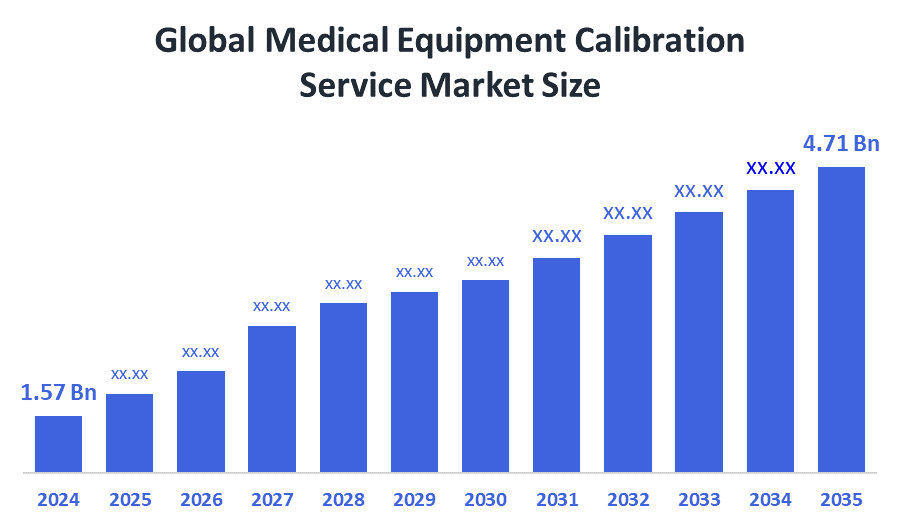
According to Decision Advisors, the Global Medical Equipment Calibration Service Market Size is expected to grow from USD 1.57 billion in 2024 to USD 4.71 billion by 2035, at a CAGR of 10.5% during the forecast period 2025-2035. The global medical equipment calibration service market operates by stringent compliance requirements which organizations like U.S. Food and Drug Administration (FDA) and International Organization for Standardization (ISO) established. Healthcare facilities are adopting regular calibration services because modern medical devices have become more complex and they need precise diagnostic results which require equipment that meets safety and legal standards.
Market Overview/ Introduction
The Global Medical Equipment Calibration Service Market offers services which verify the precise function of medical devices while meeting established healthcare standards. The scope includes calibration of diagnostic and therapeutic equipment which includes imaging systems, ventilators, infusion pumps, patient monitors and laboratory analyzers that hospitals and diagnostic centers use. The market expands due to precision diagnostics have become more popular and medical technology has grown more complex, U.S. Food and Drug Administration and International Organization for Standardization regulations have become more rigid. Healthcare providers are increasingly outsourcing calibration services to specialized firms to maintain equipment accuracy and regulatory compliance. The future of the business will benefit from digital monitoring, predictive maintenance and AI-based equipment management solutions.
- The PMDA enforces Japan’s Quality Management System (QMS) for medical devices, aligning with ISO?13485, supporting calibration, testing, and regulatory compliance, strengthening device accuracy, safety, and traceability in healthcare.
- The National Institute of Standards and Technology (NIST) manages federal laboratory accreditation programs, including NVLAP, ensuring ISO/IEC?17025-compliant calibration services, measurement traceability, and regulatory compliance for medical equipment.
Notable Insights: -
- Asia-Pacific holds the largest regional market share approximately 24% in the global medical equipment calibration service market
- North America is the fastest growing region market share approximately 38% in the global medical equipment calibration service market
- By service type, the preventive maintenance segment held a dominant position approximately 11% in terms of market share in 2025.
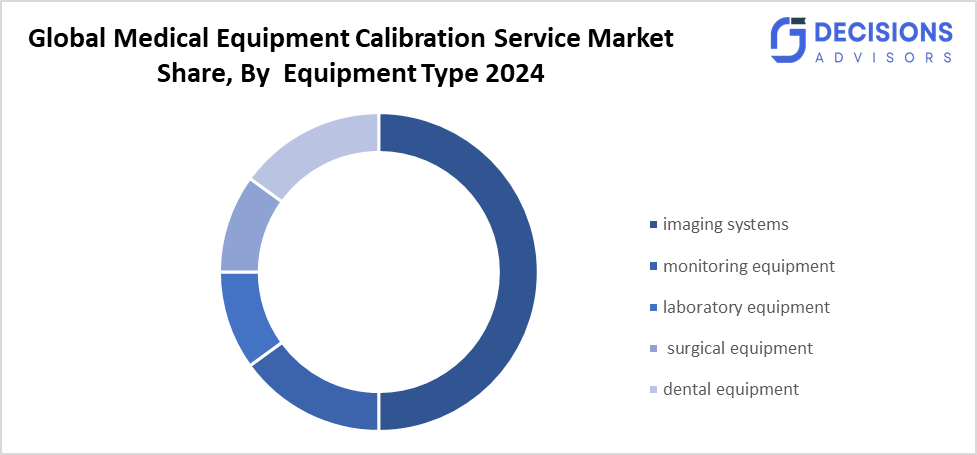
- By equipment type, imaging systems segment is the dominating accounting for approximately 12% of the global market share in 2025.
- The compound annual growth rate of the global medical equipment calibration service market is 10.5%.
- The market is likely to achieve a valuation of USD 4.71 Billion by 2035.
What is role of technology in grooming the market?
Technology is rapidly advancing and shaping the global medical equipment calibration service market by driving efficiency, accuracy and increase service implementation. Digital innovation through IoT-enabled monitoring which achieves 26% adoption in new contracts, cloud-based calibration tracking and predictive maintenance creates faster turnaround times and increases equipment availability. About 66% of facilities currently operate software-based calibration systems instead of traditional manual log methods. The combination of automation together with analytics creates multiple benefits due to it decreases errors while enabling organizations to meet their regulatory obligations which results in better calibration systems and market expansion.
Market Drivers
The global medical equipment calibration service market is driven by rising adoption of advanced medical devices which include AI-integrated imaging and autonomous ultrasound systems along with global medical device shipments that will exceed 530 billion in 2024. Stringent regulatory standards (ISO?13485, ISO?17025, FDA, EU MDR) compel hospitals and manufacturers to maintain precise calibration which increases demand for calibration services. Approximately 45% of total calibration volumes are now handled through mobile and third-party calibration services which provide better access to remote areas and faster service times. IoT-enabled predictive calibration and cloud-based tracking systems improve operational efficiency while government programs such as FDA ASCA and CSIR-NPL and PMDA QMS have established new infrastructure. The market will grow at a rate between 12% to 13% compound annual growth rate until 2030 due to rising healthcare expenditures and increasing emphasis on patient safety.
Restrain
The market experiences limitations due to high operational expenses for advanced calibration equipment and software and expert personnel training restrict small hospital facilities and developing market regions from adopting these technologies. International service providers spend more time and resources to achieve compliance due to countries have different regulatory requirements which create complicated compliance processes. Medical facilities that depend on their own calibration equipment together with extended product replacement times, which doctors use for their equipment testing, create a situation where they need less outside medical device service. The increasing demand for accuracy and compliance-focused calibration services will experience market penetration delays due to these factors.
Competitive Analysis:
The report offers the appropriate analysis of the key organizations/companies involved within the medical equipment calibration service market, along with a comparative evaluation primarily based on their product of offering, business overviews, geographic presence, enterprise strategies, segment market share, and SWOT analysis. The report also provides an elaborative analysis focusing on the current news and developments of the companies, which includes product development, innovations, joint ventures, partnerships, mergers & acquisitions, strategic alliances, and others. This allows for the evaluation of the overall competition within the market.
Top Companies in Global Medical Equipment Calibration Service Market
- Tektronix, Inc.
- Fluke Biomedical
- Transcat, Inc.
- Trescal
- NS Medical Systems
- JM Test Systems
- Biomedical Technologies Inc.
- JPen Medical
- TAG Medical
- Keysight Technologies
- MTS Systems Corporation
- Beamex Oy Ab
- AMETEK, Inc.
- Eurofins Scientific
- SGS SA
Government Initiatives
|
Country |
Key Government Initiatives |
|
UK |
In 2026, the UK government is implementing a major update to the UK Medical Device Regulations, introducing strengthened pre?market and post?market requirements to enhance patient safety, align with international standards, and support MedTech innovation, impacting calibration and compliance practices across the sector. |
|
US |
The U.S. Food and Drug Administration mandates periodic testing under 21 CFR Part 820 and supports the ASCA program, while National Institute of Standards and Technology provides traceability standards ensuring reliable calibration and measurement accuracy. |
|
India |
India’s National Medical Devices Policy 2023 aims to accelerate growth of the medical device sector through regulatory streamlining, infrastructure development, R&D support, and human resource development while improving quality and safety standards for medical technologies |
Study on the Supply, Demand, Distribution, and Market Environment of Medical Equipment Calibration Service Market
The supply chain for the global medical equipment calibration service market consists of original equipment manufacturers, third-party calibration service providers, and hospital laboratories that conduct their own calibrations. In-house services represent approximately 43% of total service volume, while third-party providers contribute approximately 38%, offering cost-efficient and faster calibration solutions. The distribution of services takes place through three methods which include on-site services and laboratory services and digital calibration systems, while on-site services generate approximately 60% of total revenue. Organizations operate according to compliance requirements which stem from U.S. Food and Drug Administration regulations and ISO/IEC 17025 standard requirements. The market distribution in North America reaches approximately 38%, while Asia-Pacific exhibits the most rapid growth.
Price Analysis and Consumer Behaviour Analysis
The medical equipment calibration service market establishes its pricing structure through three primary factors which include the complexity of medical devices and their calibration needs and the governing regulations. Advanced imaging systems require calibration services which can cost more than USD 12,000 for each maintenance session while standard devices need basic equipment maintenance. The requirement for special equipment and licensed technicians to operate high-end equipment results in elevated service expenses. Most hospitals budget only 3% to 5% of their total operational expenses for clinical engineering and calibration work. Hospitals and diagnostic laboratories make their purchasing choices based on equipment reliability and regulatory compliance with more than 80% of hospitals using preventive calibration programs to achieve 20% to 30% equipment uptime reduction. Healthcare providers increasingly prefer multi-vendor service contracts and third-party providers to achieve 10% to 15% cost savings and faster service turnaround.
Market Segmentation
The medical equipment calibration service market share is classified into service type, equipment type, and by customer type
- The preventive maintenance segment dominated the market in 2024, and is projected to grow at a substantial CAGR of approximately 11% during the forecast period.
Based on the service type, the medical equipment calibration service market is divided into routine calibration, preventive maintenance, repair and corrective maintenance, and performance validation and testing. Among these, the preventive maintenance segment dominated the market in 2024, and is projected to grow at a substantial CAGR of approximately 11% during the forecast period. The 2024 medical equipment calibration market showed its largest share through preventive maintenance due to hospitals used this method to decrease downtime while achieving ISO 13485, FDA and EU MDR compliance and keeping their equipment operating correctly.
- The imaging systems segment accounted for the largest share in 2024, and is anticipated to grow at a significant CAGR of approximately 12% during the forecast period.
Based on the equipment type, the medical equipment calibration service market is divided into imaging systems, monitoring equipment, laboratory equipment, surgical equipment, and dental equipment. Among these, the supermarkets and hypermarkets segment accounted for the largest share in 2024, and is anticipated to grow at a significant CAGR of approximately 12% during the forecast period. Imaging devices such as MRI, CT, X-ray, and ultrasound systems are high-value, technologically complex, and widely used across hospitals and diagnostic centers, requiring The growth of the company is driven by factors which include the rising use of advanced imaging technologies and the implementation of artificial intelligence in diagnostic processes, the expansion of healthcare facilities and the need for businesses to use third-party mobile calibration services that help reduce equipment downtime.
- The hospitals and clinics segment dominated the market in 2024, and is projected to grow at a substantial approximately 11.5%CAGR during the forecast period.
Based on the customer type, the medical equipment calibration service market is divided into hospitals and clinics, diagnostic laboratories, medical device manufacturers, research and academic institutions and government agencies. Among these, the hospitals and clinics segment dominated the market in 2024, and is projected to grow at a substantial approximately 11.5%CAGR during the forecast period. the global medical equipment calibration service market was mainly controlled by the hospitals and clinics segment during 2024 due to medical facilities needed to calibrate their critical devices multiple times to maintain accurate measurement, operational safety and to meet legal requirements. The global healthcare expenditure which surpassed 9.5 trillion in 2024, drives the market demand for advanced medical equipment, on-site services and third-party calibration services, which will grow at a compound annual growth rate between 11% and 12% until 2035.
Strategies to Implement for Growth of the Market in Non-Leading Regions
The medical equipment calibration service market will experience growth in non-leading regions through the development of local calibration facilities and mobile calibration units which will enable them to support distant hospitals. The shortage of certified technicians requires governments and private providers to create regional calibration laboratories together with training programs. The implementation of digital calibration platforms together with IoT-based monitoring and cloud tracking systems will enhance both service efficiency and compliance requirements. The collaboration between global calibration companies and local healthcare organizations will create new market opportunities for both parties. The implementation of subsidies together with regulatory awareness programs and public–private partnerships will motivate hospitals to perform regular equipment calibration which will result in better equipment performance and patient safety and improved healthcare outcomes in developing countries.
Regional Segment Analysis of the Spirits Market
- North America (U.S., Canada, Mexico)
- Europe (Germany, France, U.K., Italy, Spain, Rest of Europe)
- Asia-Pacific (China, Japan, India, Rest of APAC)
- South America (Brazil and the Rest of South America)
- The Middle East and Africa (UAE, South Africa, Rest of MEA)
Asia Pacific is anticipated to hold the largest share approximately 24% of the medical equipment calibration service market over the predicted timeframe.
Asia Pacific is anticipated to hold the largest share of the Medical Equipment Calibration Service Marketover the predicted timeframe. The Medical Equipment Calibration Service Market will experience its largest market share in Asia Pacific during the upcoming prediction period because of the fast development of healthcare systems and the increasing use of medical devices. In 2026, Asia Pacific represented approximately 24% of the global market and is expected to grow at a CAGR of 11.35% through 2035, which will make it one of the fastest growing regions. The hospital capacity growth, diagnostic volume increase, government standards improvement initiatives and digital calibration tool usage by 57% of large hospitals drive this growth. The healthcare system expansion through strong investment and the middle-class growth in demand for advanced diagnostic services drive service adoption.
North America is expected to grow at a rapid CAGR approximately 38% in the medical equipment calibration service market during the forecast period.
The medical equipment calibration service market in North America will experience rapid growth during the forecast period due to the region has established healthcare systems which include advanced medical equipment and needs to follow strict regulatory standards. The North American market had a 2026 market share approximately 38% which equated to a market value between USD 0.9 billion and USD 1.1 billion and it will grow at a compound annual growth rate between 12% and 13% until 2035. The market expands because more hospitals in the United States start using AI-based imaging systems together with IoT devices for real-time monitoring and their partnerships with external calibration providers. The regional market expands because predictive maintenance requirements and cloud-based calibration tracking systems become more popular.
Europe is the 3rd largest region to grow in the medical equipment calibration service market during the region.
European countries enforce strict regulatory standards which include the EU Medical Device Regulation (MDR) and ISO 17025 requirements that demand hospitals to conduct regular and documented equipment calibration procedures. The demand for professional calibration services emerges from hospitals and diagnostic centers, which prioritize device accuracy and patient safety. Market expansion receives backing from both high healthcare expenditures, which will reach approximately 2.3 trillion in 2024, and advanced hospital infrastructure. The market benefits from third-party and mobile calibration services because they provide organizations with affordable and timely equipment maintenance solutions. Digital calibration tools with Internet of Things (IoT) capabilities enable organizations to enhance their equipment monitoring processes and predictive maintenance systems and documentation procedures.
Future Market Trends in Global Medical Equipment Calibration Service Market: -
- AI?Driven Calibration Optimization
Artificial intelligence and machine learning will increasingly be used to analyze device performance data and predict calibration needs and automate scheduling which will decrease equipment downtime while improving maintenance efficiency for complex medical equipment.
- Expansion of Virtual and Remote Calibration Services
Remote calibration will enable technicians to assist on-site staff by using augmented reality (AR) guidance and secure digital connections and IoT monitoring from their centralized hubs which will increase accessibility while decreasing service costs.
- Standardization and Regulatory Harmonization
Healthcare facilities will adopt routine and advanced calibration services because global calibration standards and regulatory frameworks including ISO 13485 ISO 17025 FDA and EU MDR will simplify compliance across different regions while providing standardized documentation and quality benchmarks.
Recent Development
- In January 2026, CSIR?National Physical Laboratory inaugurated two apex calibration facilities—strengthening India’s National Metrology Institute role by providing traceable measurements for research, industry, environmental monitoring, and biomedical metrology, reducing import reliance and supporting medical device quality and patient safety
- In May 2025, Philips partnered with Evidia to install sustainable Ambition BlueSeal MRI, CT?5300?Premium, and advanced imaging systems at Aleris Elisabeth Hospital, Uppsala, Sweden. These eco?friendly diagnostic systems will require updated calibration routines to maintain accuracy and performance, driving demand for specialized medical equipment calibration services.
- In March–April 2025, Siemens Healthineers and Tower Health entered a 10?year Value Partnership to standardize imaging equipment across the Tower Health network and embed full lifecycle calibration, maintenance, and digital tools, enhancing operational consistency and diagnostic accuracy
- In April 2024, IIT Madras launched India’s first mobile medical device calibration facility under the Anaivarukkum IITM initiative, providing ISO?standard calibration for devices in remote hospitals, enhancing access, accuracy, and cost-efficiency, supporting the Global Medical Equipment Calibration Service Market.
- In April 2024, Fluke Corporation launched the Fluke 9500C Oscilloscope Calibrator, offering automated, high-accuracy multi-channel calibration (<4?GHz), improving throughput, reliability, and precision in medical equipment calibration labs globally.
How is Recent Developments Helping the Market?
The global medical equipment calibration service market experiences major enhancements through recent developments which increase service delivery capabilities and extend market presence to additional areas while boosting operational benefits. Cloud-based tracking and IoT remote monitoring systems now experience growing adoption rates which track between 26% and 55% of new customer contracts that will begin in 2024 due to these systems help businesses reduce equipment downtime while providing their calibration experts with advanced predictive capabilities. More than 45% of calibration work now depends on third-party and OEM service models which help organizations achieve better turnaround times while meeting ISO 17025 and FDA requirements. The market efficiency of mobile, automated calibration innovations together with their ability to enhance service quality and coverage across all international markets.
Market Segment
This study forecasts revenue at global, regional, and country levels from 2020 to 2035. Decision Advisors has segmented the medical equipment calibration service market based on the below-mentioned segments:
Global Medical Equipment Calibration Service Market, By Service Type
- Routine Calibration
- Preventive Maintenance
- Repair and Corrective Maintenance
- Performance Validation and Testing
Global Medical Equipment Calibration Service Market, By Equipment Type
- Imaging Systems (X-ray, Ultrasound, MRI, CT)
- Monitoring Equipment (Patient Monitors, Defibrillators)
- Laboratory Equipment (Chemistry Analyzers, Blood Gas Analyzers)
- Surgical Equipment (Laser Systems, Surgical Robots)
- Dental Equipment
Global Medical Equipment Calibration Service Market, By Customer Type
- Hospitals and Clinics
- Diagnostic Laboratories
- Medical Device Manufacturers
- Research and Academic Institutions
- Government Agencies
Global Medical Equipment Calibration Service Market, By Regional Analysis
- North America
- US
- Canada
- Mexico
- Europe
- Germany
- UK
- France
- Italy
- Spain
- Russia
- Rest of Europe
- Asia Pacific
- China
- Japan
- India
- South Korea
- Australia
- Rest of Asia Pacific
- South America
- Brazil
- Argentina
- Rest of South America
- Middle East & Africa
- UAE
- Saudi Arabia
- Qatar
- South Africa
- Rest of the Middle East & Africa
Frequently Asked Questions (FAQ)
Q1. How is predictive maintenance changing calibration schedules for advanced medical devices?
A: The system employs IoT sensors and AI analytics to conduct real-time equipment monitoring which produces calibration schedules that adapt according to equipment usage. The system achieves a 20 to 30 percent reduction in downtime while maintaining compliance with regulations who require high-precision equipment to function correctly especially MRI and CT systems.
Q2. What role do mobile “labs on wheels” play in expanding calibration access in rural and emerging markets?
A: Mobile calibration units deliver on-site services to distant hospitals which results in a 40-50% reduction of transportation costs and operational time while they enhance access to essential equipment repairs in remote areas.
Q3. How are IoT and cloud-based tracking systems improving calibration compliance across multi-hospital networks?
A: The system allows cross-site calibration records to be monitored through its three features, which include centralized scheduling and real-time monitoring and automated alerts. The system enables organizations to follow regulations more effectively while decreasing the chances of missing or postponing calibration activities.
Q4. Can calibration services reduce operational costs and energy consumption for large hospitals?
A: Yes. The regular application of preventive and predictive calibration procedures results in reduced unexpected equipment breakdowns which decrease maintenance costs between 10 and 15% while the equipment operates at optimal energy efficiency to achieve sustainability and operational performance.
Q5. How is the rise of AI-integrated diagnostic equipment influencing specialized calibration services?
A: The AI-enabled imaging and monitoring equipment needs precise calibration procedures for its hardware components and software algorithms because of their increased operational demands. The providers have developed AI-assisted calibration tools which help their customers achieve better accuracy measurement results and compliance requirements while reducing service delivery time.
Check Licence
Choose the plan that fits you best: Single User, Multi-User, or Enterprise solutions tailored for your needs.
We Have You Covered
- 24/7 Analyst Support
- Clients Across the Globe
- Tailored Insights
- Technology Tracking
- Competitive Intelligence
- Custom Research
- Syndicated Market Studies
- Market Overview
- Market Segmentation
- Growth Drivers
- Market Opportunities
- Regulatory Insights
- Innovation & Sustainability
Report Details
| Scope | Global |
| Pages | 210 |
| Delivery | PDF & Excel via Email |
| Language | English |
| Release | Apr 2026 |
| Access | Download from this page |