
Global Medical Equipment Cooling Market
 |
Pages:
210
|
Pages:
210
Global Medical Equipment Cooling Market Size, Share, By Type (Liquid-based Cooling, Air-based Cooling), By Compressor (Scroll Compressors, Screw Compressors, Centrifugal Compressors, Reciprocating Compressors), By Configuration (Packaged Systems, Modular Systems, Split Systems) and By Region (North America, Europe, Asia-Pacific, Latin America, Middle East, and Africa), Analysis and Forecast 2025-2035.
REPORT COVERAGE
Global
Market Snapshot
- Market Size (2025): USD 464.8 Billion
- Projected Market Size (2035): USD 723.9 Billion
- Compound Annual Growth Rate (CAGR): 4.53%
- Largest Regional Market: North America
- Fastest Growing Region: Asia-Pacific
- 3rd Largest Region: Europe
- Base Year: 2025
- Historical Period: 2021–2024
- Forecast Period: 2025–2035
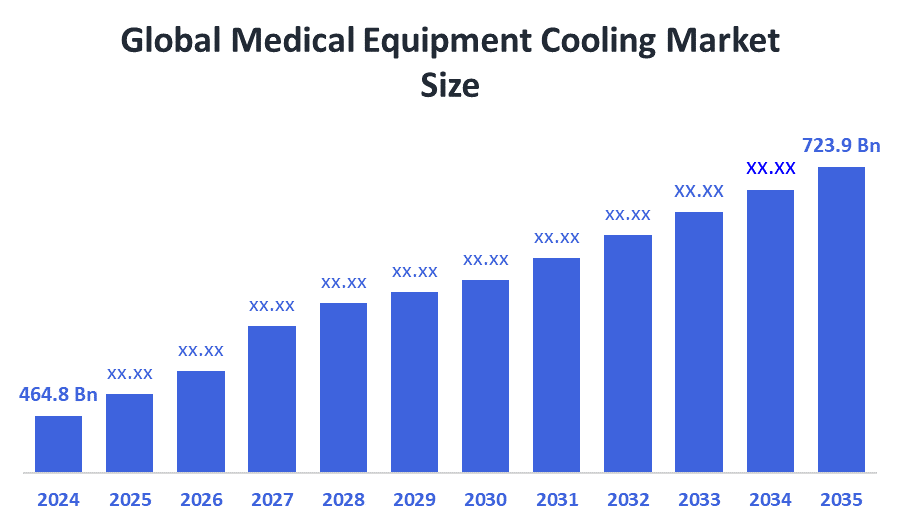
According to Decision Advisors, the Global Medical Equipment Cooling Market Size is expected to grow from USD 464.8 billion in 2025 to USD 723.9 billion by 2035, at a CAGR of 4.53% during the forecast period 2025-2035. It is Motivated by the growing incidence of chronic diseases, an elderly demographic, and greater investments in hospital infrastructure, the market is moving toward effective liquid-based cooling systems, Growing Demand for Advanced Imaging, Hospital Infrastructure Expansion.
Market Overview/ Introduction
Cooling systems for medical equipment are intended to eliminate heat, control humidity, and ensure thermal stability for essential medical devices that generate a lot of wattage. These systems avert overheating, which helps to maintain the longevity and precision of diagnostic imaging systems (MRI, CT) and supporting laboratory equipment. Technology advancement is playing a crucial role in driving the medical equipment cooling market, with the rising adoption of smart cooling devices that enable precise temperature control and efficient performance. Creation of intelligent, preemptive monitoring systems that forecast component failures and enhance energy efficiency, leading to lower operational costs and better patient safety. Modular chillers are becoming more popular due to their flexibility, quicker installation, and reduced maintenance needs especially in smaller clinics and specialized applications.
- The American Rescue Plan Act of 2021 allocated USD 1.9 trillion to strengthen U.S. healthcare infrastructure, indirectly promoting adoption of advanced medical devices and supporting demand for efficient cooling systems in hospitals and clinical environments.
- India’s Budget 2024–25 allocated over USD 10 billion to the healthcare sector, supporting infrastructure modernization and indirectly driving demand for advanced imaging equipment and associated cooling systems in hospitals and diagnostic centers.
- In Singapore, Ministry of Health Singapore continues to invest in healthcare infrastructure and advanced diagnostic technologies, increasing the adoption of MRI and CT scanners and driving demand for sophisticated cooling solutions to ensure reliable medical equipment performance.
Notable Insights: -
- North America holds the largest regional market share approximately 45% in the Medical Equipment Cooling.
- Asia-Pacific is the fastest growing region in the medical equipment cooling the share of 34.8%.
- By compressor, the direct to consumer segment accounted for the largest share in 2025, and is anticipated to grow at a significant CAGR of approximately 43.8% during the forecast period.
- The compound annual growth rate of the medical equipment cooling is 4.53%.
- The market is likely to achieve a valuation of USD 723.9 Billion by 2035.
What is role of technology in grooming the market?
Technology is crucial for the progress of the global medical equipment cooling market, as it allows for greater efficiency, dependable operations, and accuracy in thermal management systems that underpin contemporary healthcare infrastructure. The widespread use of high-intensity imaging modalities like MRI and CT scanners has increased thermal loads, prompting the adoption of advanced cooling technologies, especially liquid-based systems, which make up almost 62% of installations due to their superior heat dissipation capabilities. At the same time, the adoption of IoT-enabled sensors and advanced monitoring systems is transforming maintenance procedures. About 22% of newly installed systems feature smart functionalities that utilize predictive analytics to decrease downtime by nearly 14%.
How is Recent Developments Helping the Market?
Recent advancements are greatly bolstering the Global Medical Equipment Cooling Market by fostering innovation, enhancing efficiency, and ensuring regulatory alignment within healthcare infrastructure. With the development of cooling technologies such as compact liquid cooling systems and thermoelectric solutions, effective thermal management is becoming possible for diagnostic and surgical equipment of ever-increasing sophistication. The increasing incorporation of digital health platforms has expedited the uptake of smart cooling systems that feature IoT-based monitoring and predictive maintenance functions, thereby enhancing their operational efficiency and uptime. Moreover, the enhancement of healthcare infrastructure and the proliferation of diagnostic centers are generating an ongoing need for dependable cooling solutions.
Market Drivers
The swift growth of sophisticated diagnostic and therapeutic technologies are responsible for the generation of considerable heat and in need of effective thermal management systems which is fueling the global medical equipment cooling market. A key driver of growth is the rising use of high-performance imaging devices like MRI and CT scanners in hospitals and diagnostic centers. Moreover, increased investments in healthcare infrastructure especially in emerging markets are facilitating the use of advanced medical devices and, as a result, increasing the need for dependable cooling solutions. The increasing focus on the durability of equipment, operational efficiency, and patient safety is promoting the adoption of advanced cooling technologies.
Restrain
There are significant constraints on the global medical equipment cooling market, because of the considerable upfront capital required for sophisticated cooling systems and their incorporation into intricate medical devices. Furthermore, the costs associated with energy consumption and ongoing maintenance needs can put a strain on healthcare budgets. Limited technical expertise in emerging regions, along with compatibility challenges posed by legacy equipment, further impede widespread adoption and restrict overall market growth.
Competitive Analysis:
The report offers the appropriate analysis of the key organizations/companies involved within the Medical Equipment Cooling market, along with a comparative evaluation primarily based on their product of offering, business overviews, geographic presence, enterprise strategies, segment market share, and SWOT analysis. The report also provides an elaborative analysis focusing on the current news and developments of the companies, which includes product development, innovations, joint ventures, partnerships, mergers & acquisitions, strategic alliances, and others. This allows for the evaluation of the overall competition within the market.
Top Companies in Global Medical Equipment Cooling Market
- Whaley Products Inc.
- Glen Dimplex Group
- Parker Hannifin Corporation
- Laird Thermal Systems
- Cold Shot Chillers
- Drake Refrigeration Inc.
- Filtrine Manufacturing Company
- General Air Products Inc.
- Legacy Chiller Systems Inc.
- Lytron Inc.
- Motivair Corporation
- American Chillers
- Haskris
- Johnson Thermal Systems
- KKT Chillers.
Government Initiatives
|
Country |
Key Government Initiatives |
|
UK |
Sustainability and eco-design regulations in the UK and EU mandate high energy efficiency and low-GWP refrigerants, including limits around GWP ≤150, driving adoption of sustainable cooling systems and innovation across medical equipment and hospital infrastructure environments. |
|
US |
The need to prevent thermal damage in MRI machines, CT scanners, and linear accelerators is critical, with nearly 72% of OEMs globally integrating built-in cooling solutions, supported by government regulations and standards ensuring safety, efficiency, and reliable medical system performance. |
|
China |
China’s NMPA and Made in China policies promote domestic high-end medical device manufacturing to reduce import dependency, driving innovation and increased adoption of advanced cooling technologies essential for reliable performance of medical equipment. |
Market Segmentation
The medical equipment cooling market share is classified into type, compressor, and configuration.
- The liquid-based cooling segment dominated the market in 2025, and is projected to grow at a substantial CAGR of approximately 58% during the forecast period.
Based on the type, the medical equipment cooling market is divided into liquid-based cooling, air-based cooling. Among these, the liquid-based cooling segment dominated the market in 2025, and is projected to grow at a substantial CAGR of approximately 58% during the forecast period. This pre-eminence is fueled by its better cooling efficiency for high-performance, heat-producing diagnostic tools such as MRI and CT scanners, as well as reduced noise levels, reliable performance, and enhanced thermal transfer rates.
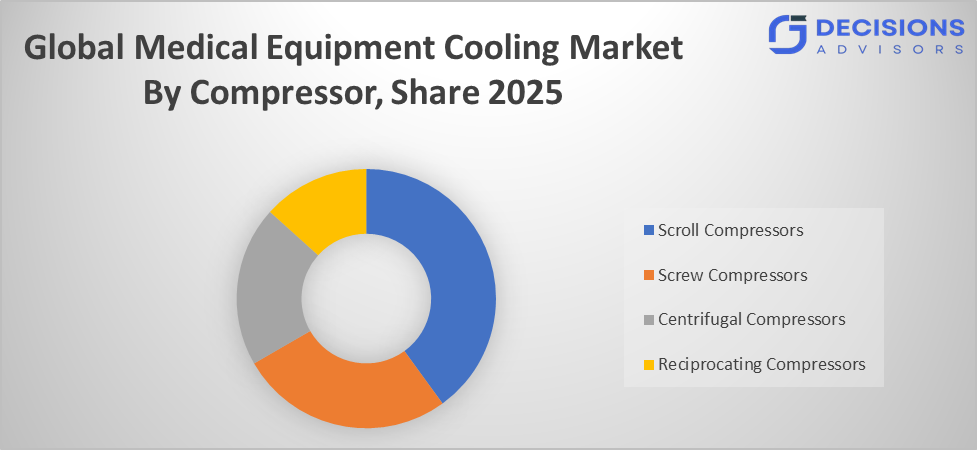
- The scroll compressors segment accounted for the largest share in 2025, and is anticipated to grow at a significant CAGR of approximately 43.8% during the forecast period.
Based on the compressor, the medical equipment cooling market is divided into scroll compressors, screw compressors, centrifugal compressors, reciprocating compressors. Among these, the scroll compressors segment accounted for the largest share in 2025, and is anticipated to grow at a significant CAGR of approximately 43.8 % during the forecast period. It is because of their high efficiency, low noise levels, and minimal vibration. These elements are essential for precision cooling in sensitive clinical environments such as imaging systems, offering high reliability and reduced maintenance as well. Due to their calm and constant functioning, they are well-suited for use in hospitals, where they guarantee that vibrations do not interfere with delicate medical equipment such as MRIs and CT scans.
- The packaged systems segment dominated the market in 2025, and is projected to grow at a substantial CAGR of approximately 45% during the forecast period.
Based on the configuration, the medical equipment cooling market is divided into packaged systems, modular systems, and split systems. Among these, the packaged systems segment dominated the market in 2025, and is projected to grow at a substantial CAGR of approximately 45% during the forecast period. Among original equipment manufacturers (OEMs) and hospitals enhancing their imaging facilities, the prevalence of packaged systems is especially marked, as they offer a combination of high performance and easy installation. Packaged systems provide consistent and accurate temperature regulation for delicate medical devices with high heat loads, thereby improving their reliability and lifespan.
Strategies to Implement for Growth of the Market in Non-Leading Regions
Growth in the medical equipment cooling market across non-leading regions can be achieved through a mix of affordability, localization, and strategic collaboration. Companies should focus on developing cost-effective, energy-efficient, and modular cooling systems suited for mid-tier hospitals and diagnostic centers with budget constraints. Strengthening partnerships with OEMs and healthcare providers enables seamless integration with imaging systems such as MRI and CT scanners, improving adoption rates. Expanding local service networks and providing technical training can address skill gaps and build customer confidence. Additionally, leveraging government healthcare investments and infrastructure expansion programs will open new opportunities. Promoting retrofit solutions for aging equipment and introducing IoT-enabled cooling systems for predictive maintenance can further enhance market penetration and long-term growth.
Regional Segment Analysis of the Medical Equipment Cooling Market
- North America (U.S., Canada, Mexico)
- Europe (Germany, France, U.K., Italy, Spain, Rest of Europe)
- Asia-Pacific (China, Japan, India, Rest of APAC)
- South America (Brazil and the Rest of South America)
- The Middle East and Africa (UAE, South Africa, Rest of MEA)
North America is anticipated to hold the largest share with share of approximately 45% of the medical equipment cooling market over the predicted timeframe. It is propelled by the area boasts a comprehensive network of hospitals and imaging facilities that emphasize cutting-edge technology, resulting in a significant need for sophisticated, effective cooling systems to guarantee the uninterrupted functioning of high-performance imaging devices. The growing number of elderly individuals and the escalating incidence of cancer, cardiovascular diseases, and neurological disorders make it essential to carry out diagnostic procedures (such as MRI and CT scans) with regularity. These procedures demand dependable cooling systems to handle the significant heat produced during their operation.
Asia Pacific is expected to grow at a rapid CAGR in the medical equipment cooling market during the forecast period. It is poised because of the increasing investments in healthcare infrastructure, the aging demographic, and the escalation of chronic diseases. Liquid-based cooling systems, holding approximately 54.5% of the market share, are driving efficiency in imaging and diagnostic devices, with China, Japan, and India dominating this sector. The rise in cancer and other chronic diseases has led to a spike in diagnostic imaging procedures, necessitating sophisticated and dependable cooling systems for high-performance equipment.
Europe is the 3rd largest region to grow in the medical equipment cooling market during the region. The Europe market is fueled because high prevalence of chronic diseases and a rapidly aging population, resulting in an increase in the use of MRI, CT, and PET scanners. These devices produce considerable heat, necessitating sophisticated liquid-based cooling systems to ensure precision and avoid damage The market totally holds 30% market share.
Future Market Trends in Medical Equipment Cooling Market: -
- Technological Integration (AI & IoT):
Next-gen cooling systems are incorporating AI, robotics, and IoT to improve performance monitoring, enable real-time analytics, and facilitate predictive maintenance, thereby minimizing downtime.
- Energy Efficiency & Sustainability:
A notable effort is underway to adopt environmentally friendly refrigerants with low Global Warming Potential (GWP) and energy-efficient systems in order to meet international sustainability objectives and more stringent regulations.
??????? - Rapid Growth of Scroll Compressors:
Among the various types of compressors, scroll compressors are anticipated to exhibit the highest growth rate owing to their excellent heat rejection abilities, diminished vibration, and reduced noise levels
Recent Development
- In October 2024, General Air Products showcased advanced water-cooled chiller systems for diagnostic imaging applications, enhancing energy efficiency, cooling reliability, and supporting stable performance of critical medical equipment in hospital environments.
- In September 2024, Pelonis Technologies introduced advanced air-cooled heat exchangers for operating room devices and patient monitoring systems, enhancing energy efficiency, temperature stability, and ensuring reliable performance in sensitive healthcare environments.
- In January 2024, Emerson Climate Technologies partnered with an AI firm to develop intelligent chillers using machine learning to predict cooling demand, enhance energy efficiency, and ensure reliable performance for advanced medical equipment cooling systems.
- In January 2024, Star Refrigeration partnered with GE HealthCare to deliver high-performance cooling solutions for MRI systems, aiming to reduce energy consumption, enhance efficiency, and support reliable operation of advanced medical imaging equipment.
Market Segment
This study forecasts revenue at global, regional, and country levels from 2020 to 2035. Decision Advisor has segmented the Medical Equipment Cooling market based on the below-mentioned segments:
Global Medical Equipment Cooling Market, By Type
- Liquid-based Cooling
- Air-based Cooling
Global Medical Equipment Cooling Market, By Compressor
- Scroll Compressors
- Screw Compressors
- Centrifugal Compressors
- Reciprocating Compressors
Global Medical Equipment Cooling Market, By Configuration
- Packaged Systems
- Modular Systems
- Split Systems
Global Medical Equipment Cooling Market, By Regional Analysis
- North America
- US
- Canada
- Mexico
- Europe
- Germany
- UK
- France
- Italy
- Spain
- Russia
- Rest of Europe
- Asia Pacific
- China
- Japan
- India
- South Korea
- Australia
- Rest of Asia Pacific
- South America
- Brazil
- Argentina
- Rest of South America
- Middle East & Africa
- UAE
- Saudi Arabia
- Qatar
- South Africa
- Rest of the Middle East & Africa
Frequently Asked Questions (FAQ)
Q. What role do compressors play in medical equipment cooling systems?
A. Compressors are critical components influencing cooling efficiency and reliability, with scroll compressors gaining traction due to their low noise, high efficiency, and superior thermal performance in medical applications.
Q. How do regulatory frameworks impact market growth?
A. Stringent regulations related to energy efficiency, environmental sustainability, and patient safety are compelling manufacturers to adopt eco-friendly refrigerants and high-performance cooling technologies, thereby fostering innovation and compliance.
Q. What strategic initiatives can support growth in emerging markets?
A. Localized manufacturing, cost-effective modular solutions, partnerships with OEMs, and leveraging government healthcare investments are key strategies to enhance market penetration in non-leading regions.
Q. Why is liquid-based cooling emerging as a dominant segment?
A. Liquid-based cooling accounts for a significant share due to its superior heat dissipation capabilities, lower noise levels, and ability to support high-performance imaging systems such as MRI and CT scanners.
Check Licence
Choose the plan that fits you best: Single User, Multi-User, or Enterprise solutions tailored for your needs.
We Have You Covered
- 24/7 Analyst Support
- Clients Across the Globe
- Tailored Insights
- Technology Tracking
- Competitive Intelligence
- Custom Research
- Syndicated Market Studies
- Market Overview
- Market Segmentation
- Growth Drivers
- Market Opportunities
- Regulatory Insights
- Innovation & Sustainability
Report Details
| Scope | Global |
| Pages | 210 |
| Delivery | PDF & Excel via Email |
| Language | English |
| Release | Mar 2026 |
| Access | Download from this page |