
Global Medical Fiber Optics Market
 |
Author:
David J
|
Pages:
200
|
Author:
David J
|
Pages:
200
Global Medical Fiber Optics Market Size, Share By Fiber Type (Glass Optical Fibers, Plastic Optical Fibers, Specialty Fibers, and Others), By Application (Endoscopy, Medical Imaging, Laser Surgery, Illumination, and Biomedical Sensing), By End User (Hospitals & Clinics, Ambulatory Surgical Centers, Diagnostic Laboratories, and Research & Academic Institutes), and By Region (North America, Europe, Asia-Pacific, Latin America, Middle East & Africa), Analysis and Forecast 2026-2035
CAGR
7.3%
REVENUE 2025
USD Billion 2.25
FORECAST 2035
USD Billion 4.55
REPORT COVERAGE
Global
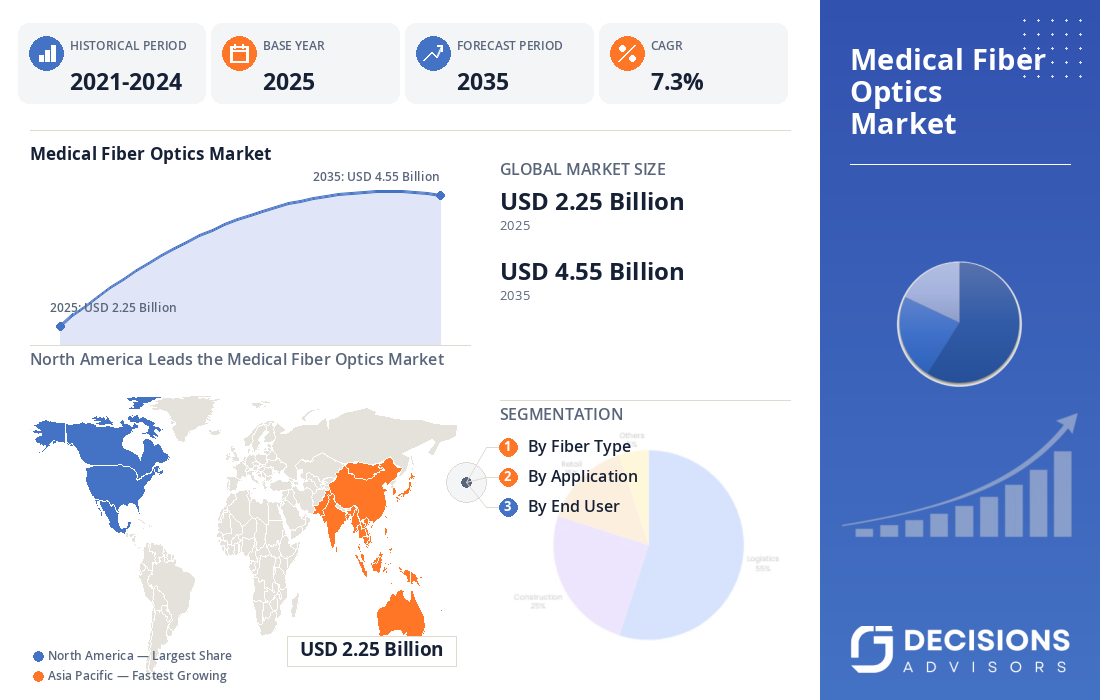
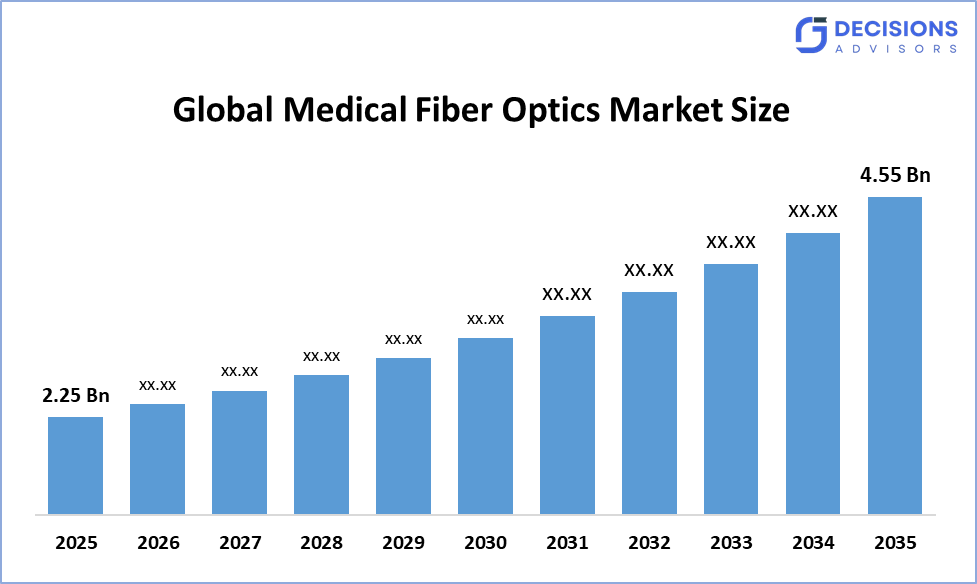
The Global Medical Fiber Optics Market Size is predicted to grow from USD 2.25 Billion in 2025 and is likely to reach around USD 4.55 Billion by 2035, with a CAGR of 7.30%. According to Decision Advisors, increasing adoption of minimally invasive procedures, advanced endoscopic imaging, catheter-based diagnostics, laser surgery, and fiber-optic biomedical sensing is driving market expansion. Fiber optics enable high-resolution imaging, illumination, laser-energy delivery, and sensing through compact medical instruments, making them increasingly important in next-generation medical devices.
Market Snapshot
- Global Medical Fiber Optics Market Size (2025): USD 2.25 Billion
- Projected Global Medical Fiber Optics Market Size (2035): USD 4.55 Billion
- Global Medical Fiber Optics Market Compound Annual Growth Rate (CAGR): 7.30%
- Largest Regional Market: North America
- 2nd Largest Region: Asia-Pacific
- Fastest Growing Region: Asia-Pacific
- Base Year: 2025
- Historical Period: 2021-2024
- Market Forecast Period: 2026-2035.
Market Overview/ Introduction
The global medical fiber optics market comprises specialized optical fibers, fiber bundles, optical cables, probes, assemblies, sensors, and related components designed for medical imaging, illumination, laser-energy delivery, diagnostics, and biomedical sensing. Medical fiber optics allow light and optical information to travel through very small and flexible pathways, supporting minimally invasive procedures where conventional optical systems may be too large or difficult to integrate. Endoscopy remains a core application, while OCT, NIRS, catheter-based imaging, laser surgery, and fiber-optic sensing are expanding the addressable market. The market is benefiting from the worldwide shift toward minimally invasive procedures, rising healthcare expenditure, aging populations, increasing chronic-disease prevalence, and technological advances in medical imaging. Medical-device manufacturers are increasingly developing smaller endoscopes, catheter-based systems, robotic surgical instruments, and single-use devices, creating demand for compact, high-performance optical components.
- United States, NIH/NIBIB supports research in optical imaging and spectroscopy, including fiber-optic imaging devices, advanced light sources, biomedical sensing, and image-guided interventions.
- Japan, Japan's medical-device innovation framework continues to support advanced medical technologies and evaluation standards for endoscopy and other minimally invasive diagnostic technologies.
- China, China's medical-device modernization policies are supporting development and commercialization of high-end medical imaging, diagnostic, and innovative medical-device technologies.
Notable Insights: -
- North America is anticipated to hold approximately 38% share of the Global Medical Fiber Optics Market over the predicted timeframe.
- Asia-Pacific is expected to grow at the fastest CAGR, reaching approximately 25% share by the end of the forecast period.
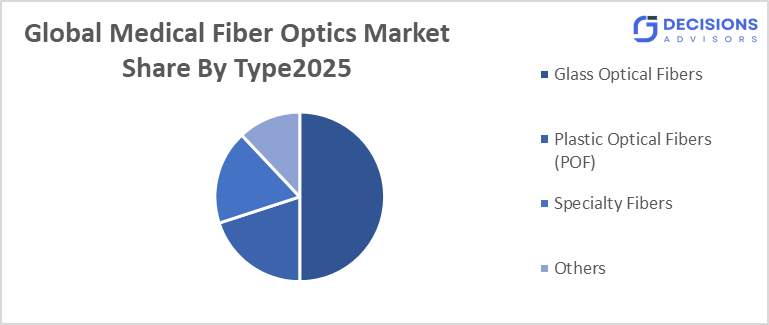
- By Fiber Type, the Glass Optical Fibers segment dominated the market and holds approximately 50% share in 2025 and is projected to grow at a substantial CAGR during the forecast period.
- By Application, the Endoscopy segment dominated the market and holds approximately 36% share in 2025 and is projected to grow at a substantial CAGR during the forecast period.
- By End User, Hospitals & Clinics dominated the market and hold approximately 58% share in 2025.
- The compound annual growth rate of the Global Medical Fiber Optics Market is 7.30%.
- The market is likely to achieve a valuation of USD 4.55 Billion by 2035.
Market Drivers
The Global Medical Fiber Optics Market is primarily driven by increasing adoption of minimally invasive surgery and diagnostic procedures. Fiber-optic systems enable physicians to illuminate, visualize, and access internal anatomical areas through narrow instruments, reducing the physical footprint of medical equipment and supporting less invasive interventions. Growing use of gastrointestinal, urological, gynecological, pulmonary, cardiovascular, and other endoscopic procedures is therefore increasing demand for optical fibers and imaging bundles. Technological development is another major driver. Medical-device manufacturers are integrating fiber optics into OCT systems, NIRS systems, laser-delivery platforms, catheter-based imaging devices, robotic surgery systems, and biomedical sensors. The development of ultra-thin fiber bundles and specialty fibers is enabling higher-resolution imaging in increasingly smaller instruments. Coherent's AxioView launch in January 2026 demonstrates the move toward catheter-ready imaging assemblies for OCT, NIRS, and multimodal procedures.
Restrain
The Global Medical Fiber Optics Market faces restraints related to high manufacturing costs, stringent medical-device qualification requirements, and technical complexity. Medical-grade fibers must meet demanding requirements for optical performance, mechanical durability, biocompatibility, sterilization compatibility, and dimensional precision. Custom optical assemblies can require specialized manufacturing equipment and extensive validation before they can be integrated into commercial medical devices. Fiber attenuation, bending losses, connector losses, mechanical stress, and sensitivity to manufacturing tolerances can also affect performance. In addition, medical-device manufacturers must manage regulatory approval and quality-management requirements, increasing development time and costs. Supply-chain dependence on specialty glass, optical coatings, precision connectors, and customized components can create additional challenges.
Competitive Analysis:
The report offers the appropriate analysis of the key organizations/companies involved within the Global Medical Fiber Optics Market, along with a comparative evaluation primarily based on their product offerings, business overviews, geographic presence, enterprise strategies, segment market share, and SWOT analysis. The report also provides an elaborative analysis focusing on the current news and developments of the companies, which includes product development, innovations, joint ventures, partnerships, mergers & acquisitions, strategic alliances, and others. This allows for the evaluation of the overall competition within the market.
Top Companies in the Global Medical Fiber Optics Market
- Coherent Corp.
- SCHOTT AG
- Molex / Phillips Medisize
- LEONI AG
- Integra LifeSciences Corporation
- Fiberoptics Technology Incorporated
- MKS Instruments / Newport
- Heraeus Holding GmbH
- Gulf Fiberoptics
- Timbercon.
Government Initiatives
|
Country |
Key Government Initiatives |
|
United States |
NIH/NIBIB programs support optical imaging, spectroscopy, biomedical sensing, and fiber-optic imaging research aimed at improving minimally invasive diagnosis and treatment |
|
Japan |
Government medical-device innovation programs and evaluation frameworks support development and commercialization of advanced endoscopy, imaging, and minimally invasive technologies |
|
China |
Medical-device modernization and innovation policies support high-end medical imaging, advanced diagnostics, and development of innovative medical devices |
Market Segmentation
The Global Medical Fiber Optics Market share is classified into fiber type, application, and end user.
- The Glass Optical Fibers segment dominated the market and holds approximately 50% share in 2025 and is projected to grow at a substantial CAGR during the forecast period.
Based on Fiber Type, the global medical fiber optics market is divided into glass optical fibers, plastic optical fibers, specialty fibers, and others. Among these, Glass Optical Fibers dominate because they provide high optical transmission, low attenuation, strong bandwidth performance, and stable performance in demanding medical applications. They are widely used for imaging bundles, endoscopic systems, laser delivery, and specialty sensing. Their optical efficiency and reliability make them particularly suitable for advanced medical devices where precision and image quality are critical.
- The Endoscopy segment accounted for the largest share of approximately 36% in 2025 and is anticipated to grow at a significant CAGR during the forecast period.
Based on Healthcare Setting, the market is divided into Hospitals, Outpatient Facilities, and Other Settings. Among these, Hospitals accounted for the largest share and held approximately 50.8% share in 2025. Hospitals utilize a broad range of reimbursed technologies across inpatient admissions, emergency departments, hospital outpatient departments, surgical procedures, diagnostic services, and intensive-care environments. Increasing surgical volumes and adoption of sophisticated technologies are supporting reimbursement activity.
- The Hospitals & Clinics segment accounted for the largest share of approximately 58% in 2025 and is anticipated to grow at a significant CAGR during the forecast period.
Based on End User, the market is divided into Hospitals & Clinics, Ambulatory Surgical Centers, Diagnostic Laboratories, and Research & Academic Institutes. Hospitals and clinics dominate because they perform a large proportion of endoscopic examinations, minimally invasive surgeries, diagnostic procedures, and laser-based treatments. These facilities also have greater access to advanced imaging and surgical technologies. Increasing replacement of older equipment and adoption of next-generation minimally invasive platforms will support continued demand.
Regional Segment Analysis of the Global Medical Fiber Optics Market
- North America (U.S., Canada, Mexico)?
- Europe (Germany, U.K., France, Italy, Spain, Netherlands, Rest of Europe).
- Asia-Pacific (China, Japan, India, Australia, South Korea, Rest of Asia-Pacific).
- South America (Brazil, Argentina, Rest of South America).
- Middle East & Africa (UAE, Saudi Arabia, South Africa, Rest of MEA).
North America is anticipated to hold approximately 38% share of the Global Medical Fiber Optics Market over the predicted timeframe.
North America is anticipated to hold approximately 38% share of the Global Medical Fiber Optics Market over the predicted timeframe. The region benefits from advanced healthcare infrastructure, high healthcare expenditure, extensive adoption of minimally invasive procedures, and a strong medical-device and photonics ecosystem. The United States is the primary contributor because of its large hospital network, high procedure volumes, medical-device R&D, and strong presence of companies such as Coherent, Integra LifeSciences, and other optical and medical-device suppliers.
Europe is expected to hold approximately 22% share during the forecast period.
Europe is expected to hold approximately 22% share during the forecast period. Germany, France, the U.K., Switzerland, Italy, and the Netherlands contribute significantly through advanced medical-device manufacturing, specialty glass, photonics research, and healthcare infrastructure. Companies such as SCHOTT and LEONI support the region's optical-component and medical-device ecosystem. The region's emphasis on advanced healthcare technologies, minimally invasive treatment, patient safety, and medical-device quality supports continued adoption.
Asia-Pacific is the fastest-growing region in the Global Medical Fiber Optics Market and is expected to reach approximately 25% share by 2035.
Asia-Pacific is the fastest-growing region in the Global Medical Fiber Optics Market and is expected to reach approximately 25% share by 2035. China, Japan, India, and South Korea are major contributors because of expanding healthcare infrastructure, increasing medical-device production, rising healthcare expenditure, and growing adoption of minimally invasive procedures. China benefits from large-scale medical-device manufacturing and a growing domestic healthcare market.
Future Market Trends in Global Medical Fiber Optics Market: -
-
- Ultra-Thin Imaging Fiber Bundles.
The development of ultra-thin imaging bundles will be an important market trend as medical-device manufacturers seek smaller and more flexible endoscopes. High fiber density and compact diameters enable manufacturers to improve visualization while maintaining small instrument profiles.
-
- Catheter-Based Multimodal Imaging.
Medical fiber optics are increasingly moving into catheter-based OCT, NIRS, and multimodal imaging. Coherent's AxioView assemblies demonstrate this trend, providing catheter-ready geometries for cardiovascular, neurovascular, and gastrointestinal applications.
-
- Growth of Fiber-Optic Biomedical Sensing.
Fiber Bragg grating and other optical sensing technologies are creating opportunities in pressure, temperature, physiological monitoring, and interventional medicine. Optical sensors can provide measurements in environments where conventional electrical sensors face electromagnetic-interference limitations.
-
- AI-Enabled Medical Imaging.
AI and advanced image-processing technologies are increasingly being combined with optical imaging. AI can assist with image interpretation, lesion detection, surgical guidance, and real-time clinical decision support, increasing the value of high-quality optical data generated by fiber-optic systems.
Recent Development
- In January 2026, Coherent Corp. launched AxioView™ imaging fiber assemblies for OCT, NIRS, and multimodal catheter-based imaging systems. The assemblies target cardiovascular, neurovascular, and gastrointestinal applications and include catheter-ready distal geometries and ISO 13485-certified manufacturing.
- In March 2025, Phillips Medisize expanded its medical fiber-optics portfolio, highlighting POLYMICRO™ and FIBERGUIDE™ specialty fiber-optic solutions, custom optical assemblies, high-power optical probes, distal-end preparation, and fiber Bragg grating optical fibers for medical sensing.
- In May 2025, Fiber Optics Group acquired FiberTech Optica, strengthening its portfolio of complex fiber-optic assemblies and expanding its North American presence. FiberTech Optica's products include custom bundles, arrays, probes, and cables used in biomedical applications.
Market Segment
This study forecasts revenue at global, regional, and country levels from 2021 to 2035. Decision Advisors has segmented the Global Medical Fiber Optics Market based on the below-mentioned segment:
Global Medical Fiber Optics Market, By Fiber Type.
- Glass Optical Fibers
- Plastic Optical Fibers
- Specialty Fibers
- Others.
Global Medical Fiber Optics Market, By Application.
- Endoscopy
- Medical Imaging
- Laser Surgery
- Illumination
- Biomedical Sensing.
Global Medical Fiber Optics Market, By End User.
- Hospitals & Clinics
- Ambulatory Surgical Centers
- Diagnostic Laboratories
- Research & Academic Institutes.
Global Medical Fiber Optics Market, By Regional Analysis.
- North America
- US
- Canada
- Mexico
- Europe
- Germany
- UK
- France
- Italy
- Spain
- Russia
- Rest of Europe
- Asia Pacific
- China
- Japan
- India
- South Korea
- Australia
- Rest of Asia Pacific
- South America
- Brazil
- Argentina
- Rest of South America
- Middle East & Africa
- UAE
- Saudi Arabia
- Qatar
- South Africa
- Rest of the Middle East & Africa
Frequently Asked Questions (FAQ)
Q. What are the major applications of medical fiber optics?
A. Major applications include endoscopy, medical imaging, laser surgery, illumination, and biomedical sensing. Fiber optics allow light, images, laser energy, and sensor signals to be delivered through compact medical instruments, making them particularly valuable for minimally invasive procedures.
Q. Why are glass optical fibers widely used in medical devices?
A. Glass optical fibers provide low optical attenuation, high transmission efficiency, strong bandwidth, and reliable performance. These properties make them suitable for demanding applications such as endoscopic imaging, laser delivery, OCT, and specialty biomedical sensing.
Q. How are medical fiber optics supporting minimally invasive surgery?
A. Fiber optics enable illumination, visualization, laser-energy delivery, and sensing through small instruments and catheters. This allows medical-device manufacturers to create smaller systems while providing physicians with high-quality visualization and guidance during minimally invasive procedures.
Q. What is driving the growth of catheter-based medical fiber optics?
A. The increasing use of OCT, NIRS, intravascular imaging, and other image-guided interventions is creating demand for miniature catheter-ready optical assemblies. Coherent's AxioView launch in 2026 specifically targets these applications.
Check Licence
Choose the plan that fits you best: Single User, Multi-User, or Enterprise solutions tailored for your needs.
We Have You Covered
- 24/7 Analyst Support
- Clients Across the Globe
- Tailored Insights
- Technology Tracking
- Competitive Intelligence
- Custom Research
- Syndicated Market Studies
- Market Overview
- Market Segmentation
- Growth Drivers
- Market Opportunities
- Regulatory Insights
- Innovation & Sustainability
Report Details
| Scope | Global |
| Pages | 200 |
| Delivery | PDF & Excel via Email |
| Language | English |
| Release | Aug 2026 |
| Access | Download from this page |