
Global Medical Linear Accelerator Market
 |
Author:
David J
|
Pages:
200
|
Author:
David J
|
Pages:
200
Global Medical Linear Accelerator Market Size, Share By Energy Type (Low-Energy, High-Energy), By Application (Hospitals, Clinics, Research Institutes, Medical Schools), By Technology (Intensity-Modulated Radiation Therapy, Volumetric Modulated Arc Therapy, Image-Guided Radiation Therapy, Stereotactic Radiosurgery/Stereotactic Body Radiation Therapy), and By Region (North America, Europe, Asia-Pacific, Latin America, Middle East & Africa), Analysis and Forecast 2026-2035
CAGR
11.4%
REVENUE 2025
USD Billion 5.5
FORECAST 2035
USD Billion 16.2
REPORT COVERAGE
Global
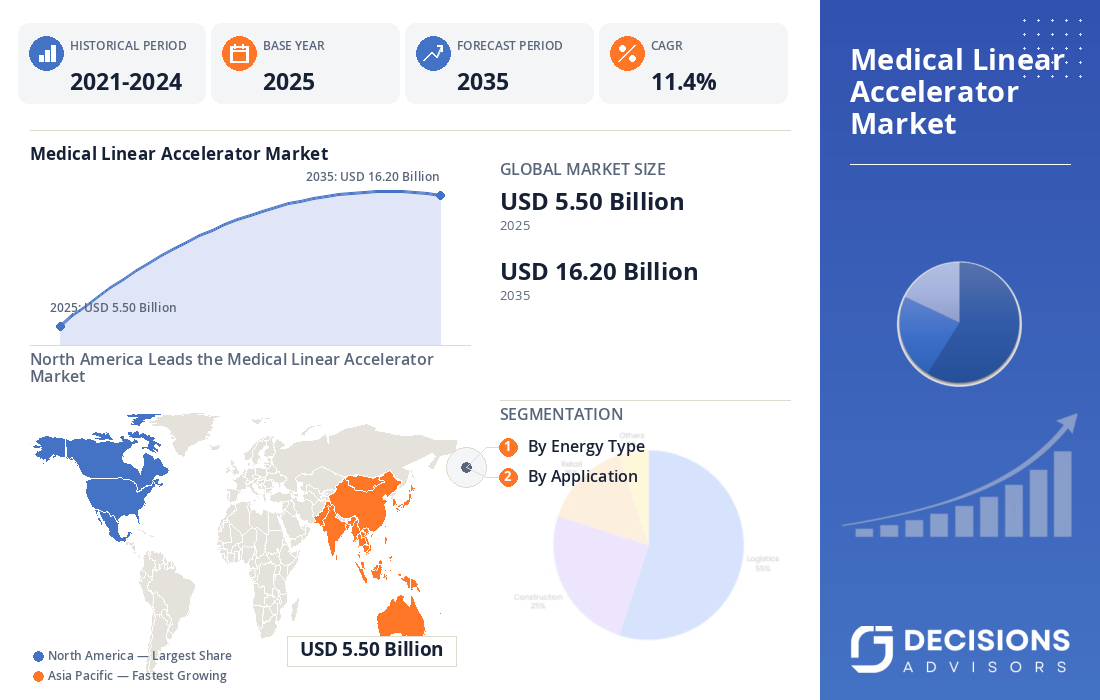
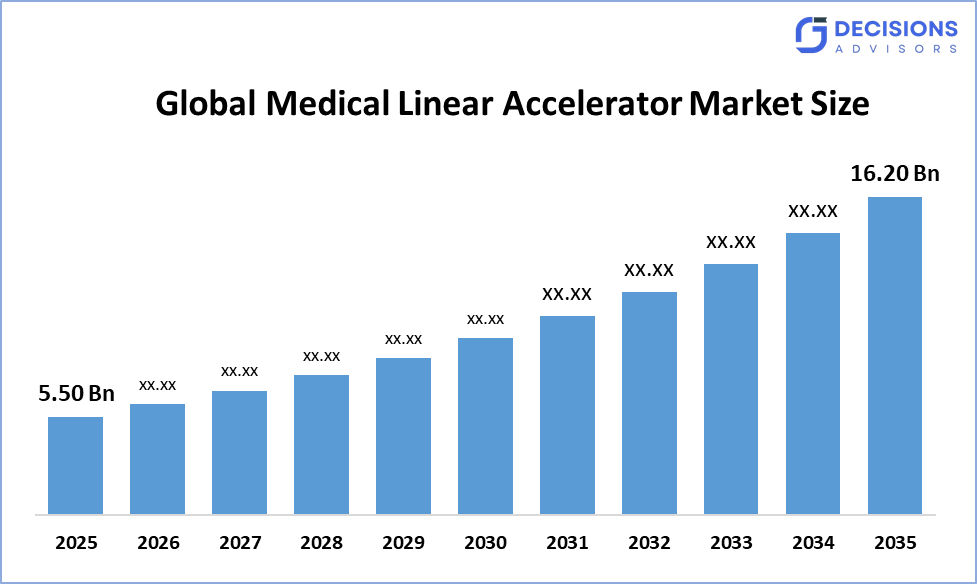
The Global Medical Linear Accelerator Market Size is predicted to grow from USD 5.50 Billion in 2025 and is likely to reach around USD 16.20 Billion by 2035 with a CAGR of 11.40%. According to Decision Advisors, the market is benefiting from the increasing global cancer burden, replacement of aging radiation therapy systems, expansion of oncology infrastructure, and growing adoption of image-guided and adaptive radiation therapy. Advanced LINAC platforms increasingly combine high-precision radiation delivery with sophisticated imaging, motion management, treatment planning, and automated workflows.
Market Snapshot
- Global Medical Linear Accelerator Market Size (2025): USD 5.50 Billion
- Projected Global Medical Linear Accelerator Market Size (2035): USD 16.20 Billion
- Global Medical Linear Accelerator Market CAGR: 11.40%
- Largest Regional Market: North America
- 2nd Largest Region: Asia-Pacific
- Fastest Growing Region: Asia-Pacific
- Base Year: 2025
- Historical Period: 2021-2024
- Market Forecast Period: 2026-2035.
Market Overview/ Introduction
The Global Medical Linear Accelerator Market comprises sophisticated radiation therapy equipment used to generate high-energy X-rays or electron beams for external-beam cancer treatment. Medical linear accelerators are central to modern radiation oncology because they can deliver radiation with high precision while incorporating technologies such as intensity-modulated radiation therapy (IMRT), volumetric modulated arc therapy (VMAT), image-guided radiation therapy (IGRT), stereotactic radiosurgery, and stereotactic body radiation therapy. Increasing cancer incidence, population aging, expansion of oncology facilities, and replacement of older radiation systems are supporting market growth. The technology landscape is moving toward highly integrated and intelligent radiation platforms.
- United States, The National Cancer Institute received USD 7.224 billion in FY2025 enacted appropriations, supporting cancer research and related clinical innovation.
- Japan, Japan's Fourth Basic Plan to Promote Cancer Control emphasizes comprehensive cancer care and development of advanced cancer-treatment capabilities, supporting continued investment in sophisticated radiation therapy.
- China, Expansion of oncology infrastructure and regulatory approvals for advanced radiation platforms is supporting the modernization of radiotherapy services. Accuray received Chinese NMPA approvals for Radixact SynC and CyberKnife S7 in January 2025.
Notable Insights: -
- North America is anticipated to hold approximately 32% share of the Global Medical Linear Accelerator Market over the predicted timeframe.
- Asia-Pacific is expected to be the fastest-growing region, holding approximately 30% of the share during the forecast period.
- By Energy Type, the High-Energy segment dominated the market and holds approximately 65% share in 2025 and is projected to grow at a substantial CAGR during the forecast period.
- By Application, the Hospitals segment dominated the market and holds approximately 70% share in 2025 and is projected to grow at a substantial CAGR during the forecast period.
- The compound annual growth rate of the Global Medical Linear Accelerator Market is 11.40%.
- The market is likely to achieve a valuation of approximately USD 16.20 Billion by 2035.
Market Drivers
The Global Medical Linear Accelerator Market is primarily driven by the rising global incidence of cancer and increasing demand for high-quality radiation treatment. As cancer diagnoses increase, hospitals and specialized cancer centers are expanding radiotherapy capacity and replacing older equipment with modern LINAC platforms. Technological advances in IMRT, VMAT, IGRT, stereotactic treatment, adaptive radiotherapy, and motion management are also encouraging healthcare providers to upgrade their systems. AI-enabled treatment planning and automated workflows are improving operational efficiency and supporting more personalized radiation delivery. In addition, healthcare providers are increasingly seeking systems capable of treating more patients within existing infrastructure, creating demand for faster treatment delivery and streamlined workflows. Expansion of oncology infrastructure in emerging economies, particularly China and India, is creating additional long-term opportunities.
Restrain
The Global Medical Linear Accelerator Market faces restraints associated with the high capital expenditure required to purchase, install, shield, commission, and maintain LINAC systems. Hospitals require specialized infrastructure, radiation shielding, power systems, and trained clinical personnel before operating these platforms. The shortage of radiation oncologists, medical physicists, dosimetrists, and radiation therapists can restrict utilization, particularly in developing healthcare markets. Regulatory requirements, equipment maintenance, software upgrades, and complex treatment-planning workflows also increase the total cost of ownership.
Competitive Analysis:
The report offers the appropriate analysis of the key organizations/companies involved within the global medical linear accelerator market, along with a comparative evaluation primarily based on their product offerings, business overviews, geographic presence, enterprise strategies, segment market share, and SWOT analysis. The report also provides an elaborative analysis focusing on the current news and developments of the companies, which includes product development, innovations, joint ventures, partnerships, mergers & acquisitions, strategic alliances, and others. This allows for the evaluation of the overall competition within the market.
Top Companies in the Global Medical Linear Accelerator Market
- Varian, a Siemens Healthineers company
- Elekta AB
- Accuray Incorporated
- Siemens Healthineers
- Philips
- Hitachi
- Canon Medical Systems
- Brainlab
- C-RAD
- RaySearch Laboratories.
Government Initiatives
|
Country |
Key Government Initiatives |
|
United States |
The National Cancer Institute received USD 7.224 billion in FY2025 enacted appropriations, supporting cancer research, clinical research infrastructure, and oncology innovation |
|
Japan |
Japan's Fourth Basic Plan to Promote Cancer Control focuses on comprehensive cancer treatment and strengthening advanced cancer-care capabilities |
|
China |
China's continued expansion of cancer-care infrastructure and regulatory approvals for advanced radiotherapy systems are supporting modernization of radiation oncology facilities |
Market Segmentation
The Global Medical Linear Accelerator Market share is classified into Energy Type, Application, and Technology.
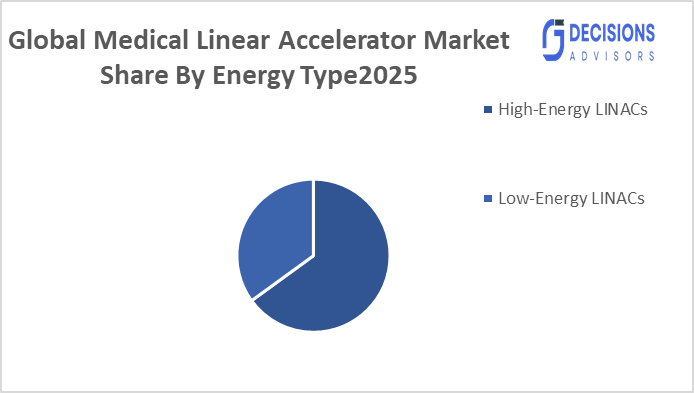
- The High-Energy segment dominated the market and holds approximately 65% share in 2025 and is projected to grow at a substantial CAGR during the forecast period.
Based on Energy Type, the Global Medical Linear Accelerator Market is divided into Low-Energy and High-Energy systems. Among these, High-Energy LINACs dominate because they can deliver radiation suitable for a wide range of deep-seated and complex tumors. They are extensively used in advanced radiation therapy techniques including IMRT, VMAT, IGRT, and stereotactic treatment. Their broad clinical applicability makes them particularly attractive to large hospitals and comprehensive cancer centers. Continued modernization of radiation oncology departments is expected to support the segment's leading position.
- The Hospitals segment accounted for the largest share of approximately 70% in 2025 and is anticipated to grow at a significant CAGR during the forecast period.
Based on Application, the market is divided into Hospitals, Clinics, Research Institutes, and Medical Schools. Among these, Hospitals accounted for the largest share because hospitals typically operate comprehensive oncology departments and treat significantly larger patient volumes. They also have greater access to capital budgets for major radiation-equipment purchases. Hospitals are increasingly replacing aging LINAC systems with platforms offering integrated imaging, adaptive treatment, motion management, and automated workflows.
- The Intensity-Modulated Radiation Therapy (IMRT) segment accounted for the largest share of approximately 38% in 2025 and is anticipated to grow at a significant CAGR during the forecast period.
Based on Technology, the market is divided into Intensity-Modulated Radiation Therapy, Volumetric Modulated Arc Therapy, Image-Guided Radiation Therapy, and Stereotactic Radiosurgery/Stereotactic Body Radiation Therapy. Among these, IMRT dominates because it allows radiation oncologists to precisely shape and modulate radiation doses around tumors while limiting exposure to surrounding healthy tissues. Its established clinical use across multiple cancer types supports widespread adoption. Modern LINACs can integrate IMRT with image guidance and sophisticated multileaf collimators, improving treatment precision.
Regional Segment Analysis of the Global Medical Linear Accelerator Market
- North America (U.S., Canada, Mexico)?
- Europe (Germany, U.K., France, Italy, Spain, Netherlands, Rest of Europe).
- Asia-Pacific (China, Japan, India, Australia, South Korea, Rest of Asia-Pacific).
- South America (Brazil, Argentina, Rest of South America).
- Middle East & Africa (UAE, Saudi Arabia, South Africa, Rest of MEA).
North America is anticipated to hold approximately 32% share of the Global Medical Linear Accelerator Market over the predicted timeframe.
The region maintains its leading position because of its advanced healthcare infrastructure, high cancer-treatment demand, sophisticated reimbursement environment, and strong adoption of precision radiation therapy. The United States is home to major radiation oncology technology companies and leading cancer centers that drive demand for advanced LINAC platforms. Hospitals are increasingly adopting adaptive radiotherapy, image-guided therapy, stereotactic treatment, and AI-enabled treatment-planning technologies. In 2025, Siemens Healthineers and Prisma Health announced a USD 50 million multi-year radiation-therapy investment that included acquisition of Varian's Ethos adaptive radiotherapy system.
Asia-Pacific is expected to grow at the fastest CAGR in the Global Medical Linear Accelerator Market, holding approximately 30% of the share during the forecast period.
The region benefits from a large patient population, rising cancer incidence, growing healthcare expenditure, and expansion of specialized oncology facilities. China, Japan, India, South Korea, and Australia represent important markets. China and India provide particularly strong long-term opportunities because of their large cancer populations and ongoing expansion of radiation-treatment infrastructure. Regulatory approvals for advanced radiotherapy platforms are also supporting manufacturers' efforts to increase their presence in the region.
Europe is expected to hold approximately 23% share of the Global Medical Linear Accelerator Market during the forecast period.
The European market benefits from sophisticated national healthcare systems, strong cancer-control policies, established radiation oncology networks, and high adoption of advanced medical technologies. Germany, the United Kingdom, France, Italy, and Spain represent major contributors. European technology developers are emphasizing adaptive radiotherapy, CT-guided systems, AI-enabled imaging, and integrated treatment workflows. Elekta's Evo CT-Linac is an example of the industry's movement toward AI-enhanced adaptive radiation treatment.
Future Market Trends in Global Medical Linear Accelerator Market: -
-
- AI-Enabled Adaptive Radiotherapy.
AI is becoming increasingly important in radiation oncology because it can assist with contouring, treatment planning, image analysis, and adaptive treatment workflows. AI-enabled platforms can help clinicians respond to anatomical changes during a treatment course while reducing manual workload.
-
- Growth of CT- and MRI-Guided LINAC Systems.
Integration of advanced imaging directly into radiation-treatment platforms is expected to remain a major technology trend. CT- and MRI-guided LINACs provide improved visualization of tumors and surrounding anatomy and can support treatment adaptation.
-
- Expansion of Stereotactic and Hypofractionated Treatment.
SRS and SBRT are gaining attention because they can deliver highly precise radiation in fewer treatment sessions for appropriately selected patients. The approach can reduce patient travel and treatment burden while improving the utilization of radiation oncology resources.
-
- Increasing Demand for High-Throughput LINAC Platforms.
Hospitals are increasingly seeking radiation systems that can treat more patients efficiently while maintaining high clinical precision. Faster patient positioning, automated imaging, streamlined treatment workflows, and advanced motion management can increase daily treatment capacity.
Recent Development
- In January 2026, Elekta received FDA 510(k) clearance for Elekta Evo, enabling its AI-powered CT-Linac technology to enter the U.S. radiation oncology market.
- In March 2026, Varian TrueBeam received FDA clearance for low-dose radiotherapy for adults with medically refractory osteoarthritis, expanding the potential clinical applications of the platform beyond conventional cancer treatment.
- In July 2025, Siemens Healthineers and Prisma Health announced a USD 50 million radiation-therapy investment, including Varian's Ethos adaptive radiotherapy technology.
Market Segment
This study forecasts revenue at global, regional, and country levels from 2021 to 2035. Decision Advisors has segmented the global medical linear accelerator market based on the below-mentioned segment:
Global Medical Linear Accelerator Market, By Energy Type.
- Low-Energy
- High-Energy.
Global Medical Linear Accelerator Market, By Application.
- Hospitals
- Clinics
- Research Institutes
- Medical Schools.
Global Medical Linear Accelerator Market, By Technology.
- Intensity-Modulated Radiation Therapy (IMRT)
- Volumetric Modulated Arc Therapy (VMAT)
- Image-Guided Radiation Therapy (IGRT)
- Stereotactic Radiosurgery/Stereotactic Body Radiation Therapy (SRS/SBRT).
Global Medical Linear Accelerator Market, By Regional Analysis.
- North America
- US
- Canada
- Mexico
- Europe
- Germany
- UK
- France
- Italy
- Spain
- Russia
- Rest of Europe
- Asia Pacific
- China
- Japan
- India
- South Korea
- Australia
- Rest of Asia Pacific
- South America
- Brazil
- Argentina
- Rest of South America
- Middle East & Africa
- UAE
- Saudi Arabia
- Qatar
- South Africa
- Rest of the Middle East & Africa
Frequently Asked Questions (FAQ)
Q. What is a medical linear accelerator used for?
A. A medical linear accelerator generates high-energy X-rays or electrons that are used for external-beam radiation therapy. Modern LINACs support advanced techniques such as IMRT, VMAT, IGRT, SRS, and SBRT, enabling clinicians to deliver radiation more precisely to tumors.
Q. Why are hospitals the largest application segment in the medical linear accelerator market?
A. Hospitals generally treat larger numbers of cancer patients and operate multidisciplinary radiation oncology departments. Their greater capital budgets and need to replace aging equipment also make hospitals the primary purchasers of advanced LINAC systems.
Q. Which region is expected to grow fastest in the medical linear accelerator market?
A. Asia-Pacific is expected to be the fastest-growing region because of expanding cancer-care infrastructure, rising patient volumes, modernization of radiotherapy equipment, and increasing adoption of advanced radiation technologies.
Q. How is AI changing medical linear accelerator technology?
A. AI is being integrated into treatment planning, image analysis, contouring, workflow automation, and adaptive radiotherapy. These capabilities can help reduce planning time, improve treatment personalization, and support faster clinical workflows.
Check Licence
Choose the plan that fits you best: Single User, Multi-User, or Enterprise solutions tailored for your needs.
We Have You Covered
- 24/7 Analyst Support
- Clients Across the Globe
- Tailored Insights
- Technology Tracking
- Competitive Intelligence
- Custom Research
- Syndicated Market Studies
- Market Overview
- Market Segmentation
- Growth Drivers
- Market Opportunities
- Regulatory Insights
- Innovation & Sustainability
Report Details
| Scope | Global |
| Pages | 200 |
| Delivery | PDF & Excel via Email |
| Language | English |
| Release | Aug 2026 |
| Access | Download from this page |