
Global Medical Scheduling Software Market
 |
Author:
David J
|
Pages:
210
|
Author:
David J
|
Pages:
210
Global Medical Scheduling Software Market Size, Share By Deployment Mode (Cloud-Based, On-Premise, and Hybrid), By Application (Patient Scheduling, Appointment Reminders, Calendar Management, Automated Rescheduling, and Reporting & Analytics), By End Use (Hospitals, Clinics, Diagnostic Centers, Ambulatory Surgical Centers, and Other Healthcare Facilities), and By Region (North America, Europe, Asia-Pacific, Latin America, Middle East & Africa), Analysis and Forecast 2026-2035.
CAGR
12.55%
REVENUE 2025
USD Billion 2.1
FORECAST 2035
USD Billion 6.85
REPORT COVERAGE
Global
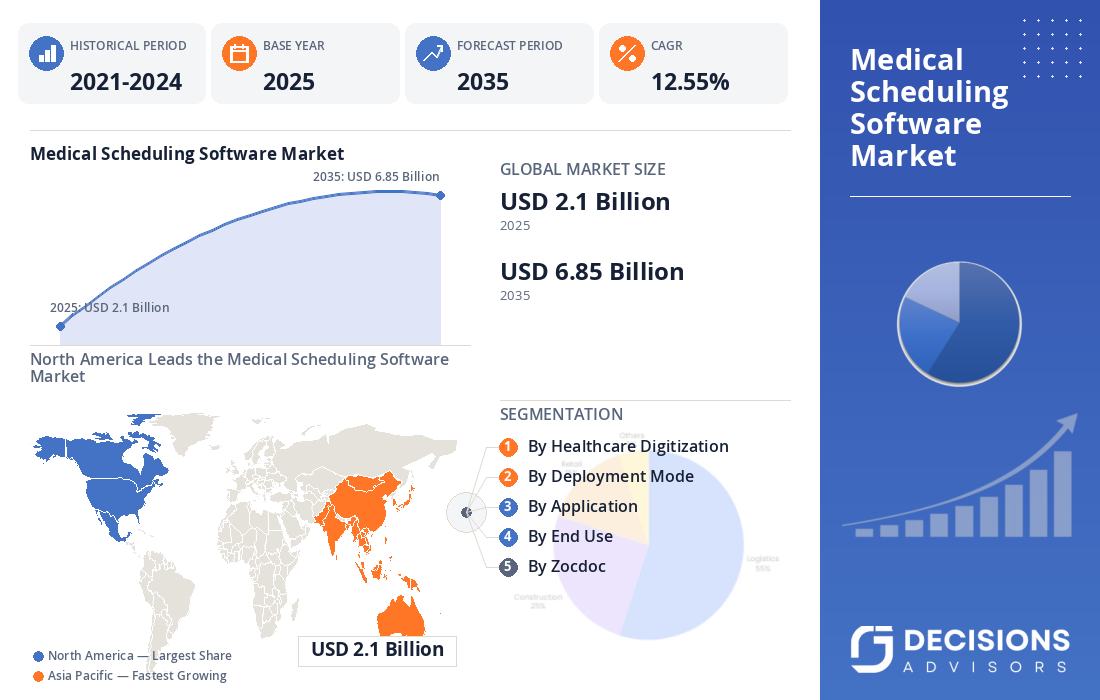
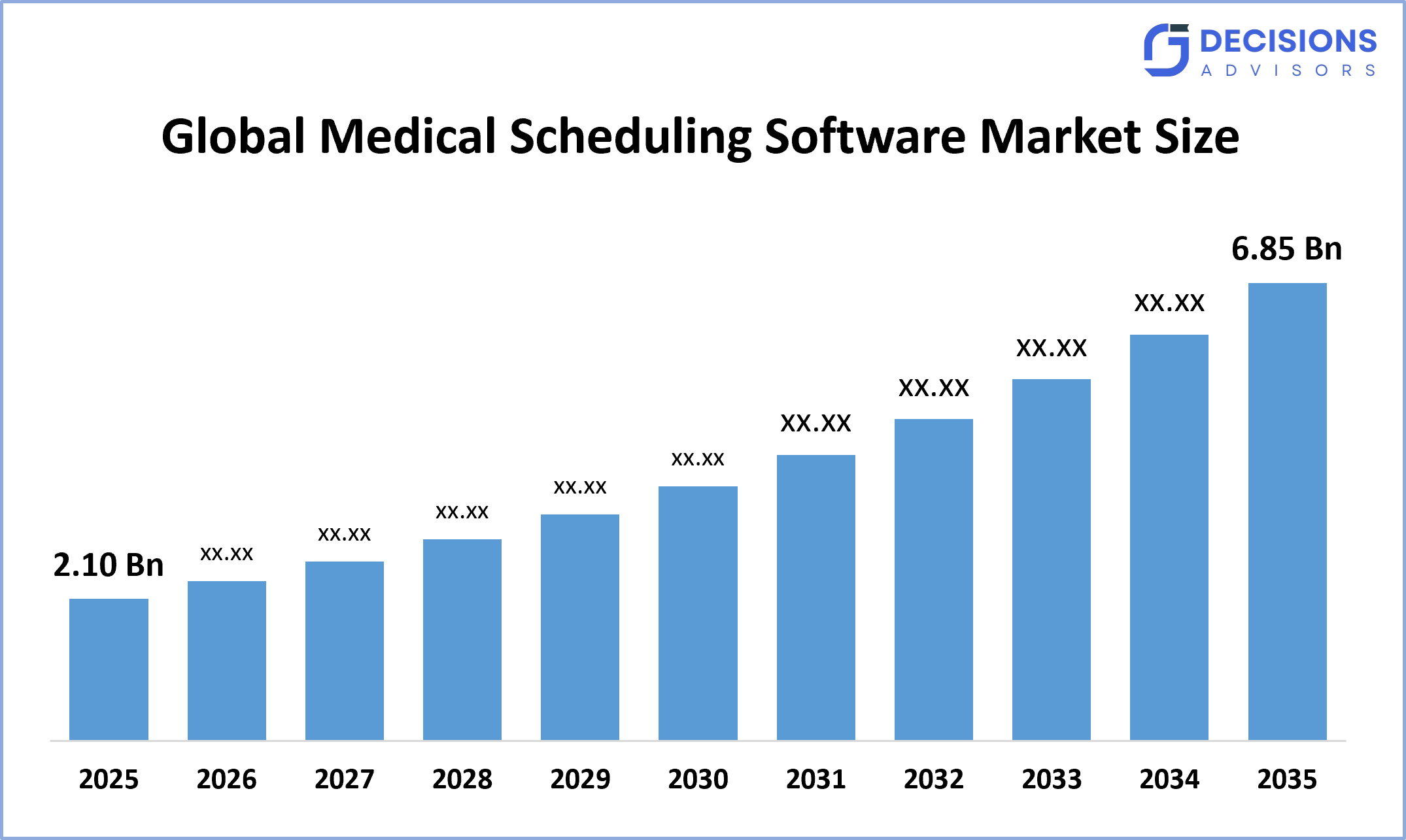
The Global Medical Scheduling Software Market Size was valued at approximately USD 2.10 Billion in 2025 and is projected to reach around USD 6.85 Billion by 2035, expanding at a CAGR of 12.55% during 2026-2035. The market is supported by healthcare digitization, increasing outpatient volumes, demand for convenient patient access, growing adoption of cloud-based healthcare software, and the integration of scheduling platforms with electronic health records (EHRs), patient portals, telehealth, and revenue-cycle systems.
Market Snapshot
- Global Medical Scheduling Software Market Size (2025) USD 2.10 Billion
- Projected Global Medical Scheduling Software Market Size (2035): USD 6.85 Billion
- Global Medical Scheduling Software Market CAGR:12.55%
- Largest Regional Market: North America
- 2nd Largest Region: Europe
- Fastest Growing Region : Asia-Pacific
- Base Year: 2025
- Historical Period: 2021-2024
- Market Forecast Period: 2026-2035.
Market Overview/ Introduction
The Global Medical Scheduling Software Market comprises digital solutions designed to automate and optimize appointment booking, provider availability, patient calendars, reminders, cancellations, rescheduling, waitlists, resource allocation, and scheduling analytics. Healthcare organizations are increasingly moving away from manual telephone-based appointment management toward digital scheduling through websites, mobile applications, patient portals, conversational interfaces, and integrated EHR environments. The transition is being accelerated by rising healthcare utilization, pressure to improve staff productivity, patient expectations for convenient 24/7 access, and the need to reduce missed appointments and unused clinical capacity. Medical scheduling software is also evolving into an important component of the healthcare digital front door.
- United States, CMS interoperability initiatives are encouraging healthcare technology providers to adopt standardized APIs and FHIR-based data exchange. The CMS Interoperability and Prior Authorization Final Rule includes requirements around Patient Access, Provider Access, Payer-to-Payer, and Prior Authorization APIs, strengthening the digital infrastructure supporting connected healthcare applications.
- Japan, Japan's Healthcare DX policy is supporting standardized electronic medical records, electronic prescriptions, healthcare-information sharing, and modernization of hospital information systems.
- India, The Ayushman Bharat Digital Mission is building interoperable digital-health infrastructure through Health IDs, healthcare professional and facility registries, and connected digital health records, creating a favorable environment for digitally enabled patient-access and scheduling applications.
Notable Insights: -
- North America is anticipated to hold approximately 39% share of the Global Medical Scheduling Software Market over the forecast timeframe.
- Asia-Pacific is expected to be the fastest-growing regional market, accounting for approximately 22% share by 2035 as healthcare providers accelerate digital transformation.
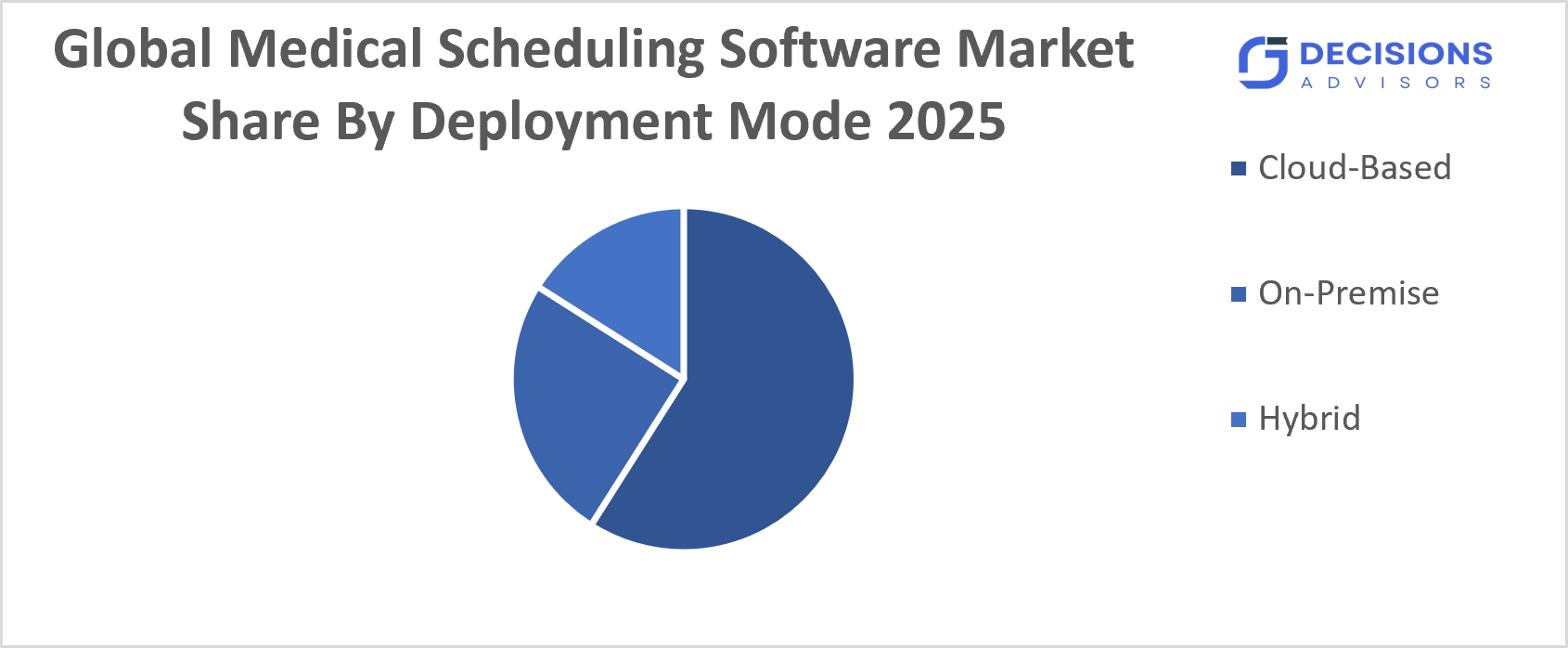
- By Deployment Mode, the Cloud-Based segment dominated the market and holds approximately 59% share in 2025 and is projected to grow at a substantial CAGR during the forecast period.
- By Application, the Patient Scheduling segment dominated the market and holds approximately 35% share in 2025 and is projected to grow at a substantial CAGR during the forecast period.
- By End Use, Hospitals dominated the market and hold approximately 42% share in 2025.
- The compound annual growth rate of the Global Medical Scheduling Software Market is 12.55%.
- The market is likely to achieve a valuation of USD 6.85 Billion by 2035.
Market Drivers
The Global Medical Scheduling Software Market is being driven by increasing healthcare utilization, expanding outpatient care, and the need to improve clinical-resource utilization. Hospitals and clinics are under pressure to manage larger appointment volumes while controlling administrative labor costs, making automated scheduling increasingly valuable. Digital appointment booking also improves patient convenience by allowing patients to select providers, locations, appointment types, and available time slots without relying entirely on telephone-based scheduling. Integration with EHRs, patient portals, telehealth platforms, digital registration, and healthcare CRM systems is further increasing the value of scheduling software. AI-based scheduling is emerging as a particularly important growth driver because it can automate appointment conversations, identify appropriate time slots, manage cancellations, fill vacancies from waitlists, and support personalized patient access.
Restrain
The market faces several adoption challenges, including interoperability complexity, cybersecurity requirements, healthcare-data privacy, implementation costs, and resistance to changing established administrative workflows. Scheduling platforms frequently need to exchange information with EHRs, practice-management systems, billing platforms, provider directories, patient portals, and telehealth systems, making integration particularly difficult for organizations operating older IT infrastructure.
Competitive Analysis:
The report offers the appropriate analysis of the key organizations/companies involved within the global medical scheduling software market, along with a comparative evaluation primarily based on their product offerings, business overviews, geographic presence, enterprise strategies, segment market share, and SWOT analysis. The report also provides an elaborative analysis focusing on the current news and developments of the companies, which includes product development, innovations, joint ventures, partnerships, mergers & acquisitions, strategic alliances, and others. This allows for the evaluation of the overall competition within the market.
Top Companies in the Global Medical Scheduling Software Market
- Epic Systems Corporation
- Oracle Health
- athenahealth, Inc.
- eClinicalWorks
- NextGen Healthcare, Inc.
- AdvancedMD, Inc.
- Doctolib
- Zocdoc
- Practo
- Veradigm.
Government Initiatives
|
Country |
Key Government Initiatives |
|
United States |
CMS interoperability and patient-access initiatives are promoting standardized healthcare APIs and FHIR-based information exchange, supporting greater connectivity between EHRs, patient-access platforms, and healthcare applications |
|
Japan |
Healthcare DX initiatives are promoting standardized electronic medical records, electronic prescriptions, digital health-information sharing, and modernization of hospital information systems |
|
China |
Smart-hospital and healthcare digitalization programs are supporting electronic registration, hospital information systems, telemedicine, digital health services, and intelligent healthcare management |
Market Segmentation
The Global Medical Scheduling Software Market share is classified into Deployment Mode, Application, and End Use.
- The Cloud-Based segment dominated the market and holds approximately 59% share in 2025 and is projected to grow at a substantial CAGR during the forecast period.
Based on Deployment Mode, the global medical scheduling software market is divided into cloud-based, on-premise, and hybrid. Cloud-based platforms are increasingly preferred because they provide centralized access, easier updates, scalable infrastructure, and lower upfront hardware requirements. Healthcare organizations operating multiple facilities can use cloud platforms to coordinate provider calendars and appointment availability across locations. Integration with other cloud healthcare applications further strengthens the segment.
- The Patient Scheduling segment accounted for the largest share of approximately 35% in 2025 and is anticipated to grow at a significant CAGR during the forecast period.
Based on Application, the market is divided into patient scheduling, appointment reminders, calendar management, automated rescheduling, and reporting & analytics. Patient scheduling remains the core function because it directly connects patients with available physicians, departments, locations, and appointment slots. Growing patient demand for online and mobile booking is increasing adoption. Integration with EHRs and patient portals also allows providers to automate scheduling while maintaining clinical and administrative data consistency.
- The Hospitals segment accounted for the largest share of approximately 42% in 2025 and is anticipated to grow at a significant CAGR during the forecast period.
Based on End Use, the market is divided into hospitals, clinics, diagnostic centers, ambulatory surgical centers, and other healthcare facilities. Hospitals require sophisticated scheduling because they coordinate multiple physicians, specialties, diagnostic services, procedures, rooms, and equipment. Large healthcare networks also benefit from centralized scheduling across multiple facilities. The increasing focus on patient throughput and operational efficiency is expected to support continued hospital adoption.
Regional Segment Analysis of the Global Medical Scheduling Software Market
- North America (U.S., Canada, Mexico)?
- Europe (Germany, U.K., France, Italy, Spain, Netherlands, Rest of Europe).
- Asia-Pacific (China, Japan, India, Australia, South Korea, Rest of Asia-Pacific).
- South America (Brazil, Argentina, Rest of South America).
- Middle East & Africa (UAE, Saudi Arabia, South Africa, Rest of MEA).
Asia Pacific is anticipated to hold approximately 22% share of the global medical scheduling software market by 2035.
The region is expected to experience the fastest growth because healthcare providers across China, India, Japan, South Korea, Australia, and Southeast Asia are increasing investments in digital healthcare infrastructure. Expanding private healthcare networks, rising outpatient volumes, smartphone penetration, telemedicine adoption, and government-supported healthcare digitization are creating favorable conditions for online scheduling. India is developing interoperable digital-health infrastructure, Japan is advancing Healthcare DX, and China continues expanding smart-hospital capabilities.
North America is expected to remain the largest regional market, holding approximately 39% share of the global medical scheduling software market.
The region benefits from mature EHR infrastructure, high healthcare IT expenditure, extensive cloud adoption, strong presence of healthcare software companies, and high patient demand for digital access. U.S. hospitals and physician practices are increasingly connecting scheduling with patient portals, telehealth, digital intake, insurance workflows, and clinical systems. AI-powered scheduling is also developing rapidly because healthcare providers are seeking ways to reduce administrative workloads and improve appointment utilization.
Europe is expected to hold approximately 25% share of the Global Medical Scheduling Software Market by 2035.
The European market is supported by digital-health initiatives, electronic health-record development, online patient-access programs, and growing adoption of cloud healthcare infrastructure. The U.K., Germany, France, Italy, and the Nordic countries are important contributors. European providers are increasingly focused on patient self-service, interoperable health-information systems, and improved utilization of healthcare resources.
Future Market Trends in Global Medical Scheduling Software Market: -
-
- AI-Powered Conversational Scheduling.
AI-powered conversational scheduling is expected to become one of the most significant trends. Patients can increasingly interact with scheduling systems through natural-language conversations rather than navigating complex menus.
-
- Predictive No-Show Management.
Scheduling platforms are increasingly incorporating analytics and machine learning to identify appointments that may be at higher risk of cancellation or non-attendance. Providers can use automated reminders and targeted communications to improve attendance.
-
- EHR and FHIR-Based Interoperability.
Scheduling platforms are moving toward deeper integration with EHRs and standardized healthcare APIs. Interoperability allows patient demographics, provider information, appointment availability, referrals, clinical requirements, and other relevant information to move between connected applications.
-
- Digital Front Door Integration.
Medical scheduling software is increasingly becoming part of a broader digital front door that includes provider search, appointment booking, registration, insurance verification, telehealth, digital check-in, payments, reminders, and patient messaging.
Recent Development
- In May 2025, Zocdoc launched Zo by Zocdoc, an AI phone assistant designed to handle appointment-scheduling conversations and help patients book care through natural-language interactions.
- In May 2025, Epic expanded conversational patient-access capabilities, enabling healthcare organizations to use AI-supported interactions for appointment scheduling and related patient workflows.
- In December 2025, Oracle Health expanded Oracle Health Patient Portal scheduling capabilities, including self-scheduling, cancellation, rescheduling, multiple-appointment coordination, and a Scheduling AI Agent supporting natural-language scheduling workflows.
Market Segment
This study forecasts revenue at global, regional, and country levels from 2021 to 2035. Decision Advisors has segmented the global medical scheduling software market based on the below-mentioned segment:
Global Medical Scheduling Software Market, By Deployment Mode.
- Cloud-Based
- On-Premise
- Hybrid
- Others.
Global Medical Scheduling Software Market, By Application.
- Patient Scheduling
- Appointment Reminders
- Calendar Management
- Automated Rescheduling
- Reporting & Analytics.
Global Medical Scheduling Software Market, By End Use.
- Hospitals
- Clinics
- Diagnostic Centers
- Ambulatory Surgical Centers
- Other Healthcare Facilities.
Global Medical Scheduling Software Market, By Regional Analysis.
- North America
- US
- Canada
- Mexico
- Europe
- Germany
- UK
- France
- Italy
- Spain
- Russia
- Rest of Europe
- Asia Pacific
- China
- Japan
- India
- South Korea
- Australia
- Rest of Asia Pacific
- South America
- Brazil
- Argentina
- Rest of South America
- Middle East & Africa
- UAE
- Saudi Arabia
- Qatar
- South Africa
- Rest of the Middle East & Africa
Frequently Asked Questions (FAQ)
Q. What is medical scheduling software?
A. Medical scheduling software is healthcare IT software used to manage patient appointments, provider availability, calendars, reminders, cancellations, rescheduling, waitlists, and related administrative workflows. Modern systems increasingly connect these functions with EHRs, patient portals, telehealth, and digital patient-access platforms.
Q. Why is cloud-based medical scheduling software gaining adoption?
A. Cloud-based platforms provide scalable infrastructure, centralized management, remote accessibility, and easier software updates. They are particularly valuable for healthcare organizations operating multiple clinics or hospitals because scheduling information can be coordinated across locations.
Q. How is AI changing medical scheduling software?
A. AI enables conversational booking, intelligent appointment matching, automated rescheduling, predictive no-show analysis, and waitlist optimization. AI can also reduce the administrative workload associated with telephone scheduling and repetitive patient communications.
Q. Which segment is expected to dominate the Medical Scheduling Software Market?
A. Patient Scheduling is expected to remain the leading application segment because appointment booking represents the fundamental requirement for healthcare scheduling. Hospitals are expected to remain the largest end-use segment because of their complex multi-department scheduling requirements.
Check Licence
Choose the plan that fits you best: Single User, Multi-User, or Enterprise solutions tailored for your needs.
We Have You Covered
- 24/7 Analyst Support
- Clients Across the Globe
- Tailored Insights
- Technology Tracking
- Competitive Intelligence
- Custom Research
- Syndicated Market Studies
- Market Overview
- Market Segmentation
- Growth Drivers
- Market Opportunities
- Regulatory Insights
- Innovation & Sustainability
Report Details
| Scope | Global |
| Pages | 210 |
| Delivery | PDF & Excel via Email |
| Language | English |
| Release | Aug 2026 |
| Access | Download from this page |