
Global MEMS Energy Harvesting Devices Market
 |
Author:
Shruti G
|
Pages:
210
|
Author:
Shruti G
|
Pages:
210
Global MEMS Energy Harvesting Devices Market Size, Share, By Technology (Piezoelectric Energy Harvesting, Thermoelectric Energy Harvesting, Electromagnetic Energy Harvesting, RF Energy Harvesting), By Application (Wireless Sensor Networks, IoT Devices, Consumer Electronics, Industrial Monitoring, Healthcare Devices), By End Use (Automotive, Industrial, Healthcare, Consumer Electronics, Aerospace & Defence) and By Region (North America, Europe, Asia-Pacific, Latin America, Middle East, and Africa), Analysis and Forecast 2026-2035
CAGR
15.76%
REVENUE 2025
USD Billion 3.5
FORECAST 2035
USD Billion 15.13
REPORT COVERAGE
Global
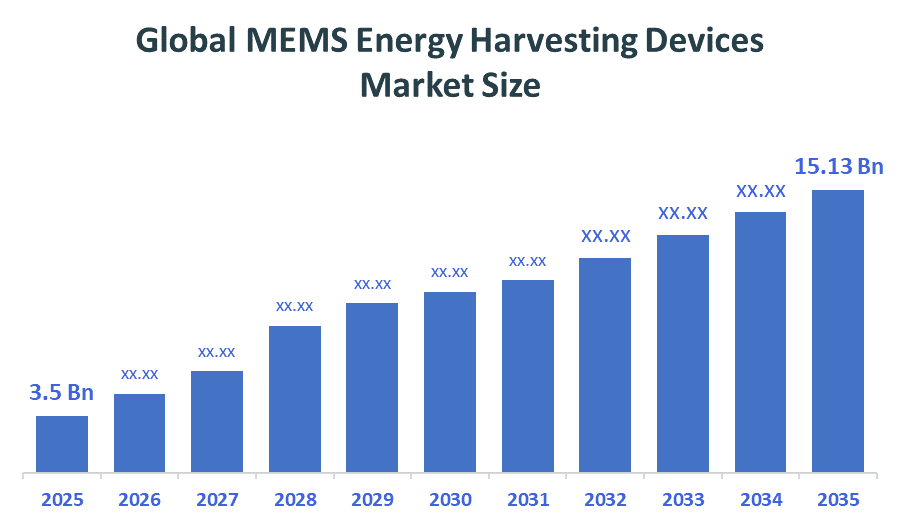
The Global MEMS Energy Harvesting Devices Market Size is forecasted to grow from USD 3.5 Billion in 2025 and going to reach approx. USD 15.13 Billion by 2035. According to Decision Advisors, there is a detailed research report on the Global MEMS Energy Harvesting Devices Market highlights piezoelectric energy harvesting dominate the global market, accounting for approximately 40–45% of the total share worldwide. STMicroelectronics and Texas Instruments, generates strong revenue through their MEMS sensor and low-power semiconductor portfolios, which accounts for approximately 18–22% market share, thus acting as a main driving innovation in ultra-low power IoT and self-powered electronic systems.
Market Snapshot
- Global MEMS Energy Harvesting Devices Market Size (2025): USD 3.5 Billion
- Projected Global MEMS Energy Harvesting Devices Market Size (2035): USD 15.13 Billion
- Global MEMS Energy Harvesting Devices Market Compound Annual Growth Rate (CAGR): 15.76%
- Largest Regional Market: Asia- Pacific
- Fastest Growing Region: North America
- 3rd Largest Region: Europe
- Base Year: 2025
- Historical Period: 2021–2025
- Forecast Period: 2025–2035
Market Overview/ Introduction
The MEMS Energy Harvesting Devices Market includes micro-electromechanical systems designed to convert ambient energy sources such as vibration, heat, light, and radio frequency (RF) signals into usable electrical power. These devices have gained critical importance because they enable autonomous systems to operate autonomously in multiple domains, including autonomous sensors and IoT networks and wearable electronics and remote monitoring devices, without needing standard battery power. The market experiences strong growth because Industry 4.0 and smart city infrastructure and low-power wireless communication technologies are rapidly expanding. MEMS-based energy harvesters help organizations decrease maintenance expenses while enhancing system dependability through their capacity to operate continuously in remote locations and hard-to-reach areas. The increasing use of AI-enabled edge computing devices together with smaller electronic components drives faster adoption while improving energy efficiency and enabling the creation of advanced intelligent and environmentally friendly electronic systems.
- In June 2025 in USA and Asia, DARPA and NSF funding in the U.S., along with smart city programs in Japan, South Korea, and China, is accelerating MEMS energy harvesting sensors for IoT monitoring and battery-free infrastructure systems
Notable Insights: -
- North America is the fastest growing region market share approximately 7.5% in the Global MEMS Energy Harvesting Devices Market.
- Asia Pacific holds the largest regional market share approximately 48% in the Global MEMS Energy Harvesting Devices Market.
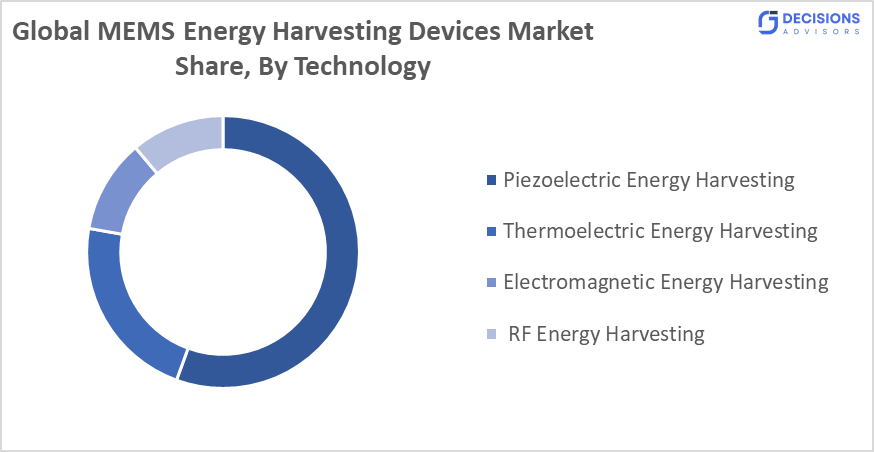
- By technology, the Piezoelectric Energy Harvesting segment held a dominant position approximately 13% in terms of market share in 2025.
- By application, Wireless Sensor Networks segment is the dominating accounting for approximately 12% of the global market share in 2025.
- The compound annual growth rate of the Global MEMS Energy Harvesting Devices Market is 15.76%.
- The market is likely to achieve a valuation of USD 15.13Billion by 2035.
What is role of technology in grooming the market?
The MEMS Energy Harvesting Devices Market expands through technological progress because it leads to better energy conversion efficiency and smaller device sizes and complete system functionality. The development of piezoelectric and thermoelectric and RF harvesting technologies has achieved two major goals which allow smaller devices to produce more electrical power and work with small electronic devices without problems. The combination of advanced nanomaterials with thin-film fabrication techniques enables devices to achieve better sensitivity and extended durability which makes them suitable for use in industrial environments. The AI power management systems use machine learning to control energy storage and distribution which guarantees reliable and efficient operation of IoT networks and sensor networks. The creation of hybrid energy harvesting systems which use multiple energy sources from their environment increases both system reliability and operational performance. The combination of improved low-power semiconductor design with better edge computing integration creates new application possibilities that enable global industrial automation and healthcare and automotive and smart infrastructure sectors to adopt these technologies.
Market Drivers
The MEMS Energy Harvesting Devices Market experiences growth because of expanding IoT ecosystems which create a need for electronic devices that operate without batteries and need no maintenance. The industrial automation sector requires wireless sensor networks because companies need these networks to conduct predictive maintenance and monitor their operations in real time. The increasing implementation of smart cities and smart infrastructure initiatives drives the adoption of self-sufficient traffic management sensors and environmental monitoring sensors and security system sensors. Wearable and implantable medical devices in healthcare now use MEMS energy harvesting technology to enhance their operational reliability while decreasing their need for maintenance. Market expansion receives support from industry 4.0 initiatives combined with developments in low-power electronic technology and miniature device technology. The global adoption of energy solutions which provide long-lasting sustainable power needs especially sustainable energy solutions which decrease battery usage.
Restrain
The MEMS Energy Harvesting Devices Market faces several restraints that may limit its growth potential. One major challenge is the low power output of energy harvesting systems, which restricts their use in high-energy-demand applications. Performance is highly dependent on environmental conditions such as vibration, heat, or light availability, making efficiency inconsistent. High initial development and integration costs also hinder widespread adoption, especially among small manufacturers. Additionally, lack of standardized design protocols creates compatibility issues across devices and platforms. Competition from advanced low-power batteries and energy-efficient chip technologies further restricts market expansion.
Competitive Analysis:
The report offers the appropriate analysis of the key organizations/companies involved within the Global MEMS Energy Harvesting Devices Market, along with a comparative evaluation primarily based on their product of offering, business overviews, geographic presence, enterprise strategies, segment market share, and SWOT analysis. The report also provides an elaborative analysis focusing on the current news and developments of the companies, which includes product development, innovations, joint ventures, partnerships, mergers & acquisitions, strategic alliances, and more. This allows for the evaluation of the overall competition within the market.
Top Companies in Global MEMS Energy Harvesting Devices Market
- STMicroelectronics N.V.
- Texas Instruments Incorporated
- Analog Devices, Inc.
- Microchip Technology Inc.
- EnOcean GmbH
- Cymbet Corporation
- Powercast Corporation
- ABB Ltd.
- Siemens AG
- Honeywell International Inc.
- NXP Semiconductors N.V.
- Murata Manufacturing Co., Ltd.
- TDK Corporation
- Infineon Technologies AG
- MicroGen Systems, Inc.
- e-peas S.A.
- LORD MicroStrain (Parker Hannifin Corporation)
- Fujitsu Limited
- Advanced Linear Devices, Inc.
- Silicon Laboratories Inc.
Government Initiatives
|
Country |
Key Government Initiatives |
|
China |
In January 2026, China’s smart city and IoT expansion is driving large-scale MEMS energy harvesting deployment across infrastructure, enabling battery-free sensors, lower maintenance costs, and efficient long-term autonomous monitoring systems. |
|
Japan |
In October 2025, Japan’s net-zero 2050 strategy supports self-powered biomedical devices and wearable technologies for elderly care, driving MEMS-based ultra-low-power sensors and long-term battery-free healthcare monitoring systems |
|
India |
In October 2025, India’s energy-efficient infrastructure growth is supported by India–Japan cooperation, promoting clean technology, smart grids, and renewable integration aligned with Net Zero 2070 and sustainable urban development goals. |
Study on the Supply, Demand, Distribution, and Market Environment of Global MEMS Energy Harvesting Devices Market
The MEMS energy harvesting ecosystem consists of semiconductor manufacturers, MEMS foundries, IoT device makers, and system integrators. Asia-Pacific dominates supply due to strong MEMS fabrication hubs in Taiwan, Japan, and South Korea, contributing nearly 60% of global production. Demand is primarily driven by industrial IoT and smart infrastructure projects. OEM integration accounts for 70% of distribution channels, while aftermarket retrofit applications represent 30%. Long-term contracts between chip manufacturers and IoT solution providers ensure stable supply chains. Growing investments in edge computing and autonomous systems are strengthening market dynamics.
Price Analysis and Consumer Behaviour Analysis
MEMS energy harvesting modules are available across a wide price range depending on technology type, efficiency, and application complexity. Basic vibration-based harvesters typically cost between USD 5–20, making them suitable for low-power sensors and entry-level IoT devices. More advanced RF-based micro-energy harvesting modules are priced between USD 20–100, depending on their sensitivity and energy conversion efficiency. High-performance hybrid systems, which combine multiple energy sources such as vibration, thermal, and RF, range from USD 50–150 due to their superior output and reliability. Consumer adoption is primarily driven by reliability 65%, maintenance-free operation 55%, and long lifecycle performance 50%. Industrial users focus more on ROI and system integration flexibility rather than initial cost. Additionally, nearly 40% of IoT solution providers are increasingly adopting hybrid harvesting solutions to reduce battery dependency and improve operational sustainability.
Market Segmentation
The Global MEMS Energy Harvesting Devices Market share is classified into product type, laptop category and end user
- The Piezoelectric Energy Harvesting segment dominated the market in 2024, and is projected to grow at a substantial CAGR of approximately 13% during the forecast period.
Based on the Technology, the Global MEMS Energy Harvesting Devices Market is divided into Piezoelectric Energy Harvesting, Thermoelectric Energy Harvesting, Electromagnetic Energy Harvesting, RF Energy Harvesting. Among these, the Piezoelectric Energy Harvesting segment dominated the market in 2024, and is projected to grow at a substantial CAGR of approximately 13% during the forecast period Piezoelectric energy harvesting dominates because it efficiently converts mechanical vibrations from machines, vehicles, and infrastructure into electrical energy. It is highly scalable, cost-effective, and compatible with MEMS fabrication. Its strong performance in industrial IoT, predictive maintenance, and wearable sensors makes it the preferred technology for battery-free, low-power electronic systems globally.
- The Wireless Sensor Networks segment accounted for the largest share in 2024, and is anticipated to grow at a significant CAGR of approximately 12% during the forecast period.
Based on the Application, the Global MEMS Energy Harvesting Devices Market is divided into Wireless Sensor Networks, IoT Devices, Consumer Electronics, Industrial Monitoring, Healthcare Devices. Among these, the Gaming Laptops segment accounted for the largest share in 2024, and is anticipated to grow at a significant CAGR of approximately 12% during the forecast period. the Wireless Sensor Networks segment accounted for the largest share in 2024, driven by large-scale deployment in smart infrastructure, industrial automation, and environmental monitoring systems. It is anticipated to grow at a significant CAGR of approximately 11–14% during the forecast period, supported by increasing demand for battery-free, low-maintenance distributed sensing systems in smart cities and Industry 4.0 applications.
- The Individual segment dominated the market in 2024, and is projected to grow at a substantial CAGR approximately 11% during the forecast period.
Based on the end use, the Global MEMS Energy Harvesting Devices Market is divided (Automotive, Industrial, Healthcare, Consumer Electronics, Aerospace and Defense. Among these, the Individual segment dominated the market in 2024, and is projected to grow at a substantial CAGR approximately 11% during the forecast period. Industrial segment dominated the market in 2024, driven by widespread adoption of MEMS-based energy harvesting in industrial IoT sensors, predictive maintenance systems, and smart factory automation networks.
Strategies to Implement for Growth of the Market in Non-Leading Regions
Growth in non-leading regions such as Latin America, the Middle East, and Africa can be accelerated through localized manufacturing and cost-efficient MEMS energy harvesting solutions tailored for emerging IoT and industrial applications. Companies should focus on developing affordable piezoelectric and RF-based harvesters suitable for low-power sensors used in agriculture, utilities, and infrastructure monitoring. Strengthening partnerships with regional telecom providers and smart city developers will improve deployment of battery-free sensor networks. Governments should be engaged through pilot projects and subsidy programs to promote adoption in public infrastructure. Establishing regional supply chains and distribution hubs will reduce logistics costs and improve availability. Additionally, training programs and awareness initiatives can help accelerate technology adoption in industrial automation and environmental monitoring systems.
Regional Segment Analysis of the Global MEMS Energy Harvesting Devices Market
- North America (U.S., Canada, Mexico)
- Europe (Germany, France, U.K., Italy, Spain, Rest of Europe)
- Asia-Pacific (China, Japan, India, Rest of APAC)
- South America (Brazil and the Rest of South America)
- The Middle East and Africa (UAE, South Africa, Rest of MEA)
Asia Pacific is anticipated to hold the largest share approximately 48% of the Global MEMS Energy Harvesting Devices Market over the predicted timeframe.
Asia Pacific is anticipated to hold the largest share of approximately 48% of the Global MEMS Energy Harvesting Devices Market over the predicted timeframe. This dominance is driven by the region’s strong semiconductor manufacturing base, especially in countries such as China, Japan, South Korea, and Taiwan, which collectively support large-scale MEMS fabrication and IoT hardware production. Rapid industrial automation, expansion of smart city projects, and growing adoption of wireless sensor networks further strengthen regional demand. Additionally, increasing investments in low-power electronics, 5G infrastructure, and Industry 4.0 technologies are accelerating the deployment of energy harvesting systems. Cost-effective manufacturing capabilities and the presence of major electronics OEMs also make Asia Pacific the global hub for innovation and production in this market.
North America is expected to grow at a rapid CAGR approximately 7.5% in the Global MEMS Energy Harvesting Devices Market during the forecast period. North America is expected to grow at a rapid CAGR of approximately 7.5% in the Global MEMS Energy Harvesting Devices Market during the forecast period. This growth is driven by strong adoption of IoT-based industrial automation, smart infrastructure development, and increasing deployment of wireless sensor networks across manufacturing and energy sectors. The region also benefits from high investments in research and development of low-power MEMS technologies and advanced semiconductor solutions. Rising demand for battery-free medical devices, wearable electronics, and smart building systems further supports market expansion. Additionally, the presence of major technology companies and continuous innovation in edge computing and AI-integrated devices are accelerating the adoption of energy harvesting solutions across diverse applications.
Europe is the 3rd largest region to grow in the Global MEMS Energy Harvesting Devices Market during the region.
Europe is the third-largest region in the Global MEMS Energy Harvesting Devices Market during the forecast period. The region’s growth is driven by increasing adoption of Industry 4.0 technologies, smart factory automation, and expanding deployment of IoT-enabled industrial monitoring systems. Strong emphasis on energy efficiency and sustainability policies across countries such as Germany, France, and the United Kingdom is further supporting the use of battery-free and low-power electronic solutions. Europe also benefits from advanced R&D capabilities in MEMS technology, supported by leading semiconductor and electronics companies. Rising applications in automotive systems, smart infrastructure, and healthcare devices are strengthening demand. Additionally, EU regulations promoting carbon reduction and sustainable electronics are encouraging wider adoption of energy harvesting technologies across industrial and consumer applications.
Future Market Trends in Global MEMS Energy Harvesting Devices Market: -
- Rise of Hybrid Energy Harvesting Systems
The market is shifting toward hybrid solutions that combine vibration, thermal, and RF energy sources. These systems improve efficiency, reliability, and continuous power generation, making them ideal for industrial IoT and remote monitoring applications.
- Expansion of Self-Powered IoT and Smart Devices
Increasing deployment of autonomous sensors in smart cities, healthcare, and industrial automation is driving demand for battery-free systems. This reduces maintenance costs and supports large-scale, long-term sensor networks.
- Advancements in AI-Integrated and Miniaturized MEMS Technologies
AI-based power management and ultra-miniaturized MEMS devices are improving energy optimization and enabling integration into wearable electronics, medical implants, and next-generation low-power computing systems. Bottom of Form
Recent Development
- In January 2026: SMK Electronics launched HarvestLoop™ energy harvesting solutions at CES 2026, featuring solar-powered coin batteries and LoRaWAN trackers for battery-free IoT monitoring and sustainable low-power wireless connectivity systems.
- In Jan 2025, WePower Technologies, Launched the Gemns™ Energy Harvesting Generator product line at CES 2025, introducing kinetic energy harvesting solutions designed to power IoT devices without batteries through electromagnetic induction, enabling maintenance-free, self-powered wireless sensing systems.
- In Jan 2026: STMicroelectronics introduced the LSM6DSV32X smart inertial measurement unit (IMU) featuring an embedded AI finite state machine and machine learning core, improving motion tracking efficiency and extending smartwatch battery life by nearly 30% through advanced ultra-low-power optimization.
- In June 2025: GlobalFoundries and Bosch Sensortec expanded collaboration on 130 nm CMOS-MEMS technology by strengthening access to standardized Process Design Kits (PDKs), enabling faster prototyping and reduced non-recurring engineering (NRE) costs by up to 40% for MEMS and IoT sensor development applications.
How is Recent Developments Helping the Market?
The present market for Global MEMS Energy Harvesting Devices Market has received substantial assistance from recent technological advancements which improve thermal performance and operational efficiency and enable new product development. The adoption of advanced cooling technologies such as vapor chambers and liquid metal systems enables laptops to handle higher processing loads while maintaining optimal temperatures. The development of graphene-based materials and ultra-thin thermal components results in better heat dissipation which enables users to create compact device designs. The deployment of AI-based thermal management systems enables real-time improvements in cooling efficiency which leads to decreased overheating incidents and enhanced power usage effectiveness. The manufacturers of gaming and high-performance laptops for their products now include multi-fan and hybrid cooling systems. Advanced technologies increase device reliability while they extend product lifespan and meet the growing global need for lightweight and powerful high-performance computing systems.
Market Segment
This study forecasts revenue at global, regional, and country levels from 2020 to 2035. Decision Advisors has segmented the Global MEMS Energy Harvesting Devices Market based on the below-mentioned segments:
Global MEMS Energy Harvesting Devices Market, By Technology
- Piezoelectric Energy Harvesting
- Thermoelectric Energy Harvesting
- Electromagnetic Energy Harvesting
- RF Energy Harvesting
Global MEMS Energy Harvesting Devices Market, By Application
- Wireless Sensor Networks
- IoT Devices
- Consumer Electronics
- Industrial Monitoring
- Healthcare Devices
Global MEMS Energy Harvesting Devices Market, By End Use
- Automotive
- Industrial
- Healthcare
- Consumer Electronics
- Aerospace and Defense
Global MEMS Energy Harvesting Devices Market, By Regional Analysis
- North America
- US
- Canada
- Mexico
- Europe
- Germany
- UK
- France
- Italy
- Spain
- Russia
- Rest of Europe
- Asia Pacific
- China
- Japan
- India
- South Korea
- Australia
- Rest of Asia Pacific
- South America
- Brazil
- Argentina
- Rest of South America
- Middle East & Africa
- UAE
- Saudi Arabia
- Qatar
- South Africa
- Rest of the Middle East & Africa
Frequently Asked Questions (FAQ)
1. What makes MEMS energy harvesting technology different from conventional power solutions?
MEMS energy harvesting devices convert ambient energy such as vibration, heat, RF, and light into electricity, enabling battery-free operation for low-power electronic systems and reducing long-term maintenance requirements.
2. Which type of energy source is most commonly used in MEMS harvesting systems?
Piezoelectric energy harvesting is the most widely used due to its efficiency in converting mechanical vibrations from industrial equipment, infrastructure, and wearable devices into usable electrical energy.
3. How does MEMS energy harvesting support IoT expansion?
It enables self-powered IoT sensors that can operate continuously without battery replacement, making large-scale deployments in smart cities, agriculture, and industrial monitoring more cost-effective and sustainable.
4. What are the key limitations of MEMS energy harvesting devices?
Their performance depends heavily on environmental conditions, and energy output is relatively low, which limits their use in high-power applications.
5. Which industries benefit the most from MEMS energy harvesting solutions?
Industrial automation, healthcare devices, automotive systems, aerospace, and smart infrastructure sectors benefit the most due to their need for long-life, low-maintenance sensor networks.
Check Licence
Choose the plan that fits you best: Single User, Multi-User, or Enterprise solutions tailored for your needs.
We Have You Covered
- 24/7 Analyst Support
- Clients Across the Globe
- Tailored Insights
- Technology Tracking
- Competitive Intelligence
- Custom Research
- Syndicated Market Studies
- Market Overview
- Market Segmentation
- Growth Drivers
- Market Opportunities
- Regulatory Insights
- Innovation & Sustainability
Report Details
| Scope | Global |
| Pages | 210 |
| Delivery | PDF & Excel via Email |
| Language | English |
| Release | Apr 2026 |
| Access | Download from this page |