
Global MEMS Mirrors Market
 |
Author:
Achal E
|
Pages:
200
|
Author:
Achal E
|
Pages:
200
Global MEMS Mirrors Market Size, Share By Application (Laser Beam Steering, Microscopy, Projectors, Optical Switches, and Sensor Systems), By Technology (Electrostatic, Electromagnetic, Electrothermal, and Piezoelectric), By End Use (Consumer Electronics, Automotive, Healthcare, and Aerospace & Defense), and By Region (North America, Europe, Asia-Pacific, Latin America, Middle East & Africa), Analysis and Forecast 2026-2035
CAGR
8.68%
REVENUE 2025
USD Billion 1.85
FORECAST 2035
USD Billion 4.25
REPORT COVERAGE
Global
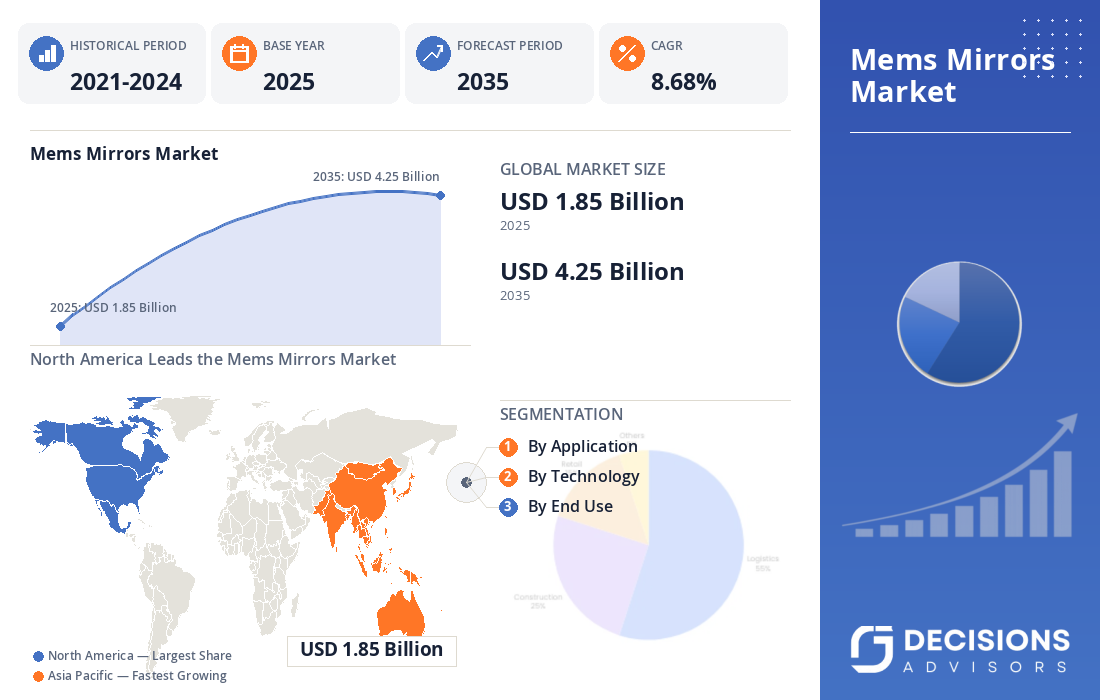
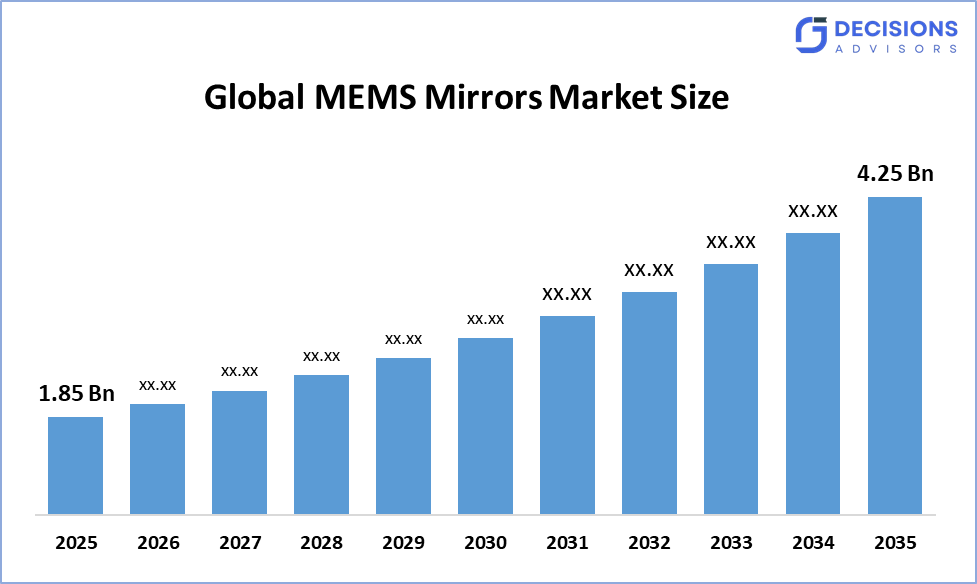
The Global MEMS Mirrors Market Size is predicted to grow from USD 1.85 Billion in 2025 and is likely to reach around USD 4.25 Billion by 2035, with a CAGR of 8.68%. According to Decision Advisors, the market is being driven by increasing demand for compact optical beam-steering solutions across LiDAR, AR/VR, laser projection, 3D sensing, biomedical imaging, and optical communications. North America remains a major contributor because of its strong MEMS and photonics ecosystem, while Asia-Pacific is expected to record the fastest expansion as semiconductor manufacturing, automotive electronics, and consumer-device production increase.
Market Snapshot
- Global MEMS Mirrors Market Size (2025): USD 1.85 Billion
- Projected Global MEMS Mirrors Market Size (2035): USD 4.25 Billion
- Global MEMS Mirrors Market Compound Annual Growth Rate (CAGR): 8.68%
- Largest Regional Market: North America
- 2nd Largest Region: Asia-Pacific
- Fastest Growing Region: Asia-Pacific
- Base Year: 2025
- Historical Period: 2021-2024
- Market Forecast Period: 2026-2035.
Market Overview/ Introduction
The global MEMS mirrors market comprises miniature optical mirrors manufactured using microelectromechanical systems technology to control, redirect, and scan light with high speed and precision. MEMS mirrors combine mechanical structures, actuators, reflective surfaces, and electronic control systems in compact architectures. They are increasingly used in laser beam steering, LiDAR, optical switching, laser projection, microscopy, biomedical imaging, 3D sensing, and augmented and virtual reality systems. Market growth is supported by the transition toward smaller, lighter, faster, and more energy-efficient optical systems. Automotive manufacturers are increasing investment in advanced sensing and LiDAR, while consumer electronics companies are developing AR glasses, compact projectors, depth-sensing systems, and other optical products requiring miniature beam-steering components. Major participants include Texas Instruments, Hamamatsu Photonics, MicroVision, Mirrorcle Technologies, STMicroelectronics, OQmented, Preciseley Microtechnology, and other MEMS and photonics specialists.
- United States, Semiconductor and MEMS manufacturing initiatives under the CHIPS and Science Act are strengthening domestic capabilities for advanced semiconductor and sensor technologies.
- Japan, Government-supported semiconductor and Post-5G programs are encouraging R&D in advanced semiconductor technologies and MEMS-related manufacturing.
- China, Investment in domestic semiconductor manufacturing, smart manufacturing, LiDAR, consumer electronics, and automotive technology is supporting demand for MEMS-based optical components.
Notable Insights: -
- North America is anticipated to hold approximately 34% share of the Global MEMS Mirrors Market over the predicted timeframe.
- Asia-Pacific is expected to grow at a rapid CAGR in the Global MEMS Mirrors Market, holding approximately 31% of the share during the forecast period.
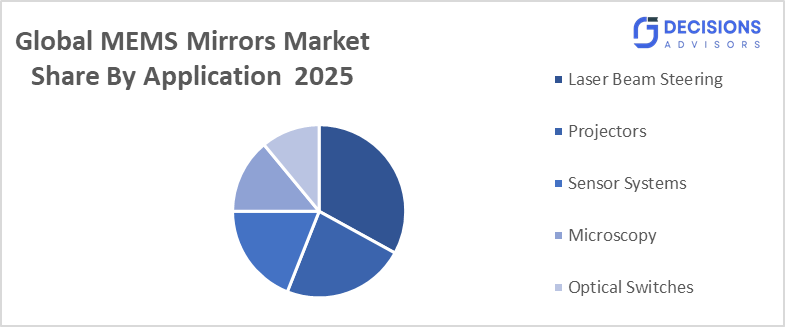
- By Application, the Laser Beam Steering segment dominated the market and holds approximately 33% share in 2025 and is projected to grow at a substantial CAGR during the forecast period.
- By Technology, the Electrostatic segment dominated the market and holds approximately 43% share in 2025 and is projected to grow at a substantial CAGR during the forecast period.
- By End Use, the Consumer Electronics segment dominated the market and holds approximately 36% share in 2025 and is projected to grow at a substantial CAGR during the forecast period.
- The compound annual growth rate of the Global MEMS Mirrors Market is 8.68%.
- The market is likely to achieve a valuation of USD 4.25 Billion by 2035.
Market Drivers
The global MEMS mirrors market is experiencing growth because optical systems increasingly require compact and high-speed beam-steering components. Automotive LiDAR is one of the strongest demand areas because MEMS mirrors can steer laser beams across a field of view while occupying less space than conventional mechanical scanning mechanisms. The increasing development of advanced driver-assistance systems and autonomous-driving technologies is creating additional opportunities for MEMS-based optical scanning. The rapid expansion of AR/VR and smart-glasses technologies is another important driver. MEMS mirrors can be integrated into miniature laser-scanning display engines, helping manufacturers reduce optical-system size while maintaining precise light control. Consumer electronics applications such as compact projectors, 3D sensing, smartphones, and wearable devices are also supporting demand.
Restrain
The global MEMS mirrors market faces challenges associated with manufacturing complexity, reliability requirements, and high development costs. MEMS mirrors require precise fabrication, actuator integration, reflective coatings, packaging, calibration, and control electronics, which can increase production complexity. Environmental factors such as temperature fluctuations, vibration, humidity, contamination, and mechanical shock can affect optical performance, particularly in automotive and aerospace applications.
Competitive Analysis:
The report offers the appropriate analysis of the key organizations/companies involved within the global MEMS mirrors market, along with a comparative evaluation primarily based on their product offerings, business overviews, geographic presence, enterprise strategies, segment market share, and SWOT analysis. The report also provides an elaborative analysis focusing on the current news and developments of the companies, which includes product development, innovations, joint ventures, partnerships, mergers & acquisitions, strategic alliances, and others. This allows for the evaluation of the overall competition within the market.
Top Companies in the Global MEMS Mirrors Market
- Texas Instruments
- Hamamatsu Photonics
- MicroVision
- Mirrorcle Technologies
- OQmented
- STMicroelectronics
- Preciseley Microtechnology
- Sercalo Microtechnology
- Teledyne DALSA
- Opus Microsystems.
Government Initiatives
|
Country |
Key Government Initiatives |
|
United States |
The CHIPS and Science Act supports domestic semiconductor and MEMS manufacturing, research, and supply-chain development, strengthening the ecosystem required for advanced MEMS and optical components |
|
Japan |
Japan's semiconductor and Post-5G initiatives support advanced semiconductor R&D, manufacturing technologies, and next-generation electronic components, creating favorable conditions for MEMS development |
|
China |
China's semiconductor self-reliance, smart manufacturing, automotive electronics, and advanced sensing initiatives are supporting domestic development and adoption of MEMS technologies |
Market Segmentation
The Global MEMS Mirrors Market share is classified into application, technology, and end use.
- The Laser Beam Steering segment dominated the market and holds approximately 33% share in 2025 and is projected to grow at a substantial CAGR during the forecast period.
Based on Application, the Global MEMS Mirrors Market is divided into Laser Beam Steering, Microscopy, Projectors, Optical Switches, and Sensor Systems. Among these, Laser Beam Steering dominates the market and holds approximately 33% share in 2025. The segment benefits from the expanding deployment of LiDAR, 3D sensing, laser projection, and optical scanning systems. MEMS mirrors provide rapid and precise angular movement within compact packages, making them attractive for applications where conventional mechanical scanners are too large or power-intensive. Increasing demand for automotive sensing and advanced optical systems is expected to maintain the segment's leading position.
- The Electrostatic segment accounted for the largest share of approximately 43% in 2025 and is anticipated to grow at a significant CAGR during the forecast period.
Based on Technology, the market is divided into Electrostatic, Electromagnetic, Electrothermal, and Piezoelectric. Among these, Electrostatic accounted for the largest share and holds approximately 43% share in 2025. Electrostatic actuation is well suited to MEMS manufacturing because of its compact structure, low power requirements, rapid response, and compatibility with semiconductor fabrication processes. These characteristics make electrostatic mirrors particularly attractive for optical scanning, LiDAR, projection, and AR applications.
- The Consumer Electronics segment accounted for the largest share of approximately 36% in 2025 and is anticipated to grow at a significant CAGR during the forecast period.
Based on End Use, the market is divided into Consumer Electronics, Automotive, Healthcare, and Aerospace & Defense. Among these, Consumer Electronics accounted for the largest share and holds approximately 36% share in 2025. Demand is supported by AR/VR devices, smart glasses, compact projectors, smartphones, 3D sensing systems, and wearable electronics. Manufacturers are increasingly looking for miniaturized optical components capable of providing high-speed beam control while reducing overall system size and energy consumption.
Regional Segment Analysis of the Global MEMS Mirrors Market
- North America (U.S., Canada, Mexico)?
- Europe (Germany, U.K., France, Italy, Spain, Netherlands, Rest of Europe).
- Asia-Pacific (China, Japan, India, Australia, South Korea, Rest of Asia-Pacific).
- South America (Brazil, Argentina, Rest of South America).
- Middle East & Africa (UAE, Saudi Arabia, South Africa, Rest of MEA).
Asia Pacific is anticipated to hold approximately 31% share of the Global MEMS Mirrors Market over the predicted timeframe.
Asia-Pacific is expected to be the fastest-growing regional market because of its strong electronics manufacturing ecosystem, expanding semiconductor capacity, automotive production, and consumer electronics industry. China, Japan, South Korea, India, and Taiwan provide extensive semiconductor and electronics supply chains that support MEMS development and integration. The region is also witnessing increasing investment in LiDAR, AR/VR, smart devices, optical sensing, and advanced automotive electronics. Growing domestic semiconductor capabilities and government-backed technology programs are expected to strengthen the regional market through 2035.
North America is expected to maintain the largest share of the Global MEMS Mirrors Market, holding approximately 34% of the share during the forecast period.
The region benefits from strong MEMS research capabilities, specialized optical technology companies, aerospace and defense applications, automotive technology development, and advanced semiconductor infrastructure. The United States is particularly important for LiDAR, AR/VR, 3D sensing, biomedical imaging, and optical communications. Government investment in semiconductor manufacturing and MEMS technologies is further supporting domestic production capabilities and supply-chain resilience.
Europe is expected to remain a significant market for MEMS mirrors, holding approximately 22% share during the forecast period.
The region has established photonics, semiconductor, automotive, industrial automation, and precision-engineering industries. Germany, France, the United Kingdom, Switzerland, and other European countries contribute to the development and adoption of advanced optical technologies. Increasing electric-vehicle production, ADAS deployment, industrial automation, and AR/VR development are creating additional opportunities for MEMS mirrors.
Future Market Trends in Global MEMS Mirrors Market: -
-
- Expansion of MEMS Mirrors in Automotive LiDAR.
Automotive LiDAR is expected to remain a major growth opportunity for MEMS mirrors. Vehicle manufacturers and sensor developers are seeking smaller, faster, and more reliable scanning architectures for ADAS and autonomous-driving applications.
-
- Increasing Adoption in AR Smart Glasses.
AR smart glasses are expected to create substantial demand for miniature optical scanning components. MEMS mirrors can be integrated into laser-beam-scanning display engines, enabling compact optical architectures.
-
- Integration with Closed-Loop Position Sensing.
Future MEMS mirror products are expected to increasingly integrate position sensing and closed-loop control. Such integration can improve angular accuracy, repeatability, stability, and calibration. These capabilities are especially valuable in LiDAR, industrial inspection, biomedical imaging, and aerospace applications where optical positioning must remain highly accurate.
-
- Growth in 3D Sensing and Optical Communications.
MEMS mirrors are expected to expand beyond conventional projection and scanning applications into 3D sensing, free-space optical communication, metrology, biomedical imaging, and telecommunications. Their compact size and rapid beam-steering capabilities make them attractive for next-generation optical systems requiring precise and electronically controlled light movement.
Recent Development
- In August 2026, TDK acquired assets from OQmented to strengthen its AR display technology capabilities, including MEMS mirror and laser beam-scanning technologies for next-generation optical systems.
- In March 2026, Mirrorcle Technologies entered into a technology transfer agreement with Kaynes Semicon to establish MEMS mirror manufacturing capabilities in India.
- In February 2026, Mirrorcle Technologies introduced its A9M12 MEMS Mirror Series, targeting high-performance dual-axis optical beam-steering applications.
Market Segment
This study forecasts revenue at global, regional, and country levels from 2021 to 2035. Decision Advisors has segmented the Global MEMS Mirrors Market based on the below-mentioned segment:
Global MEMS Mirrors Market, By Application.
- Laser Beam Steering
- Microscopy
- Projectors
- Optical Switches
- Sensor Systems.
Global MEMS Mirrors Market, By Technology.
- Electrostatic
- Electromagnetic
- Electrothermal
- Piezoelectric.
Global MEMS Mirrors Market, By End Use.
- Consumer Electronics
- Automotive
- Healthcare
- Aerospace & Defense.
Global MEMS Mirrors Market, By Regional Analysis.
- North America
- US
- Canada
- Mexico
- Europe
- Germany
- UK
- France
- Italy
- Spain
- Russia
- Rest of Europe
- Asia Pacific
- China
- Japan
- India
- South Korea
- Australia
- Rest of Asia Pacific
- South America
- Brazil
- Argentina
- Rest of South America
- Middle East & Africa
- UAE
- Saudi Arabia
- Qatar
- South Africa
- Rest of the Middle East & Africa
Frequently Asked Questions (FAQ)
Q. What are MEMS mirrors used for?
A. MEMS mirrors are used to rapidly redirect and scan laser or optical beams. Major applications include LiDAR, AR/VR displays, laser projection, 3D sensing, microscopy, biomedical imaging, optical switching, and telecommunications.
Q. Why are MEMS mirrors important for LiDAR?
A. MEMS mirrors provide rapid and precise laser-beam steering within compact optical packages. This allows LiDAR manufacturers to reduce the size and mechanical complexity of scanning systems while maintaining accurate field-of-view coveragend.
Q. Which technology dominates the MEMS Mirrors Market?
A. Electrostatic actuation is expected to remain the leading technology, accounting for approximately 43% of the market in 2025. Its low power consumption, compact architecture, rapid response, and compatibility with semiconductor manufacturing make it suitable for several high-growth optical applications.
Q. Which application is expected to lead the MEMS Mirrors Market?
A. Laser Beam Steering is expected to remain the leading application, accounting for approximately 33% of the market in 2025. LiDAR, 3D sensing, laser projection, and optical scanning are major demand areas.
Check Licence
Choose the plan that fits you best: Single User, Multi-User, or Enterprise solutions tailored for your needs.
We Have You Covered
- 24/7 Analyst Support
- Clients Across the Globe
- Tailored Insights
- Technology Tracking
- Competitive Intelligence
- Custom Research
- Syndicated Market Studies
- Market Overview
- Market Segmentation
- Growth Drivers
- Market Opportunities
- Regulatory Insights
- Innovation & Sustainability
Report Details
| Scope | Global |
| Pages | 200 |
| Delivery | PDF & Excel via Email |
| Language | English |
| Release | Aug 2026 |
| Access | Download from this page |