
Global Metabolic Dysfunction-Associated Steatohepatitis Market
 |
Author:
Disha B
|
Pages:
275
|
Author:
Disha B
|
Pages:
275
Global Metabolic Dysfunction-Associated Steatohepatitis Market Size, Share, and COVID-19 Impact Analysis, By Therapeutic Targets (Farnesoid X receptor, Peroxisome proliferator activated receptor, and FGF-21), By Treatment (Drug Therapy, Phytic Acid Based Nano-Medicine Therapy, Diabetes Control, Regular Exercise and Weight Management, and Others), and By Region (North America, Europe, Asia-Pacific, Latin America, Middle East, and Africa), Analysis and Forecast 2025 - 2035
CAGR
20.76%
REVENUE 2024
USD Billion 2.34
FORECAST 2035
USD Billion 18.64
REPORT COVERAGE
Global
Global Metabolic Dysfunction-Associated Steatohepatitis Market Size Insights Forecasts to 2035
- The Global Metabolic Dysfunction-Associated Steatohepatitis Market Size Was Estimated at USD 2.34 Billion in 2024
- The Market Size is Expected to Grow at a CAGR of around 20.76% from 2025 to 2035
- The Worldwide Metabolic Dysfunction-Associated Steatohepatitis Market Size is Expected to Reach USD 18.64 Billion by 2035
- North America is expected to Grow the fastest during the forecast period.
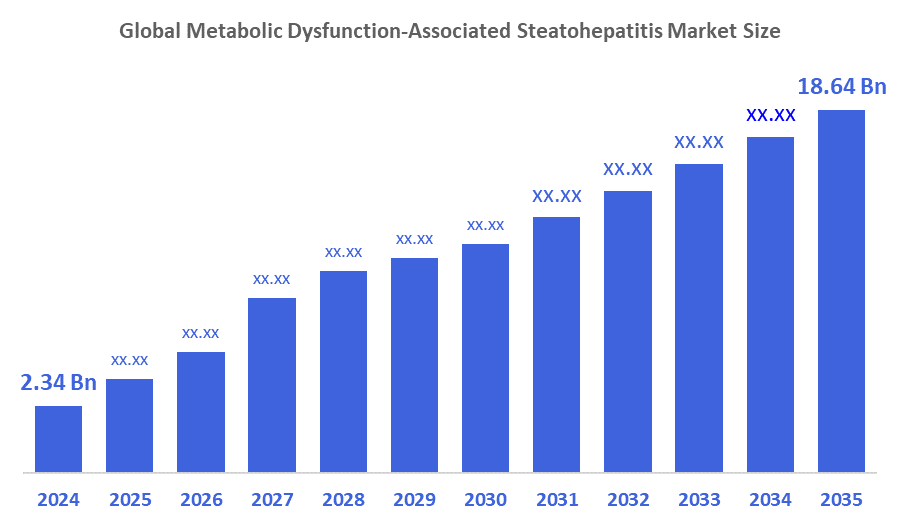
According to a Research Report Published by Decisions Advisors and Consulting, The Global Metabolic Dysfunction-Associated Steatohepatitis Market Size was worth around USD 2.34 Billion in 2024 and is predicted to Grow to around USD 18.64 Billion by 2035 with a compound annual growth rate (CAGR) of 20.76% from 2025 to 2035. Market growth for metabolic dysfunction-associated steatohepatitis (MASH) remains significant, driven by increased public awareness of the metabolic conditions associated with MASH, rising healthcare expenditures, and the development of improved diagnostic and treatment options. Moreover, well-established pharmaceutical companies and start-ups are developing innovative products targeting the fundamental cause of the disease, which boosts the market expansion.
Market Overview
The metabolic dysfunction-associated steatohepatitis market includes diagnosing, treating, managing MASH, and researching the role of the liver in obesity. Moreover, diabetes type 2 diabetes and related metabolic disorders could be intersecting in such a disorder condition. MASH is a form of liver disease involving excess fat accumulating within the liver (also known as fatty liver disease). This accumulation of fat results in inflammation in the liver, which can lead to liver damage (also referred to as hepatic damage). MASH is believed to be caused by metabolic disorders related to elevated blood sugar levels, obesity and/or the presence of elevated blood cholesterol levels. While MASH is considered a type of fatty liver disease, alcohol does not have to be consumed in significant amounts for the diagnosis to be made. MASH may present as having no noticeable signs or symptoms at first; however, as the disease progresses, symptoms of the disease may begin to develop approximately two weeks after MASH has developed. Diagnosing MASH requires taking into consideration the patient's clinical assessment, their family history, laboratory testing for hepatitis C, the presence of Hepatitis B virus, laboratory blood tests and measurements of the liver's stiffness using a technique called elastography. Imaging methods utilised by physicians to determine whether or not there is an increased amount of fat in the patient's liver include abdominal ultrasound and CT scans.
MetaVia Inc, a clinical-stage biotech focused on cardiometabolic diseases, declared an $8.1 million underwritten public offering to fund development of its obesity treatment candidate DA-1726. The offering includes common stock and warrants, priced at $3.10 per unit.
In October 2025, Novo Nordisk made its biggest MASH bet when it paid $5.2 billion to purchase Akero Therapeutics, focusing on Akero's FGF21 agonist for metabolic liver disease.
In September 2025, Roche acquired Phase 3 asset pegozafermin, a potential best-in-class FGF21 analogue for moderate-to-severe MASH, by purchasing 89bio for up to $3.5 billion ($2.4 billion upfront).
Report Coverage
This research report categorises the metabolic dysfunction-associated steatohepatitis market based on various segments and regions, forecasts revenue growth, and analyzes trends in each submarket. The report analyses the key growth drivers, opportunities, and challenges influencing the metabolic dysfunction-associated steatohepatitis market. Recent market developments and competitive strategies, such as expansion, product launch, development, partnership, merger, and acquisition, have been included to draw the competitive landscape in the market. The report strategically identifies and profiles the key market players and analyzes their core competencies in each sub-segment of the metabolic dysfunction-associated steatohepatitis market.
Driving Factors
The increase in the incidence of metabolic syndrome and the accumulation of fat in the liver, inflammation and scarring as a result of it will be driving the growth of the metabolic dysfunctions associated with steatohepatitis (MAS). Additionally, THR-beta agonists, such as resmetirom, act as catalysts for reversing the progression of the disease by increasing the regulation of lipid metabolism in the liver. Moreover, a growing number of consumers are using dietary supplements (e.g., vitamin E, omega-3's, and silymarin) to alleviate symptoms of this disease and to promote liver health, which generates new market opportunities. The increasing acceptance of and use of gastric bypass surgery in severely obese individuals will also continue to facilitate market expansion. Finally, the increasing awareness and willingness to explore the use of stem cell therapy will also provide major support for the growth of the MAS market during the forecasted period. Even more importantly, with the help of stem cells, we may one day be able to generate new liver tissue, reduce the amount of fibrosis that occurs, and improve liver function, which influences the key market players for innovations.
Restraining Factors
The complexity of MASH's interactions between metabolic, genetic and environmental factors presents a challenge to developing a uniform treatment, as each patient may respond differently to treatment, dependent on the extent of liver damage and the presence of co-morbid conditions. In addition to this, the lack of systemic and accepted criteria for diagnosis inhibit development of both a detection and a treatment program. As a result of these obstacles, drug development is slowed down; product launch is delayed; and patient access is limited, thereby limiting the overall growth of the market.
Market Segmentation
The metabolic dysfunction-associated steatohepatitis market share is classified into therapeutic targets, and treatment.
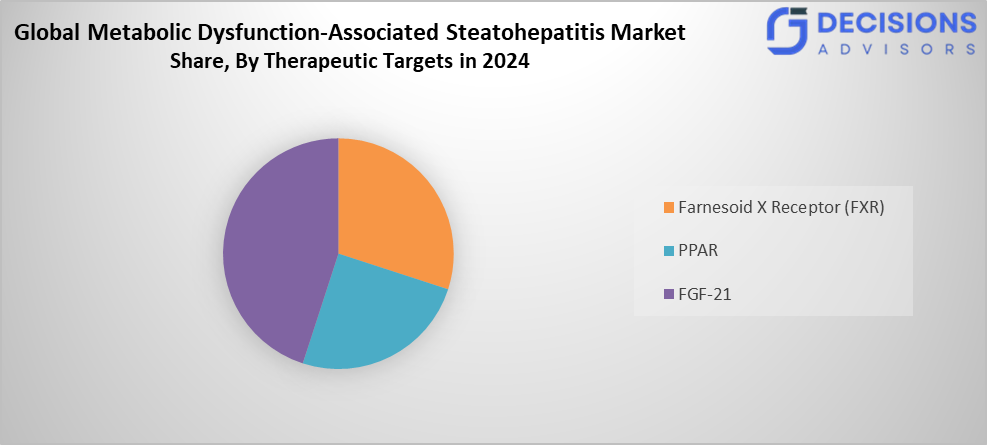
- The FGF-21 segment accounted for the largest market share in 2024 and is anticipated to grow at a significant CAGR during the forecast period.
Based on the therapeutic targets, the metabolic dysfunction-associated steatohepatitis market is segmented into farnesoid X receptor, peroxisome proliferator-activated receptor, and FGF-21. Among these, the FGF-21 segment accounted for the largest market share in 2024 and is anticipated to grow at a significant CAGR during the forecast period. FGF-21 treatments have a high efficacy with improved liver fat, inflammation and fibrosis, as well as offering metabolic benefits across the spectrum of obesity, insulin resistance and dyslipidemia, which are the key features associated with MASH. Besides, FGF-21 treatments will lead in terms of total sales in the future because of the positive trend they have established within the treatment range.
- The drug therapy segment accounted for the highest revenue share in 2024 and is expected to grow at a notable CAGR over the forecast period.
Based on the treatment, the metabolic dysfunction-associated steatohepatitis market is segmented into drug therapy, phytic acid-based nano-medicine therapy, diabetes control, exercise and weight management, and others. Among these, the drug therapy segment accounted for the highest revenue share in 2024 and is expected to grow at a notable CAGR over the forecast period. This segment growth contributed to the market expansion due to drug therapy offering a targeting of bile acid pathways, improving lipid and glucose metabolism, and GLP?1 receptor agonists (like semaglutide) addressing obesity and insulin resistance. These form the backbone of emerging treatments, aiming to reduce liver inflammation, fibrosis, and metabolic dysfunction. For instance, Rezdiffra's mechanism of action is that of a beta-thyroid hormone receptor partial agonist. Many genes play a role in lipid metabolism and are primarily controlled by the liver beta-thyroid hormone receptor. Therefore, Rezdiffra reduces intrahepatic triglyceride levels and improves liver health by reducing fatty degeneration in the liver.
Regional Segment Analysis of the Metabolically Dysfunctional-Associated Steatohepatitis Market
- North America (U.S., Canada, Mexico)
- Europe (Germany, France, U.K., Italy, Spain, Rest of Europe)
- Asia-Pacific (China, Japan, India, Rest of APAC)
- South America (Brazil and the Rest of South America)
- The Middle East and Africa (UAE, South Africa, Rest of MEA)
Asia Pacific is anticipated to hold the largest share of the metabolic dysfunction-associated steatohepatitis market over the predicted timeframe.
Asia Pacific is anticipated to hold the largest share of the metabolic dysfunction-associated steatohepatitis market over the predicted timeframe. Asia-Pacific offers enormous potential for market expansion and is anticipated to witness significant growth in the upcoming years due to expanding healthcare infrastructure, rising awareness, and increased investments in medical research. Metabolic disorders are rapidly rising in the region as a consequence of sedentary lifestyles, urbanisation, and dietary changes. MASH is becoming more common as obesity rates rise in nations like China and India.
North America is expected to grow at a rapid CAGR in the metabolic dysfunction-associated steatohepatitis market during the forecast period. The North American metabolic dysfunction-associated steatohepatitis (mash) market is projected to have a dominant share due to the high prevalence of metabolic disorders like Obesity and Type 2 Diabetes. Further, there is strong support from R&D initiatives and increased public awareness; North American countries also benefit from a strong healthcare infrastructure. Additionally, the presence of large pharmaceutical companies and ongoing clinical trial research within the MASH space continues to drive the growth of this market. The United States, in particular, has a large population of patients who require innovative medicine and diagnostic technology for MASH.
The U.S. government launched its first-ever national study to assess the prevalence of metabolic dysfunction-associated steatotic liver disease (MASLD), formerly known as NAFLD. The study will be led by the Agency for Healthcare Research and Quality (AHRQ) in collaboration with other federal agencies, aiming to provide accurate data on how widespread MASLD is.
Competitive Analysis:
The report offers the appropriate analysis of the key organizations/companies involved within the metabolic dysfunction-associated steatohepatitis market, along with a comparative evaluation primarily based on their product offering, business overviews, geographic presence, enterprise strategies, segment market share, and SWOT analysis. The report also provides an elaborative analysis focusing on the current news and developments of the companies, which includes product development, innovations, joint ventures, partnerships, mergers & acquisitions, strategic alliances, and others. This allows for the evaluation of the overall competition within the market.
List of Key Companies
- Alnylam Pharmaceuticals, Inc.
- Alimentiv Inc.
- Arrowhead Pharmaceuticals Inc.
- Boehringer Ingelheim International GmbH
- Cellarity
- Corcept Therapeutics, Incorporated
- Gilead Sciences, Inc.
- Galectin Therapeutics, Inc.
- Ionis Pharmaceuticals
- Lilly
- Madrigal Pharmaceuticals
- Merck & Co., Inc.
- Novo Nordisk A/S
- Novartis AG
- Others
Key Target Audience
- Market Players
- Investors
- End-users
- Government Authorities
- Consulting and Research Firm
- Venture capitalists
- Value-Added Resellers (VARs)
Recent Development
- In August 2025, the FDA officially approved Wegovy (semaglutide 2.4 mg injection) for adults with noncirrhotic metabolic dysfunction-associated steatohepatitis (MASH) and moderate to advanced liver fibrosis. This makes Wegovy the first GLP-1 receptor agonist with an indication for MASH, expanding its use beyond obesity and cardiovascular risk reduction.
- In August 2024, PathAI launched AIM-MASH, an AI-powered tool integrated into its AISight Image Management System, designed to improve reproducibility and scalability in assessing metabolic dysfunction-associated steatohepatitis (MASH) and liver fibrosis. This marks a significant step in digital pathology, enabling more consistent and efficient evaluation of liver disease progression.
Market Segment
This study forecasts revenue at global, regional, and country levels from 2020 to 2035. Decisions Advisors has segmented the metabolic dysfunction-associated steatohepatitis market based on the below-mentioned segments:
Global Metabolic Dysfunction-Associated Steatohepatitis Market, By Therapeutic Targets
- Farnesoid X receptor
- Peroxisome proliferator-activated receptor
- FGF-21
Global Metabolic Dysfunction-Associated Steatohepatitis Market, By Treatment
- Drug Therapy
- Phytic Acid-Based Nano-Medicine Therapy
- Diabetes Control
- Exercise and Weight Management
- Others
Global Metabolic Dysfunction-Associated Steatohepatitis Market, By Regional Analysis
- North America
- US
- Canada
- Mexico
- Europe
- Germany
- UK
- France
- Italy
- Spain
- Russia
- Rest of Europe
- Asia Pacific
- China
- Japan
- India
- South Korea
- Australia
- Rest of Asia Pacific
- South America
- Brazil
- Argentina
- Rest of South America
- Middle East & Africa
- UAE
- Saudi Arabia
- Qatar
- South Africa
- Rest of the Middle East & Africa
Frequently Asked Questions (FAQ)
- What is the projected market size and growth rate for the Global MASH Market?
The market was valued at USD 2.34 billion in 2024 and is expected to reach USD 18.64 billion by 2035, growing at a CAGR of 20.76% from 2025 to 2035.
- What are the main therapeutic targets in the MASH market?
The market segments by therapeutic targets into Farnesoid X receptor, Peroxisome proliferator-activated receptor, and FGF-21, with FGF-21 holding the largest share in 2024 due to its efficacy in reducing liver fat, inflammation, and fibrosis.
- Which treatment segment dominates the MASH market?
Drug therapy led with the highest revenue share in 2024 and is projected to grow at a notable CAGR, driven by innovations like GLP-1 receptor agonists (e.g., semaglutide) and THR-beta agonists such as resmetirom.
- What drives the growth of the MASH market?
Key drivers include rising incidence of metabolic syndrome, obesity, and type 2 diabetes; advancements in diagnostics like elastography; innovative therapies targeting lipid metabolism; and increasing use of supplements and stem cell research.
- What are the major challenges restraining MASH market expansion?
Complex patient-specific factors (metabolic, genetic, environmental), lack of standardised diagnostic criteria, and delays in drug development limit uniform treatments and patient access.
- Which region holds the largest market share, and why?
Asia-Pacific is anticipated to hold the largest share due to rapid urbanisation, rising obesity in countries like China and India, expanding healthcare infrastructure, and growing investments in research.
- Who are the leading companies in the MASH market?
Key players include Madrigal Pharmaceuticals, Novo Nordisk, Gilead Sciences, Roche (via 89bio), Alnylam Pharmaceuticals, Boehringer Ingelheim, Ionis Pharmaceuticals, and Lilly, focusing on drug development, acquisitions, and clinical trials.
Check Licence
Choose the plan that fits you best: Single User, Multi-User, or Enterprise solutions tailored for your needs.
We Have You Covered
- 24/7 Analyst Support
- Clients Across the Globe
- Tailored Insights
- Technology Tracking
- Competitive Intelligence
- Custom Research
- Syndicated Market Studies
- Market Overview
- Market Segmentation
- Growth Drivers
- Market Opportunities
- Regulatory Insights
- Innovation & Sustainability
Report Details
| Scope | Global |
| Pages | 275 |
| Delivery | PDF & Excel via Email |
| Language | English |
| Release | Feb 2026 |
| Access | Download from this page |