
Global Metal Deactivator Market
 |
Author:
Aditya G
|
Pages:
210
|
Author:
Aditya G
|
Pages:
210
Global Metal Deactivator Market Size, Share By Type (Fuel Additives, Lubricant Additives, Polymer Additives, and Others), By Application (Gasoline, Diesel & Middle Distillates, Jet Fuel, Industrial Fluids & Lubricants, and Polymers), By End-User Industry (Automotive & Transportation, Industrial, Aviation & Defense, Chemicals & Polymers, and Others), and By Region (North America, Europe, Asia-Pacific, Latin America, Middle East & Africa), Analysis and Forecast 2026-2035
CAGR
7.67%
REVENUE 2025
USD Billion 2.65
FORECAST 2035
USD Billion 5.55
REPORT COVERAGE
Global
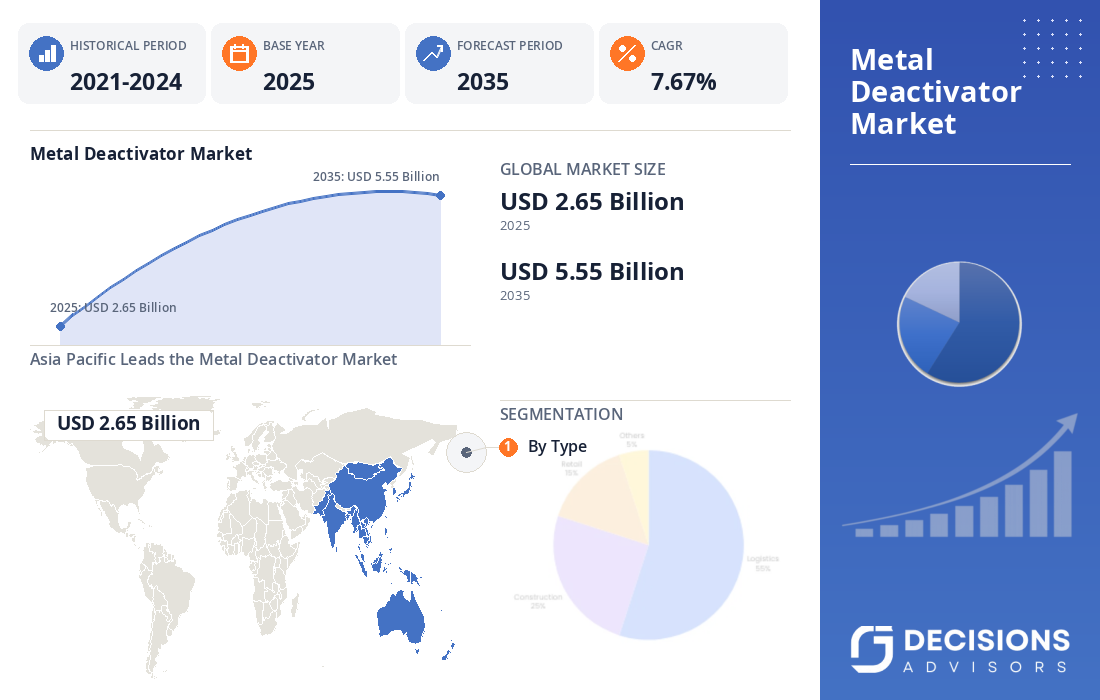
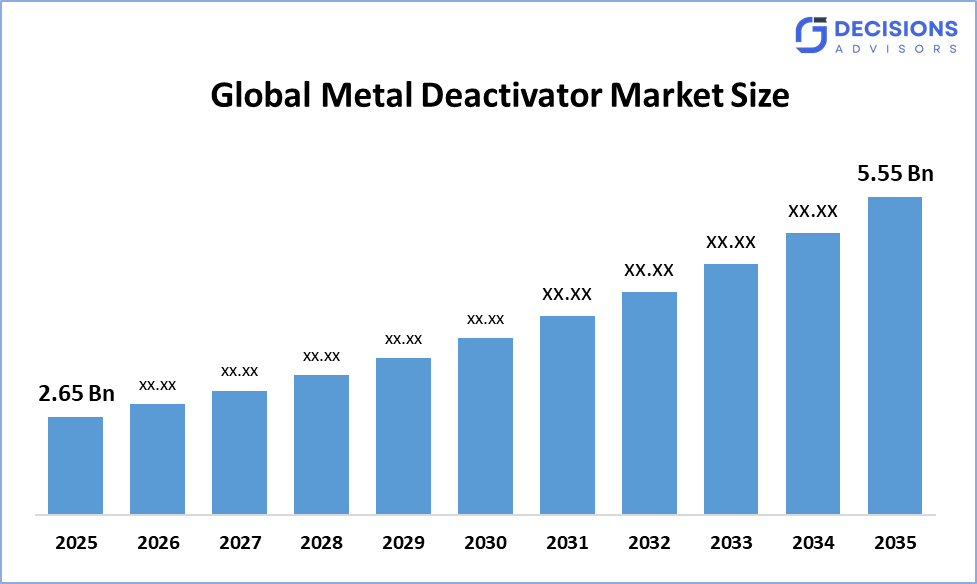
The Global Metal Deactivator Market Size is predicted to grow from USD 2.65 Billion in 2025 and is likely to reach around USD 5.55 Billion by 2035, with a CAGR of 7.67%. The market is supported by increasing demand for high-performance fuels and lubricants, greater industrial equipment utilization, stringent fuel-quality requirements, and rising demand for additives that prevent metal-catalyzed oxidation. Public market research confirms that Asia-Pacific is the leading regional market and that fuel additives, oil-soluble formulations, and automotive applications represent important market segments.
Market Snapshot
- Global Metal Deactivator Market Size (2025): USD 2.65 Billion
- Projected Global Metal Deactivator Market Size (2035): USD 5.55 Billion
- Global Metal Deactivator Market Compound Annual Growth Rate (CAGR): 7.67%
- Largest Regional Market: Asia Pacific
- 2nd Largest Region: North America
- Fastest Growing Region: Asia Pacific
- Base Year: 2025
- Historical Period: 2021-2024
- Market Forecast Period: 2026-2035.
Market Overview/ Introduction
The Global Metal Deactivator Market represents the specialty-chemical industry supplying additives that suppress the catalytic activity of metals such as copper, iron and other transition metals in fuels, lubricants, polymers and industrial fluids. Trace metals can accelerate oxidation, increase gum and deposit formation, reduce thermal stability and shorten fluid service life. Metal deactivators function primarily by chemically binding or passivating these metal ions, thereby reducing their ability to catalyze degradation reactions. The market therefore plays an important role in maintaining fuel quality, lubricant performance, equipment reliability and polymer durability. Demand is expanding as automotive fleets, industrial machinery, aviation systems and energy infrastructure increasingly require high-performance fluids capable of operating for longer periods under severe conditions. The market is also benefiting from increased refinery activity, tighter fuel-quality specifications, higher lubricant-performance requirements and development of advanced fluid formulations.
- United States, EPA fuel regulations and continuing renewable-fuel requirements are encouraging refiners and additive formulators to improve fuel stability and performance.
- China, Rapid automotive production, refining capacity and industrialization are increasing consumption of advanced fuel and lubricant additives.
- India, Expanding vehicle ownership, industrial machinery and cleaner-fuel requirements are increasing demand for advanced additive packages.
- Japan and South Korea, Advanced automotive manufacturing, high-performance lubricants and sophisticated industrial equipment create demand for specialized metal-passivation chemistry.
Notable Insights: -
- Asia Pacific is anticipated to hold approximately 44.67% share of the Global Metal Deactivator Market over the predicted timeframe.
- North America is expected to remain the second-largest regional market, holding approximately 24% share during the forecast period.
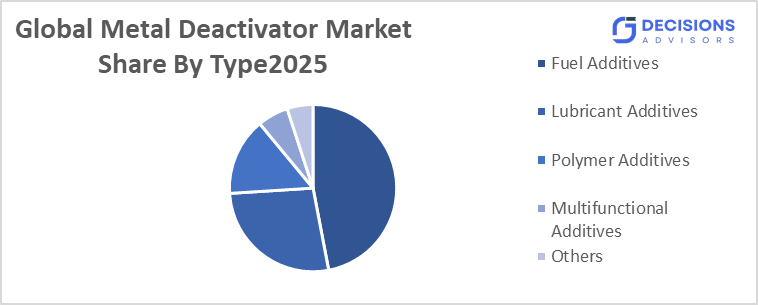
- By Type, the Fuel Additives segment dominated the market and holds approximately 46.7% share in 2025.
- By End-User Industry, the Automotive & Transportation segment dominated the market and holds approximately 41% share in 2025. Public market research also identifies automotive as the largest end-user category.
- The compound annual growth rate of the Global Metal Deactivator Market is 7.67%.
- The market is likely to achieve a valuation of USD 5.55 Billion by 2035.
Market Drivers
The increasing need for reliable machinery and longer equipment service life is a major factor supporting metal deactivator demand. Metal contaminants can accelerate oxidation in fuels and lubricants, making passivation increasingly important in automotive engines, industrial gear systems, hydraulic equipment, turbines and other machinery. As manufacturers seek longer drain intervals and higher operating efficiency, additive packages increasingly combine metal deactivation with antioxidant, corrosion-control and deposit-control functionality. The automotive sector is another major contributor because vehicle engines and fuel systems operate under increasingly demanding thermal and mechanical conditions. Expanding vehicle production across China, India and Southeast Asia is creating additional demand for advanced fuels and lubricants. APAC's fuel-additives market is projected to grow as vehicle production, fuel-quality requirements and industrialization increase.
Restrain
The Global Metal Deactivator Market faces several constraints. Fluctuations in crude-oil and petrochemical raw-material prices can increase manufacturing costs and create uncertainty for additive producers. Technavio identifies crude-oil price fluctuations among the key market challenges. Regulatory complexity is another restraint because additive manufacturers must demonstrate compatibility, safety and environmental performance across different fuels, lubricants and industrial applications. Reformulation costs can increase when regulations restrict particular chemical families or impose additional registration requirements. In addition, metal deactivators are normally incorporated at relatively low treat rates, which makes customer qualification, performance testing and formulation compatibility particularly important.
Competitive Analysis:
The report offers the appropriate analysis of the key organizations/companies involved within the Global Metal Deactivator Market, along with a comparative evaluation primarily based on their product offerings, business overviews, geographic presence, enterprise strategies, segment market share, and SWOT analysis. The report also provides an elaborative analysis focusing on the current news and developments of the companies, which includes product development, innovations, joint ventures, partnerships, mergers & acquisitions, strategic alliances, and others. This allows for the evaluation of the overall competition within the market.
Top Companies in the Global Metal Deactivator Market
- BASF SE
- Afton Chemical Corporation
- Innospec Inc.
- The Lubrizol Corporation
- Infineum International Limited
- Clariant AG
- LANXESS AG
- ADEKA Corporation
- Dow Inc.
- Eastman Chemical Company.
Government Initiatives
|
Country |
Key Government Initiatives |
|
United States |
EPA fuel-quality and Renewable Fuel Standard requirements continue to influence fuel formulation and additive requirements |
|
Japan |
Government support for next-generation vehicles, energy efficiency and advanced mobility technologies supports demand for higher-performance automotive fluids |
|
China |
Industrial and petrochemical modernization programs, alongside expanding vehicle production and refining infrastructure, support demand for advanced fuel and lubricant additives |
Market Segmentation
The Global Metal Deactivator Market share is classified into Type, Application and End-User Industry.
- The Fuel Additives segment dominated the market and holds approximately 46.7% share in 2025 and is projected to grow at a substantial CAGR during the forecast period.
Based on Type, the Global Metal Deactivator Market is divided into Fuel Additives, Lubricant Additives, Polymer Additives, and Others. Among these, Fuel Additives dominate the market and hold approximately 46.7% share in 2025. Fuel systems are particularly vulnerable to catalytic oxidation from trace metals, particularly copper. Metal deactivators help suppress this reaction and improve storage stability, deposit control and fuel performance. Growing fuel consumption, stricter fuel-quality requirements and increasing use of advanced additive packages are supporting continued demand.
- The Gasoline segment accounted for the largest individual application share of approximately 39% in 2025 and is anticipated to grow at a significant CAGR during the forecast period.
Based on Application, the market is divided into Gasoline, Diesel & Middle Distillates, Jet Fuel, Industrial Fluids & Lubricants, and Polymers. Gasoline represents a major application because copper contamination can accelerate oxidation and formation of gum and deposits. Diesel and middle-distillate fuels represent another substantial opportunity, while jet fuel is becoming increasingly important because thermal and oxidative stability are critical aviation requirements.
- The Automotive & Transportation segment accounted for the largest share of approximately 41% in 2025 and is anticipated to grow at a significant CAGR during the forecast period.
Based on End-User Industry, the market is divided into Automotive & Transportation, Industrial, Aviation & Defense, Chemicals & Polymers, and Others. Automotive & Transportation dominates because of the enormous consumption of fuels, engine oils, transmission fluids and other automotive fluids. Increasing vehicle production in emerging economies further expands the addressable market. Longer service intervals and increasingly demanding engine operating conditions increase the importance of oxidation control. Industrial and aviation applications provide additional growth through high-performance fluid requirements.
Regional Segment Analysis of the Global Metal Deactivator Market
- North America (U.S., Canada, Mexico)?
- Europe (Germany, U.K., France, Italy, Spain, Netherlands, Rest of Europe).
- Asia-Pacific (China, Japan, India, Australia, South Korea, Rest of Asia-Pacific).
- South America (Brazil, Argentina, Rest of South America).
- Middle East & Africa (UAE, Saudi Arabia, South Africa, Rest of MEA).
Asia Pacific is anticipated to hold approximately 44.67% share of the Global Metal Deactivator Market over the predicted timeframe.
Asia Pacific is the dominant regional market because of its large automotive manufacturing base, extensive refining infrastructure, industrial expansion and increasing demand for high-performance lubricants. China is the largest contributor, while India is developing rapidly as automotive production, fuel consumption and industrial machinery deployment increase. Japan and South Korea provide demand from advanced automotive, electronics and industrial sectors. Public market research estimates that APAC contributed more than 38% of incremental global metal-deactivator growth during the forecast period.
North America is expected to grow at a rapid CAGR in the Global Metal Deactivator Market, holding approximately 24% of the share during the forecast period.
The region benefits from mature fuel-additive and lubricant industries, significant automotive production, industrial machinery demand and a large aviation sector. The United States also has stringent fuel regulations that encourage sophisticated additive formulations. Leading global suppliers maintain significant manufacturing, technical and distribution capabilities in the region.
Europe is expected to hold approximately 20% share of the Global Metal Deactivator Market during the forecast period.
Europe represents an important premium market because of advanced automotive manufacturing, sophisticated industrial equipment and strong environmental and chemical regulations. Demand is increasingly centered on high-performance, low-impact additive chemistries. European producers such as BASF, Clariant and LANXESS contribute to regional innovation and supply capabilities.
Future Market Trends in Global Metal Deactivator Market: -
-
- Multifunctional Additive Formulations.
Additive manufacturers are increasingly developing formulations that combine metal deactivation with antioxidant, corrosion-inhibition, detergent and deposit-control functions. This approach reduces formulation complexity and enables fuel and lubricant manufacturers to achieve multiple performance objectives from fewer additive components.
-
- Growth in High-Performance Automotive Fluids.
Automotive manufacturers are demanding fluids that remain stable under higher temperatures, longer service intervals and increasingly sophisticated engine and transmission designs. This is increasing the need for advanced metal-passivation chemistry capable of maintaining fluid stability over extended operating periods.
-
- Sustainable Metal Deactivator Chemistry.
Environmental regulations are encouraging suppliers to develop lower-impact metal deactivators with improved biodegradability, reduced toxicity and compatibility with bio-based lubricants and renewable fuels. Sustainability is expected to become an increasingly important factor in product selection alongside technical performance.
-
- Expansion Across Aviation and Industrial Applications.
Jet fuel, turbine lubricants, hydraulic fluids, industrial gear oils and metalworking fluids provide significant opportunities beyond traditional automotive applications. The need for improved oxidation stability and equipment reliability should support increasing adoption of metal deactivators in high-value industrial applications.
Recent Development
- In August 2026, Baischem announced that its newly expanded production line for Petrocor® T591 metal deactivator successfully completed its first trial run. T591 is a DMTD-derived ashless metal deactivator used in engine oils, industrial lubricants, gear oils, metalworking fluids, and oil-and-gas applications.
- In October 2025, BASF’s Chemetall business launched Gardolene® D, a chromium-free and fluoride-free passivation solution for copper foils used in electric-vehicle batteries and energy-storage systems.
- In September 2025, Afton Chemical launched HiTEC® 12582, a dedicated additive for hydrogen-fueled heavy-duty engines. The launch expands Afton's fuel and lubricant additive technology toward lower-emission propulsion systems and demonstrates the industry's movement toward advanced additive formulations for emerging fuels.
Market Segment
This study forecasts revenue at global, regional, and country levels from 2021 to 2035. Decision Advisors has segmented the Global Metal Deactivator Market based on the below-mentioned segment:
Global Metal Deactivator Market, By Type.
- Fuel Additives
- Lubricant Additives
- Polymer Additives
- Multifunctional Additives
- Others.
Global Metal Deactivator Market, By Application.
- Gasoline
- Diesel & Middle Distillates
- Jet Fuel
- Industrial Fluids & Lubricants
- Polymers.
Global Metal Deactivator Market, By End-User Industry.
- Automotive & Transportation
- Industrial
- Aviation & Defense
- Chemicals & Polymers
- Others.
Global Metal Deactivator Market, By Regional Analysis.
- North America
- US
- Canada
- Mexico
- Europe
- Germany
- UK
- France
- Italy
- Spain
- Russia
- Rest of Europe
- Asia Pacific
- China
- Japan
- India
- South Korea
- Australia
- Rest of Asia Pacific
- South America
- Brazil
- Argentina
- Rest of South America
- Middle East & Africa
- UAE
- Saudi Arabia
- Qatar
- South Africa
- Rest of the Middle East & Africa
Frequently Asked Questions (FAQ)
Q. What is a metal deactivator and why is it used?
A. A metal deactivator is a specialty additive that suppresses the catalytic activity of metals such as copper and iron. It helps prevent metal-induced oxidation and degradation in fuels, lubricants, polymers and industrial fluids.
Q. Which segment dominates the Global Metal Deactivator Market?
A. Fuel additives represent the leading type segment, accounting for approximately 46.7% of the market. Automotive & transportation is the leading end-user category because of extensive fuel and lubricant consumption.
Q. Which region dominates the Global Metal Deactivator Market?
A. Asia Pacific is the dominant regional market, accounting for approximately 44.67% of 2025 revenue in the latest published market benchmark. Strong automotive manufacturing, refining capacity and industrialization in China and India are major contributors.
Q. What is driving the growth of metal deactivators in automotive applications?
A. Increasing vehicle production, longer lubricant service intervals, higher engine operating temperatures and demand for improved fuel stability are increasing the need for advanced additive packages. APAC's rapidly expanding automotive sector is particularly important to future demand.
Check Licence
Choose the plan that fits you best: Single User, Multi-User, or Enterprise solutions tailored for your needs.
We Have You Covered
- 24/7 Analyst Support
- Clients Across the Globe
- Tailored Insights
- Technology Tracking
- Competitive Intelligence
- Custom Research
- Syndicated Market Studies
- Market Overview
- Market Segmentation
- Growth Drivers
- Market Opportunities
- Regulatory Insights
- Innovation & Sustainability
Report Details
| Scope | Global |
| Pages | 210 |
| Delivery | PDF & Excel via Email |
| Language | English |
| Release | Aug 2026 |
| Access | Download from this page |