
Global Metastatic Non-Small Cell Lung Cancer Market
 |
Pages:
210
|
Pages:
210
Global Metastatic Non-Small Cell Lung Cancer Market Size, Share, By Therapy Type (Targeted Therapy, Immunotherapy, Chemotherapy, Combination Therapy), By Biomarker (EGFR, ALK, KRAS, ROS1, BRAF, MET, HER2, Others), By End User (Hospitals, Cancer Research Centers, Specialty Clinics), and By Region (North America, Europe, Asia-Pacific, Latin America, Middle East & Africa), Analysis and Forecast 2025?2035
REPORT COVERAGE
Global
Market Snapshot
- Market Size (2025): USD 18.60 Billion
- Projected Market Size (2035): USD 51.26 Billion
- Compound Annual Growth Rate (CAGR): 10.67%
- Largest Regional Market: Asia-Pacific
- Fastest Growing Region: North America
- 3rd Largest Region: Europe
- Base Year: 2025
- Historical Period: 2021–2024
- Forecast Period: 2026–2035
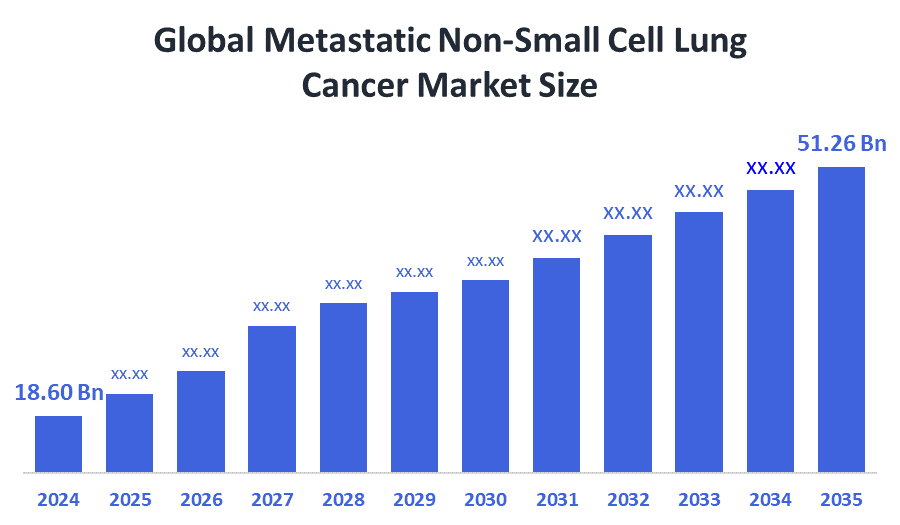
According to Decision Advisors, the Global Metastatic Non-Small Cell Lung Cancer Market Size is expected to grow from USD 18.60 billion in 2024 to USD 51.26 billion by 2035, at a CAGR of 10.67% during the forecast period 2025-2035. Global Metastatic Non-Small Cell Lung Cancer Market is projected to grow significantly over the next decade due to targeted molecular therapies (EGFR, ALK, KRAS), rising incidence, advancements in immunotherapy (PD-1/PD-L1), immune checkpoint inhibitors, targeted therapies, biomarker testing, combination therapies, advanced diagnostics & liquid biopsies, rising healthcare expenditure.
Market Overview/ Introduction
The worldwide market for metastatic non-small cell lung cancer (NSCLC) treatment encompasses all businesses that develop and distribute treatments for advanced-stage NSCLC when cancer spreads to distant body parts beyond the lungs. The market includes immunotherapies and targeted therapies alongside chemotherapy and combination therapies, which work to improve patient survival rates. The market expansion is driven by rising lung cancer cases across the world and increasing acceptance of precision medicine and new biomarker-based treatments, which address EGFR, ALK and KRAS mutations. The market expansion receives additional support from improved access to next-generation sequencing diagnostic tools, rising healthcare expenses, and the continuous drug development process, which includes both new innovations and product approvals.
- Ayushman Bharat PM-JAY provides up to ?5 lakh annual coverage for cancer treatment at empanelled hospitals. The Health Minister’s Cancer Patient Fund supports below-poverty-line patients at regional cancer centers. Combined with various state-level schemes, total government financial assistance can exceed ?10 lakh, improving access to advanced cancer treatments across India.
- Rajiv Gandhi Jeevandayee Arogya Yojana (RGJAY), launched in 2012, provided free tertiary care to low-income families. It was succeeded by Mahatma Jyotiba Phule Jan Arogya Yojana (MJPJAY), covering over 1,000 procedures including cancer treatments up to ?1.5 lakh. Additionally, the Chief Minister’s Relief Fund offers financial support for uncovered high-cost treatments.
Notable Insights: -
- Asia-Pacific holds the largest regional market share in the global spirit market.
- North America is the fastest-growing region in the global spirit market.
- The Immunotherapy segment dominated the market in 2025 and is projected to grow at a substantial CAGR during the forecast period.
- The EGFR mutation segment accounted for the largest share in 2025, and it's anticipated to grow at a significant CAGR during the forecast period.
- The compound annual growth rate of the global spirit market is 10.67%.
- The market is likely to achieve a valuation of USD 51.26 billion by 2035.
What is role of technology in grooming the market?
Technology plays a transformative role in the metastatic NSCLC market by enabling precision diagnostics, personalized treatment, and improved patient outcomes. Advanced technologies such as next-generation sequencing (NGS) allow comprehensive genomic profiling, helping clinicians identify actionable mutations. Liquid biopsy techniques are gaining traction due to their non-invasive nature and ability to monitor tumor progression in real time. Artificial intelligence (AI) and machine learning are increasingly used in drug discovery, clinical trial optimization, and treatment planning, improving efficiency and reducing development timelines. Additionally, digital health platforms and telemedicine are enhancing patient monitoring and treatment adherence. These innovations collectively contribute to faster diagnosis, targeted treatment, and improved survival rates, driving overall market growth.
Market Drivers
The global metastatic non-small cell lung cancer market is propelled by the demand for this industry, which grows because more people are getting diagnosed with medical conditions. The widespread approval of PD-1/PD-L1 inhibitors brought a complete transformation to the management of metastatic disease. Innovations in mutation identification now enable scientists to develop better targeted therapies that focus on specific mutations (EGFR, ALK, BRAF, MET, ROS-1, HER2, RET, and KRAS). The combination of immunotherapy and chemotherapy through dual immunotherapy shows better survival results for patients. The development of liquid biopsy and next-generation sequencing (NGS) diagnostic methods enables medical professionals to diagnose patients more quickly because these methods provide rapid testing results. The combination of modern payment systems and better healthcare facilities makes it easier for patients to access expensive, specialized medical treatments. The quick development of bispecific antibodies together with antibody-drug conjugates (ADCs) has created new treatment options for patients who do not respond to current therapies. The increased use of next-generation sequencing (NGS) and liquid biopsies enables early resistance diagnosis and non-invasive mutation tracking, which allows doctors to change treatments without needing invasive procedures.
Restrain
The metastatic non-small cell lung cancer market faces restraints due to the high cost of targeted therapies and immunotherapies, limiting affordability in developing regions. Additionally, limited access to advanced diagnostics, stringent regulatory approvals, treatment resistance, and potential adverse effects of therapies further challenge widespread adoption and hinder overall market growth.
Competitive Analysis:
The report offers the appropriate analysis of the key organizations/companies involved within the metastatic non-small cell lung cancer market, along with a comparative evaluation primarily based on their product of offering, business overviews, geographic presence, enterprise strategies, segment market share, and SWOT analysis. The report also provides an elaborative analysis focusing on the current news and developments of the companies, which includes product development, innovations, joint ventures, partnerships, mergers & acquisitions, strategic alliances, and others. This allows for the evaluation of the overall competition within the market.
Top Companies in Global Metastatic Non-Small Cell Lung Cancer Market
- AstraZeneca
- Roche Holding AG
- Bristol-Myers Squibb
- Merck & Co
- Pfizer Inc.
- Novartis AG
- Amgen Inc
- Eli Lilly and Company
- Takeda Pharmaceutical Company
- Bayer AG
Government Initiatives
|
Country |
Key Government Initiatives |
|
UK |
The UK adoption of circulating tumor DNA “blood-first” testing, supported by the National Health Service, is closely linked to the metastatic non-small cell lung cancer market. It accelerates mutation detection, enables targeted therapy use, reduces biopsy delays, and drives demand for precision diagnostics and advanced oncology treatments. |
|
US |
The Lung-MAP clinical trial, accessible via Lung-MAP.org or the National Cancer Institute, is directly related to the metastatic non-small cell lung cancer market. It advances precision medicine by matching targeted therapies to genetic profiles, shaping treatment innovation, improving outcomes, and influencing future oncology drug development strategies. |
|
China |
India released its first evidence-based national lung cancer guidelines in early 2026 to standardize diagnosis and treatment across healthcare systems. The guidelines emphasize molecular testing and stage-specific therapies, improving consistency in care delivery, supporting precision medicine adoption, and enhancing access to appropriate treatment across both public and private healthcare sectors. |
Market Segmentation
The metastatic non-small cell lung cancer market share is classified into therapy type, biomarker, and end user
- The immunotherapy segment dominated the market in 2025 and is projected to grow at a substantial CAGR during the forecast period.
Based on the therapy type, the metastatic non-small cell lung cancer market is divided into targeted therapy, immunotherapy, chemotherapy, and combination therapy. Among these, The Immunotherapy segment dominated the market in 2025, and is projected to grow at a substantial CAGR during the forecast period. Due to its superior clinical outcomes, including improved overall survival and durable responses compared to chemotherapy. The widespread adoption of PD-1/PD-L1 inhibitors, increasing approvals, and effectiveness across multiple patient groups have significantly driven demand, positioning immunotherapy as the standard of care in metastatic NSCLC treatment.
- The EGFR mutation segment accounted for the largest share in 2025, and is anticipated to grow at a significant CAGR of during the forecast period.
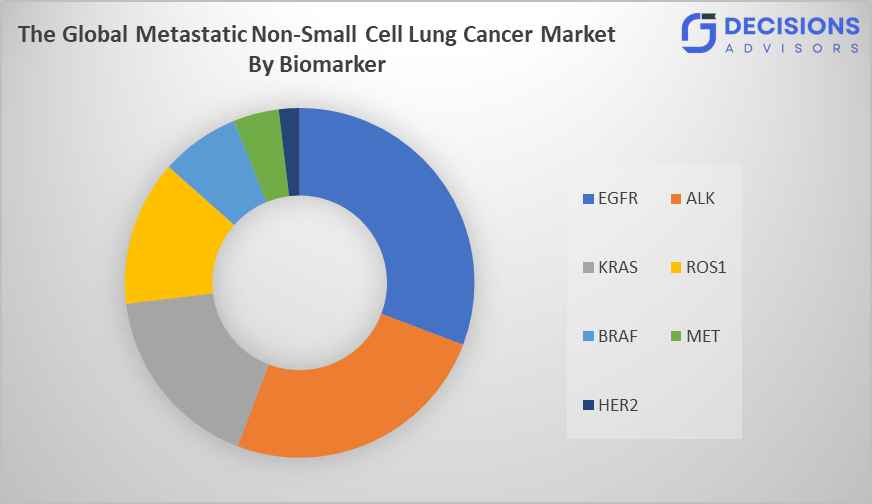
Based on the biomarker, the metastatic non-small cell lung cancer market is divided into EGFR, ALK, KRAS, ROS1, BRAF, MET, HER2, and others. Among these, the EGFR mutation segment accounted for the largest share in 2025, and it's anticipated to grow at a significant CAGR during the forecast period. Due to the high prevalence of EGFR mutations, particularly in Asian populations, and the strong clinical efficacy of EGFR-targeted therapies. The availability of multiple approved tyrosine kinase inhibitors (TKIs) and routine biomarker testing has significantly driven adoption, supporting continued growth during the forecast period.
- The hospitals segment dominated the market in 2025, and is projected to grow at a substantial CAGR during the forecast period.
Based on the end user, the metastatic non-small cell lung cancer market is divided into hospitals, cancer research centers and specialty clinics. Among these, The Hospitals segment dominated the market in 2025, and is projected to grow at a substantial CAGR during the forecast period. Due to the availability of advanced diagnostic infrastructure, specialized oncology care, and access to multidisciplinary treatment approaches. Hospitals serve as primary centers for administering complex therapies such as immunotherapy and targeted treatments, thereby driving higher patient inflow and supporting sustained growth during the forecast period.
Strategies to Implement for Growth of the Market in Non-Leading Regions
Growth in non-leading regions can be accelerated through strategic investments in healthcare infrastructure, improved access to diagnostics, and expansion of treatment availability. Companies can enhance market penetration by introducing cost-effective therapies and biosimilars, making advanced treatments more accessible to a broader patient population. Strengthening the availability of molecular diagnostic tools such as next-generation sequencing (NGS) and liquid biopsy is critical to enable early detection and biomarker-driven treatment in emerging markets. Expanding hospital networks, oncology centers, and specialty clinics can further improve patient access to advanced therapies. Additionally, collaborations with local governments, healthcare providers, and research institutions can support awareness programs, early screening initiatives, and faster adoption of innovative treatments. Strategic partnerships can also help streamline regulatory approvals and reimbursement pathways.
Regional Segment Analysis of the Metastatic Non-Small Cell Lung Cancer Market
- North America (U.S., Canada, Mexico)
- Europe (Germany, France, U.K., Italy, Spain, Rest of Europe)
- Asia-Pacific (China, Japan, India, Rest of APAC)
- South America (Brazil and the Rest of South America)
- The Middle East and Africa (UAE, South Africa, Rest of MEA)
Asia Pacific is anticipated to hold the largest share of the Metastatic Non-Small Cell Lung Cancer Market over the predicted timeframe.
Asia Pacific is anticipated to hold the largest share of the metastatic non-small cell lung cancer market over the predicted timeframe. The dominance of this region is primarily driven by the high burden of lung cancer cases, particularly in China and India. According to Global Cancer Observatory (GLOBOCAN), Asia accounts for over 60% of global lung cancer incidence, with China alone contributing the highest number of cases worldwide. The region also benefits from a large patient population, rising air pollution levels, high smoking prevalence, and improving healthcare infrastructure. Additionally, the higher prevalence of EGFR mutations (30% in Asian NSCLC patients vs. 14% in Western populations) has significantly increased the adoption of targeted therapies. Government initiatives to expand oncology care and growing access to next-generation sequencing (NGS) and biomarker testing are further supporting regional market growth.
North America is expected to grow at a rapid CAGR in the Metastatic Non-Small Cell Lung Cancer Market during the forecast period.
North America is expected to grow at a rapid CAGR in the Metastatic Non-Small Cell Lung Cancer Market during the forecast period. This growth is driven by the high adoption of advanced therapies, strong presence of key pharmaceutical companies, and robust healthcare infrastructure. The region leads in the use of immunotherapy (PD-1/PD-L1 inhibitors) such as pembrolizumab and nivolumab, which have become standard treatments for metastatic NSCLC. According to the American Cancer Society, lung cancer remains the leading cause of cancer-related deaths in the U.S., supporting sustained demand for innovative treatments. Additionally, favorable reimbursement frameworks, rapid FDA approvals, and extensive clinical trial activity are accelerating market growth. The increasing adoption of precision medicine and combination therapies is further enhancing treatment outcomes and driving expansion.
Europe is the 3rd largest region to grow in the spirit market during the region. It is because Europe is supported by advanced healthcare systems and strong oncology research capabilities. Key countries such as Germany, France, and United Kingdom play a significant role in market growth. According to European Cancer Information System (ECIS), lung cancer is among the most commonly diagnosed cancers in Europe, contributing significantly to healthcare burden. The region has seen increased adoption of targeted therapies and immunotherapies, supported by favorable regulatory frameworks from the European Medicines Agency (EMA).
Future Market Trends in Global Metastatic Non-Small Cell Lung Cancer Market: -
- Rapid Expansion of Precision Medicine and Biomarker-Driven Therapies
The market is witnessing a strong shift toward precision medicine, where treatments are tailored based on genetic mutations such as EGFR, ALK, KRAS, and ROS1. The adoption of biomarker testing and next-generation sequencing (NGS) is significantly increasing, enabling clinicians to select highly targeted therapies for improved patient outcomes. Targeted therapies currently account for a major share of the treatment landscape, with dominant market share in therapy segments, reflecting their effectiveness in mutation-specific cases. These therapies are expected to remain a cornerstone of treatment due to their ability to deliver higher efficacy with reduced toxicity compared to chemotherapy.
- Growing Dominance of Immunotherapy and Next-Generation Checkpoint Inhibitors
Immunotherapy, particularly PD-1/PD-L1 inhibitors, is rapidly becoming the standard of care for metastatic NSCLC. These therapies have transformed treatment paradigms by improving overall survival and progression-free survival rates compared to traditional chemotherapy. The immunotherapy segment is projected to grow at the fastest CAGR, driven by increasing approvals, expanded indications, and improved clinical outcomes.
- Rise of Combination Therapies and Advanced Treatment Modalities
Combination therapies such as immunotherapy combined with chemotherapy or targeted therapy are emerging as a key trend in metastatic NSCLC treatment. These approaches address tumour heterogeneity and resistance, leading to better clinical outcomes and longer survival durations.
Recent Development
In February 2026, the FDA granted accelerated approval to Zongertinib (Hernexeos) for treating metastatic non-squamous non-small cell lung cancer with HER2 (ERBB2) mutations. This approval expanded targeted therapy options and improved patient access to precision treatments, supporting advancements in HER2-mutant NSCLC management.
In February 2026, Bayer’s Sevabertinib (Hyrnuo) had received Breakthrough Therapy Designation from the FDA for first-line treatment of HER2-mutant metastatic non-small cell lung cancer. This designation had accelerated its development and review, highlighting its potential to address unmet clinical needs in HER2-positive NSCLC patients.
In May 2025, Telisotuzumab vedotin (Emrelis) had received accelerated approval for patients with c-Met–high metastatic non-small cell lung cancer. This approval had introduced a targeted therapy option, addressed unmet clinical needs in previously treated patients, and strengthened precision medicine approaches in managing advanced NSCLC cases.
How is Recent Developments Helping the Market?
Recent developments are significantly accelerating the growth of the metastatic non-small cell lung cancer market by improving treatment outcomes and expanding therapeutic options. Advancements in immunotherapy, targeted therapies, and antibody-drug conjugates have enhanced survival rates and reduced disease progression. Increasing approvals of mutation-specific drugs for EGFR, KRAS, and HER2 are strengthening precision medicine approaches. Additionally, innovations in liquid biopsy and next-generation sequencing enable faster and less invasive diagnosis, supporting early treatment decisions. Government initiatives and clinical trial expansion are further improving patient access to advanced therapies, while continuous R&D investments are driving innovation and ensuring a strong future pipeline in the market.
Market Segment
This study forecasts revenue at global, regional, and country levels from 2020 to 2035. Decision Advisors has segmented the Metastatic Non-Small Cell Lung Cancer Market based on the below-mentioned segments:
Global Metastatic Non-Small Cell Lung Cancer Market, By Therapy Type
- Targeted Therapy
- Immunotherapy
- Chemotherapy
- Combination Therapy
Global Metastatic Non-Small Cell Lung Cancer Market, By Biomarker
- EGFR
- ALK
- KRAS
- ROS1
- BRAF
- MET
- HER2
- Others
Global Metastatic Non-Small Cell Lung Cancer Market, By End User
- Hospitals
- Cancer Research centers
- Specialty Clinics
Global Metastatic Non-Small Cell Lung Cancer Market, By Regional Analysis
- North America
- US
- Canada
- Mexico
- Europe
- Germany
- UK
- France
- Italy
- Spain
- Russia
- Rest of Europe
- Asia Pacific
- China
- Japan
- India
- South Korea
- Australia
- Rest of Asia Pacific
- South America
- Brazil
- Argentina
- Rest of South America
- Middle East & Africa
- UAE
- Saudi Arabia
- Qatar
- South Africa
- Rest of the Middle East & Africa
Frequently Asked Questions (FAQ)
Q How are biosimilars expected to impact the metastatic NSCLC market?
A. Biosimilars are likely to reduce treatment costs significantly, improving access to advanced therapies in emerging markets. Their introduction will intensify competition, encourage price optimization, and expand patient access to biologics, particularly in cost-sensitive regions, thereby supporting overall market penetration and growth.
Q. What role do real-world evidence (RWE) and data analytics play in this market?
A. Real-world evidence and advanced analytics help evaluate long-term treatment effectiveness, safety, and patient outcomes beyond clinical trials. This supports better clinical decision-making, enhances regulatory approvals, and enables pharmaceutical companies to refine treatment strategies and demonstrate value to payers.
Q. How is patient stratification influencing treatment development?
A. Patient stratification based on genetic mutations and biomarkers allows for more precise therapy selection. This approach improves treatment success rates, reduces adverse effects, and drives the development of highly targeted drugs, making precision medicine a central growth driver in the NSCLC market.
Q. What challenges do pharmaceutical companies face in clinical trial recruitment?
A. Recruiting eligible patients is challenging due to strict biomarker criteria and competition among trials. Limited patient pools, high screening failure rates, and geographic disparities can delay studies, increase costs, and slow down the development and commercialization of new therapies.
Check Licence
Choose the plan that fits you best: Single User, Multi-User, or Enterprise solutions tailored for your needs.
We Have You Covered
- 24/7 Analyst Support
- Clients Across the Globe
- Tailored Insights
- Technology Tracking
- Competitive Intelligence
- Custom Research
- Syndicated Market Studies
- Market Overview
- Market Segmentation
- Growth Drivers
- Market Opportunities
- Regulatory Insights
- Innovation & Sustainability
Report Details
| Scope | Global |
| Pages | 210 |
| Delivery | PDF & Excel via Email |
| Language | English |
| Release | Mar 2026 |
| Access | Download from this page |