
Global Metaverse in Gaming Market
 |
Author:
Kunal M
|
Pages:
200
|
Author:
Kunal M
|
Pages:
200
Global Metaverse in Gaming Market Size, Share By Platform Type (Virtual Worlds & Social Gaming, AR/VR Immersive Gaming, Blockchain/ Play-to-Earn Gaming, and Others), By Device (PC & Console, Mobile, VR/AR Headsets), By End-User (Casual Gamers, Esports & Competitive Gamers, Enterprise/Brand Gaming), and By Region (North America, Europe, Asia-Pacific, Latin America, Middle East & Africa), Analysis and Forecast 2026-2035
CAGR
25.38%
REVENUE 2025
USD Billion 24.08
FORECAST 2035
USD Billion 238.0
REPORT COVERAGE
Global
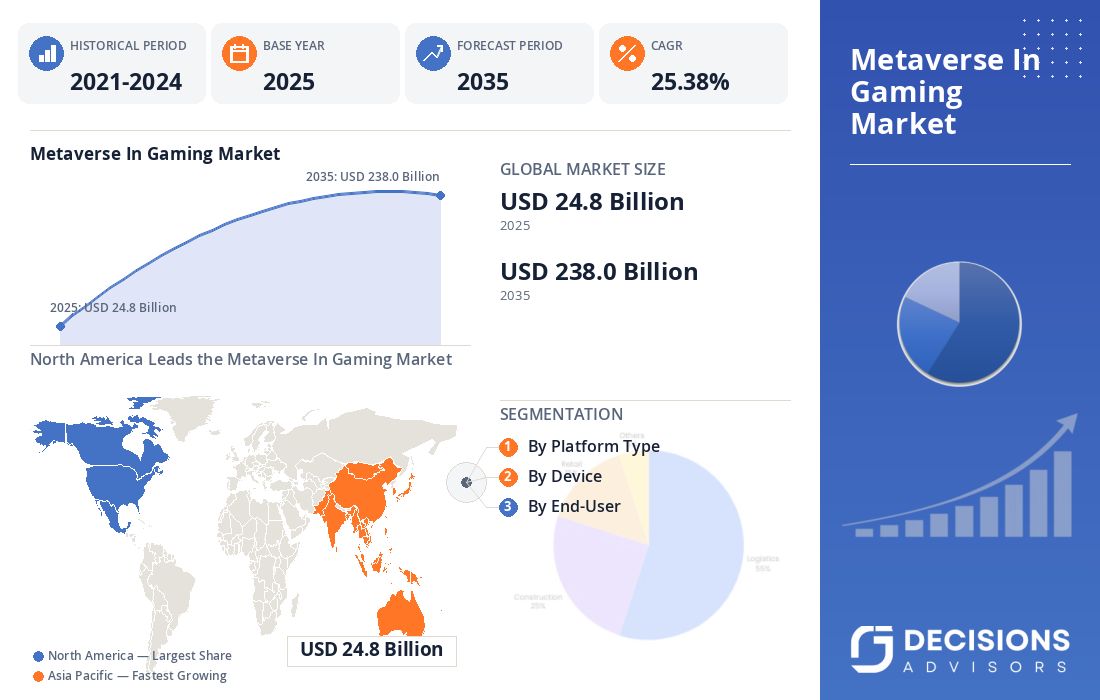
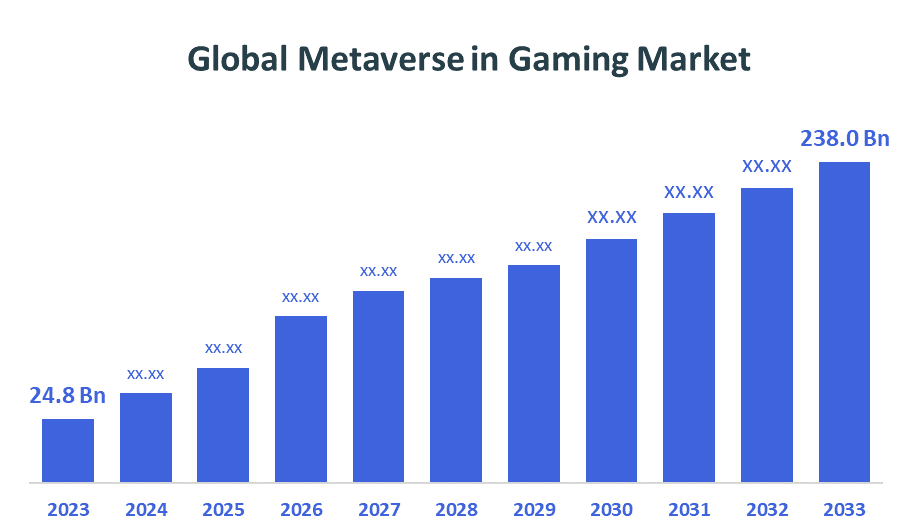
The Global Metaverse in Gaming Market Size is predicted to grow from USD 24.8 Billion in 2025 and is likely to reach around USD 238.0 Billion by 2035 with a CAGR of 25.38%. According to Decision Advisors, a detailed research report on the market reflects that the touchless sensing adoption trend dominates the Global Metaverse in Gaming Market, accounting for approximately 42% of the total share worldwide. Roblox Corporation leads the market with over 111.8 million daily active users and approximately approx 17 – 23% in quarterly bookings, making it the key contributor to global market development and growth dynamics.
Market Snapshot
- Global Metaverse in Gaming Market Size (2025): USD 24.8 Billion
- Projected Global Metaverse in Gaming Market Size (2035): USD 238.0 Billion
- Global Metaverse in Gaming Market Compound Annual Growth Rate (CAGR): 25.38%
- Largest Regional Market: North America
- 2nd Largest Region: Asia Pacific
- Fastest Growing Region: Asia Pacific
- Base Year: 2025
- Historical Period: 2021-2024
- Market Forecast Period: 2026-2035
Market Overview/ Introduction
The Global Metaverse in Gaming Market refers to the industry built around persistent, immersive virtual worlds that combine gaming, social interaction, digital commerce and creator economies, powered by AR/VR, blockchain, cloud computing and AI technologies Market growth is being driven by rising consumer demand for interactive, socially connected gaming experiences, growing daily active user bases on platforms such as Roblox and Fortnite, and increasing investment in immersive hardware such as VR/AR headsets .Government-backed digital economy initiatives from South Korea, UAE, Saudi Arabia, Singapore and the United States are creating supportive frameworks for metaverse infrastructure, XR hardware adoption and virtual economy regulation. Key companies including Meta Platforms, Roblox Corporation, Epic Games, Microsoft, Tencent Holdings, NVIDIA and Unity Technologies are developing game engines, cloud rendering platforms and immersive hardware to expand the metaverse gaming ecosystem. The market is expected to see continued expansion supported by advancements in real-time 3D content creation, blockchain-based play-to-earn models, cross-platform interoperability and growing brand/enterprise participation in virtual gaming worlds
Notable Insights: -
- Asia Pacific is anticipated to holding approximately 35%, share of the Global Metaverse in Gaming Market over the predicted timeframe.
- North America is expected to remain the leading regional market in the Global Metaverse in Gaming Market by holding approximately 40% of the share during the forecast period.
- By platform type, the Virtual Worlds & Social Gaming segment dominated the market and holds approximately 42% share in 2025 and is projected to grow at a substantial CAGR during the forecast period.
- By device, the Mobile segment dominated the market and holds a significant share in 2025 and is projected to grow at a substantial CAGR during the forecast period.
- The compound annual growth rate of the Global Metaverse in Gaming Market is 25.38%.
- The market is likely to achieve a valuation of USD 238.0 Billion by 2035.
Market Drivers
The Global Metaverse in Gaming Market experiences growth because of rising consumer demand for immersive, socially connected and persistent gaming experiences across platforms such as Roblox, Fortnite and Minecraft. The expansion of affordable VR/AR headsets, including improved Meta Quest devices and Apple Vision Pro's commercial rollout, is accelerating consumer adoption of immersive gaming hardware. The integration of blockchain technology and play-to-earn models drives adoption among users seeking verifiable digital asset ownership within virtual worlds. Rising investment from major technology companies in game engines, cloud rendering and AI-powered content generation continues to expand the scale and realism of metaverse gaming environments. The growing participation of brands and enterprises hosting virtual events, concerts and advertising within gaming metaverses further supports market expansion.
Restrain
The Global Metaverse in Gaming Market faces challenges such as high development and infrastructure costs for building persistent 3D virtual worlds, limited interoperability between competing gaming platforms, and concerns over data privacy, user safety and content moderation, particularly involving younger audiences.
Competitive Analysis:
The report offers the appropriate analysis of the key organizations/companies involved within the Global Metaverse in Gaming Market along with a comparative evaluation primarily based on their product offerings, business overviews, geographic presence, enterprise strategies, segment market share, and SWOT analysis. The report also provides an elaborative analysis focusing on the current news and developments of the companies, which includes product development, innovations, joint ventures, partnerships, mergers & acquisitions, strategic alliances, and others. This allows for the evaluation of the overall competition within the market.
Top 10 Companies Global Metaverse in Gaming Market
- Meta Platforms, Inc
- Roblox Corporation
- Epic Games, Inc.
- Microsoft Corporation
- Tencent Holdings Ltd.
- NVIDIA Corporation
- Unity Technologies
- Sony Interactive Entertainment
- Electronic Arts Inc.
- NetEase, Inc.
Government Initiatives
|
Country |
Key Government Initiatives |
|
US |
The U.S. government supports immersive technologies through NSF-funded AI, XR, and spatial computing research, alongside initiatives promoting responsible virtual-world governance and data protection. |
|
South Korea |
South Korea’s Ministry of Science and ICT supports metaverse development through national strategies, funding, infrastructure, talent development, and regulatory frameworks for immersive content. |
|
China |
The UAE’s Dubai Metaverse Strategy promotes metaverse innovation, investment, infrastructure, and digital-economy growth, supporting immersive technologies, virtual experiences, and future digital services. |
Market Segmentation
The Global Metaverse in Gaming Market share is classified into platform type, device, and end-user.
- The Virtual Worlds & Social Gaming segment dominated the market and holds approximately 42% share in 2025 and is projected to grow at a substantial CAGR during the forecast period.
Based on platform type, the Global Metaverse in Gaming Market is divided into Virtual Worlds & Social Gaming, AR/VR Immersive Gaming, Blockchain/ Play-to-Earn Gaming, and Others. Among these, the Virtual Worlds & Social Gaming segment dominates the market and holds approximately 42% share in 2025. This dominance is due to the massive user bases of platforms such as Roblox, Fortnite and Minecraft, which combine gaming with social interaction, user-generated content and creator monetization, making them the most preferred entry point into the gaming metaverse.
- The Mobile device segment accounted for a leading share of approximately 45%in 2025 and is anticipated to grow at a significant CAGR during the forecast period.
Based on the device, the market is divided into PC & Console, Mobile, and VR/AR Headsets. Among these, Mobile holds a leading share of approximately 45% due to its wide accessibility, affordability and improving processing power, allowing large user bases in emerging markets to access metaverse gaming experiences without dedicated hardware. Growing 5G penetration further supports segment growth, making mobile a key access channel in the Global Metaverse in Gaming Market.
- The Casual Gamers end-user segment accounted for the largest share of approximately 50% in 2025 and is anticipated to grow at a significant CAGR during the forecast period.
Based on end-user, the market is divided into Casual Gamers, Esports & Competitive Gamers, and Enterprise/Brand Gaming. Among these, Casual Gamers dominate the market and hold approximately 50% share in 2025 due to widespread appeal of user-generated content platforms and social gaming experiences across younger demographics. Rising enterprise and brand participation, hosting virtual concerts, product launches and advertising within gaming metaverses, is also emerging as a fast-growing contributor to overall market revenue.
Regional Segment Analysis of the Global Metaverse in Gaming Market
- North America (U.S., Canada, Mexico)?
- Europe (Germany, France, U.K., Italy, Spain, Rest of Europe)
- Asia-Pacific (China, Japan, India, Rest of APAC)
- South America (Brazil and the Rest of South America)?
- The Middle East and Africa (UAE, South Africa, Rest of MEA)
North America is anticipated to hold approximately 40% share of the Global Metaverse in Gaming Market over the predicted timeframe.
North America holds approximately 40% share of the Global Metaverse in Gaming Market due to the strong presence of leading gaming and technology companies such as Meta, Roblox, Epic Games, Microsoft and NVIDIA, along with high consumer spending on gaming hardware and immersive experiences. The region benefits from advanced digital infrastructure, high-speed internet penetration and early adoption of VR/AR devices. Strong venture capital investment in blockchain gaming and metaverse startups further strengthens market growth. Additionally, the presence of major esports events and virtual entertainment platforms contributes to sustained demand across the region.
Asia Pacific is expected to grow at the fastest CAGR in the Global Metaverse in Gaming Market, holding approximately 35% during the forecast period.
Asia Pacific is expected to grow at the fastest CAGR in the Global Metaverse in Gaming Market, holding approximately 35% due to a massive mobile gaming user base, rapid 5G rollout, and strong presence of gaming companies such as Tencent, NetEase and ByteDance. The region benefits from high smartphone penetration and rising disposable incomes, which support growing consumer spending on mobile and immersive gaming. Government-backed digital economy initiatives in South Korea, China and Singapore further accelerate metaverse gaming infrastructure development. Additionally, growing interest in blockchain-based play-to-earn gaming among younger populations across India and Southeast Asia contributes to sustained regional demand.
Europe is expected to grow at a steady CAGR in the Global Metaverse in Gaming Market during holding approximately 20% the forecast period.
Europe is expected to grow at a steady CAGR in the Global Metaverse in Gaming Market, holding approximately 20% supported by strong regulatory frameworks for digital consumer protection, growing esports culture, and increasing investment in immersive entertainment by companies across Germany, France and the UK. Rising adoption of VR/AR devices in gaming and entertainment, combined with expanding 5G infrastructure, further supports market expansion across the region.
Future Market Trends in Global Metaverse in Gaming Market: -
- Growth of AI-Powered Content Generation
AI is increasingly used to generate game assets, non-player characters, dialogue and entire virtual environments in real time, reducing development costs and enabling more dynamic, personalized gaming metaverse experiences. This trend is accelerating the pace of virtual world creation globally.
- Expansion of Cross-Platform Interoperability
Developers are working towards enabling avatars, digital assets and in-game items to move seamlessly across different gaming metaverse platforms. Interoperability standards are expected to improve user retention and unlock new monetization opportunities for creators and platforms alike.Rise of Blockchain-Based Play-to-Earn Gaming
Blockchain integration is enabling verifiable ownership of in-game assets, NFTs and virtual currencies, allowing players to earn real-world value through gameplay. Growing adoption of decentralized gaming economies is expected to attract a new generation of players and investors.
- Increasing Enterprise and Brand Participation
Brands and enterprises are increasingly hosting virtual concerts, product launches, advertising campaigns and training simulations within gaming metaverses such as Roblox and Fortnite. This trend is opening new revenue streams beyond traditional in-game purchases and subscriptions.
Recent Development
- In October 2025, Apple introduced an upgraded Vision Pro with the M5 chip, improving performance, display rendering, battery life and spatial experiences. The device continued to target premium immersive-computing and gaming applications.
- In January 2024, Unity announced general availability of its visionOS support, enabling developers to create immersive games and applications for Apple Vision Pro using Unity's XR and PolySpatial technologies.
Market Segment
This study forecasts revenue at global, regional, and country levels from 2020 to 2035. Decision Advisors has segmented the Global Metaverse in Gaming Market based on the below-mentioned segments:
Global Metaverse in Gaming Market, By Platform Type
- Virtual Worlds & Social Gaming
- AR/VR Immersive Gaming
- Blockchain/ Play-to-Earn Gaming
- Others
Global Metaverse in Gaming Market, By Device
- PC & Console
- Mobile
- VR/AR Headsets
Global Metaverse in Gaming Market, By End-User
- Casual Gamers
- Esports & Competitive Gamers
- Enterprise/Brand Gaming
Global Metaverse in Gaming Market, By Regional Analysis
- North America
- US
- Canada
- Mexico
- Europe
- Germany
- UK
- France
- Italy
- Spain
- Russia
- Rest of Europe
- Asia Pacific
- China
- Japan
- India
- South Korea
- Australia
- Rest of Asia Pacific
- South America
- Brazil
- Argentina
- Rest of South America
- Middle East & Africa
- UAE
- Saudi Arabia
- Qatar
- South Africa
- Rest of the Middle East & Africa
Frequently Asked Questions (FAQ)
Q. What is driving the growth of the Global Metaverse in Gaming Market?
A. Growth is driven by rising consumer demand for immersive, socially connected gaming experiences, growing adoption of affordable VR/AR headsets, and increasing investment in AI-powered content generation and blockchain-based play-to-earn gaming models.
Q. Which region leads the Global Metaverse in Gaming Market?
A. North America leads the market, supported by the strong presence of major gaming and technology companies, while Asia Pacific is expected to register the fastest growth due to its large mobile gaming user base and rapid 5G adoption.
Q. Who are the key players in the Global Metaverse in Gaming Market?
A. Key players include Meta Platforms, Roblox Corporation, Epic Games, Microsoft Corporation, Tencent Holdings, NVIDIA Corporation, Unity Technologies, Sony Interactive Entertainment, Electronic Arts and NetEase.
Q. What challenges does the Global Metaverse in Gaming Market face?
A. The market faces challenges from high infrastructure and development costs, limited interoperability between competing platforms, data privacy and content moderation concerns, and the cost and comfort limitations of VR/AR hardware.
Check Licence
Choose the plan that fits you best: Single User, Multi-User, or Enterprise solutions tailored for your needs.
We Have You Covered
- 24/7 Analyst Support
- Clients Across the Globe
- Tailored Insights
- Technology Tracking
- Competitive Intelligence
- Custom Research
- Syndicated Market Studies
- Market Overview
- Market Segmentation
- Growth Drivers
- Market Opportunities
- Regulatory Insights
- Innovation & Sustainability
Report Details
| Scope | Global |
| Pages | 200 |
| Delivery | PDF & Excel via Email |
| Language | English |
| Release | Aug 2026 |
| Access | Download from this page |